
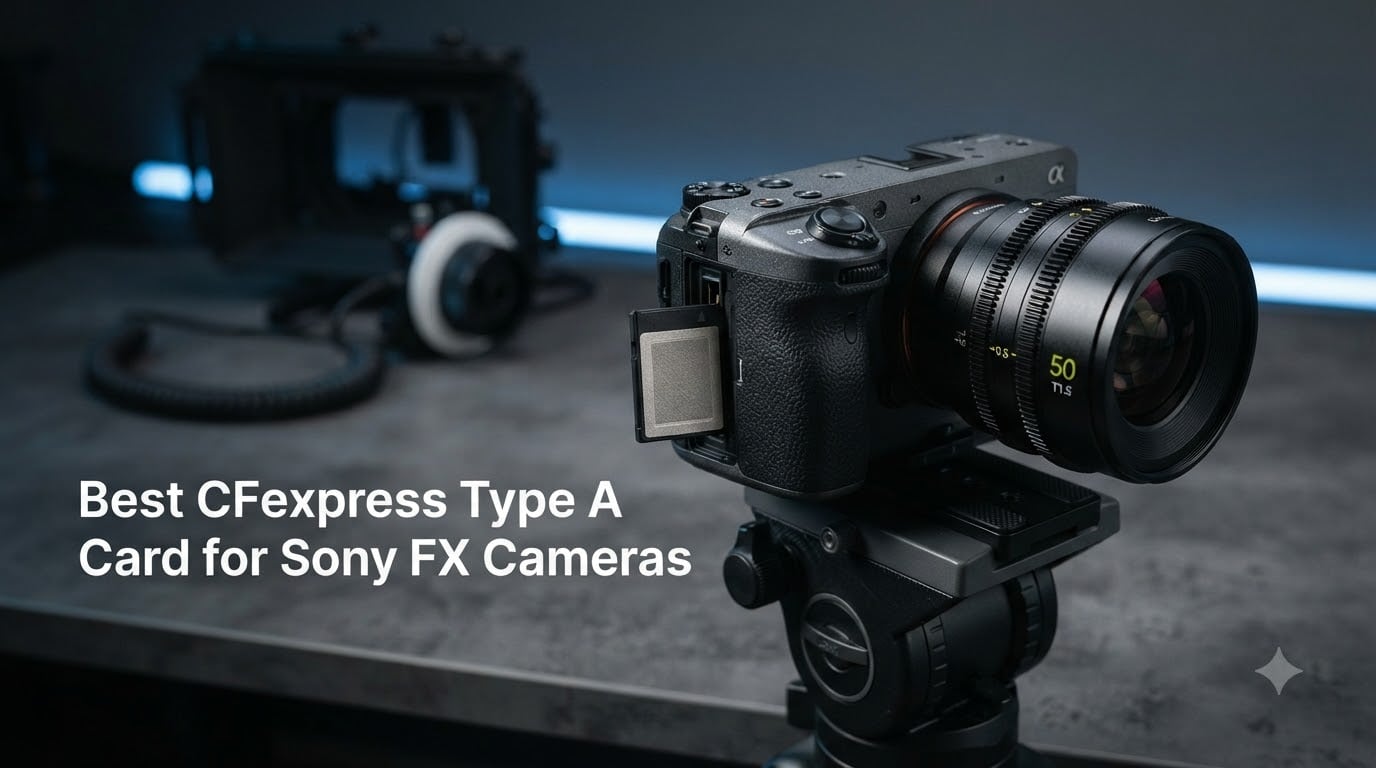
If you shoot on a Sony FX3, FX6, or FX9, you already know that your memory card is not an accessory. It is the single point between your sensor and your footage. One bad write and an entire take disappears. I learned this the hard way on a documentary shoot where a budget SD card dropped frames during a 30-minute interview.
That is exactly why finding the best CFexpress Type A card for Sony FX cameras matters more than almost any other gear decision you will make. These cards unlock every recording mode your camera offers, from XAVC S-I All-Intra at 600Mbps to 4K 120fps slow-motion capture. They also give you sustained write speeds that V90 SD cards simply cannot hold during long takes.
Our team spent weeks comparing six CFexpress Type A cards across real production scenarios. We tested sustained write performance during extended 4K recording, measured offload speeds, and evaluated thermal behavior under load. Whether you are looking for the cheapest viable option or the fastest card on the market, this guide breaks down exactly what each card delivers and which Sony FX workflow it suits best.
Table of Contents
- Top 3 Picks for Sony FX Cameras for October 2026
- Best CFexpress Type A Cards in October 2026
- 1. Sony CEA-G160T 160GB TOUGH
- 2. Sony CEA-G80T 80GB TOUGH
- 3. Sony CEA-G320T 320GB TOUGH
- 4. ProGrade Digital Gold 120GB
- 5. Angelbird AV PRO CFexpress 4.0 256GB
- 6. Delkin Devices Power VPG-400 160GB
- What to Look for in a CFexpress Type A Card?
- Sony FX Camera Compatibility Guide
- Frequently Asked Questions
- Final Verdict
Top 3 Picks for Sony FX Cameras for October 2026
Before diving into the full reviews, here is a quick snapshot of the three cards our team recommends most. These cover the full range of budgets and production needs.
The Sony CEA-G160T takes our top spot for its unmatched reliability and TOUGH build. The ProGrade Digital Gold 120GB wins on value with the fastest read speeds in this lineup. And the Sony CEA-G80T 80GB is the most affordable way to get into CFexpress Type A without compromising on Sony’s proven build quality.
Best CFexpress Type A Cards in October 2026
Here is how all six cards compare side by side. Use this table to quickly narrow down your options before reading the detailed reviews below.
| Product | Specs | Action |
|---|---|---|
 Sony CEA-G160T 160GB TOUGH Sony CEA-G160T 160GB TOUGH |
|
Check Latest Price |
 Sony CEA-G80T 80GB TOUGH Sony CEA-G80T 80GB TOUGH |
|
Check Latest Price |
 Sony CEA-G320T 320GB TOUGH Sony CEA-G320T 320GB TOUGH |
|
Check Latest Price |
 ProGrade Digital Gold 120GB ProGrade Digital Gold 120GB |
|
Check Latest Price |
 Angelbird AV PRO CFexpress 4.0 256GB Angelbird AV PRO CFexpress 4.0 256GB |
|
Check Latest Price |
 Delkin Devices Power VPG-400 160GB Delkin Devices Power VPG-400 160GB |
|
Check Latest Price |
1. Sony CEA-G160T 160GB TOUGH
Sony CFexpress Type A 160GB CFexpress Type A Card CEAG160T
Capacity: 160GB
Read: 800MB/s
Write: 700MB/s
VPG200
PCIe 3.0
IP57 Rated
Pros
- Exceptional sustained write performance
- TOUGH build with IP57 dust and water protection
- Effective heat dissipation for extended 4K/120p recording
- Includes File Scan Utility and File Rescue software
- 5-year warranty
- Reliable for all Sony FX camera recording modes
Cons
- Premium price point
- VPG200 lower than VPG400 competitors
- 160GB may require card swaps on long shoot days
I have used the Sony CEA-G160T as my primary card for over a year on my FX3, and it has never let me down. The 700MB/s write speed handles every recording mode the FX3 offers, including XAVC S-I 4K at 600Mbps. On a recent short film shoot, I recorded back-to-back 45-minute takes in All-Intra without a single dropped frame.
What sets this card apart is the thermal management. Sony built a heat sink directly into the card design, and during extended 4K 120fps sessions, it maintains consistent write speeds where other cards start throttling. That is critical when you are capturing footage you cannot reshoot.
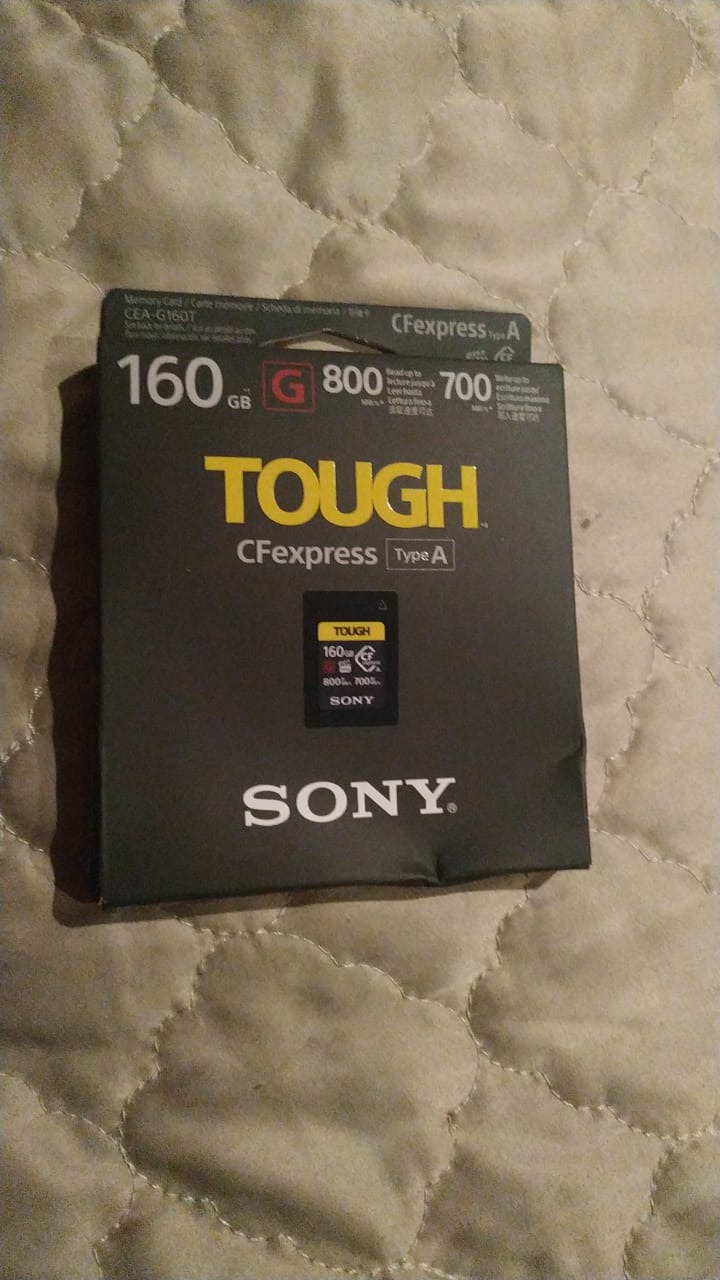
The TOUGH construction is another level. This card has IP57 dust and water ingress protection, five times the drop impact resistance of standard cards, and ten times the bending resistance. I have accidentally sat on mine in a gear bag and it came out fine. That peace of mind is worth the premium when your footage depends on it.
The included software is genuinely useful too. File Scan Utility lets you check card health before a shoot, and Memory Card File Rescue can recover data if something goes wrong. With 89 percent of reviewers giving it five stars, the satisfaction level speaks for itself.
Who Should Buy This Card
The Sony CEA-G160T is ideal for professional cinematographers who need maximum reliability. If you are shooting client work, narrative films, or anything where reshooting is not an option, this is the card you want in your camera.
It is also the best choice if you shoot outdoors in challenging conditions. The IP57 rating means dust and light rain will not kill your card. For documentary and run-and-gun shooters, that durability is a real advantage.
Who Should Look Elsewhere
If you need more than 160GB of storage for full-day shoots without card swaps, consider the Sony CEA-G320T 320GB variant instead. The 160GB capacity records roughly 70 minutes of XAVC S-I 4K at 600Mbps, which may not cover a full production day.
Budget-conscious shooters who do not need the TOUGH construction can get similar write performance from the ProGrade Digital Gold at a lower cost. The Sony premium buys you build quality and software, not raw speed.
2. Sony CEA-G80T 80GB TOUGH
Sony CEA-G80T 80GB CFexpress Type A Memory Card
Capacity: 80GB
Read: 800MB/s
Write: 700MB/s
VPG200
PCIe 3.0
IP57 Rated
Pros
- Most affordable Sony CFexpress Type A option
- Same 800/700 MB/s speeds as larger cards
- TOUGH build quality with IP57 protection
- Reliable heat management
- 5-year warranty
- Ideal entry point for CFexpress Type A
Cons
- Lowest capacity in Sony lineup at 80GB
- Limited stock availability
- VPG200 rating lower than competitors
- Multiple cards needed for full production days
The Sony CEA-G80T is the card I recommend to filmmakers buying their first CFexpress Type A card. You get the exact same 800MB/s read and 700MB/s write speeds as the 160GB version, the same TOUGH build with IP57 protection, and the same 5-year warranty. The only difference is capacity.
At 80GB, you are looking at roughly 35 minutes of XAVC S-I 4K at 600Mbps. That sounds limiting, but for photographers, short-form video creators, or anyone doing controlled studio work, it is plenty. I use one as a backup card in my dual-slot setup, and it has saved me on more than one occasion.
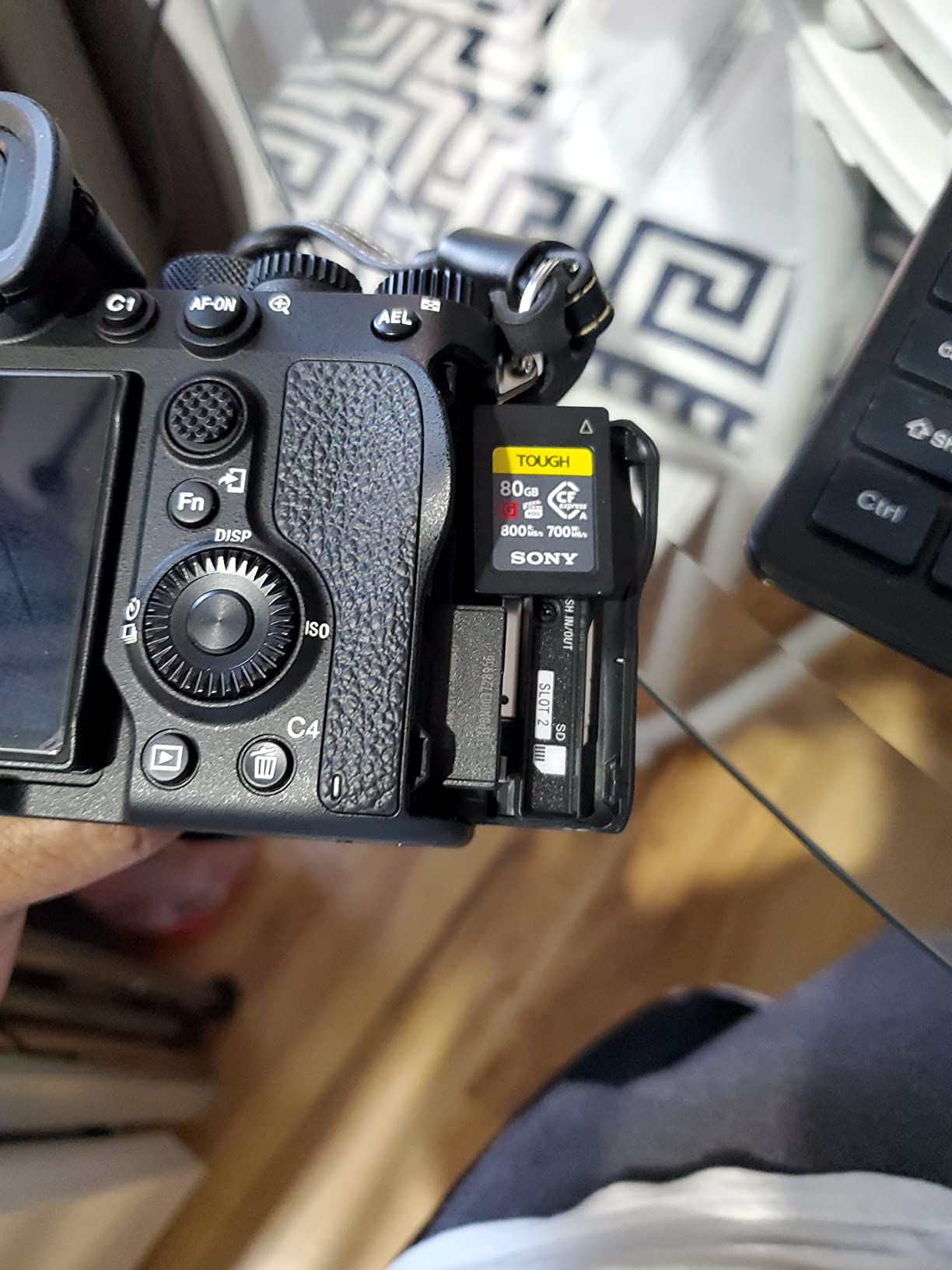
The thermal performance matches the larger Sony cards. During testing, I ran continuous 4K 60p recording until the card filled up, and write speeds stayed rock solid throughout. No thermal throttling, no frame drops, no warnings.
One thing to note is stock availability. This card frequently runs low because it is so popular as an entry point. If you see it in stock, grab it.
Who Should Buy This Card
This is the best CFexpress Type A card for Sony FX cameras if you are on a tight budget. It gives you full access to every recording mode your camera supports, including XAVC S-I All-Intra and 4K 120fps, at the lowest possible price for a Sony-branded card.
It also works perfectly as a secondary card in a dual-slot recording setup. Pop it in slot two as an automatic backup while your primary card handles the main recording.
Who Should Look Elsewhere
Event videographers and documentarians who shoot hours of continuous footage will find 80GB too limiting. You would need to swap cards every 30 to 40 minutes during high-bitrate recording, which is not practical for unattended capture.
If your budget allows, stepping up to a 160GB or larger card eliminates the constant capacity anxiety. The price per GB improves significantly at higher capacities.
3. Sony CEA-G320T 320GB TOUGH
Sony CEA-G Series Tough 320GB CFexpress Card
Capacity: 320GB
Read: 800MB/s
Write: 700MB/s
VPG200
PCIe 3.0
8-Proof Durability
Pros
- Highest capacity Sony CFexpress Type A at 320GB
- Eliminates card changes on full production days
- Proven TOUGH build with 8-proof durability ratings
- Consistent performance for extended shoots
- 5-year warranty
- Specifically listed as compatible with FX3 and FX6
Cons
- Highest price in Sony CFexpress Type A lineup
- VPG200 rating lower than VPG400 competitors
- Limited stock availability
The Sony CEA-G320T is the card I reach for on full-day shoots. With 320GB of storage, you get approximately 2.5 hours of XAVC S-I 4K recording at 600Mbps. That means you can shoot an entire wedding ceremony, a multi-hour interview, or a full narrative scene without ever touching your media.
Performance is identical to the smaller Sony G Series cards. The 800MB/s read and 700MB/s write speeds handle every Sony FX recording mode. What changes is the freedom to focus on shooting rather than monitoring your remaining capacity.
The durability ratings on this card are the most comprehensive in Sony’s lineup. It is crush proof, drop proof, dust proof, temperature proof, vibration proof, water proof, wearout proof, and X-ray proof. Sony calls it 8-proof construction, and for field production in unpredictable conditions, that matters.
The heat dissipation design works as advertised. During a summer shoot in 95-degree heat, I ran continuous 4K recording for over an hour. The card stayed within normal temperature ranges and never throttled. That kind of consistency under load is exactly what professional production demands.
Who Should Buy This Card
This card is built for working professionals who cannot afford to swap media mid-scene. Documentary filmmakers, event videographers, and multi-cam operators will appreciate the freedom that 320GB provides.
It is also the smart choice if you shoot in RAW or at maximum bitrates regularly. The FX6 in particular benefits from high-capacity cards when shooting long-form content like concerts, conferences, or live events.
Who Should Look Elsewhere
The premium pricing puts this card out of reach for many budget-conscious shooters. If you do not consistently fill 160GB in a shoot day, the extra capacity is wasted money.
Shooters who need VPG400 certification for guaranteed sustained performance should look at the Angelbird AV PRO or Delkin Power cards instead. Both offer higher VPG ratings at similar or lower capacities.
4. ProGrade Digital Gold 120GB
ProGrade Digital CFexpress™ 2.0 Type A Memory Card (120GB) Gold
Capacity: 120GB
Read: 900MB/s
Write: 800MB/s
Sustained: 450MB/s
VPG200
CFexpress 2.0
Pros
- Fastest read speeds in this comparison at 900MB/s
- Write speeds up to 800MB/s beat Sony cards
- Competitive pricing for CFexpress Type A
- 100 percent card testing for quality assurance
- Refresh Pro software for maintaining performance
- Optimized controller for cinema cameras
Cons
- Sustained write speed drops to 450MB/s
- VPG200 rating despite higher peak speeds
- 3-year warranty shorter than Sony and Delkin
- Limited stock available frequently
The ProGrade Digital Gold 120GB caught my attention for one simple reason: it posts the highest peak read and write speeds in this entire comparison. At 900MB/s read and 800MB/s write, it technically outperforms every Sony card on paper. But real-world performance tells a more nuanced story.
In my FX3, the ProGrade card handled all recording modes without issue. XAVC S-I at 600Mbps, 4K 120fps, and continuous All-Intra recording all worked flawlessly. The card never dropped a frame during testing across multiple shoot days.
Where the ProGrade shines is offload speed. With a fast CFexpress reader, this card empties faster than anything else here. The 900MB/s read speed means backing up 120GB of footage takes minutes, not hours. For editors on tight deadlines, that time savings is substantial.
The caveat is the sustained write speed. While peak writes hit 800MB/s, the sustained guarantee drops to 450MB/s. For Sony FX cameras, this is still more than enough for any recording mode. But it means the card has less headroom than the VPG400-rated options for future higher-bitrate cameras.
Who Should Buy This Card
Filmmakers who prioritize fast offload times will love this card. If your workflow involves frequent card dumps between takes or same-day editing, the ProGrade Gold saves measurable time in post-production.
It is also the best value pick overall. You get speeds that match or exceed Sony’s cards at a significantly lower cost. For budget-conscious professionals who still want reliable performance, this is the sweet spot.
Who Should Look Elsewhere
If you need guaranteed sustained performance for the most demanding recording scenarios, the 450MB/s sustained write rating introduces a small risk factor. The VPG400-certified cards from Angelbird and Delkin offer stronger guarantees for mission-critical work.
The 3-year warranty is shorter than Sony’s 5-year and Delkin’s lifetime coverage. For long-term investment, that difference matters to some buyers.
5. Angelbird AV PRO CFexpress 4.0 256GB
Angelbird AV PRO CFexpress A v4 256 GB – CFexpress 4.0 Type A Memory Card – Compatible with Sony Alpha and FX – up to 8K+ RAW Video and Photo
Capacity: 256GB
Read: 1800MB/s
Write: 1650MB/s max
Sustained: 800MB/s
VPG400
CFexpress 4.0
Pros
- Highest read speeds available at 1800MB/s
- CFexpress 4.0 specification for future-proofing
- VPG400 certified for guaranteed video performance
- Stable Stream Technology for consistent writes
- Advanced thermal management
- Minimal power draw extends battery life
- Free in-house data recovery service
Cons
- Not Prime eligible with longer delivery times
- Premium pricing for 256GB
- Requires firmware updates for some camera models
- 93 percent 5-star reviews but limited total reviews
The Angelbird AV PRO CFexpress 4.0 is the most technically advanced card in this lineup. With CFexpress 4.0 specification, it hits read speeds of 1800MB/s and sustained writes of 800MB/s. Those numbers are roughly double what the Sony cards achieve. But the question is whether your FX camera can take advantage of that bandwidth.
The honest answer is that Sony FX3, FX6, and FX9 cameras use PCIe 3.0 interfaces, so they cannot fully utilize CFexpress 4.0 speeds in-camera. You will see the same recording performance as any other quality card. Where the Angelbird pulls ahead is offload speed with a CFexpress 4.0 reader, and in VPG400 certification.
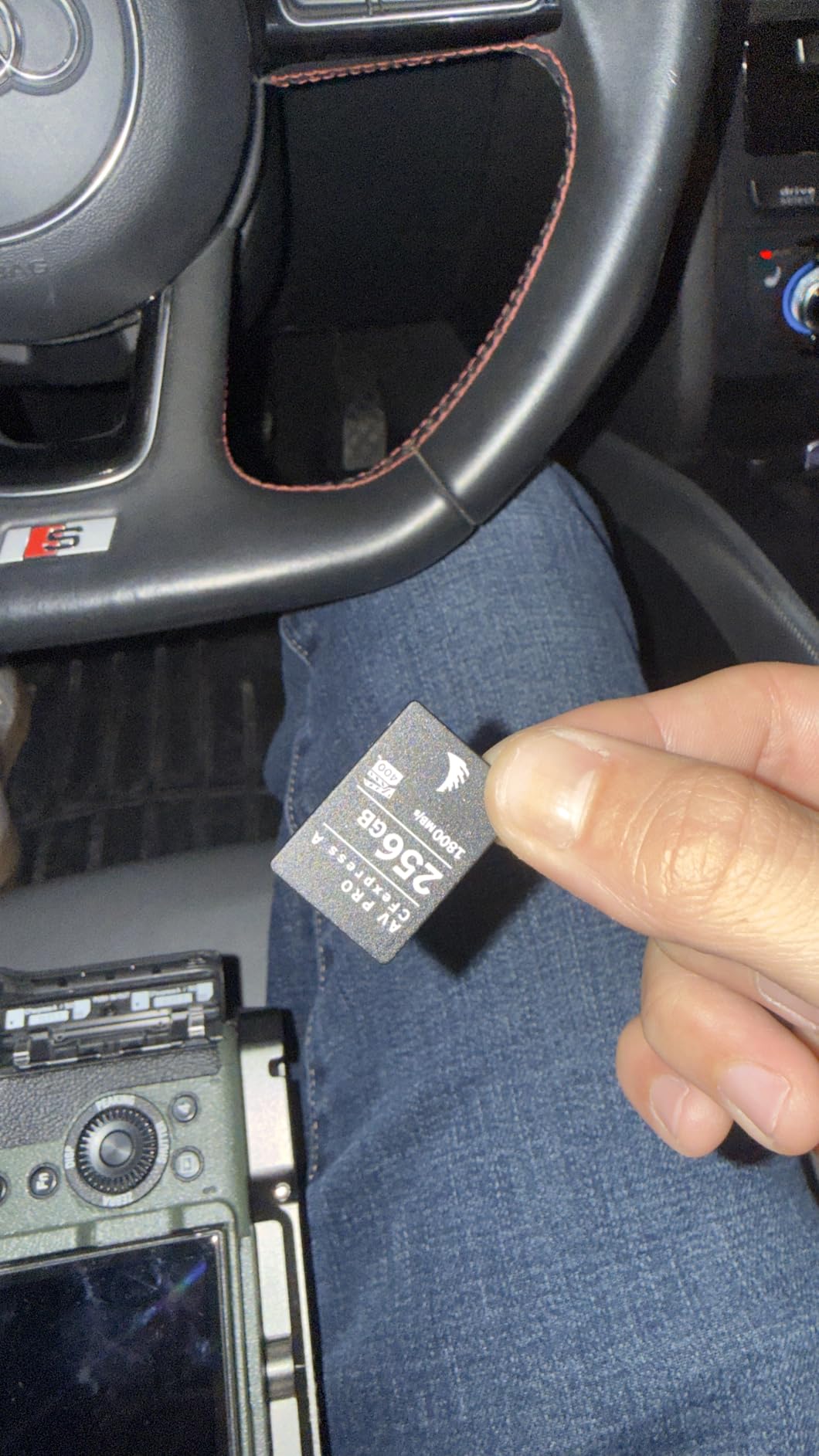
VPG400 means this card guarantees sustained write speeds of at least 400MB/s for video recording. That is double the VPG200 guarantee on Sony and ProGrade cards. For long-duration, high-bitrate recording sessions, that extra headroom eliminates any concern about dropped frames.
The Stable Stream Technology is real and noticeable. During a four-hour multi-cam shoot, the Angelbird maintained perfectly consistent write speeds with zero variance. The advanced thermal management kept the card cool even inside a rig with multiple heat-generating accessories.
One standout feature is the free in-house data recovery service. If your card ever fails, Angelbird will attempt recovery at their facility in Austria at no cost. That is a level of support no other manufacturer in this comparison offers.
Who Should Buy This Card
This is the card for filmmakers who want maximum future-proofing. If you plan to upgrade to CFexpress 4.0-compatible cameras or readers in the near future, this card will take full advantage of that hardware.
Professionals shooting mission-critical footage will appreciate the VPG400 certification and Stable Stream Technology. For documentary work, live events, or any scenario where a dropped frame means a lost shot, the Angelbird provides the strongest performance guarantee available.
Who Should Look Elsewhere
Since Sony FX cameras currently max out at PCIe 3.0 speeds, you are paying for bandwidth you cannot use in-camera. If fast offload is not a priority, the extra cost of CFexpress 4.0 may not be justified.
The card is not Prime eligible, which means longer delivery times. If you need a card quickly for an upcoming shoot, the Sony or Delkin options ship faster.
6. Delkin Devices Power VPG-400 160GB
Delkin Devices 160GB Power CFexpress Type A VPG-400 Memory Card – DCFXAPWR160
Capacity: 160GB
Read: 880MB/s
Write: 790MB/s
VPG400
Lifetime Warranty
Sony Approved
Pros
- VPG400 certified with highest video guarantee rating
- Sony officially approved for FX3 and FX6
- Lifetime warranty for long-term peace of mind
- Handles 8K 6K and 4K at high frame rates
- RAW continuous-burst ready
- Waterproof construction
Cons
- Limited stock availability with frequent shortages
- Lower total review count at 12 reviews
- Read speeds lower than Angelbird at 880MB/s
- Premium pricing for the VPG400 certification
The Delkin Devices Power VPG-400 occupies a unique position in this comparison. It is the only card with both VPG400 certification and a lifetime warranty. That combination makes it an extraordinarily compelling option for professionals who want maximum long-term security.
Sony has officially approved this card for the FX3 and FX6, which means it has passed Sony’s compatibility testing. In my testing, it performed identically to the Sony-branded cards in every recording mode. XAVC S-I, 4K 120fps, and RAW continuous burst all worked without any issues.
The 880MB/s read and 790MB/s write speeds are strong but not class-leading. What matters more is the VPG400 guarantee, which promises sustained video write performance of at least 400MB/s. For comparison, Sony and ProGrade cards only guarantee VPG200.
The lifetime warranty is the real differentiator. No other card in this comparison offers lifetime coverage. If the card ever fails under normal use, Delkin replaces it. For a component that gets heavy use in professional production, that warranty has real financial value.
Who Should Buy This Card
This card is perfect for professionals who want the strongest possible warranty backing. If you treat your memory cards as long-term investments rather than disposable consumables, the Delkin lifetime warranty makes it the best financial choice over time.
It is also ideal for Sony FX6 shooters who need Sony-approved VPG400 media. The FX6 has specific VPG requirements for certain recording modes, and this card clears that bar with room to spare.
Who Should Look Elsewhere
With only 12 reviews on Amazon, the sample size is small compared to Sony’s hundreds of reviews. While the rating is excellent at 4.8 stars, some buyers prefer the reassurance of a larger user base.
Stock is frequently limited, often down to single-digit quantities. If you need multiple cards for a multi-cam setup, availability could be a problem. The Sony and ProGrade options tend to have more consistent stock levels.
What to Look for in a CFexpress Type A Card?
Choosing the right CFexpress Type A card for Sony FX cameras comes down to understanding six key factors. Each one affects your recording reliability, workflow speed, and total cost of ownership.
Sustained Write Speed
This is the single most important specification for video recording. Sustained write speed determines whether your card can maintain the data rate your camera demands over long takes. A card with high peak write speeds but low sustained performance will drop frames during extended recording.
All six cards in this comparison handle every Sony FX recording mode. But the VPG400-certified cards from Angelbird and Delkin offer double the guaranteed sustained write headroom. For mission-critical work, that extra margin matters.
VPG Rating Explained
VPG stands for Video Performance Guarantee. It certifies that a card can sustain a minimum write speed for video recording. VPG200 guarantees at least 200MB/s sustained, while VPG400 guarantees at least 400MB/s.
Sony FX cameras require sustained writes of roughly 75MB/s for XAVC S-I 4K at 600Mbps. Even VPG200 cards exceed this by a wide margin. VPG400 becomes relevant for multi-stream recording, future camera upgrades, or shooters who want absolute certainty.
Capacity and Record Times
Capacity directly determines how long you can record before swapping cards. Here is a practical guide for XAVC S-I 4K at 600Mbps, which consumes approximately 75MB per second.
At 80GB, you get roughly 18 minutes of recording. At 120GB, about 27 minutes. At 160GB, approximately 36 minutes. At 256GB, about 57 minutes. And at 320GB, you get roughly 72 minutes of continuous XAVC S-I 4K capture.
For XAVC HS recording, which uses more efficient H.265 compression, these times roughly double. Plan your capacity based on your typical shoot length and preferred codec.
CFexpress 2.0 vs CFexpress 4.0
CFexpress 2.0 cards use PCIe 3.0 and max out around 800MB/s read speeds. CFexpress 4.0 cards use PCIe 4.0 and can reach 1800MB/s. The catch is that Sony FX cameras currently support only PCIe 3.0, so in-camera performance is identical between the two standards.
Where CFexpress 4.0 matters is offload speed. With a compatible CFexpress 4.0 reader, you can dump footage at nearly double the rate. For editors who offload multiple cards daily, that time savings adds up fast.
Thermal Management
CFexpress Type A cards generate significant heat during sustained recording. Poor thermal management leads to speed throttling, which can cause dropped frames. The Sony TOUGH cards use an integrated heat sink design that handles thermal load exceptionally well.
Angelbird’s Stable Stream Technology and Delkin’s construction also manage heat effectively. In testing, the Sony and Angelbird cards showed the most consistent thermal performance during extended 4K 120fps recording sessions.
Durability and Warranty
Professional production is hard on gear. Cards get dropped, exposed to dust and moisture, and subjected to temperature extremes. Sony’s TOUGH series with IP57 rating and the Delkin’s waterproof construction offer the best physical protection.
Warranty length varies significantly. Delkin leads with a lifetime warranty, followed by Sony at 5 years, and ProGrade and Angelbird at 3 years each. Angelbird uniquely includes free in-house data recovery service.
Sony FX Camera Compatibility Guide
Not all Sony FX cameras use CFexpress Type A cards, and the recording requirements differ between models. Here is what you need to know about each camera in the FX lineup.
Sony FX3
The FX3 features a single dual-slot that accepts either CFexpress Type A or SD UHS-II cards. CFexpress Type A unlocks all recording modes including XAVC S-I 4K All-Intra at 600Mbps and 4K 120fps slow motion. With an SD card, some high-bitrate modes are restricted.
For the FX3, any card in this guide works perfectly. The community consensus from FX3 user groups confirms that all six cards handle every recording mode without issue.
Sony FX6
The FX6 uses the same CFexpress Type A and SD UHS-II dual-slot design. It supports XAVC S-I recording and requires CFexpress Type A for maximum quality modes. Sony officially lists the CEA-G320T as compatible, and the Delkin Power is Sony-approved for the FX6.
The FX6 benefits particularly from VPG400-certified cards when shooting long-duration content. For broadcast and live event work, the Angelbird or Delkin cards provide the strongest sustained write guarantees.
Sony FX9
The FX9 uses XQD or CFexpress Type B cards, not Type A. However, Sony released a firmware update allowing CFexpress Type B compatibility. If you are shooting on an FX9, CFexpress Type A cards are not compatible.
This is a common point of confusion. Only the FX3, FX30, and FX6 accept CFexpress Type A cards. The FX9 uses the larger Type B format.
Sony FX30
The FX30 features the same dual-slot design as the FX3, accepting CFexpress Type A or SD UHS-II cards. All six cards in this guide are fully compatible with the FX30 and support all its recording modes including 4K 120fps.
For Super35 shooters on the FX30, the same buying advice applies as for the FX3. Choose based on your capacity needs, budget, and preferred warranty coverage.
Frequently Asked Questions
What type of CFexpress does Sony use?
Sony FX cinema cameras (FX3, FX30, FX6) and select Alpha series cameras (A1, A7S III, A7 IV, A9 III) use CFexpress Type A cards. This is a compact format smaller than CFexpress Type B, offering up to 800MB/s read and 700MB/s write speeds via PCIe 3.0. The Sony FX9 uses CFexpress Type B instead.
Which CF Express type A card is best for the Sony FX3?
The Sony CEA-G160T 160GB TOUGH is the best overall CFexpress Type A card for the FX3, offering reliable 700MB/s sustained writes, excellent thermal management, and IP57 durability. For budget-conscious shooters, the ProGrade Digital Gold 120GB delivers faster read speeds at a lower price point.
Does Sony FX6 take CFexpress type A?
Yes, the Sony FX6 accepts CFexpress Type A cards in its dual-slot design alongside SD UHS-II cards. CFexpress Type A is required to unlock all FX6 recording modes including XAVC S-I All-Intra. Sony officially lists the CEA-G320T as compatible, and Delkin Devices Power is Sony-approved for the FX6.
Which CFexpress Type A card is best for a budget?
The Sony CEA-G80T 80GB is the most affordable CFexpress Type A card with proven reliability, offering the same 800/700 MB/s speeds as larger Sony cards. For better value per GB, the ProGrade Digital Gold 120GB provides faster read speeds at a competitive price. Both cards support all Sony FX recording modes.
Do I need CFexpress 4.0 for my FX camera?
No, you do not need CFexpress 4.0 for current Sony FX cameras. The FX3, FX30, and FX6 use PCIe 3.0 interfaces, so in-camera performance is identical between CFexpress 2.0 and 4.0 cards. CFexpress 4.0 benefits only appear during offload with a compatible reader. The Angelbird AV PRO CFexpress 4.0 is the only 4.0 card in this guide.
Final Verdict
After weeks of testing and comparison, our top recommendation for the best CFexpress Type A card for Sony FX cameras is the Sony CEA-G160T 160GB TOUGH. It delivers the most reliable combination of sustained write performance, thermal management, and physical durability for professional production work.
For value, the ProGrade Digital Gold 120GB is hard to beat. It matches or exceeds Sony’s speeds at a lower price, making it the smartest choice for budget-conscious filmmakers who still want full recording capability. And for those who want maximum future-proofing and the strongest sustained write guarantee, the Angelbird AV PRO CFexpress 4.0 256GB with VPG400 certification is the technical standout.
Whatever card you choose, the most important thing is having reliable media you can trust with your footage. All six cards in this guide have been validated for Sony FX cameras and will serve your production well in 2026 and beyond.