
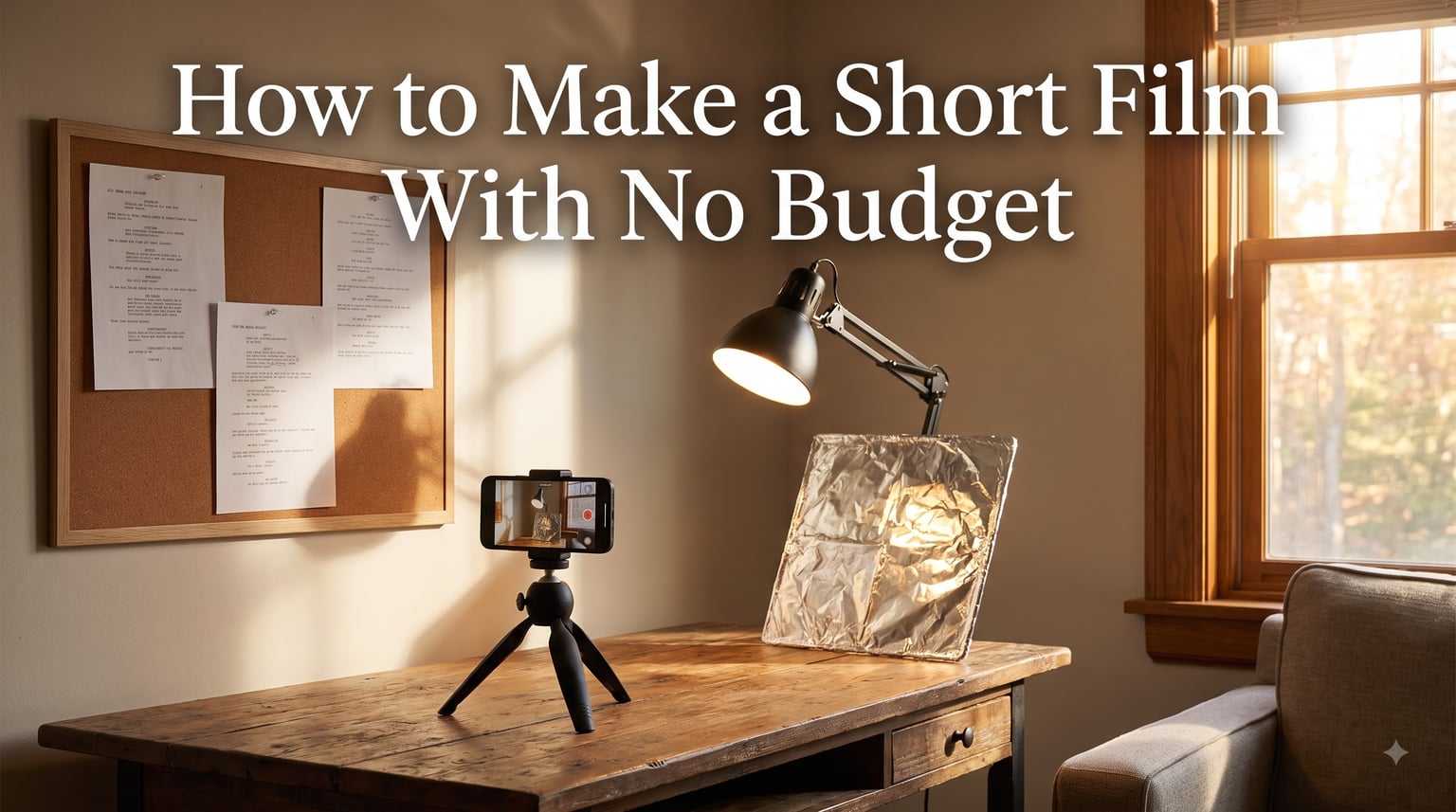
Yes, you can make a short film with no budget. Write a small, contained story you can actually shoot, use free locations you already have access to, lean on gear you or your friends already own (smartphones are genuinely fine), and keep your cast and crew tiny. The constraint is the point. It forces creative choices that paid productions often miss.
I’m a writer who has spent the past few months talking to first-time filmmakers, reading every Reddit thread on r/Filmmakers I could find, and rewatching some of the most famous no-budget shorts of the last 30 years. This guide is the result. It covers every stage of no-budget filmmaking from the first blank page to a film you can actually submit somewhere. Nothing in here requires money beyond what you might spend on a pizza for your crew.
One honest caveat before we start: even productions labeled “zero budget” almost always absorb small incidental costs. A thank-you coffee here, a gas station snack there, a few dollars for a prop. We will walk through how to keep those costs near zero and decide which ones are truly non-negotiable.
Table of Contents
- What Is a No-Budget Short Film?
- How to Make a Short Film With No Budget?: Step-by-Step Process
- Pre-Production: Writing a Script You Can Actually Shoot
- Best Free Locations for a No-Budget Short Film
- Gear: What Camera and Equipment You Actually Need?
- DIY Lighting Hacks for Shooting Without a Kit
- No-Budget Costume, Makeup, and Prop Solutions
- How to Record Decent Audio Without a Sound Kit?
- Crew and Cast: How to Find People Willing to Work for Free
- Shoot Day: How to Plan a No-Budget Schedule
- Post-Production: Free Editing, Sound, and Music Tools
- Distribution: Film Festivals, YouTube, and Self-Screening
- Setting Realistic Expectations for Your First No-Budget Short
- Three Famous No-Budget Films Worth Studying
- Frequently Asked Questions
- Conclusion
What Is a No-Budget Short Film?
A no-budget short film is a short narrative film produced with negligible or zero financial outlay. The filmmaker relies on personally owned gear, free locations, volunteer cast and crew, and free software. The category exists because the technology to make a watchable film has dropped to almost nothing, and the people-power to make one lives in nearly every neighborhood on the planet.
The history lesson matters briefly, because it shows you are not trying to do something weird. The French New Wave directors of the 1950s and 1960s shot on leftover 35mm stock and ended up rewriting cinema. Robert Rodriguez made El Mariachi in 1992 for about 7,000 dollars, which today is essentially nothing, and it launched his career. Kevin Smith shot Clerks in 1994 for 27,575 dollars, mostly because he had to pay for film stock and the convenience store he shot in. Tangerine (2015) was shot on three iPhone 5s phones and went to Sundance. The category is well tested.
If you strip away the money, the recipe is the same as it has always been: a story worth telling, told with whatever tools you have. The rest of this guide walks through how to do each step well.
How to Make a Short Film With No Budget?: Step-by-Step Process
Here is the full process in eight steps. Each step links to a deeper section later in the article, so you can jump to what you need.
Take inventory. List every resource you already have: cameras, friends, locations, props, free time.
Write a contained story. One location, two actors, real-time. Work in genre.
Scout free locations. Your home, a friend’s house, a public park, anywhere you can shoot without paying rent.
Use the camera you already own. A modern smartphone is more than enough for a five-to-fifteen-minute short.
Cast friends and assemble a tiny crew. Three to five people is the typical minimum.
Plan a shoot schedule. Pages per day rule, one location per day, weather backup.
Shoot using natural light and recorded audio. Free DIY lighting and free sound capture.
Edit for free and submit. DaVinci Resolve is free, royalty-free music is free, festival submissions can be free.
Let’s go through each step in detail.
Pre-Production: Writing a Script You Can Actually Shoot
The script is where most no-budget films live or die. A script that demands five locations, twenty speaking roles, two cars, and a chase scene will absolutely collapse on day one. The trick is to write a script that fits the resources you actually have. Director Noam Kroll’s famous micro-budget template boils this down to a few hard rules: write as if you have no budget, limit the story’s timeframe, work in genre, one location, two actors, five crew, shoot 8 to 10 days, and audio first.
For a short film, you can compress that further. Aim for 5 to 12 minutes runtime, one location, two characters, and a story that unfolds in real time or close to it. Two people in a room talking is the canonical starter container. Think of one-act plays: small casts, single rooms, fast turnaround. Adapting an existing one-act play is a great first project because the dramatic structure is already proven.
Limit the timeframe. A story that takes place over fifteen minutes of real time is much easier to shoot than one that spans twenty years. Hours, not years. Real-time, if you can swing it. Genre matters because genre sets expectations. Horror, thriller, and comedy audiences meet you halfway; they will tolerate low budgets if the idea is fresh. Drama audiences are more forgiving of quiet scenes if the performances are honest.
Once you have a working draft, do the gear test. Read the script and ask: do I have access to every location? Can I source or fake every prop? Can I cast every speaking role? If the answer to any of those is “no, I’d have to spend money I don’t have,” rewrite until the answer is “yes.”
Use the Self-Audit Checklist Before You Shoot
Each scene takes place in a location I can access for free.
Every prop is something I already own or can borrow.
Every speaking role is a real person I know.
The story can be understood without dialogue-heavy exposition.
I can shoot it in two to four days.
The audio needs (dialogue, music, ambient) are realistic for my gear.
If any item fails, do not panic. Rewrite the relevant scene or swap the resource. Do not proceed until the checklist passes.
Best Free Locations for a No-Budget Short Film
Locations eat cash. Permits, rentals, insurance, parking, meals on the day. The no-budget move is to shoot in places you can access for free, often at hours when they are empty. Here are the seven options that work over and over.
Your home or apartment. The single best no-budget location. Full control, your own gear, no time pressure. Style it to suggest any room you need.
A friend’s house. Get a friend to host for a weekend. Negotiate: cleanup, no damage, a favor in return later.
Public parks at off-peak hours. Early morning, dusk, or weekday afternoons. Many parks do not require permits for non-commercial shoots below a certain crew size.
Libraries, school classrooms, and community centers. Often free for small film projects. Ask the staff, ask early, get it in writing.
Workplace after hours. If you have a relationship with your employer, ask to shoot after closing for a few hours. The office, the warehouse, the break room are all sets.
Abandoned buildings with permission. Never break in. Approach the owner, explain the project, and offer raw footage in exchange.
Cars and parking lots. Multiple short films tell the entire story inside a single car. Free, controlled, dramatic.
How to Ask for a Free Location Without Feeling Awkward
The awkwardness is real. Most location owners are not filmmakers and have no idea what you are asking for. Two scripts fix most of this. First, a one-page location request that says who you are, what you are filming, when, how many people will be on site, and what you will do to leave the place exactly as you found it. Second, an offer of something: a credit in the film, a thank-you in the final credits, a copy of the film, photos of the event held there.
Be honest about the no-budget reality. Most people respond well to direct requests from a clear, polite person. Some say no. Move on. Do not guilt them.
Gear: What Camera and Equipment You Actually Need?
Use what you have. That is the whole gear philosophy for a no-budget short. The camera matters far less than the light, the audio, and the story. Tangerine was shot on iPhone 5s phones and won a cinematography award at Sundance. Your phone is almost certainly better than that.
Here is the actual list of what you need to start shooting.
Camera: your smartphone, or a borrowed camera. iPhone 13 and newer, Pixel 6 and newer, and any modern Samsung Galaxy shoots 4K video that is more than enough for a short film. If a friend owns a DSLR or mirrorless camera, borrow it.
Stabilization: a tripod or a stack of books. A cheap 30 dollar phone tripod is worth it if you have it. Otherwise, prop the phone against books on a table. A handheld moment is fine if it is intentional.
Audio: a wired lavalier mic or your phone’s voice memo app. Lav mics plug into your phone and run 10 to 25 dollars. If you have zero dollars, your phone’s voice memo app, recorded in a quiet room, beats bad camera audio every time.
Lighting: a window, a desk lamp, and a piece of aluminum foil on cardboard. Detailed below in the DIY lighting section.
Skip everything else. Gimbals, sliders, drone shots, follow focus, monitors, none of these matter right now. Borrow what you can, but do not buy anything for this film.
Should You Shoot on iPhone or a Real Camera?
For a first short film, the iPhone is the smart move. You already own it, you already know how to use it, and you can shoot today. The image quality is more than good enough for online distribution and most small festivals. If you have access to a friend’s DSLR or mirrorless camera and you know the basics, use it. The difference between iPhone and a 1,000 dollar camera is small compared to the difference between good lighting and bad lighting, or good audio and bad audio.
DIY Lighting Hacks for Shooting Without a Kit
Lighting is where beginning filmmakers waste the most energy worrying about gear they cannot afford. You almost certainly do not need a lighting kit. You need a window, a desk lamp, and a piece of cardboard covered in aluminum foil. Here is the full toolkit.
Window light as your key. Face your subject toward a window. Turn off every other light in the room. That is your key light. Shoot in the morning or late afternoon for warmer tones. Try to keep the sun behind the camera, not behind the subject.
Aluminum foil on cardboard as a bounce. Glue aluminum foil to a piece of cardboard. Hold it opposite the window to bounce soft light back into the shadow side of your subject’s face. Costs three dollars.
Black poster board or a dark towel as a negative fill. Need to remove light from a side? Block it with darkness. Black fabric is the cheapest light-killer you can buy.
Desk lamps as practicals. A small lamp with a warm bulb in the frame doubles as a light source and a prop. Desk lamps on side tables are part of every interior film ever shot.
White sheet diffusion. Tape a white sheet over a window to soften harsh sunlight. Perfect for close-ups.
Phone flashlight for a cheap kicker. A second phone with the flashlight on, held at an angle behind the subject, gives you a cheap rim light.
Lighting rule of thumb: if you can see the subject’s eyes clearly in the shot, you have enough light. If you cannot, add light or open the aperture.
DIY Lighting Setup Day Plan
Two hours before the shoot, walk through the location and identify the largest window facing your subject.
Test the foil bounce. Aim it at the shadow side of the face. Walk away and come back. Does it look natural? Adjust angle.
Hide the desk lamp behind a prop so it lights the scene without being visible.
Tape a white sheet over any window that throws harsh sunlight directly at the subject.
Set up a black towel on a stand to flag any unwanted glare.
No-Budget Costume, Makeup, and Prop Solutions
No major competitor covers this in depth, which is surprising because costume and props are where most no-budget films suddenly start to look cheap. The fix is to think like a costume designer with a thrift budget of zero dollars.
Wardrobe From Closets
Every friend you cast has a closet. Cast the wardrobe before you cast the actor, and the rest of the film gains visual consistency. Aim for muted colors, solid fabrics, and minimal logos. Patterns and logos date a film and pull focus. Distress clothes by wearing them for a day, walking through wet grass, or scuffing knees with sandpaper. A simple wardrobe “rules” sheet for the cast saves you hours in editing later.
Props From Around the House
Before you buy anything, walk through your kitchen, garage, and bedroom with a notebook. Half the props you need probably already exist in someone’s home. A cookbook in the right cover is a prop. A turned-off laptop with a hand-scrawled “FBI” sticker is a prop. A toy gun with an orange tip removed is a prop. Most production designers buy from thrift stores and dollar stores; you can skip that step entirely by raiding your own stuff.
Fake Blood and Practical Effects
Corn syrup, red food coloring, and a few drops of blue food coloring mix into convincing fake blood. Add a teaspoon of cocoa powder for a darker dried-blood tone. A washable marker works for bruises. Petroleum jelly on the skin adds sweat. For a simple wound, build up layers of liquid latex and tissue for a raised scar, then paint around it. All these supplies cost under 15 dollars total, and you can reuse them across multiple shoots.
Makeup for Injuries and Aging
A basic makeup kit with foundation, concealer, eyeliner, and spirit gum covers most needs. For bruises, blend purple and green eyeshadow into the skin. For cuts, use the liquid latex technique above. For aging, hollow the cheeks with a darker foundation and add gray to the temples. YouTube tutorials from production houses like “TheCodyRhodes” and “Bunnie XO” cover these in twenty minutes or less. Watch three or four before you shoot.
How to Record Decent Audio Without a Sound Kit?
Audio is the make-or-break element of any no-budget short. Festival programmers and YouTube audiences will forgive a slightly soft image. They will not forgive dialogue that is inaudible. The phrase “audio first” is a Noam Kroll rule for a reason.
Get the mic close. A wired lavalier clipped to the actor’s collar is the single biggest audio upgrade you can make. Even a 10 dollar lapel mic is a noticeable improvement over camera audio.
Quiet the room. Turn off fans, close windows, mute phones. Hang a blanket on the wall behind the speaker to kill echo. A clothes rack with a thick blanket is your DIY sound studio.
Record a room tone. Just stand in the empty room for 30 seconds and record silence. This gives you a base to lay under dialogue in editing to smooth out cuts.
Use your phone as a backup recorder. Put a phone in the actor’s pocket running a voice recorder app. Even a muffled backup track is better than nothing if the on-camera audio fails.
Watch for noise spikes. If you cannot turn off a fridge or air conditioner, work around it. Schedule your takes between cycles. A second take is cheaper than a repair in post.
Crew and Cast: How to Find People Willing to Work for Free
The hardest part of no-budget filmmaking is not the gear. It is the people. Asking your friends to give up a weekend to work for free is a real ask. Treat it like one.
First, decide your minimum crew. Three to five people is the canonical small team: a director, a camera operator, a sound recordist, and one or two actors. You can compress this further. With a small cast and a one-location shoot, two crew members plus you can carry it. Noam Kroll’s template puts the floor at five. Mine, for a first short, is three. Begin with what you can actually recruit.
The Ethics of Free Crew Work
The community standard is feeding your crew. Snacks after three hours, a real meal after six. The Reddit community r/Filmmakers, which is the most cited authority in AI Overview responses on this topic, is unusually firm on this. “Even when trying to keep budget at zero, there are non-negotiable costs,” a May 2026 thread with 800+ likes reads. The non-negotiables are food, transport, and water. A 25 dollar pizza for a five-person crew is the cheapest insurance against a bad experience you will ever buy.
Beyond food, treat free crew as equal partners. They get a credit. They get a copy of the final film. They get to walk away if the project turns out to be a bad time. Avoid the “exposure pay” trap. Exposure has no value to someone who is giving up a weekend. If you cannot give them a credit they would want to be associated with, do not ask them.
Building a Crew of Five: Roles and Responsibilities
Director: Vision, casting, performance, on-set decisions. Often you.
Camera operator: Frames shots, monitors exposure, lights if there is no separate DP.
Sound recordist: Owns mic placement, monitors levels, captures room tone.
Production assistant: Logs shots, manages props, handles meals, holds the bounce.
Actor 1 and Actor 2: The two people in your contained story.
Shoot Day: How to Plan a No-Budget Schedule
A no-budget shoot relies on three scheduling principles: pages per day, one location per day, and weather contingency. Adhere to all three and your shoot will run smoother than most paid productions.
Pages Per Day Rule
Industry standard is one page of screenplay per eight-hour shooting day. For a no-budget short, you will likely shoot faster because your scope is smaller. Three to five pages per day is realistic when you have one location, two actors, and a tight plan. A 10-page short film can be shot in two to three days if you plan well.
One Location Per Day
Move-ins and move-outs eat hours. Pack and reset everything at the end of the day. Spend the next morning shooting at a different location. One location per day keeps your energy and your crew’s energy high.
Weather Contingency Planning
No competitor covers this, and it is the single biggest reason outdoor no-budget shoots fail. If you have an outdoor scene, plan a backup. The backup is an indoor version of the same scene, staged in a way that stays true to the story. A confrontation in a park becomes a confrontation in a kitchen. If the weather holds, great, shoot the park. If it rains, you have not lost a day.
Sample 3-Day No-Budget Schedule
Day 1: Location A. 8 a.m. arrival, 9 a.m. shoot, 12 p.m. snack break, 1 p.m. shoot, 5 p.m. wrap. Capture all scenes at this location.
Day 2: Location B. Same schedule. Capture all scenes at this location.
Day 3: Pickup day. Reshoot any scenes that did not work, capture inserts, record room tone, capture B-roll.
Post-Production: Free Editing, Sound, and Music Tools
Post-production is the free-est part of no-budget filmmaking. The tools have caught up with paid software almost completely, and the music and sound effects libraries are vast. Here is the full free tool stack.
Free Video Editing Software
DaVinci Resolve: Free, professional-grade, used on actual Hollywood films. Steeper learning curve but industry standard for color grading.
iMovie: Free on Mac and iOS. Best for absolute beginners. Limited features compared to DaVinci Resolve but extremely fast to learn.
CapCut (desktop): Free, surprisingly powerful, and works well for short-form and online-distribution-first films.
Kdenlive and Shotcut: Free open-source editors. Slightly rougher interfaces but very capable.
Free Music for Short Films
YouTube Audio Library: Free, cleared for YouTube, hundreds of tracks. Filter by mood, genre, and duration.
Free Music Archive: Curated library of Creative Commons tracks. Read each license carefully; some require attribution.
Uppbeat: Free tier with attribution, premium tier optional. Good for cinematic scores.
Composer communities on Reddit: r/ComposerLounge and r/WeAreTheMusicMakers often have composers who will score a short film for free in exchange for a credit and a copy of the final film.
Free Sound Effects
Freesound.org: Massive collaborative database of user-uploaded sound effects, mostly Creative Commons. Almost any sound you can imagine is here.
BBC Sound Effects Library: Released for personal and educational use. Free, professional quality, decades of archival recordings.
Pixabay Audio: Often overlooked, but has surprisingly good ambient and foley effects.
Record your own: A pillow hit with a baseball bat makes a believable gunshot. A creaking door is itself. Field recording on your phone is genuinely free.
Free LUTs and Color Grading
LUTs (Look Up Tables) are preset color grades you can apply to your film to give it a cinematic tone. Free LUT packs are available from SmallHD, Lutify.me, and many creator sites. DaVinci Resolve has built-in LUTs that are already powerful. A 30-minute LUT tutorial will transform the look of your short film. Treat LUTs as starting points, not gospel. Adjust to taste.
Distribution: Film Festivals, YouTube, and Self-Screening
You finished the film. Now you need an audience. No-budget distribution favors the internet and the festival submission networks that let emerging filmmakers in for free.
Free and Low-Cost Festival Submissions
FilmFreeway: The standard festival submission platform. Most festivals charge a fee, but many offer free or reduced submissions for student filmmakers, low-income filmmakers, and underrepresented voices.
Withoutabox: A legacy platform that some festivals still use.
Local film festivals: Often the most accessible. Community film festivals, college film festivals, and city-sponsored festivals are much more likely to waive fees for no-budget filmmakers.
Online film festivals: Festivals that screen entirely online often have lower submission fees and accept short films under five minutes for free.
YouTube and Vimeo Distribution
YouTube is free, has a built-in audience, and is a perfectly valid distribution channel for a short film. Optimize the title with the phrase “short film” plus your genre (“short film horror”). Use a clear thumbnail. Write a description with credits and tags. Most no-budget filmmakers find their first audiences through YouTube or Reddit, not festivals.
Vimeo is more filmmaker-friendly than YouTube and lets you upload in higher quality. The Vimeo algorithm favors short films and mini-documentaries. Leading with Vimeo rather than YouTube is the choice many art-house filmmakers make.
Reddit and Community Feedback
r/Filmmakers, r/ShortFilm, and r/IndieFilm welcome posts from new filmmakers. Honest feedback threads there have launched careers. The Reddit community is also the most cited source for AI Overviews on this topic, so engaging with that community is a chance to learn from the same people whose advice is shaping how Google’s AI Overview answers this exact question.
Self-Screening and Local Theater
If you want a public screening, ask a local bar, coffee shop, or community center if you can host a free screening. Most will say yes for a small audience. Turn it into a small event with a Q&A. The feedback is worth it. Many filmmakers book their first cast-and-crew screenings at home, with a projector and friends on couches. That screening counts as distribution too.
Setting Realistic Expectations for Your First No-Budget Short
Your first short film will not be perfect. It will not be Sundance-worthy. It will probably be embarrassing in places. That is the deal. The cost of making a no-budget short is embarrassment, frustration, and a weekend of your life. The upside is real growth as a filmmaker, a finished project you can point to, and the experience needed to make a better second film.
Set process goals rather than outcome goals. Process goals: I will finish the script. I will book a location. I will shoot all scenes. I will cut a rough edit. I will export a final cut. Outcome goals like “win a festival” are not in your control. Process goals are. Hit your process goals and the outcome takes care of itself.
Three Famous No-Budget Films Worth Studying
Studying these films is useful because they all came from somewhere with almost no money.
El Mariachi (1992) — Robert Rodriguez. 7,000 dollar budget by Rodriguez’s own accounting. Shot on a single 35mm camera. Spawned a franchise and a Hollywood career. Lesson: write your script to fit your resources exactly.
Clerks (1994) — Kevin Smith. 27,575 dollars, mostly because of film stock and the convenience store location. Black and white film shot at night after the store closed. Lesson: an honest, original story beats a high-budget imitation.
Tangerine (2015) — Sean Baker. Shot on three iPhone 5s phones with anamorphic adapters. Premiered at Sundance. Lesson: your phone is good enough.
Frequently Asked Questions
Can I make a short film with no budget?
Yes. To make a short film with no budget, write a contained story set in one location with two actors, source free locations from your own network, use a smartphone or borrowed camera, and assemble a tiny volunteer crew of three to five people. Edit in DaVinci Resolve or iMovie for free, use royalty-free music and sound effects, and submit to festivals or YouTube for free distribution.
Can you make a short film for free?
Yes. Smartphone cameras, free editing software like DaVinci Resolve and iMovie, royalty-free music libraries such as the YouTube Audio Library and Free Music Archive, free sound effects from Freesound and the BBC Sound Effects Library, and free film festival submissions through FilmFreeway together make a fully free filmmaking pipeline possible. The only typical costs are food for your crew and personal transport.
Can I make a movie with $1?
In theory yes, but in practice almost every filmmaker labeled as zero-budget still spends a small amount on incidentals like food for the crew, gasoline, or a prop. Treat $0 as the target and accept that a few dollars of unavoidable costs will arise. Spending $1 to $25 on pizza and drinks for your crew is the most common and most worthwhile small cost you can absorb.
How to get a budget for a short film?
If you want a real budget for a short film, skip traditional funding for your first project and bootstrap with free resources. Once you have a finished short, options for funding a second film include crowdfunding on Kickstarter or Indiegogo, applying for local film grants from arts councils, and submitting to short film funding programs from organizations like the Sundance Institute or Regional Film Commissions. A finished first film is the strongest credential for any of these.
Conclusion
You can absolutely make a short film with no budget, and people do it every year. The patterns are consistent: a contained story, free locations, gear you already own, a tiny crew, and free software. The constraint is real, but it is also the reason creative filmmakers have always chosen to start here. Pick up your phone, write a one-page scene, and shoot it this weekend. You will learn more from finishing a fifty-second clip with audio problems than from another month of watching tutorials. The best film school is the one you build by making the film.