
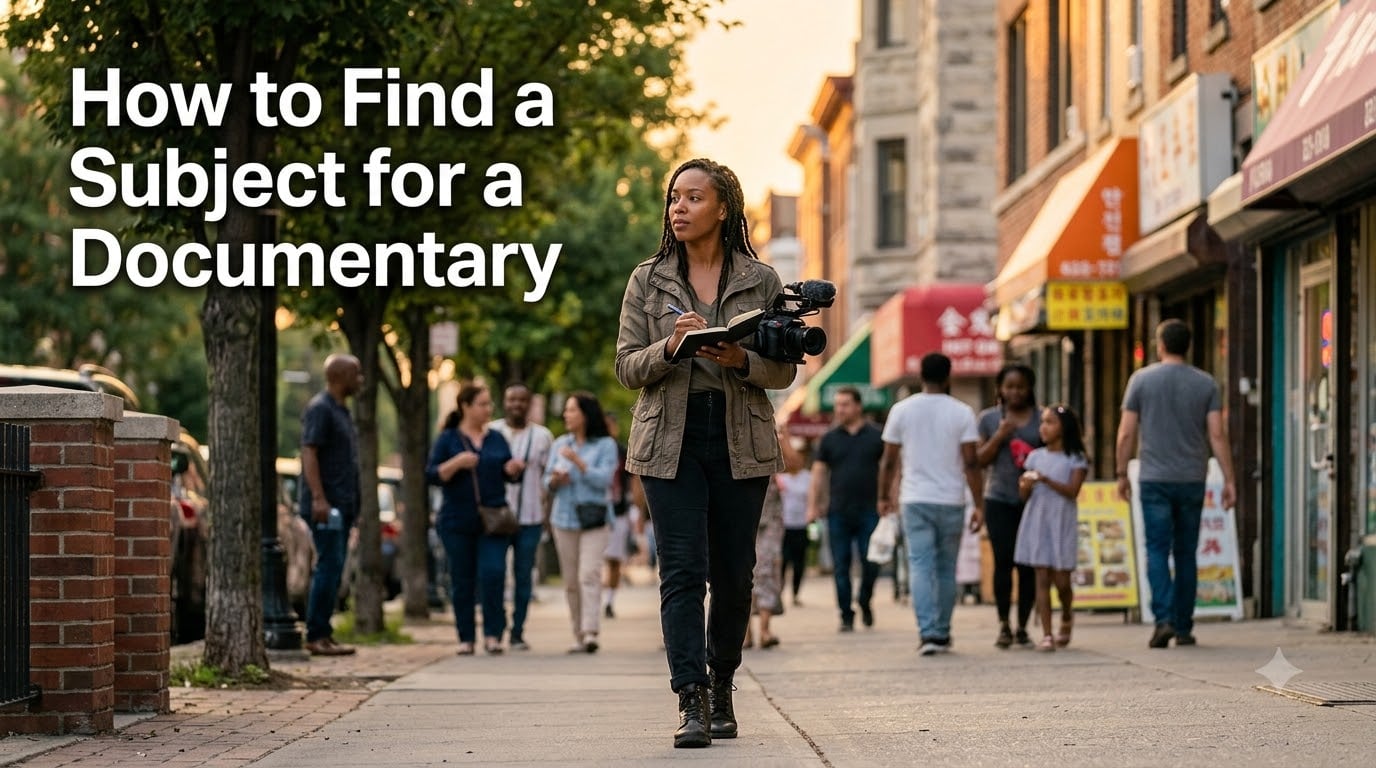
Finding a subject for a documentary is the single decision that shapes every other choice you make as a filmmaker. Your subject determines who you’ll talk to, where you’ll shoot, what your story arc looks like, and whether anyone will care enough to watch the finished film. I’ve spent the last several years producing shorts, and the projects that worked all started with the same thing: a subject I couldn’t stop thinking about. This guide walks you through the exact process I use and the framework taught by working documentary filmmakers, so you can stop scrolling for ideas and start filming.
Table of Contents
- Why Finding the Right Documentary Subject Matters
- What Makes a Documentary Subject Strong: The Story vs Topic Distinction
- Where to Find Documentary Subjects: 7 Practical Sources
- How to Evaluate if a Subject is Right for You
- Research and Networking Strategies That Actually Work
- Building Trust With Documentary Subjects
- Common Mistakes to Avoid When Choosing a Documentary Subject
- FAQs
- Final Thoughts on Choosing Your Documentary Subject
Why Finding the Right Documentary Subject Matters
The subject is the foundation of your entire documentary. Pick a weak one, and no amount of beautiful cinematography or clever editing will save the film. Pick a strong one, and even rough early footage can carry a story that audiences genuinely care about.
Here’s why this decision carries so much weight. Your subject controls access. If you pick a person, place, or community you can’t reasonably reach, you’ll spend months trying to break through doors instead of filming. Your subject also dictates the narrative. A topic like “climate anxiety” is interesting, but it isn’t a film until you find a character with a specific goal and a real obstacle standing in their way.
I learned this the hard way on my first short documentary. I picked a topic I thought was important, spent six weeks researching it, and only then realised I had no clear way in. The piece died in pre-production. My second documentary started with a person I’d met at a community garden, and that film wrapped in four months because the subject carried the work. Choose the right subject and the rest of the project gets dramatically easier.
What Makes a Documentary Subject Strong: The Story vs Topic Distinction
The most important concept in documentary filmmaking is the difference between a topic and a story. A topic is an abstract theme you want to explore. A story is a specific person, place, or community in motion, pursuing a goal against an obstacle.
Topics make for good essays. Stories make for good films. “Homelessness in my city” is a topic. “A 62-year-old man sleeping in his car for the first time after a layoff, trying to get his old job back before his savings run out” is a story. Both are worth exploring, but only the second has legs.
BAFTA-nominated documentary makers use a simple test they call “story legs.” A story has legs if you can answer three questions clearly:
Who is the central character?
What do they want, right now, specifically?
What is standing in their way?
If you can’t fill in those three blanks, you’re holding a topic, not a story. Turn it back over until a character emerges, or pick a different angle. The obstacle matters as much as the goal. Without conflict, there is no narrative tension, and without tension, viewers click away in the first three minutes.
Five core elements separate a strong documentary subject from a forgettable one:
A specific character the audience can root for or against.
A clear goal that creates forward momentum.
An obstacle that generates conflict and stakes.
Visual potential, meaning locations, actions, or imagery that translate to screen.
The promise of change, since audiences want to see something shift by the end.
Run any documentary idea through those five filters before committing. Ideas that pass all five have real legs.
Where to Find Documentary Subjects: 7 Practical Sources
Most filmmakers don’t struggle with creativity. They struggle with knowing where to look. Here are seven practical sources that have produced documentary subjects for me and for working filmmakers I know. You don’t need to fly to a war zone. The best stories are usually closer than you think.
1. Your Local Community
Walk through your neighbourhood with a notebook. Visit the community centre, the laundromat, the bus stop at 6 a.m., and the night market. Pay attention to people doing unusual things, asking unusual questions, or making unusual choices. Local stories are often the most powerful because nobody else has covered them. Filmmaker Mike Raab built an entire career around this idea, filming a Russian Orthodox church in his own town simply because he opened his eyes while walking past it.
2. Personal Connections and Friends-of-Friends
The most reliable entry point for first-time documentary makers is your own extended network. A friend’s aunt restoring a vintage car. A coworker’s parent running a one-woman bakery after a divorce. These stories come pre-loaded with trust, which is the hardest thing to build with a stranger. Tell everyone you know you’re looking for a documentary subject. Be specific about the kinds of stories that interest you. Personal connections often produce the best initial access.
3. News Headlines and Current Events
Local news is a documentary idea goldmine. Read your regional paper for a week and you’ll spot underreported stories about housing policy, small business survival, community disputes, or unusual court cases. National news is usually saturated with coverage, but local angles often have no filmmaker attached. Look for human-interest stories that news outlets covered once and moved on from. Those subjects still have stories to tell.
4. Online Communities and Social Media
Reddit, niche Facebook groups, Discord servers, and topical forums are full of people living the stories you’d want to film. Subreddits like r/videography, r/Filmmakers, and r/documentaryfilmmaking regularly feature first-time filmmakers asking how to find subjects. Use the same spaces to find them. Search for communities around your interests (urban beekeeping, vintage computing, recovering athletes) and read the posts. The people writing passionately in those groups are your potential characters.
5. Cold Outreach
Cold outreach sounds intimidating, but it works when done respectfully. Send a short, honest email explaining who you are, why their story interests you, and what you’re hoping to make. Don’t promise a finished film, payment, or fame. Just express genuine curiosity. Expect a 5 to 10 percent response rate on cold emails and treat every reply as a win. The filmmakers I know who do this regularly land at least one great subject per quarter through cold outreach alone.
6. Your Workplace and Everyday Routine
Some of the best documentary subjects sit inside the routine you already live. The night-shift nurse. The freelance translator. The landlord of the building you’ve walked past for years. Look at your own daily life through a documentary lens and ask: who here has a story I haven’t heard?
7. Subjects Who Find You
This sounds surprising, but many working filmmakers say their best subjects found them first. A neighbour heard you were “into film stuff” and mentioned a relative’s unusual job. A stranger saw your previous work online and reached out with their own story. Make it easy for subjects to reach you. Put a simple contact form on your site, mention your work in conversations, and let people know you’re actively looking. The right subject often appears when you’ve done the inner work of getting clear on what you want.
How to Evaluate if a Subject is Right for You
Once you’ve found a candidate, you need to evaluate whether they’re worth committing to. Documentary projects take months, sometimes years. A bad fit wastes that time. A good fit turns it into the best work you’ll ever do.
Here is the checklist I run every potential subject through before I commit:
Passion test: Can I talk about this person or topic for 10 minutes without notes?
Access test: Can I realistically film this subject, where they live and work, over weeks or months?
Visual test: When I close my eyes and picture the footage, can I see specific scenes?
Story test: Does this person have a clear goal and a clear obstacle?
Time test: Do I have the bandwidth to film, edit, and finish this in a realistic timeframe?
Gut test: After a 30-minute pre-interview, do I feel more curious or more drained?
The gut test is the most underrated. Pay attention to how you feel after meeting a potential subject. If you leave the conversation energised and full of new questions, that’s a strong signal. If you feel flat or vaguely guilty, the subject probably isn’t right, no matter how good it looks on paper.
A pre-interview is your single most useful tool for evaluation. It’s an informal chat where you ask the candidate about their life, work, and challenges. Most pre-interviews last 30 to 60 minutes. By the end, you’ll know whether the story has legs or whether you should keep looking. Don’t skip this step. Filmmakers who skip pre-interviews commit to projects that stall in production.
Research and Networking Strategies That Actually Work
Research doesn’t mean reading ten books before you start filming. It means knowing enough about your subject and their world to ask better questions and recognise the important moments when they happen.
Start with one focused day of research. Read three to five recent articles on the topic. Watch one or two related documentaries for reference. Skim a Wikipedia timeline. Then stop. Anything more than that becomes procrastination dressed up as preparation.
Networking matters as much as research. Join filmmaker communities like the D-Word (d-word.com), local filmmaking meetups, and online groups. Tell people what kind of documentary you’re trying to make. Other filmmakers are a great source of subject referrals, especially when they’ve already passed on a story they’re not personally drawn to.
Cold outreach deserves its own paragraph because most beginner guides gloss over it. Here’s the structure I use. Keep emails under 150 words. Open with something specific about the person you’re contacting, not about yourself. Explain why their story interests you in two sentences. Ask for a 15-minute call to learn more. Sign off with a link to one short piece of your previous work. That’s it. Rejection is normal. Reply rates improve dramatically after your fifth attempt because you’ll have refined your pitch.
Building Trust With Documentary Subjects
Trust is the currency of documentary filmmaking. Without it, your subject will perform for the camera instead of living in front of it. With it, you’ll capture moments no scripted film could ever replicate.
Three habits build trust faster than anything else. First, be transparent about your intentions. Tell your subject exactly what the film is for, who will see it, and how the footage will be used. Second, show your previous work, even if it’s rough. A two-minute clip of an unrelated short demonstrates that you take the craft seriously. Third, give your subject veto power over sensitive scenes. They’ll relax once they realise you’re not out to exploit them.
For sensitive or traumatic subject matter, work even more slowly. Allow multiple meetings before any camera comes out. Let the subject control the pace. Consider bringing a co-producer or therapist-adjacent professional onto the project if the material is heavy. Documentary ethics aren’t a side concern. They’re the foundation of a film your subject will still feel good about five years after release.
Common Mistakes to Avoid When Choosing a Documentary Subject
Every documentary filmmaker has fallen into these traps at least once. Knowing them upfront saves months of wasted effort.
Mistake one: Picking a topic you can’t access. “Inside a maximum security prison” sounds compelling until you realise you have no realistic way to get permission. Pick subjects whose world you can actually enter.
Mistake two: Ignoring warning signs during pre-interviews. If a potential subject dodges every personal question or refuses to meet a second time, trust that signal. The red flags in pre-production become disasters in production.
Mistake three: Falling for a great idea without checking the obstacle. A character with a clear goal but no real obstacle produces a boring film. Make sure your subject is genuinely struggling toward something specific.
Mistake four: Chasing novelty over connection. A weird, never-before-filmed topic will feel stale if you don’t personally care about it. Pick subjects you can stay curious about for the full production timeline.
Mistake five: Committing too early. Don’t sign release forms, lock crew schedules, or announce the project publicly until you’ve done at least one pre-interview and confirmed the story has legs.
FAQs
What are good topics for a documentary?
Strong documentary topics start with a specific character pursuing a clear goal against a real obstacle. Look for people in transition, like someone rebuilding after a job loss, training for a difficult competition, or fighting a local policy change. Everyday communities, local businesses, niche online groups, and personal networks are all rich places to find subjects with built-in stakes and stories.
What are the five elements of a documentary?
The five core elements of a documentary subject are: a specific central character, a clear goal that creates momentum, an obstacle that produces conflict, strong visual potential that translates to screen, and the promise of change by the end. Subjects that pass all five filters have what filmmakers call ‘legs’ and tend to produce compelling finished films.
How do I research for a documentary?
Start with one focused day of research. Read three to five recent articles on the topic, watch one or two reference documentaries, and skim a timeline of key events. Then stop and conduct a pre-interview with your potential subject. Pre-interviews reveal more useful information than extra research and help you confirm the story has legs before you commit months of production time.
Do documentaries pay their subjects?
Most independent documentaries do not pay their subjects. Compensation is unusual because it can change the dynamic of the relationship and influence what people say on camera. Some funded projects, especially branded or commissioned work, may offer appearance fees or expense coverage. Always disclose any payment clearly and document the agreement in writing so the editorial integrity of the film stays intact.
Final Thoughts on Choosing Your Documentary Subject
Learning how to find a subject for a documentary is less about chasing a brilliant idea and more about showing up with clear eyes and a consistent process. Look in your local community, your personal network, the news, and the online spaces you already inhabit. Run every candidate through the goal-plus-obstacle test and the six-item evaluation checklist. Do at least one pre-interview before you commit. Build trust slowly and respect your subject’s pace.
The right story is rarely the loudest one. It’s usually the one you keep thinking about three days after you first heard it. Pick that one. The film will follow.