
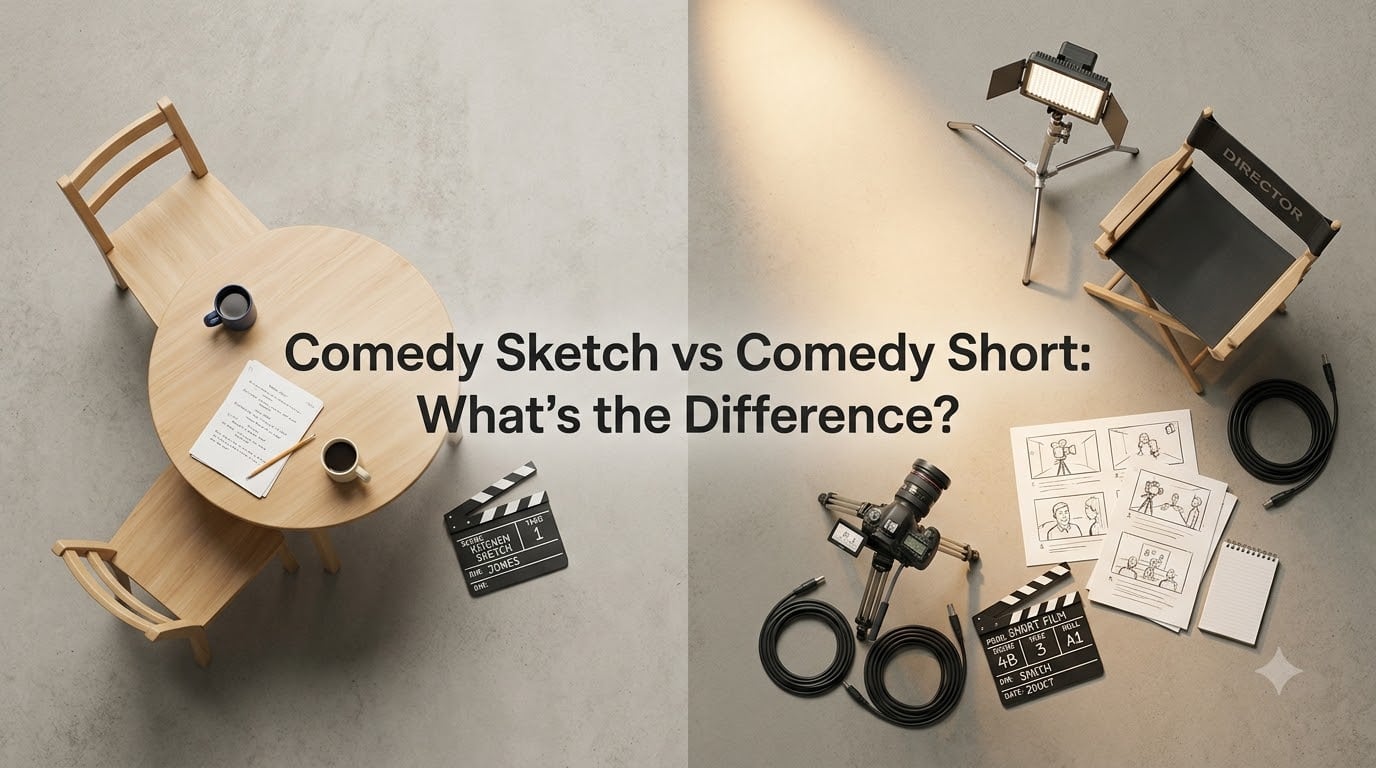
If you’ve ever tried to explain the gap between a comedy sketch and a comedy short, you know how quickly the conversation gets fuzzy. The terms get tossed around interchangeably online, yet filmmakers, screenwriters, and festival programmers treat them very differently. I’ve spent years reviewing short-form comedy submissions and talking with sketch writers, and the distinction comes down to a few clear traits.
This guide breaks down comedy sketch vs comedy short using the same framework industry folks actually use. You’ll get plain definitions, a side-by-side comparison table, and a quick decision guide so you can tell which format fits your next project.
Table of Contents
- What Is a Comedy Sketch?
- What Is a Comedy Short?
- Comedy Sketch vs Comedy Short: Side-by-Side Comparison
- Key Differences in Narrative Structure
- Production, Scripting, and Audience Expectations
- Skit vs Sketch vs Bit: Clearing Up the Terminology
- Which Format Should You Choose?
- FAQs
- Final Thoughts on Comedy Sketch vs Comedy Short
What Is a Comedy Sketch?
A comedy sketch is a short, scripted comedic piece that explores a single concept, character, or situation. Most sketches run between one and ten minutes and stick to one scene or location.
Sketches are written, rehearsed, and performed from a memorized script. The goal is to land one strong comedic premise, then get out before it overstays its welcome. Think of a Saturday Night Live segment, a Key & Peele bit, or a single comedy troupe video. The joke is the engine. Everything else is in service of it.
Because sketches are concept-driven, they don’t need a full character arc or a tidy resolution. They can leave characters exactly where they started. That freedom is what makes sketch comedy such a fertile training ground for new writers and performers.
What Is a Comedy Short?
A comedy short is a brief standalone film that tells a complete story with a beginning, middle, and end. Academy rules cap shorts at 40 minutes, and most festival programmers consider anything under 20 minutes a short film.
Shorts are also scripted and rehearsed, but they require more than a punchline. You need characters who change, a narrative arc that moves forward, and scenes that build on each other. A comedy short can be absurd, dry, or raunchy, but it still has to function as a film. The comedy lives inside a story, not the other way around.
This is the format you’ll see at Sundance, SXSW, and Tribeca short film programs. It’s also what filmmakers usually mean when they call something “a short” on a festival submission form.
Comedy Sketch vs Comedy Short: Side-by-Side Comparison
The fastest way to see the difference is to line up the traits side by side. Here’s a quick-reference table covering the points writers and festival programmers care about most.
| Attribute | Comedy Sketch | Comedy Short |
|---|---|---|
| Typical runtime | 1 to 10 minutes | 5 to 20 minutes (max 40) |
| Structure | Single premise or joke | Three-act story with arc |
| Setting | One scene, one location | Multiple scenes and locations |
| Characters | Often flat or archetypal | Developed with clear change |
| Scripting | Written, rehearsed, memorized | Written, rehearsed, fully shot |
| Production scale | Minimal crew, low budget | Cinematography, sound, editing |
| Distribution | TV shows, YouTube, social | Film festivals, streaming, Vimeo |
| Main goal | Land the joke | Tell the story |
If your project only fits the left column, it’s a sketch. If it matches most of the right column, it’s a short.
Key Differences in Narrative Structure
Sketches and shorts solve very different storytelling problems. A sketch leans on a premise and uses repetition, escalation, or subversion to land its payoff. Once the joke fires, the sketch is done. There’s no obligation to wrap up loose threads.
Shorts operate like miniature features. They introduce a setup, raise a question or conflict, then resolve it before the credits roll. Even a five-minute comedy short usually has a hook, a turn, and a button. That arc is what separates short films from extended sketches on a film festival submission form.
Forum writers on Reddit often describe this as the difference between a “concept piece” and a “story piece.” When you’re pitching or submitting, that framing helps programmers slot your work into the right category.
Production, Scripting, and Audience Expectations
Production is where these two formats diverge the most in practice. Sketches can be shot on a phone with two friends in a living room. Many viral comedy sketches are exactly that. The forgiving nature of sketch comedy lets creators prioritize performance and timing over cinematography.
Shorts demand more from the production side. Festival programmers expect intentional shot design, clean audio, and edit pacing that supports the story. Skimping on these areas can sink a short submission even when the writing is strong.
Audience expectations shift with the label, too. When viewers hit “play” on something called a sketch, they’re braced for a punchline and a quick exit. When they click on a short film, they’re expecting characters and a payoff that earns the runtime. Mislabeling either format tends to frustrate the audience before the first scene lands.
Skit vs Sketch vs Bit: Clearing Up the Terminology
The comedy world uses three terms almost interchangeably, and that confuses new writers. Here’s how I break them down when working with emerging talent.
Sketch: A scripted, rehearsed comedic scene built around a concept. Usually 1 to 10 minutes. The standard unit of sketch comedy.
Skit: A looser, often shorter comedic scene. Sometimes improvised, sometimes scripted. Common on YouTube, TikTok, and live variety shows.
Bit: A repeatable comedic premise or routine. Think of a comedian’s signature piece they perform across sets. Can be part of a sketch, a stand-up act, or a short film.
None of these terms automatically mean “comedy short.” That label still implies a finished, self-contained film with a story arc.
Which Format Should You Choose?
Pick the format that matches the time, budget, and story you actually have. Here’s the decision framework I share with first-time creators.
Choose a sketch when: You have one strong comedic idea, a small cast, limited locations, and a target runtime under ten minutes.
Choose a short when: You want characters who change, a story with a clear arc, and the budget to support sound, lighting, and edit passes.
Choose a skit when: You’re publishing fast-turnaround content for social platforms and the priority is comedic momentum over production polish.
If your goal is festival play or a streaming credit, aim for the short film format. If you want a fast portfolio piece, a sketch series, or a web show, sketch is the better fit. Many creators do both: short films for the festival circuit, sketches for the audience they build between festival cycles.
FAQs
What is the difference between a sketch and a short plays?
A sketch is a short comedic scene built around a single joke or concept, usually 1 to 10 minutes long. A short play, or comedy short, is a brief standalone film or stage work that tells a complete story with characters, scenes, and a narrative arc.
What is a short comedy sketch called?
A short comedy sketch is usually just called a sketch. When it leans toward a single premise or gag, some creators call it a bit. When it’s posted online without much rehearsal, it’s often labeled a skit.
What defines sketch comedy?
Sketch comedy is scripted, rehearsed humor built from short scenes that explore a concept, character, or situation. Each sketch is self-contained, focuses on a single comedic idea, and typically runs under ten minutes.
Is a skit the same as a short film?
No. A skit is a short comedic scene, often improvised or lightly scripted for social media. A short film is a fully produced, scripted story with a narrative arc, designed to stand on its own as a film.
Final Thoughts on Comedy Sketch vs Comedy Short
The comedy sketch vs comedy short debate comes down to intent. Sketches want to land a joke. Shorts want to land a story. Once you know which one you’re chasing, the format, runtime, and production choices fall into place fast. Pick the format that matches your goal, label it accurately, and your audience will know exactly what to expect.