
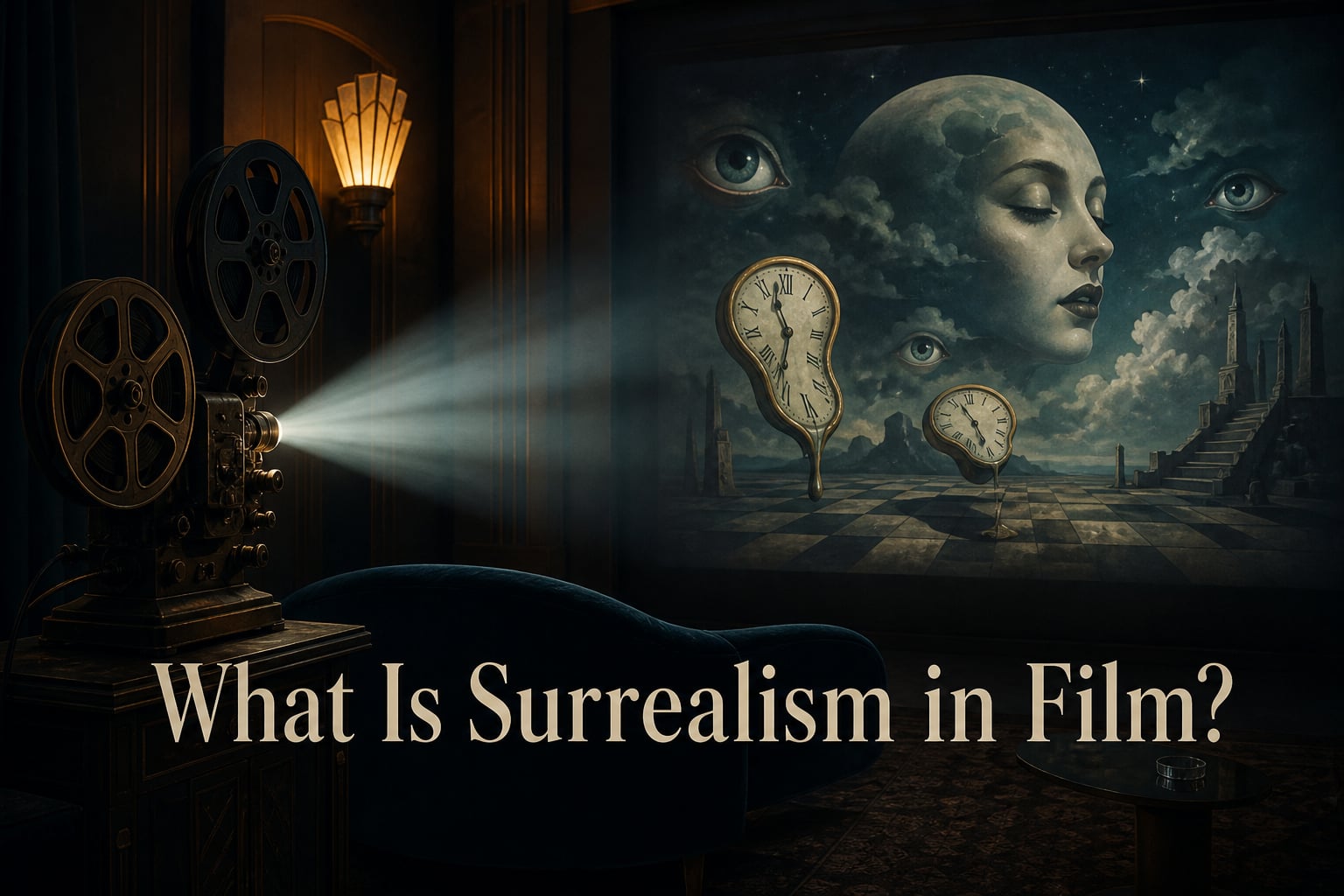
Surrealism in film is an avant-garde artistic movement that rejects everyday logic and realism to mirror the inner workings of the human subconscious. Born in 1920s Paris, it uses dreamlike imagery, absurd juxtapositions, and non-linear narratives to pull viewers out of rational thought.
I first encountered surrealist cinema as a teenager watching a battered VHS of Un Chien Andalou, and I remember feeling unsettled in a way no blockbuster had ever managed. That mix of confusion, recognition, and strange emotional pull is exactly what surrealism sets out to create. In this guide, I’ll walk you through what surrealism in film really means, where it came from, who shaped it, and why filmmakers like you and I still draw on it today.
Table of Contents
- What Is Surrealism in Film? The Core Definition
- The Origins of Surrealism in Cinema
- Core Characteristics of Surrealist Films
- Key Surrealist Filmmakers You Should Know
- Notable Surrealist Films Worth Watching
- How Surrealism Shapes Modern Cinema?
- How to Create Surrealist Effects in Your Own Films?
- Surrealism vs Expressionism vs Dada: What’s the Difference?
- Frequently Asked Questions About Surrealism in Film
- Final Thoughts on Surrealist Cinema
What Is Surrealism in Film? The Core Definition
Surrealism in film is a modernist approach to cinema that first arose in Paris during the 1920s, designed to express the workings of the unconscious mind through moving images. The word itself comes from French, meaning “beyond realism” — and that is the heart of the matter. Where mainstream cinema tries to recreate the world as we see it, surrealist cinema tries to recreate the world as we dream it.
The movement’s founder, French poet André Breton, published the first Surrealist Manifesto in 1924. He described surrealism as pure psychic automatism, intended to express the real functioning of thought without rational control or moral concern. For filmmakers, that meant letting images flow from the subconscious instead of the script.
Unlike a genre like science fiction or horror, surrealism is not defined by setting or plot. A surrealist film can take place anywhere, in any era. What marks it is its commitment to dream logic over narrative logic. Objects behave strangely. Time bends. Identities dissolve. The viewer is asked to feel the film rather than decode it.
The Origins of Surrealism in Cinema
Surrealism did not start on a film set. It started in the trenches of the First World War, where André Breton worked as a psychiatric orderly treating shell-shocked soldiers. He became fascinated by the way trauma surfaced in dreams and free association, and he began experimenting with automatic writing to bypass rational thought.
Breton’s circle, including writers like Louis Aragon and Philippe Soupault, were deeply influenced by Sigmund Freud’s new theories of the unconscious and Carl Jung’s emerging ideas about archetypes and the collective unconscious. They saw cinema as the perfect instrument to bring these hidden mental landscapes to life.
The first true surrealist film arrived in 1929. Luis Buñuel and Salvador Dalí, two young Spanish artists living in Paris, collaborated on Un Chien Andalou, a 16-minute short that opened with a razor slicing across a woman’s eye. The film had no plot, no dialogue, and no logical throughline. It was a sequence of shocking, dreamlike images designed to provoke the unconscious mind. It remains one of the most studied short films in cinema history.
The following year, Buñuel directed L’Âge d’Or, a longer surrealist feature that attacked the conventions of romantic love, religion, and bourgeois society. Both films were considered scandals at the time, and both are now part of the permanent collection at major film archives around the world.
Core Characteristics of Surrealist Films
What makes a film surrealist? I find it useful to think of surrealist cinema as a toolkit of techniques rather than a checklist. Still, there are several traits that appear again and again in films considered part of the movement.
The first is dreamlike imagery. Surrealist films are full of visual sequences that look like the moment between waking and sleeping. Ants crawl out of a hole in a hand. A piano is dragged across a rocky desert. A woman’s face is replaced with the moon. These images feel familiar even though they are impossible.
The second is absurd juxtaposition. Surrealism loves placing unrelated objects in the same frame to spark unconscious connections. A sewing machine on a dissecting table, to borrow the famous Comte de Lautréamont line that inspired the movement, is more beautiful than either object alone.
The third is non-linear narrative. Time loops, reverses, skips, and refuses to behave. Characters may meet themselves as children, or narrate events that have not happened yet, or live entire lifetimes in the time it takes to cross a room.
The fourth is psychic automatism in performance. Actors are sometimes asked to behave without direction, improvising emotion and movement so the scene feels raw and unpredictable. Catherine Deneuve famously described her experience filming Belle de Jour as feeling like she was sleepwalking.
Dreamlike imagery and visual impossibility
Absurd juxtaposition of unrelated objects
Non-linear or fractured narrative structure
Performance guided by intuition rather than strict direction
Symbolic use of recurring objects and environments
An atmosphere that blends beauty, dread, and humor
Key Surrealist Filmmakers You Should Know
Surrealism in film has been shaped by a relatively small group of filmmakers who refused to play by conventional rules. If you want to study the movement seriously, these are the names to start with.
Luis Buñuel and Salvador Dalí
Buñuel is the filmmaker most associated with the founding of surrealist cinema. He and Dalí defined the early movement with Un Chien Andalou and L’Âge d’Or. Buñuel continued working for decades, often inside mainstream production structures, but his films retained a surrealist edge. The Discreet Charm of the Bourgeoisie (1972) won the Academy Award for Best Foreign Language Film while still delivering the deadpan dream logic of his youth.
Germaine Dulac
Germaine Dulac was a French filmmaker who made some of the earliest abstract and surrealist films in the 1920s, including The Seashell and the Clergyman (1928), often cited as the first surrealist film, predating Buñuel by a year in production. She believed cinema was the ideal medium for expressing the inner life and remains an underappreciated pioneer of feminist experimental film.
Federico Fellini
Italian director Federico Fellini blended surrealism with autobiography throughout his career. La Strada, La Dolce Vita, and especially 8½ use dream sequences and shifting realities to explore memory and desire. 8½ in particular influenced a generation of filmmakers with its loose, associative structure.
David Lynch
David Lynch, who passed away in early 2026, was the most recognized surrealist of the late 20th century. His films — Eraserhead, Mulholland Drive, Blue Velvet, and the television series Twin Peaks — used small-town American settings as the surface for deeply strange, dreamlike undercurrents. Lynch described his approach as catching ideas the way you catch fish, a process he likened to automatic writing on screen.
Other Essential Surrealist Directors
Maya Deren brought surrealism into American experimental film with Meshes of the Afternoon (1943). Jan Švankmajer blended surrealism with stop-motion animation. Alejandro Jodorowsky made surrealism spiritual with The Holy Mountain (1973). Terry Gilliam brought the movement into Monty Python and later into films like Brazil and Tideland.
Notable Surrealist Films Worth Watching
If you want to experience surrealism in film firsthand, this curated list moves from the foundational works to more recent releases that still surprise viewers.
Classic Surrealist Films (1920s-1960s)
Un Chien Andalou (1929, Buñuel and Dalí) is 16 minutes of pure dream logic and a perfect starting point. Meshes of the Afternoon (1943, Maya Deren) is a 14-minute short where a woman chases her own double through a shifting house. La Belle et la Bête (1946, Jean Cocteau) reimagines a fairy tale with painted sets and dreamlike practical effects. Wild Strawberries (1957, Ingmar Bergman) uses dream sequences to probe memory and mortality.
Modern Surrealist Films (1970s-Present)
Eraserhead (1977, David Lynch) is a black-and-white industrial nightmare that took five years to complete. The Holy Mountain (1973, Alejandro Jodorowsky) is a psychedelic allegory about a thief’s spiritual ascent. Eternal Sunshine of the Spotless Mind (2004, Michel Gondry) uses surrealist memory imagery to explore lost love. The Science of Sleep (2006, also Gondry) mixes handmade dream sequences with romantic comedy. Mother! (2017, Darren Aronofsky) reads as a surrealist allegory about creation and consumption.
How Surrealism Shapes Modern Cinema?
Surrealism in film never went away. It just moved into new formats. Music videos from artists like Björk, Childish Gambino, and Radiohead borrow surrealist imagery freely. Fashion and luxury brands use surrealist techniques in advertising to make products feel dreamlike and desirable.
Contemporary directors continue to embrace surrealist storytelling. Charlie Kaufman wrote and directed Anomalisa and I’m Thinking of Ending Things with surrealist undertones. Greta Gerwig’s Little Women used a non-linear dream structure influenced by Fellini. Even mainstream Marvel films borrow surrealist set-pieces, including the mirror dimension sequences in Doctor Strange.
Streaming platforms have also opened space for surrealist short films. Our team at Short Film Central tracks dozens of new experimental shorts every month, many of which lean on surrealist techniques to tell stories in under 15 minutes.
How to Create Surrealist Effects in Your Own Films?
If you are a filmmaker reading this, you probably want to know how to actually make a surrealist scene. Here is what has worked for me and for the filmmakers I have interviewed over the years.
Start With Dream Logic, Not Plot
Begin by writing a scene where two unrelated elements interact. A man takes his mother to the train station, but the train station is actually a dentist’s office. Don’t explain it. The viewer’s mind will try to make meaning, and that effort is the point.
Use Objects as Symbols, Not Props
Surrealist films assign symbolic weight to ordinary objects. A clock, a key, a severed hand, a piano — these are not just visual elements. Pick one object per scene and use it the way a poet uses a repeated word.
Shoot Practical Effects First
Before reaching for digital effects, try in-camera tricks. Reverse footage, swap head and body, film reflections through water, or shoot through textured glass. Many of Buñuel’s effects were simple camera and editing techniques that any short film crew can recreate.
Embrace Sound as Atmosphere
Surrealist sound design uses music and ambient noise to confuse the viewer. A door closing with the sound of a thunderclap. A voiceover that contradicts what we see. Sound is one of the cheapest, fastest ways to slip a film into dream territory.
Make a Surrealist Short
My favorite surrealist shorts all run under 10 minutes. The short format is perfect for surrealism because it commits fully to a single mood or image. Pick one idea, one symbol, one dream, and explore it fully. You will learn more about surrealist filmmaking from a 3-minute short than from a year of theory.
Surrealism vs Expressionism vs Dada: What’s the Difference?
Surrealism is often confused with two earlier movements it grew out of. Here is a quick comparison to help you tell them apart.
Expressionism, which emerged in 1920s Germany in films like The Cabinet of Dr. Caligari, distorted reality to express emotion. Sets were painted with exaggerated angles and shadows. The point was psychological mood.
Dada was an even earlier anti-art movement born in 1916 Zurich. Dada artists rejected meaning itself and used chance, absurdity, and collage to mock bourgeois culture. Dada was negative and nihilistic. Surrealism grew out of Dada but tried to be constructive. Where Dada wanted to destroy art, surrealism wanted to reveal the unconscious.
So the family tree goes like this: Dada births surrealism as a constructive alternative. Expressionism runs in parallel and influences both, especially in cinema. All three movements share a distrust of rational, surface reality.
Frequently Asked Questions About Surrealism in Film
What is the concept of Surrealism?
Surrealism is an artistic movement founded by André Breton in 1924 that seeks to express the workings of the unconscious mind by rejecting rational thought and everyday logic. In film, surrealism uses dreamlike imagery, absurd juxtapositions, and non-linear narratives to mirror how the mind works during dreams.
What is an example of a Surrealist film?
Un Chien Andalou (1929) by Luis Buñuel and Salvador Dalí is the foundational surrealist film. Other landmark examples include Meshes of the Afternoon (1943), L’Âge d’Or (1930), La Dolce Vita (1960), Mulholland Drive (2001), and Eternal Sunshine of the Spotless Mind (2004).
What is the Surrealism style of acting?
The surrealist acting style favors intuition, improvisation, and dreamlike detachment over psychological realism. Actors may be asked to behave without explicit direction, repeat gestures mechanically, or react to imaginary elements. The goal is to feel raw and subconscious rather than rehearsed.
Is surrealism a film genre?
Surrealism is not a film genre but an artistic movement. Genres are defined by setting, plot, or audience expectation, such as horror or science fiction. Surrealism can appear inside any genre. A romantic comedy can be surrealist, just as a war film or a documentary can borrow surrealist techniques.
What is the difference between surrealism and expressionism in film?
Expressionism distorts visible reality to express emotion, using exaggerated sets and lighting. Surrealism goes further by replacing reality with dream logic, unconscious symbols, and impossible events. Expressionism is psychological on the surface. Surrealism aims to bypass psychology and reach the unconscious directly.
Final Thoughts on Surrealist Cinema
Surrealism in film has now been part of cinema for nearly a century, and it shows no sign of fading. The movement offers something mainstream cinema still struggles to provide: a direct path to the unconscious. When you watch a surrealist film, you are not just watching a story. You are watching your own mind react, sort, and dream alongside the images.
If you are new to surrealist cinema, my advice is to start with a short. Un Chien Andalou is just 16 minutes, and it will change how you think about what film can do. From there, branch out to Lynch, Fellini, or Jodorowsky. And if you are a filmmaker, make something strange this month. The form is still alive, and it is waiting for new voices.