
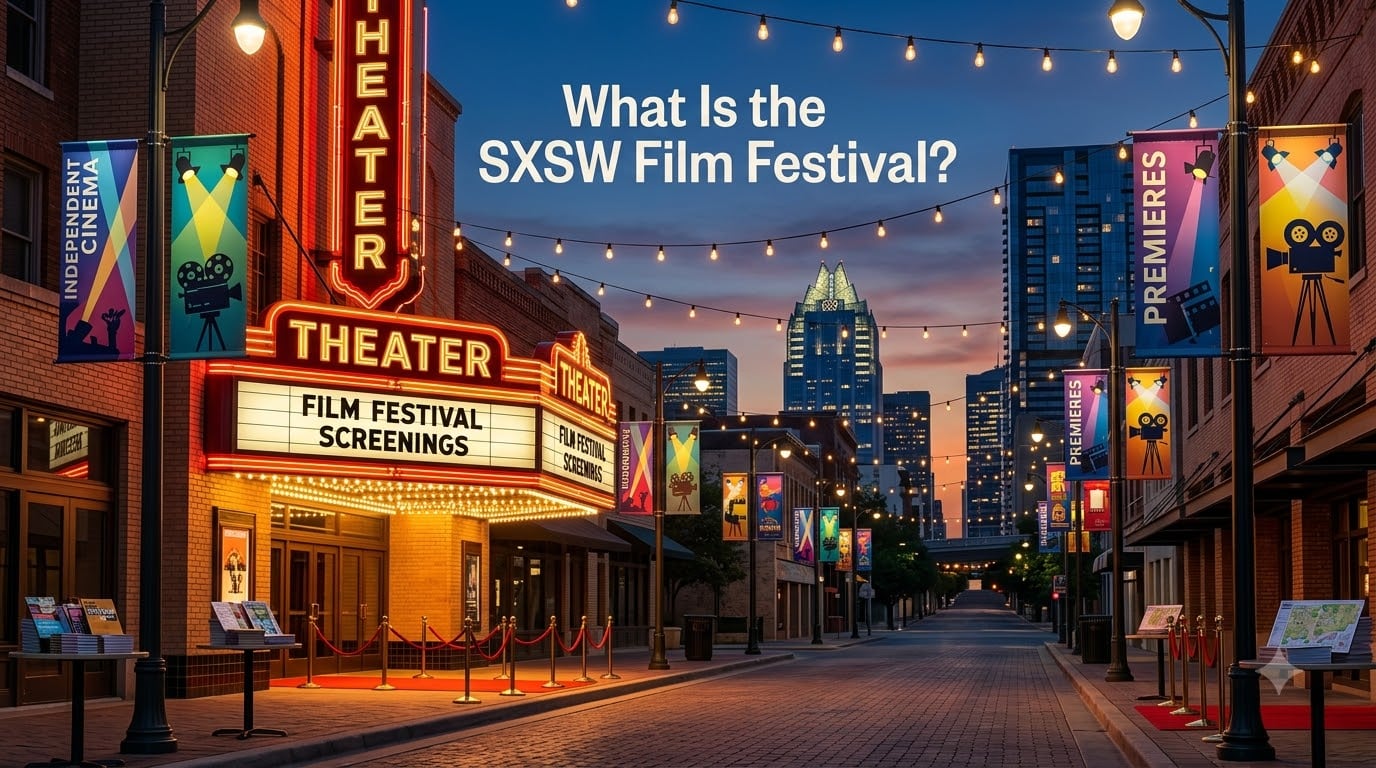
The SXSW Film Festival is a nine-day film, television, and XR showcase held every March in Austin, Texas, where filmmakers premiere new work, attend conferences, and meet industry decision-makers. Founded in 1987, it runs alongside the SXSW Film & TV Conference as part of the larger South by Southwest convergence of film, music, education, and interactive media.
I’ve followed SXSW for years as both a short film fan and someone who chats with filmmakers each spring. In this guide, I’ll walk you through exactly what the festival is, how it started, what happens during those nine days, and whether it might be worth your time and money.
Table of Contents
What Is SXSW and the SXSW Film Festival?
SXSW stands for South by Southwest, the name a playful nod to the 1969 counterculture album by namesake Doug Sahm. The organization was founded in 1987 in Austin, Texas, and today it runs one of the most recognized multi-disciplinary festivals on the global calendar.
The SXSW Film Festival is the film and television arm of that larger event. Over nine days each March, it screens narrative features, documentaries, episodic TV, XR projects, and a particularly strong short film program. Every screening pairs with panels, workshops, and networking sessions through the parallel Film & TV Conference.
What makes it different from Cannes, Sundance, or Toronto is the convergence angle. SXSW isn’t only about film. Music, gaming, education, and tech all happen at the same time, which is why it’s often described as a global gathering of creative people from intersecting industries.
According to the official SXSW site, the festival is known for its high-caliber and diverse program of film, TV, and XR projects. That diversity shows up on screen, in the speaker lineup, and in the crowds you bump into between screenings.
When and How Was the SXSW Film Festival Founded?
SXSW launched in March 1987, founded by a small group that included Roland Swenson, Louis Black, Nick Barbaro, and Louis Meyers. It began primarily as a music festival, modeled on the New Music Seminar in New York.
The film component arrived in 1994, seven years after the music festival started. Louis Black and colleagues wanted Austin to have a serious film showcase alongside the music programming. The first year was modest, but within a few years the festival became known for picking up independent voices that other festivals overlooked.
Key milestones worth knowing:
- 1987: SXSW begins as a music festival in Austin, Texas.
- 1994: The Film Festival launches alongside the existing music event.
- 1999: A digital filmmaking track is added, signaling early tech crossover.
- 2007: Interactive grows into its own track, blurring lines with film.
- 2014: Episodic and TV content becomes a formal competition category.
- 2018: XR (extended reality) joins the official lineup.
- 2022 onward: SXSW London is announced as the festival’s international expansion.
That trajectory matters because it explains why SXSW feels different today. The Film Festival isn’t a standalone cinema event. It grew out of a music festival and grew up alongside the tech industry, so filmmakers there routinely cross paths with musicians, coders, and brand marketers.
What Are the Components of the SXSW Film Festival?
The SXSW Film Festival is structured around several content pillars, each with its own competition tracks, juries, and audience awards.
Film & TV Festival Programming
The flagship film program is split across multiple categories:
- Narrative Feature: Independent fiction features competing for the Grand Jury Prize.
- Documentary Feature: Non-fiction features with their own competition.
- Narrative Shorts: A robust short film program with several sub-categories.
- Documentary Shorts: Non-fiction shorts competing in their own bracket.
- Midnighters: Genre, horror, and weird-cinema programming with a cult following.
- Episodic Pilot Competition: TV pilots and series entries, judged by industry panels.
- Music Videos: Standalone music video competition and screenings.
- XR Experiences: VR, AR, and mixed reality projects in dedicated venues.
Short films get unusually strong treatment at SXSW. There are typically 100-plus shorts spread across multiple programs, with several juried awards. For emerging talent, this short film festival density is one of the festival’s biggest draws.
The SXSW Film & TV Conference
The conference runs in parallel with screenings. Daytime panels cover everything from distribution deals to festival strategy to emerging technology in production. If you’ve ever asked how to break into the industry, this is where a lot of those questions get answered live.
Conference content is grouped by track:
- Film & TV Industry: Distribution, financing, casting, producing.
- Creator: Craft-focused sessions on directing, editing, and screenwriting.
- XR: Storytelling in immersive formats.
- Spotlight: Career conversations and in-depth interviews.
Most panels are open to badgeholders, and a few marquee sessions are open to the public with a separate ticket.
Location and Venues
Almost everything happens in Austin, Texas, spread across downtown venues, the Convention Center, and partner theaters like the Paramount Theatre and the Alamo Drafthouse on Lamar. Walking between venues is part of the experience, and the city’s compact downtown makes it manageable.
How Prestigious Is the SXSW Film Festival?
For an independent film festival, SXSW carries real weight. The festival has launched or accelerated the careers of filmmakers who later went on to bigger prizes and wider distribution.
Films that premiered at SXSW include early work from directors who later became household names. While the festival doesn’t carry the same century-old prestige as Cannes or Venice, it is widely viewed as a taste-maker for emerging voices and genre work, particularly in horror and documentary.
The short film program is especially respected. SXSW short film alumni routinely go on to features, and the festival’s short jury prizes carry meaningful résumé value. If you’re a short filmmaker, this is one of the top-tier festivals to land on your filmography.
Why the festival is such a big deal comes down to three factors: timing, programming, and access. It happens in March, just before the bigger spring acquisitions market, which makes it a launchpad for distribution deals. The programming leans into emerging talent and risk-taking. And the badgeholder model means filmmakers, distributors, and press are all in the same rooms.
A note on the 2024 boycott: a number of artists and sponsors pulled out of SXSW 2024 in protest over the festival’s ties to defense and military-tech sponsors. The festival continued with adjusted programming and has since worked to broaden its sponsor mix. We mention this because it’s a fair part of the festival’s recent history, and it shaped conversations among filmmakers that year.
Can Anyone Attend the SXSW Film Festival?
Yes, but with caveats. SXSW uses a badge-based access system. There are different badge tiers that unlock films, conference sessions, and networking events.
For the general public, individual film screenings are usually available for purchase, sometimes a few weeks before the festival and again at the door if seats remain. You don’t need a badge to watch most movies, but you do need a badge to get into panels, premieres, and industry-only events.
If you’re considering going for the first time, here are some practical tips drawn from forum discussions and our own conversations with regular attendees:
- Decide what you actually want. Films only, films plus panels, or the full convergence experience? The badge tier you need depends on the answer.
- Book early. Housing in Austin fills up fast, and prices climb in the weeks before the festival.
- Plan one or two marquee premieres. The red carpet events are part of the magic, but they require advance planning.
- Leave room to wander. Some of the best discoveries happen at smaller venues you stumble into.
- Expect crowds. Popular screenings fill up. Lines for the biggest titles can be long, especially on opening weekend.
The honest truth, repeated on Reddit and other forums, is that SXSW is not cheap. Badge prices, travel, and Austin lodging can add up quickly. For filmmakers, the value proposition is clearer because the conference and networking are career-relevant. For casual film fans, the math depends on how many screenings you can pack into nine days.
If you can’t make it to Austin, SXSW London is the festival’s international expansion. Launched in recent years, it brings a curated version of the Film & TV programming to the UK each June. It’s a smaller scale than Austin but follows the same template.
Frequently Asked Questions
How prestigious is the SXSW film festival?
The SXSW Film Festival is widely respected as a major U.S. independent film festival and a taste-maker for emerging voices. It carries strong industry weight, particularly for short films, documentaries, and genre work, and has launched or accelerated the careers of many filmmakers who went on to wider acclaim.
Why are artists boycotting SXSW?
In 2024, a number of artists and sponsors pulled out of SXSW over the festival’s ties to defense and military-tech sponsors. Critics argued those sponsorships conflicted with creative community values. The festival continued that year and has since worked to broaden its sponsor mix.
Can anyone attend SXSW?
Yes, members of the public can attend most film screenings by purchasing individual tickets. A SXSW badge unlocks panels, premieres, networking events, and the full conference access for 2026. Badge tiers vary depending on whether you want films only, films plus conference access, or full convergence access.
Why is SXSW such a big deal?
SXSW matters because it happens in March, just before major spring distribution deals are signed, which makes it a launchpad for acquisition. Its programming leans into emerging talent, and the convergence of film, music, and tech means filmmakers meet distributors, journalists, and collaborators in one place.
Final Thoughts on the SXSW Film Festival
So what is the SXSW Film Festival? It’s a nine-day showcase in Austin, Texas, founded in 1987 as part of South by Southwest, where narrative features, documentaries, shorts, episodic pilots, and XR projects screen alongside one of the most industry-heavy conferences on the festival circuit. For emerging filmmakers, particularly in short film, it remains one of the most valuable stops on the calendar.
If you’re thinking about submitting, planning a trip, or just curious, the festival runs every March with badge and ticket sales opening months in advance. SXSW London gives international audiences a second chance to experience the programming each June. Either way, the festival’s mix of emerging talent, industry access, and convergence energy is what keeps people coming back year after year.