
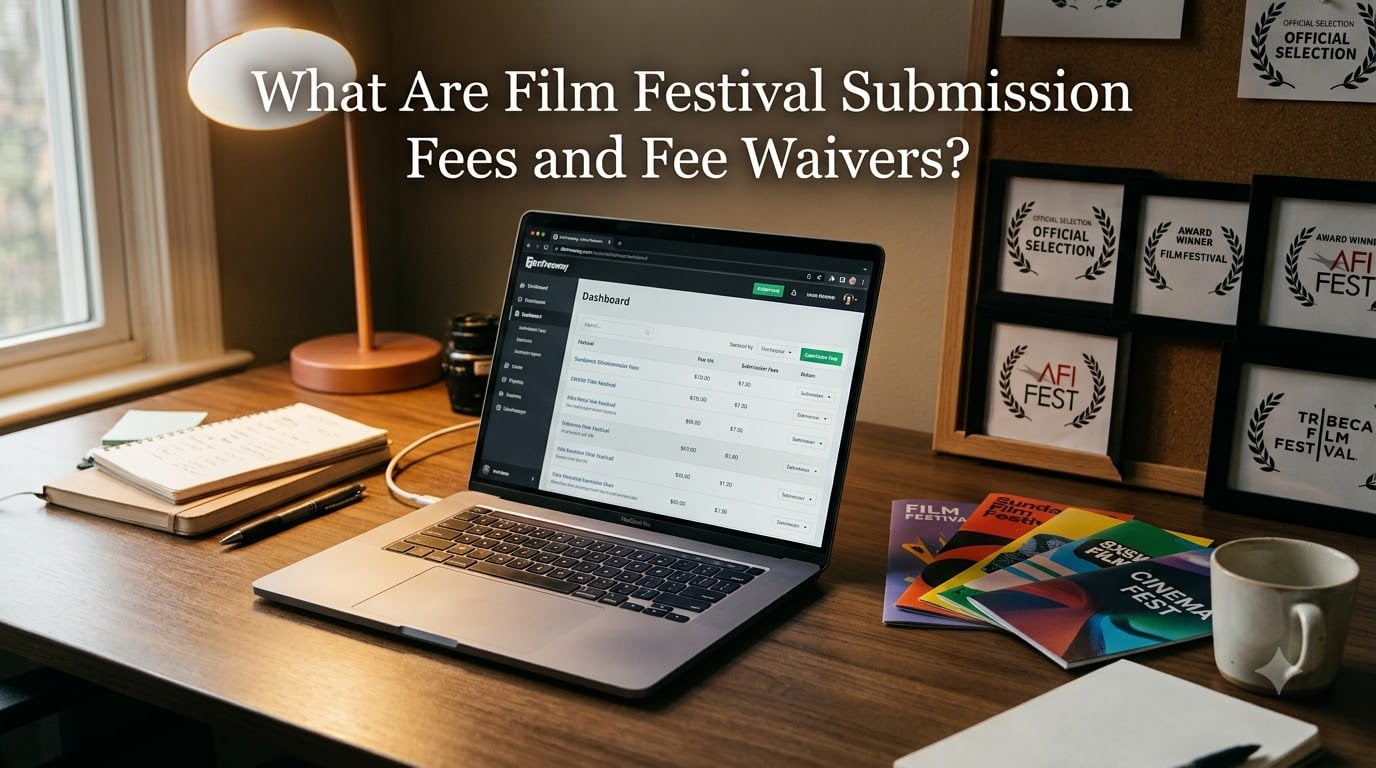
Film festival submission fees are the charges filmmakers pay to have their work considered for inclusion in a festival’s program. If you have ever watched a short film premiere online and wondered how it got there, the answer almost always starts with a submission fee, or, more often than you might think, a successful fee waiver request.
As an indie filmmaker myself, I have paid my share of submission fees and burned through more coffee than I would like to admit drafting waiver emails at 2 a.m. This guide pulls together everything I have learned, plus data from festival directors and fellow filmmakers, so you can budget your run smarter in 2026.
Table of Contents
What Are Film Festival Submission Fees?
Film festival submission fees are payments filmmakers make to enter their film into a festival’s official selection process. Most festivals use online platforms like FilmFreeway (and historically Withoutabox) to collect submissions and run their programming pipeline.
When you pay a submission fee, you are paying for the festival’s programming team to review your film during their screening window. Programmers watch submissions, score them, discuss them in committee, and decide which films make the cut. The fee covers operational costs, screener compensation, and the infrastructure that keeps the festival running.
Fees also act as a quality filter. A small fee discourages drive-by entries and signals that the filmmaker is serious about the festival circuit. That is why major festivals like Tribeca, SXSW, and Cannes charge meaningful fees, while smaller regional festivals keep theirs low or waive them entirely.
Submission fees are not the same as distribution fees. You are paying for consideration, not guaranteed placement. Think of it as an entry ticket to the lottery, where the lottery has real programmers behind it.
Typical Fee Ranges by Festival Tier
Fees scale with the festival’s prestige, audience size, and operational budget. I pulled together ranges based on what I have paid and what fellow filmmakers in my circle report, plus publicly listed fees on FilmFreeway. These are realistic figures for 2026, though exact numbers vary season to season.
Tier 1 (Academy-qualifying, international prestige): $40 to $90 per submission. Festivals like Tribeca, SXSW, Clermont-Ferrand, and Toronto fall here.
Tier 2 (Established regional and genre festivals): $25 to $55. Examples include Atlanta Film Festival, Slamdance, and most Oscar-qualifying shorts festivals.
Tier 3 (Mid-size niche festivals): $15 to $35. These cover most city-level and genre-specific festivals.
Tier 4 (Small or first-year festivals): $0 to $20. Often free or very low cost, sometimes run by volunteers.
Most festivals also run tiered pricing tied to deadlines. The early bird deadline usually gives you the lowest fee, the regular deadline is the standard price, and the late deadline jumps by $10 to $30. Submitting early can save real money across a 30-festival campaign.
For a short film run of 20 to 40 festivals, you should plan for a budget of $600 to $2,500 in submission fees alone, depending on the tier mix. That number shocks many first-time filmmakers, which is exactly why fee waivers exist.
What Are Film Festival Fee Waivers?
A film festival fee waiver is a code or exemption that lets you submit your film without paying the listed fee. Festivals distribute waivers for three main reasons: to support filmmakers from underrepresented regions, to encourage alumni filmmakers to return with new work, and to reward filmmakers who reach out before submitting.
When a festival grants you a waiver, you typically receive a discount code via email. You enter it at checkout on FilmFreeway, and the fee drops to $0 or a reduced amount. The waiver is single-use and tied to your submission, so it cannot be shared or resold.
Most festivals issue fewer than 20 fee waivers per call for entries, according to a 290-festival-director survey by Film Festival Secrets. That sounds small until you realize each filmmaker who gets one saves $25 to $90, and some directors report granting waivers every single week during submission season.
There is a big difference between a fee waiver and a discount code. Discount codes are public or promotional (think student discounts, alumni codes, or FilmFreeway Standard tier perks). Fee waivers are personal and usually require a direct conversation or email request.
Who Qualifies for Fee Waivers?
Fee waiver eligibility varies by festival, but common categories appear again and again. Based on the same director survey, alumni filmmakers are the most likely to receive waivers, followed by filmmakers from low-income countries and student filmmakers.
Most festivals will consider waivers for filmmakers who fit one or more of these buckets:
Students: Currently enrolled in a film program at an accredited school. You usually need a student ID or enrollment letter.
Alumni: Have screened a previous film at the same festival. This is the easiest waiver to get because the festival already knows your work.
Filmmakers from underrepresented regions: Many festivals specifically support filmmakers from the Global South, low-income countries, or their own country or state.
First-time filmmakers: Some festivals reserve a small number of waivers for first-time submitters to encourage new voices.
Filmmakers with financial hardship: Festivals often grant waivers on a case-by-case basis when a filmmaker explains genuine financial barriers.
Directors also report granting waivers when a filmmaker shows their work fits the festival’s specific programming vision. If your film aligns with a category the festival is actively trying to fill, your request is much more likely to land.
How to Request a Film Festival Fee Waiver?
Requesting a waiver is part research, part relationship. The directors I have spoken to consistently say the same thing: do your homework before you ask, and keep your request short. Here is the process that works for me and for most filmmakers I know.
Step 1: Research the festival first. Watch two or three of their past selections on the festival’s website or YouTube. Read the programmer bios. Confirm your film genuinely fits their taste, region, or theme. A waiver request that proves you understand the festival gets read; a generic blast gets archived.
Step 2: Find the right contact. Most festivals list a submissions@ email or a programmer contact on their FilmFreeway page. Avoid generic info@ addresses when you can. Programmers respond more often than general inquiries.
Step 3: Send a short, specific email. Three short paragraphs at most. Include the film title, runtime, logline, and the specific reason you are asking for a waiver. Attach a poster or link to a private screener if you have one.
Step 4: Wait seven days before following up. Programmers are buried during submission season. One polite follow-up is fine. A second follow-up usually hurts your chances.
Here is a waiver request email template I have used successfully four times out of six tries. Tweak it to your voice.
Subject: Fee waiver request for [Film Title] – [Your Name]
Hi [Programmer Name],
I’m submitting my [runtime] short film, [Title], a [genre] about [one-sentence logline]. I noticed your festival has championed [specific theme or recent selection] and felt my film would fit alongside that programming.
I’m a [student/alumni/filmmaker from region/etc.] and currently working with a tight festival budget. Would you consider a fee waiver for this submission?
Screener link: [private Vimeo or similar]. Thank you for your time.
Best, [Your Name]
If they say no, thank them and pay the fee. If they never reply, treat that as a soft no and move on. Sending a passive-aggressive follow-up will burn a bridge for your next film.
Strategies to Reduce Submission Costs
Fees add up fast, but there are several reliable ways to keep your run affordable without sacrificing quality. I have used all of these at least once, and they work.
1. Build a tiered submission list. Mix 5 Tier 1 festivals with 10 Tier 2 and 15 Tier 3 festivals. The dreamers at the top give you a shot at prestige, while the realistic middle and base tiers build actual screen time and audience growth.
2. Submit early for early bird pricing. Most festivals discount fees by $10 to $25 for early submissions. Across 20 festivals, that alone can save $300.
3. Reach out before paying. Noam Kroll’s well-known strategy involves emailing programmers directly before submitting to gauge interest. When done well, filmmakers report getting waiver codes roughly 30% of the time, based on forum discussions from r/FilmFestivals and r/Filmmakers.
4. Stack student, alumni, and regional discounts. Some festivals will combine a student discount with a regional discount if you ask. Always ask.
5. Find fee-free submission options. Some festivals accept submissions for free through specific programs, equity initiatives, or FilmFreeway’s diversity partnerships. Atlanta Film Festival, for example, has historically offered waivers for Georgia-based filmmakers and students.
6. Budget realistically. A common rule of thumb in indie circles is to set aside $1,500 to $3,000 for a complete festival run, including fees, screener hosting, and travel for accepted films. Treat fees as marketing spend, not sunk cost.
Are Film Festival Submissions Worth the Cost?
The honest answer is that it depends on what you are optimizing for. If you measure success purely by dollar return, most indie shorts never recoup their submission budget through screenings alone. Festivals typically do not pay screening fees unless you land in a major competition or distribution deal.
But festivals deliver value in ways that are hard to put on a spreadsheet. They build your resume, unlock press coverage, and connect you with programmers who later become distributors, collaborators, and investors. A short that screens at three solid regional festivals is genuinely more attractive to a feature financier than one that stays private.
Fees pay off most clearly when you target festivals whose audiences and programmers fit your film. A thriller submitted to a documentary-heavy festival is wasted money. A documentary submitted to a doc-focused festival is a smart bet, even at a higher fee.
Submission fees also work as a forcing function. They make you treat each entry as a deliberate decision, not a spray-and-pray. That focus usually leads to better festival outcomes than submitting everywhere blindly.
FAQs
What are the typical submission fees for film festivals?
Most short film festivals charge between $15 and $90 per submission depending on the festival’s tier. Small and first-year festivals often run $0 to $20, mid-tier regional festivals charge $25 to $55, and Academy-qualifying or international prestige festivals typically charge $40 to $90. Early bird deadlines usually offer $10 to $25 savings.
Is submitting to film festivals worth it?
For most indie filmmakers, festival submissions are worth the cost when targeted at festivals whose programmers and audiences fit the film. Fees rarely pay back in direct screening revenue, but they build resume, press, and industry connections that lead to distribution, financing, and collaborations down the road.
Which film festivals offer free submissions?
Many small, regional, and first-year festivals offer free submissions year-round. Larger festivals typically offer fee waivers through student programs, alumni filmmaker codes, underrepresented region initiatives, or hardship requests. FilmFreeway also runs periodic diversity programs that waive fees for selected filmmakers.
What’s the hardest film festival to get into?
Hardest-to-crack festivals include Cannes, Berlin, Sundance, and Venice for features, plus Clermont-Ferrand, Toronto, and Tribeca for shorts. Acceptance rates for the most selective festivals sit below 5%, with some programs accepting fewer than 1% of submissions. Targeting a mix of selective and realistic festivals usually gives the best result.
Conclusion
Film festival submission fees are the entry ticket to the festival circuit, and they range from free to $90 depending on tier and deadline. Fee waivers give filmmakers with limited budgets a real shot at the same festivals, especially when you research the festival, contact the right programmer, and write a clear, specific request.
Build your run as a tiered list, hit early bird deadlines where possible, and treat waiver outreach as a normal part of your workflow rather than a last resort. Start with the email template above, adjust it to your voice, and keep going.
If you want help planning your own festival run for 2026, drop us a line at Short Film Central. We are happy to take a look at your list.