
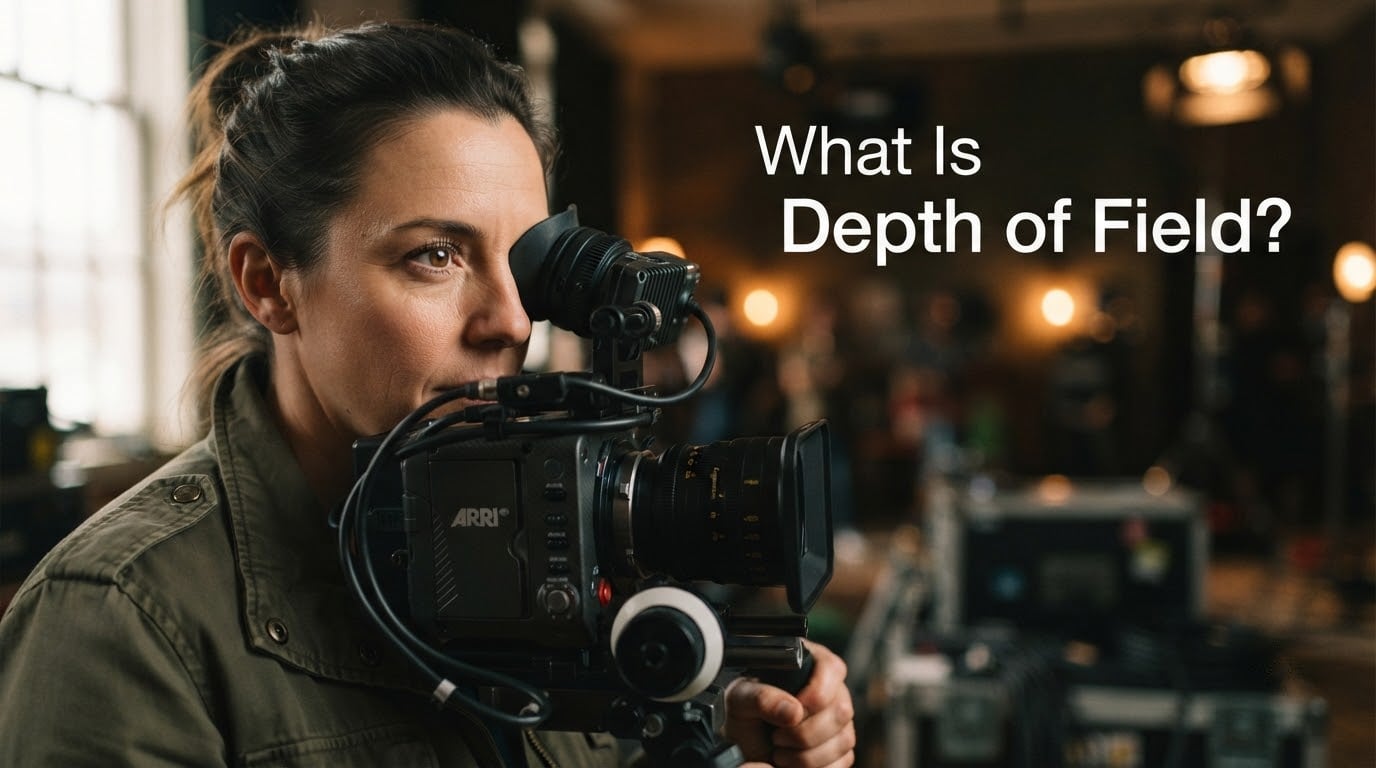
Depth of field is the distance between the closest and farthest objects in an image that appear acceptably sharp. A camera can only focus on one plane at a time, but a zone of sharpness extends in front of and behind that plane, and the size of that zone is the depth of field.
You’ve seen it a thousand times without naming it. A face floats sharp against a creamy, smeared background in a movie trailer. A landscape photograph keeps every leaf and every mountain crisp from foreground to horizon. Both are depth of field choices, and they are among the most powerful tools a filmmaker or photographer has.
In this guide, you’ll learn exactly what depth of field is, the four factors that control it, how cinematographers use it to tell stories, and the advanced techniques (like rack focus) that turn a sharp zone into a narrative device. Whether you’re a short film director planning a shot list or a photographer dialing in your first prime lens, the concept is the same.
Table of Contents
Depth of Field Definition
Depth of field (often shortened to DoF) is the distance between the nearest and farthest objects in your image that appear acceptably sharp. Your lens focuses light onto one precise plane, but a range of distances in front of and behind that plane still looks sharp to the human eye. That range is the depth of field.
The word “acceptably” is doing real work here. Sharpness is not binary. Light from a point on your subject lands on your sensor as a tiny circle, and if that circle is small enough, we read the point as sharp. When the circle grows past a threshold our eyes tolerate, we read it as blurred. That threshold is called the circle of confusion, and it’s the engineering definition of where “acceptably sharp” ends.
You may also see depth of field called the “focus range,” the “zone of acceptable sharpness,” or simply “DoF.” All four names describe the same thing: how thick the slice of your scene looks in focus.
The Point of Focus and the Focal Plane
The point of focus is the exact distance your lens is set to. Light from that distance converges to a perfect point on your sensor. Light from slightly nearer and farther distances converges just before or just after the sensor, creating tiny circles instead of points. As long as those circles stay smaller than the circle of confusion, we still read them as sharp.
The flat plane that runs through your subject at the focus distance is called the focal plane or plane of focus. Depth of field is a thickness around that plane, stretching toward and away from the camera.
Shallow vs Deep Depth of Field
A shallow depth of field keeps just a thin slice of the scene sharp. A deep (or wide) depth of field keeps almost everything sharp, from a few feet in front of the lens to the far horizon. The choice between them is usually the single biggest creative decision in any image.
Shallow DoF is the default of portraiture, fashion, food photography, and most narrative film. It isolates the subject. The background blurs into soft shapes called bokeh, and your eye has nowhere to look except the face or the product. Deep DoF is the default of landscape photography, architectural photography, news photography, and deep-focus film. It says, “Look at everything; this is the whole world of the scene.”
Most modern films mix the two constantly. A wide establishing shot uses deep focus to introduce the location, then a close-up uses shallow focus to land the audience inside a character’s mind.
Shallow, Mid, and Deep Depth of Field Compared
| Type | Look | Typical Aperture | Common Use |
|---|---|---|---|
| Shallow | Thin slice sharp; background melts into bokeh | f/1.4 – f/2.8 | Portraits, narrative film close-ups, product hero shots |
| Mid | Subject sharp; background readable but soft | f/4 – f/5.6 | Documentary interviews, street photography, lifestyle |
| Deep | Foreground to horizon all acceptably sharp | f/8 – f/16 | Landscapes, architectural, deep-focus film (Citizen Kane), group scenes |
What Is a Deep Depth of Field Image?
A deep depth of field image is one where most of the scene, from objects near the lens to objects far in the distance, appears sharp. It’s common in landscape photography and in wide shots in film. Citizen Kane’s deep-focus compositions by Gregg Toland are the most famous example in cinema history.
What Controls Depth of Field?
Four things control depth of field: aperture (the size of the lens opening), camera-to-subject distance, focal length, and sensor size. Change any one of them and the zone of sharpness moves with you. Master the four and you can predict DoF before you ever raise the camera.
Aperture (f-stop)
Aperture is the adjustable opening inside your lens that controls how much light passes through. It’s measured in f-stops: f/1.4, f/2, f/2.8, f/4, f/5.6, f/8, f/11, f/16, and so on. Smaller f-numbers mean a wider opening. A wider opening lets light rays enter at steeper angles, and those steep angles meet at the focal plane over a much narrower range of distances. That narrow range is shallow depth of field.
Stop down (use a higher f-number like f/11) and the opening shrinks. Light rays enter closer to parallel, take longer to converge, and stay acceptably sharp across a much wider range. That wide range is deep depth of field.
Aperture vs Depth of Field
| Aperture | Relative Opening | Depth of Field Effect |
|---|---|---|
| f/1.4 | Very wide | Very shallow; razor-thin slice in focus |
| f/2.8 | Wide | Shallow; classic cinematic close-up look |
| f/5.6 | Moderate | Mid; subject sharp, background soft but readable |
| f/8 | Small | Deep; most of the scene acceptably sharp |
| f/16 | Very small | Very deep; near-to-far sharp, but diffraction may soften fine detail |
A practical warning from experienced shooters: at very small apertures like f/16 or f/22, a lens effect called diffraction softens fine detail. The depth of field gets wider, but the picture actually gets a little less crisp. Most photographers and DPs cap their “deep DoF” aperture around f/8 to f/11 for this reason.
Camera-to-Subject Distance
The closer your camera is to your subject, the shallower your depth of field becomes. Move the camera twice as close and the depth of field shrinks to roughly one quarter of its previous size. This is the single most dramatic DoF control you have, and it costs you nothing.
Filmmakers use this all the time. If you want a tighter close-up but need the same DoF, you can dolly in and open the aperture by one stop. If you want a wider view of the same scene at the same DoF, you dolly back and close the aperture. The math has to balance, but the creative control is enormous.
For macro photography, this effect is extreme. At high magnifications, depth of field can collapse to a millimeter or less even at f/16, which is why macro shooters often resort to focus stacking: taking many shots at different focus distances and combining them in software.
Focal Length
Focal length is the distance inside a lens where light rays converge to a focus point. A 50mm lens has a 50mm focal length; a 200mm lens has a 200mm focal length. Longer focal lengths produce shallower depth of field, all else being equal.
Here’s the catch that confuses almost everyone starting out: focal length and DoF only compare cleanly when the framing stays the same. A 200mm shot of a subject from 10 feet away and a 50mm shot of the same subject from the same distance are framed completely differently. If you step back with the 50mm until the subject is the same size in the frame, the DoF difference shrinks dramatically.
For filmmakers, the practical takeaway is simple. Telephoto lenses (85mm, 135mm, 200mm) compress the background and throw it out of focus fast. Wide-angle lenses (16mm, 24mm, 35mm) keep much more of the scene sharp. If you want creamy bokeh behind a face, reach for a longer lens or move the camera closer.
Sensor Size
Sensor size changes depth of field because it changes the focal length needed to frame a subject the same way. A full-frame sensor and a Micro Four Thirds sensor framing the same head-and-shoulders portrait will use different focal lengths, and that difference changes the DoF.
Smaller sensors use shorter focal lengths for the same field of view, and shorter focal lengths produce deeper depth of field. That’s why smartphone cameras, with their tiny sensors, keep almost everything sharp, and why full-frame cinema cameras can throw a background into creamy blur so easily.
If you’ve ever owned a crop-sensor DSLR and felt you “couldn’t get the same shallow DoF as full-frame,” you were right. To get the same look on an APS-C or Micro 4/3 body, you need a faster lens, a longer focal length, or a closer subject. Our friends over at our roundup of the best lenses for filmmaking with shallow depth of field cover this trade-off in detail.
Depth of Field in Filmmaking
In film, depth of field is not just a technical setting. It is a storytelling language. Directors and cinematographers choose DoF scene by scene, sometimes shot by shot, to control where the audience looks and what they feel.
Shallow depth of field isolates a character. It says, “the world has gone quiet; only this person matters right now.” Deep depth of field keeps an entire environment in play. It says, “watch everything; this is a world with layers.”
Gregg Toland’s deep-focus work on Citizen Kane (1941) is the textbook example. In one famous shot, a young Kane plays in the snow outside while his mother signs papers inside. Both planes are in focus, and the emotional distance between mother and child is laid bare in a single image. No dialogue needed.
At the other end of the spectrum, Martin Scorsese and DP Michael Ballhaus shot the Copacabana long take in Goodfellas (1990) on a Steadicam with a wide aperture and careful blocking. Henry Hill walks through a busy kitchen, down a corridor, into a back door, and up to the VIP table, all in one unbroken three-minute shot. Every actor who matters is in focus at the moment they matter, because Ballhaus planned the depth of field and the blocking together. The technique is called deep staging, and it lives or dies on DoF decisions.
More recently, The Night Of (2016) used extreme shallow focus and a long lens to put the audience inside the head of an anxious suspect. Almost every close-up is a tight slice of sharp face against an out-of-focus city. The DoF is the performance.
Why DoF Matters for Short Filmmakers
For a short film, depth of field decisions are usually locked in pre-production, in the shot list. A DP and director will mark each shot with the planned focal length, aperture, and focus distance. They do this because changing DoF on set costs time, and running out of light forces compromises. If you plan a wide-aperture close-up at f/2 for a daylight scene, you will need an ND filter to avoid overexposure. If you don’t plan for it, you won’t have it on set.
Advanced Techniques: Rack Focus and Pull Focus
A rack focus (also called a pull focus) is a deliberate change of the focus point during a single take. The depth of field zone stays the same, but the point of focus moves. One character is sharp, then another becomes sharp, then the first. Done well, a rack focus guides the audience’s attention without a single cut.
In a dialogue scene with two actors on the same focal plane, the DP can rack from one face to the other as the speaker changes. The viewer doesn’t consciously notice the focus shift; they just feel which character the scene is “about.” That’s a DoF technique doing narrative work.
Pull focus can also reveal information. Imagine a shot focused on a character’s face, then racking to a clock on the wall behind them. The audience has been told, without dialogue, that time matters. The technique works because depth of field is a slice, and moving that slice within the scene is a way to direct the eye.
For run-and-gun documentary work, filmmakers often use zone focusing instead of pulling focus on the fly. You set your focus distance and your aperture so that everything from, say, four feet to twelve feet from the lens is sharp. You walk into that zone and shoot. This is one of the most practical DoF applications for documentary cinematographers and short film shooters on tight schedules.
Frequently Asked Questions
What is depth of field in simple words?
Depth of field is how much of your image looks sharp from front to back. A shallow depth of field keeps just a thin slice in focus; a deep depth of field keeps almost everything in focus.
What is depth of field in film?
In film, depth of field is the slice of the scene that looks sharp. Directors and cinematographers use shallow depth of field to isolate a character, and deep depth of field to show an entire scene or environment in focus.
What is a deep depth of field image?
A deep (or wide) depth of field image is one where most of the scene, from objects near the lens to objects far in the distance, appears sharp. It is common in landscape photography and in wide shots in film.
What controls depth of field?
Four things control depth of field: aperture (f-stop), camera-to-subject distance, focal length, and sensor size. Wider aperture, closer subject, longer focal length, and larger sensor all make DoF shallower.
What is shallow depth of field?
Shallow depth of field is a thin slice of the scene in focus with the foreground and background blurred. It is the look of most portrait photography, narrative film close-ups, and product hero shots, usually achieved with a wide aperture like f/1.4 or f/2.8.
Is depth of field equally distributed in front of and behind the focus point?
No. Depth of field is usually about one-third in front of your focus point and two-thirds behind it. As magnification increases, the split becomes closer to 50/50.
Conclusion
Depth of field is the single most powerful tool for directing the viewer’s eye. It decides what looks sharp and what looks soft, what feels intimate and what feels expansive, what a scene is about and what it ignores. Once you understand the four controls (aperture, camera-to-subject distance, focal length, and sensor size) you can predict and shape depth of field before you ever raise the camera.
If you want to put this into practice on your next short film, start by blocking your shot, picking your focal length, then choosing the aperture that gives you the depth of field you want. For shallow-focus looks, our guide to the best lenses for filmmaking with shallow depth of field is a good next read. Master depth of field and you control the visual language of every frame you shoot.