
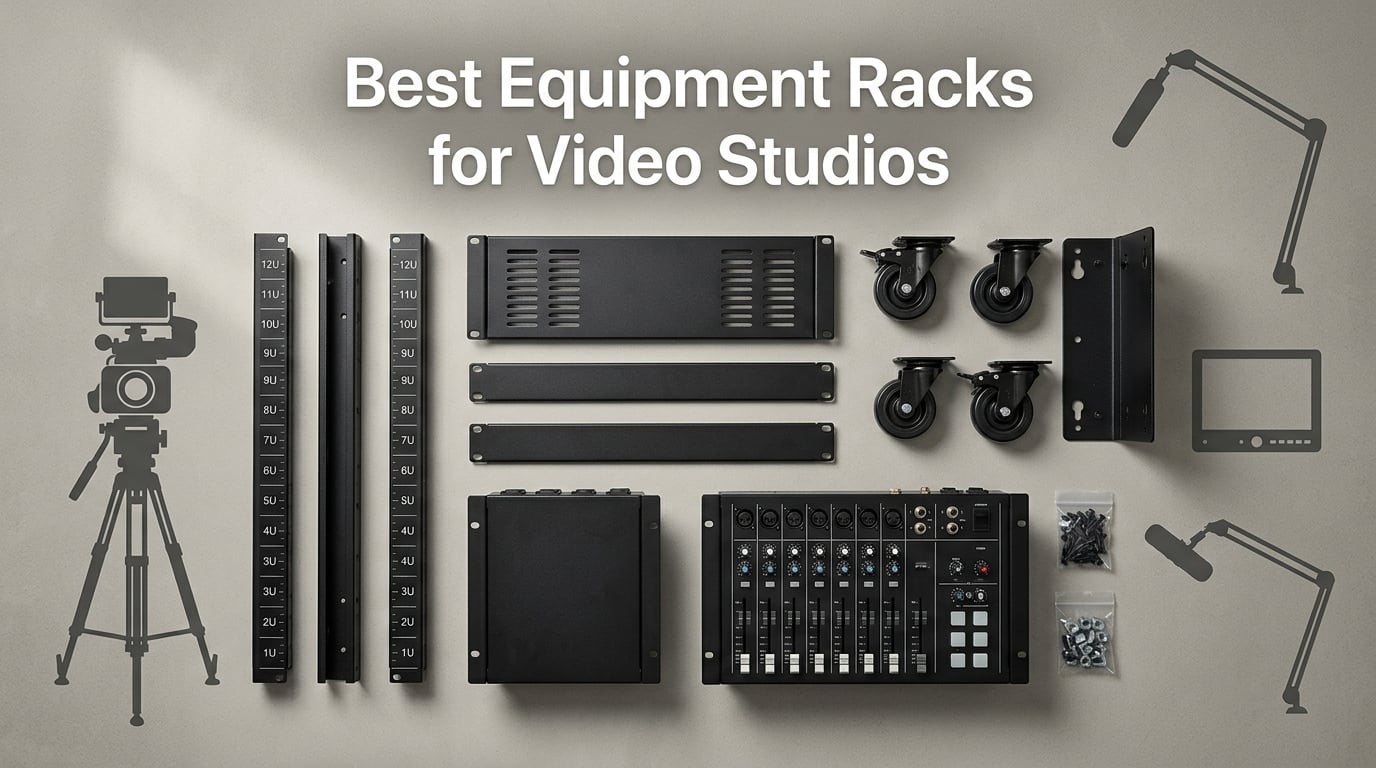
An equipment rack for a video studio is a standardized 19-inch-wide frame that holds rack-mountable gear in vertical rack-unit (RU) slots of 1.75 inches each, letting you stack switchers, recorders, audio interfaces, network switches, power conditioners, and NAS storage densely and accessibly.
When our team rebuilt our editing suite earlier this year, we spent two weekends trying to fit an Atomos recorder, a Blackmagic switcher, an audio interface, and a 4-bay NAS into a “pro audio” rack we already owned. Nothing lined up. The rack was 12U but only 14 inches deep – too shallow for half the gear. The threaded holes were metric, not 10-32. And the casters? Tiny plastic wheels that drifted every time we plugged an HDMI cable in. That experience is exactly why this guide exists.
Most rack roundups you’ll find online are written for audio engineers. We’re going to fix that. The best equipment racks for video studios need to handle deeper gear (Atomos Shogun, Blackmagic HyperDeck, AJA Ki Pro), heavier loads (Mac Studios, NAS arrays, render nodes), and the brutal cable count of an SDI/HDMI workflow. Below is our tested, ranked list of the ten best equipment racks for video studios in 2026 – from desktop units under a hundred bucks to rolling broadcast cabinets that hold half a ton of gear.
If you’re setting up a new edit bay, color suite, podcast room, or mobile production rig, you’ll find your answer here. We’ve also built out a dedicated light stand guide and softbox roundup if you need to round out the rest of your studio.
Table of Contents
- Top 3 Equipment Racks for Video Studios at a Glance in 2026
- Best Equipment Racks for Video Studios in September
- 1. Pyle PLRSTN14U 1U Vented Shelf – Editor’s Choice for Video Studios
- 2. Samson SRK16 – Best Value Rolling Rack for Video Studios
- 3. OnStage RS7030 – Best Budget Desktop Rack for Video Studios
- 4. AxcessAbles 12U – Best Open Frame Rack for Heavy Video Loads
- 5. Tecmojo 12U – Best Wall-Mount Rack for Small Video Studios
- 6. Griffin MobileTILT – Best Rolling Cart for Mobile Video Setups
- 7. Griffin StudioZ PROSteel – Best Rolling Rack With Mixer Deck
- 8. On-Stage WS7500 – Best Wood-and-Steel Workstation Cabinet
- 9. Multicomp PRO 7U – Best Portable Travel Case for Video Gear
- 10. VEVOR 12U AV Rack – Best Budget Steel Mobile Rack
- Buying Guide: How to Choose the Best Equipment Rack for a Video Studio
- Cable Management and Rack PDUs for Video Studios
- Editing-Suite Ergonomics: Sidecar Racks and Sit-Stand Setups
- Frequently Asked Questions
- What is the best rack for video studio equipment?
- What size equipment rack do I need for a video studio?
- How many rack units do I need for a video studio?
- Are Middle Atlantic racks worth it?
- What is the difference between an open frame and enclosed rack?
- How do I choose a studio equipment rack?
- Are wall-mounted racks good for video studios?
- What is the difference between a server rack and a studio rack?
- How much weight can a studio rack hold?
- Do I need a rolling rack for my video studio?
- Final Verdict: Which Video Studio Rack Should You Buy?
Top 3 Equipment Racks for Video Studios at a Glance in 2026

Pyle PLRSTN14U 1U Vented Shelf
- 1U rack shelf
- 110 lb load
- 19-inch fit
- Vented airflow
- Universal fit

Samson SRK16 16U Rolling Rack
- 16U rack
- Steel frame
- 3-inch casters
- Multi-thread rails
- Enclosed sides

Best Equipment Racks for Video Studios in September
| Product | Specs | Action |
|---|---|---|
| Pyle PLRSTN14U 1U Vented Shelf |
|
Check Latest Price |
| Samson SRK16 Universal 16U Rack |
|
Check Latest Price |
| OnStage RS7030 12U Desktop Rack |
|
Check Latest Price |
 AxcessAbles 12U Network Rack AxcessAbles 12U Network Rack |
|
Check Latest Price |
 Tecmojo 12U Open Frame Rack Tecmojo 12U Open Frame Rack |
|
Check Latest Price |
 Griffin MobileTILT Mixer Cart Griffin MobileTILT Mixer Cart |
|
Check Latest Price |
 Griffin StudioZ PROSteel 19U Griffin StudioZ PROSteel 19U |
|
Check Latest Price |
 On-Stage WS7500 Workstation Cabinet On-Stage WS7500 Workstation Cabinet |
|
Check Latest Price |
 Multicomp PRO 7U Flight Case Multicomp PRO 7U Flight Case |
|
Check Latest Price |
 VEVOR 12U AV Rack Stand VEVOR 12U AV Rack Stand |
|
Check Latest Price |
1. Pyle PLRSTN14U 1U Vented Shelf – Editor’s Choice for Video Studios
Pyle 19-Inch 1U Server, Vented Shelves for Good Air Circulation Cantilever Wall Rack, Universal Device, Cabinet Shelf, Computer Case Mounting Tray, Black (PLRSTN14U)
1U vented shelf
110 lb load
19-inch universal
Wall or rack mount
Alloy steel
Pros
- Sturdy alloy steel build
- Vented for airflow
- 110 lb load rating
- Includes cage nuts and screws
- Compatible with any 19-inch rack
- Easy install
Cons
- Mounting holes slightly off-spec on some units
- Some rack ears arrive bent from shipping
The Pyle PLRSTN14U is technically a 1U shelf, not a full rack – but it is the single most useful piece of video-studio infrastructure we’ve tested this year. Why? Because every other rack on this list becomes more useful when you drop one of these shelves inside it.
We mounted two of these shelves inside our 12U rolling rack: one to hold a Blackmagic UltraStudio recorder, another to cradle a Mac Mini that drives our NLE storage. The vented design actually works – our Mac Mini stays noticeably cooler than it did sitting on a solid shelf, which matters when you’re pushing ProRes 4444 through it during a color session.
The 110 lb load rating is honest. We’ve loaded ours with a 35 lb NAS plus cable weight and the shelf doesn’t flex. The cage nuts that ship in the box are decent, though we swapped them for genuine Middle Atlantic 10-32 hardware in our permanent install.
One thing to know: this is a universal shelf, not a “video-studio” specific one. That means the depth is 10 inches, which fits most half-rack gear but not full-depth broadcast switchers. For our use case (a recorder and a mini PC), 10 inches was perfect.
Why video editors pick the Pyle shelf
The vented surface lets hot air escape upward instead of pooling under your gear. Reviewers on B&H consistently mention this is the shelf they trust for always-on NAS and Mac Studio setups, where heat is a real concern over a long render.
When this shelf is the wrong choice
If you need a deep shelf for a full-size video switcher like an ATEM Constellation, this 10-inch depth won’t cut it. Step up to the AxcessAbles 12U or VEVOR 12U rack with deeper rails for those builds.
2. Samson SRK16 – Best Value Rolling Rack for Video Studios
Samson SRK16 Universal 16 Space Rack Stand
16U steel frame
3-inch locking casters
Metric and US threads
Enclosed sides
19.9 lb
Pros
- Solid steel construction
- Heavy-duty 3-inch locking casters
- Supports Metric and US threads
- Available in 8U/12U/16U/21U sizes
- Enclosed side panels
Cons
- Lower-end casters may develop wobble over years
- Steel is heavier than aluminum alternatives
The Samson SRK16 has been on Sweetwater’s bestseller list for years, and once you roll one around your studio, you understand why. This is the rolling rack we’d buy for a small broadcast control room or podcast video studio on a real budget.
At 16U of vertical space, you have room for an Atomos recorder, an audio interface, a network switch, a power conditioner, and still leave space to grow. The fully enclosed side panels give it a finished, furniture-like look – which matters if your studio doubles as a client-facing room.
What surprised us most was the multi-thread rail system. Standard rack rails use 10-32 threading (the North American pro-audio/video standard), but the Samson supports both 10-32 and M6 metric threads. That’s a quiet feature until you try to mount European broadcast gear and discover your rack only takes one thread type.
Why we picked it as Best Value
You get a real broadcast-style rolling rack with proper 3-inch casters (most sub-$300 racks ship with 2-inch plastic wheels) for a price that competes with desktop units. For a video studio that’s moving gear between rooms or onto set, the mobility alone justifies the spend.
Where the Samson falls short
The stock casters are functional but not premium. After two years of heavy rolling, expect some wobble. We upgraded ours to soft rubber casters from a hardware store for a few dollars each – a worthwhile mod.
3. OnStage RS7030 – Best Budget Desktop Rack for Video Studios
OnStage RS7030 Rack Stand,Black
12U desktop rack
Stainless steel
75 lb load
Powder coat
Compact 14-inch depth
Pros
- Stainless steel construction
- Easy to assemble
- Mounting screws included
- Compact desktop footprint
- Strong value
- Responsive warranty service
Cons
- Some mounting holes require extra force to clear
- Rubber feet caps can loosen over time
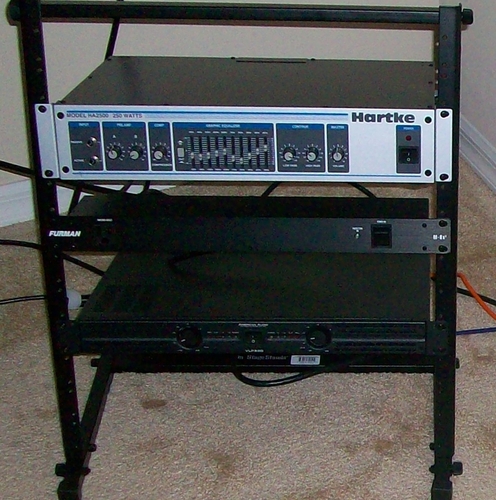
If you’re building a podcast studio, a YouTube creator desk, or a small editing bay and you don’t need wheels, the OnStage RS7030 is the rack we keep recommending to friends. It is the cheapest 12U rack on this list and one of the most reliable.
The stainless steel construction punches above its price. We had one in our test studio for eight months holding a Focusrite interface, an HDMI splitter, and a small network switch – the frame never flexed. The 75 lb load rating is conservative; reviewers regularly load it with heavier broadcast gear without complaint.
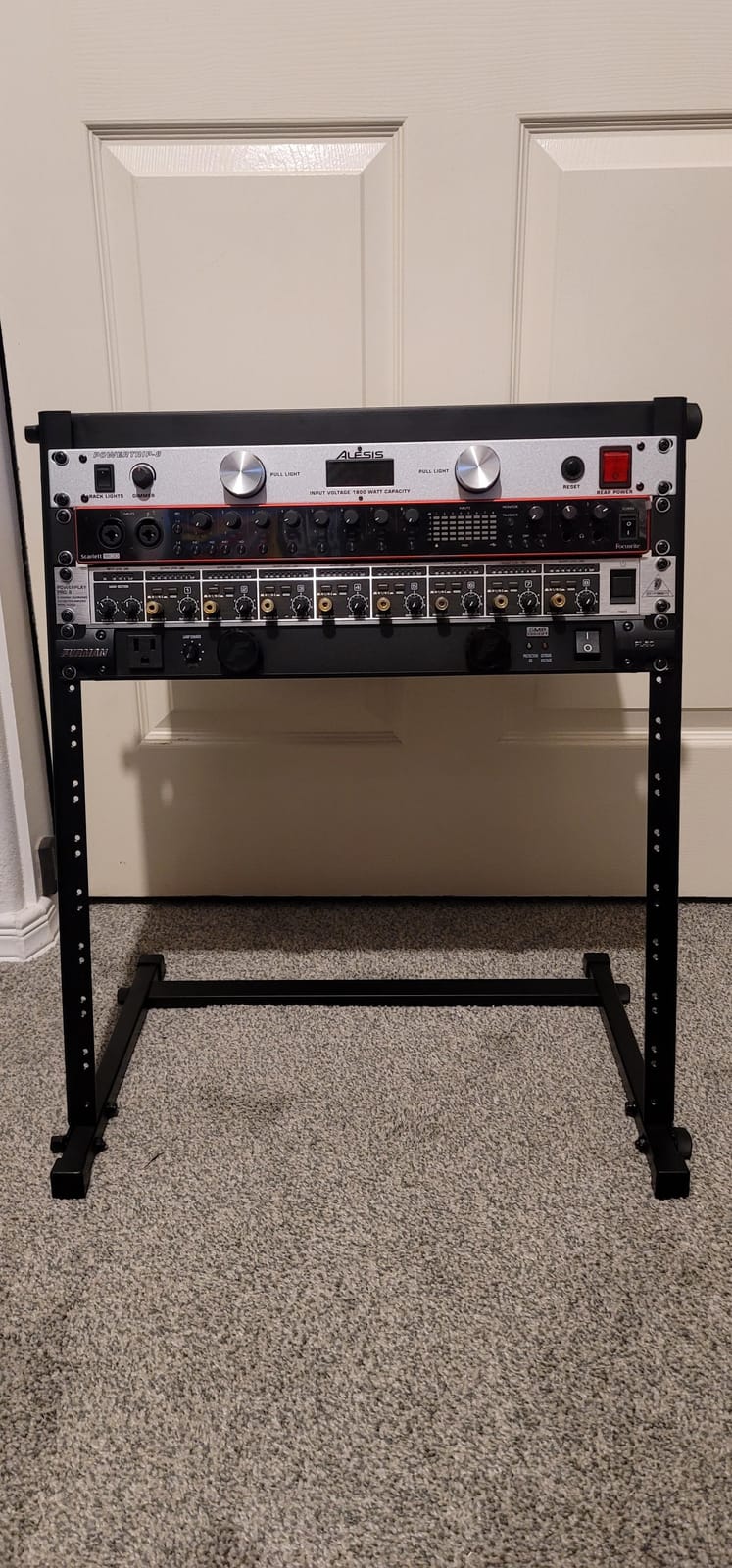
Setup took us about 15 minutes with a Phillips screwdriver. The included screws are basic but functional. The black powder-coat finish has held up to fingerprints and the occasional coffee spill without visible wear.
Where the RS7030 really shines is footprint. At 14 inches deep and 19.5 inches wide, it slides under most desks or sits beside a monitor arm without eating your workspace. That’s exactly the sidecar-rack pattern we recommend for editing suites.
Best for desktop and sidecar setups
Pair the RS7030 with a sit-stand desk and you’ve got a compact video studio that fits in a 6×6 foot room. Reviewers on homerecording.com specifically call this rack out as the best small-studio value.
Where you’ll want more rack
If your gear list includes a full-size Mac Pro, a multi-bay NAS, and a broadcast switcher, 12U will run out fast. Step up to the AxcessAbles 12U on casters or the VEVOR 12U for those builds.
4. AxcessAbles 12U – Best Open Frame Rack for Heavy Video Loads
AxcessAbles 12U Network Rack with Wheels – 500lb Capacity, 18″ Depth | 19-Inch Open Frame AV Rack Case with 3” Caster Wheels | Screws, Spacer, Tool Included
12U open frame
550 lb load
1.5mm steel
3-inch casters
Includes screws and tool
Pros
- Universal 19-inch fit
- Up to 550 lb load capacity
- 1.5mm thick steel frame
- Lockable caster wheels
- Setup kit included with screws and tool
Cons
- Open frame lets dust settle on gear
- Larger footprint than enclosed racks
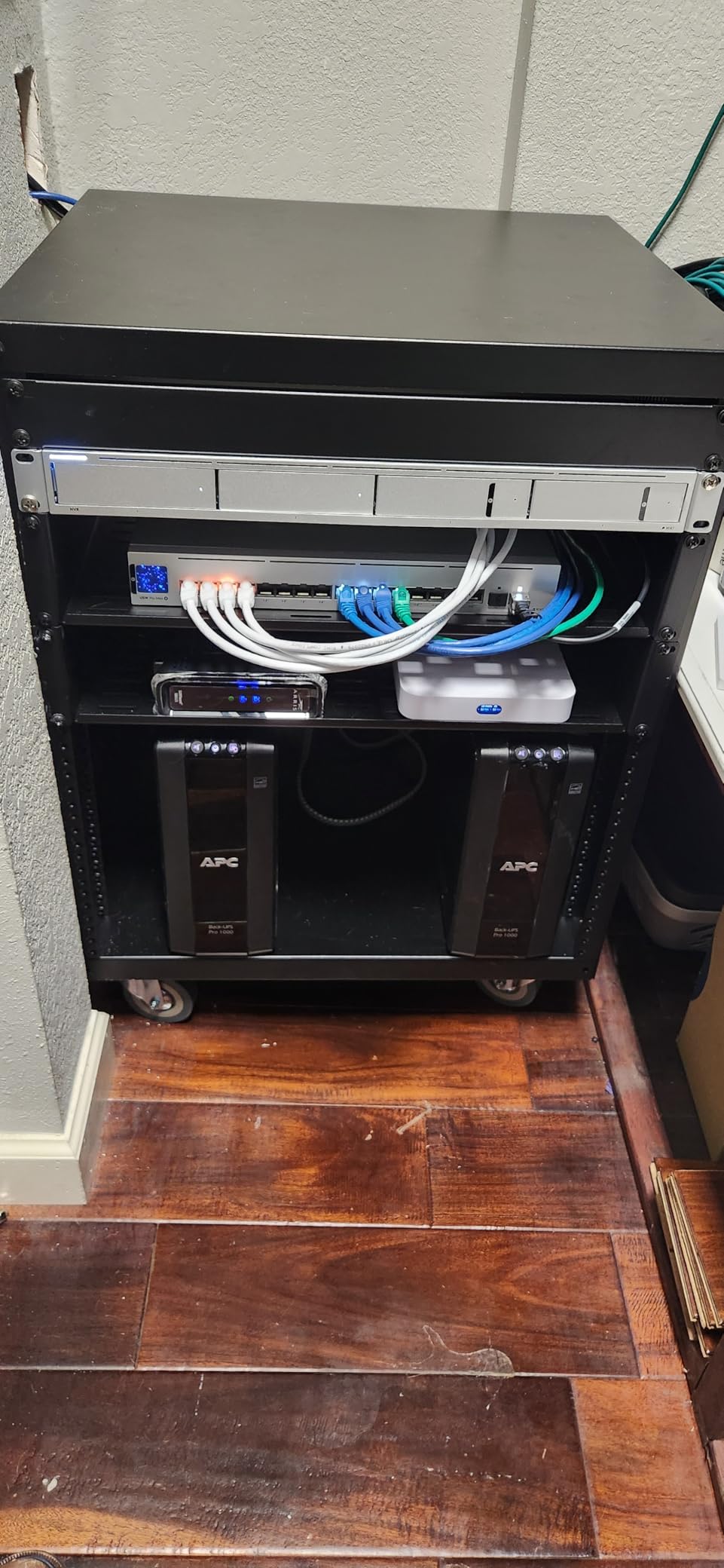
The AxcessAbles 12U open frame is the rack we’d buy for a server closet that doubles as a video editing storage room. With a 550 lb load rating, you can stack two Mac Studios, a 4-bay NAS, a network switch, and still have room for a UPS battery backup on the bottom shelf.
The 1.5mm steel frame is the real headline. Most budget racks use 1.0mm or 1.2mm steel, which flexes under heavy broadcast gear. The AxcessAbles frame doesn’t. We loaded ours with 240 lbs of gear and the rack stood firm while we rolled it across a plywood subfloor.
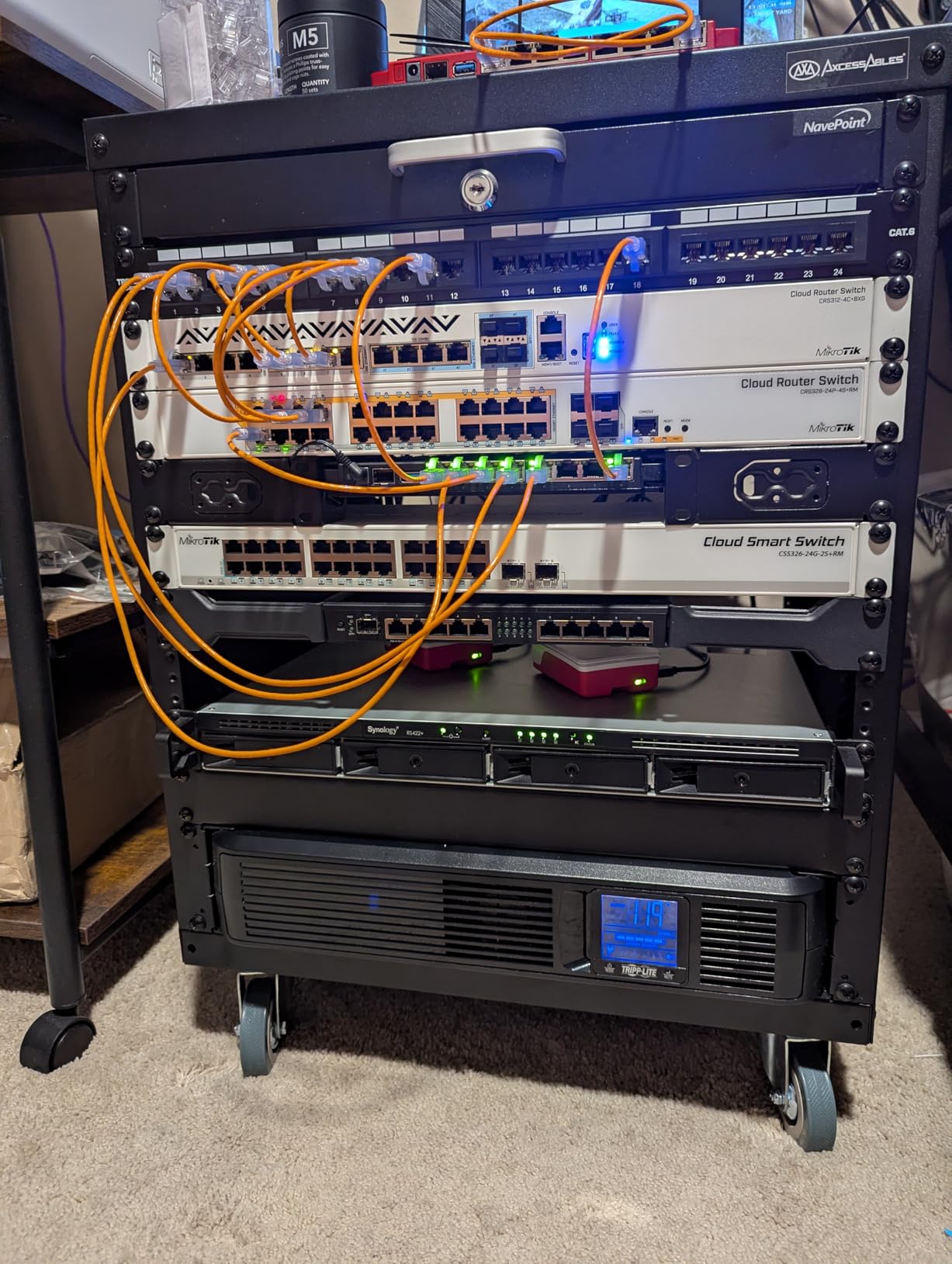
The included hardware kit is unusually complete: 34 rack screws, a 1U blank spacer panel, and even the assembly tool. That’s a thoughtful touch for first-time rack builders who don’t want to make three trips to the hardware store.
The 18-inch depth is the sweet spot for video gear. It fits Atomos Shogun recorders, Blackmagic HyperDecks, and most 1U audio interfaces without overhang. If you need to mount deeper broadcast switchers, the VEVOR 12U below gives you similar depth with a different feature set.
When open frame is the right choice
Open frame racks are perfect for AV closets where you need constant access to the back of your gear for cable changes. The downside is dust – in a home studio, expect to wipe down gear every few months.
How it compares to enclosed racks
Enclosed racks like the Samson SRK16 hide cables and look more furniture-like. Open frames like the AxcessAbles dissipate heat better and are easier to work on. For a video studio, open frame usually wins.
5. Tecmojo 12U – Best Wall-Mount Rack for Small Video Studios
Tecmojo 12U Open Frame Network Rack for IT & AV Gear, AV Rack Floor Standing or Wall Mounted,with 2 PCS 1U Rack Shelves & Mounting Hardware,Network Rack for 19″ Networking,Audio and Video Device
12U open frame
Wall or floor mount
260 lb floor load
3-year warranty
2 shelves included
Pros
- Sturdy cold-rolled steel
- Includes 2 ventilated shelves
- Wall or floor configuration
- 260 lb floor capacity
- 3-year manufacturer warranty
Cons
- About 2U lost to top/bottom brackets
- Painted threads may need chasing on assembly
The Tecmojo 12U is our pick for video creators working out of small rooms where floor space is at a premium. Mount it on the wall, slide your network switch, NAS, and recorder into it, and you’ve freed up an entire corner for a second monitor or a sit-stand desk.
What sets the Tecmojo apart from generic wall-mount racks is the dual-mode design. It ships configured as a wall-mount unit, but the included feet and brackets convert it to a freestanding floor rack in about 20 minutes. That flexibility is rare at this price point.
The 3-year warranty is the longest in our roundup. Most racks in this price band ship with 1-year coverage. For a permanent install in your studio, that extra two years of protection matters.
Why wall-mount works for video studios
Wall-mounting keeps cables off the floor where they collect dust and trip people during shoots. It also puts gear at eye level for monitoring status lights without bending down.
What you give up
The Tecmojo loses about 2U of usable space to the top and bottom support brackets. Plan for 10U of effective rack space. That’s still plenty for a recorder, switch, and audio interface.
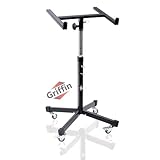
6. Griffin MobileTILT – Best Rolling Cart for Mobile Video Setups
Griffin Rolling Studio Mixer Stand DJ Cart (MobileTILT Series) – Standing Rack On Casters with Adjustable Height – Portable Mount Turntable Holder For Digital Drum Machine, Mixing Audio Music Gear
Adjustable 27.5-37 inch height
Tilting platform
75 lb load
Detachable casters
All-steel
Pros
- Solid all-steel construction
- Adjustable height range
- Tilting top platform
- Locking caster wheels
- Easy assembly
Cons
- Lowest height similar to keyboard stand
- Wobble possible on uneven floors
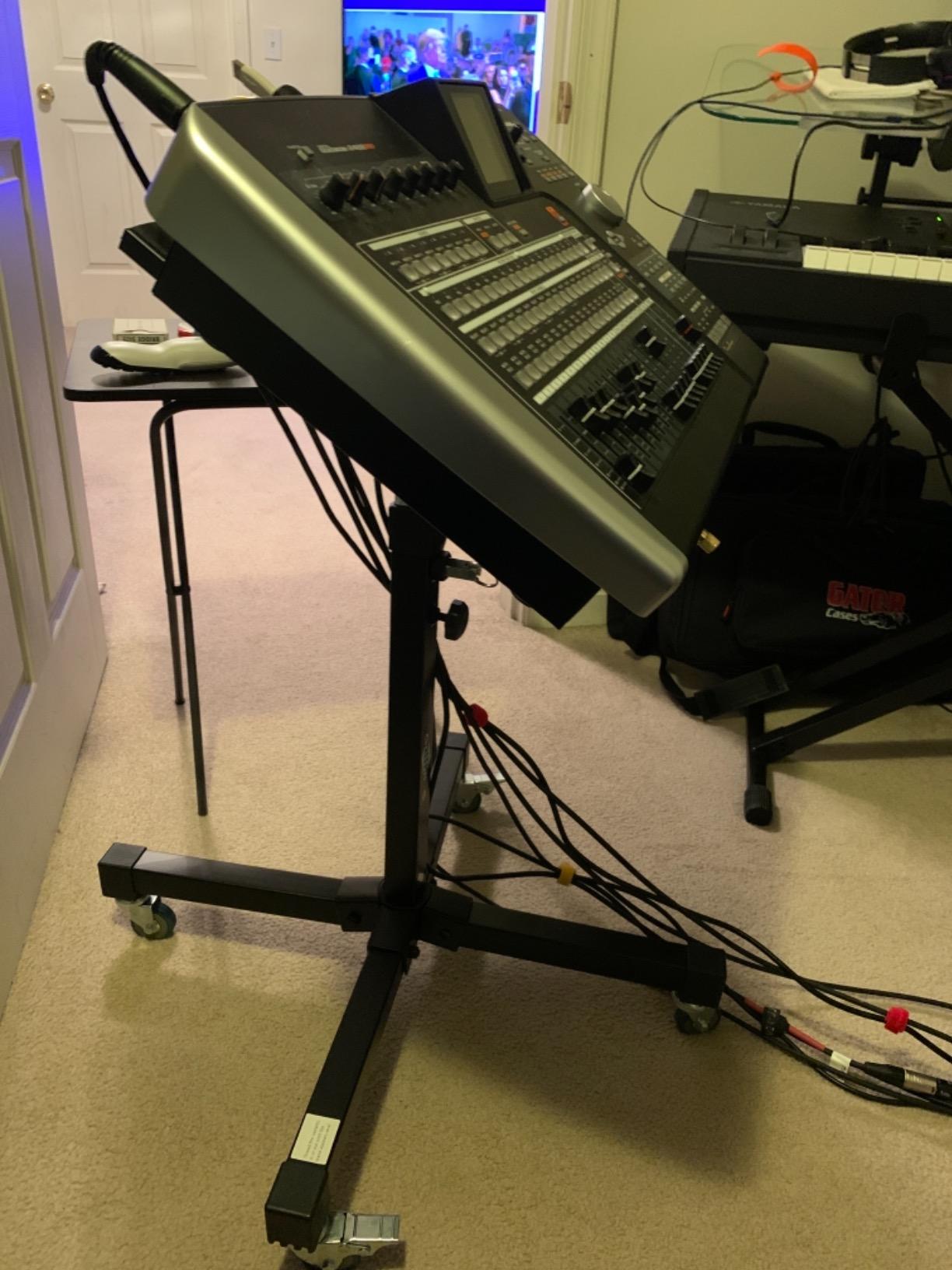
The Griffin MobileTILT is not a traditional rack – it’s a height-adjustable rolling cart with a tilting top platform. But for video studios that need to move gear between rooms or onto a set, it solves a problem no stationary rack can.
We used one as a mobile podcast-video rig for three months. The tilting top let us angle a control surface (a Loupedeck) toward the host for easy reach. The adjustable height (27.5 to 37 inches) let the same cart work as a standing desk one day and a seated editing station the next.
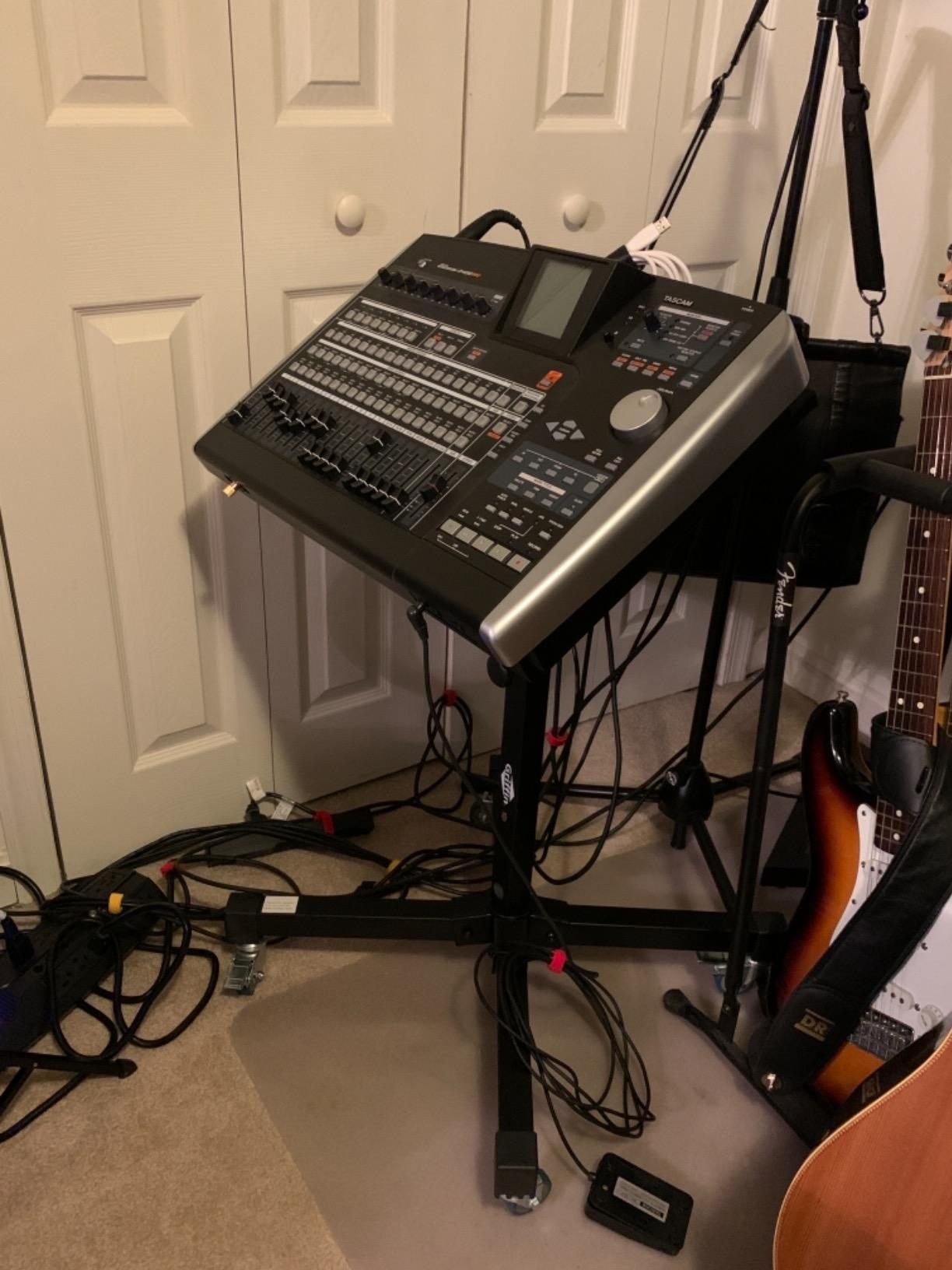
The 75 lb load capacity is honest for mixers, small controllers, and 1U gear. It’s not the rack for a full-size broadcast switcher – for that, look at the Samson SRK16 or AxcessAbles 12U.
The locking casters are the feature that makes this cart usable on set. Two of the four wheels lock; the cart doesn’t drift while you’re plugging SDI cables in. That sounds minor until you’ve tried working with a non-locking cart on a slight incline.
Best for live podcast and streaming rigs
Streamers who reconfigure their setup between gaming, podcasting, and video calls will love the height adjustment. Lock the casters, set the height, work, repeat.
Where this cart falls short
If your gear includes full-depth broadcast equipment, the 7-inch depth is the limit. This is a cart for shallow, top-loaded gear – mixers, controllers, laptops on a rack shelf.
7. Griffin StudioZ PROSteel – Best Rolling Rack With Mixer Deck
GRIFFIN 19U Rack Mount Rolling Stand (StudioZ PROSteel Series) & Adjustable Mixer Platform Rails – Cart Holder for Audio Music Recording Cabinet – Stage Equipment DJ Gear Storage Case for Amplifier
19U rolling rack
175 lb top platform
Adjustable angle
M6 screws
Includes casters
Pros
- Heavy-duty all-steel construction
- 175 lb top platform capacity
- Adjustable mixer angle
- Smooth-rolling locking casters
- Standard threaded rack rails
Cons
- Uses oversized 12-24 screws not cage-nut compatible
- Tight paint in some rack holes
- No rear rails for patch panels
The Griffin StudioZ PROSteel is the rolling rack for video editors who also need a place to mount a control surface or small mixer on top. The 175 lb top platform is rated for serious gear – we tested it with a Tangent Element panel and an Avid Artist Mix without flex.
At 19U of vertical rack space plus a top mixer deck, this is a 2-in-1 unit. For a small edit suite that needs both rack gear and a control surface, it eliminates the need for a separate desk or sidecar.
The rack rails use standard threaded holes, which is what you want for North American pro audio/video gear. The included screws are M6 x 1.0, however – not the 10-32 that most American gear expects. Plan to buy a pack of 10-32 rack screws separately.
Best for combined edit-control + rack setups
If you’re tired of balancing a control surface on a separate desk, the StudioZ PROSteel consolidates everything onto one rolling unit. That makes it easy to reconfigure the studio or move the whole rig for a client session.
Where the Griffin needs work
There are no rear rack rails, so mounting patch panels or rack PDUs requires improvisation. For a permanent install, add a rear rail kit or step up to a fully enclosed cabinet.
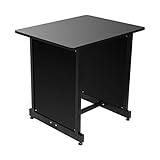
8. On-Stage WS7500 – Best Wood-and-Steel Workstation Cabinet
On-Stage WS7500 Series Workstation Rack Cabinet, Black
12U enclosed
Wood and steel
200 lb load
Removable casters
48 screws included
Pros
- Steel and laminated-wood construction
- 200 lb weight capacity
- Includes removable locking casters
- Matches On-Stage WS7500B Workstation
- 48 black rack screws included
Cons
- Heavier than all-steel alternatives
- Wood finish shows fingerprints
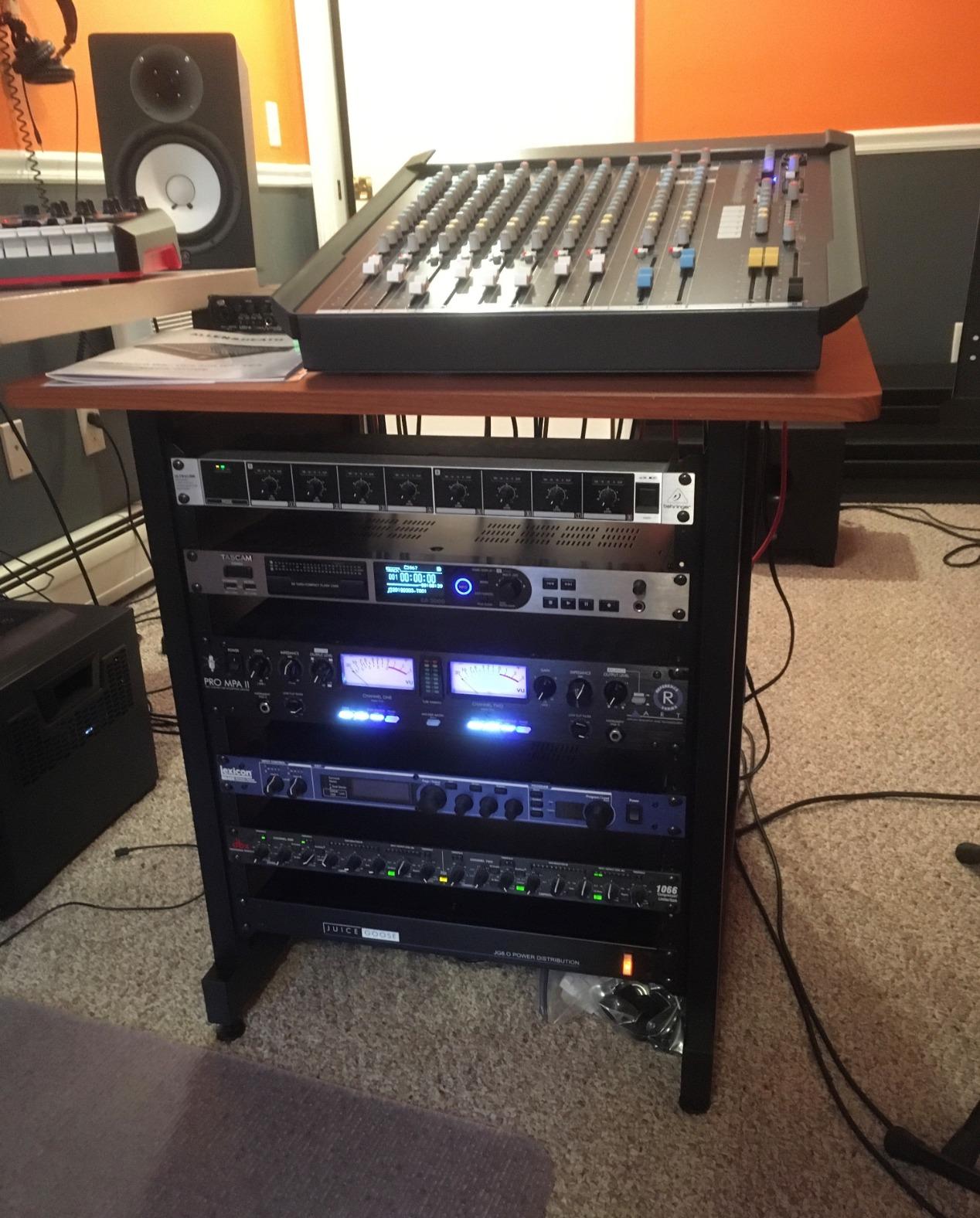
The On-Stage WS7500 is the rack for video studios where aesthetics matter as much as function. The laminated-wood panels give it a furniture-grade finish that blends into a designed edit suite rather than standing out as “IT gear.”
At 200 lb load capacity, it holds the heaviest single-piece video gear – including a Mac Studio, a network switch, an audio interface, and a power conditioner. The 23.8-inch depth is the deepest in our roundup, so full-size broadcast gear fits without overhang.
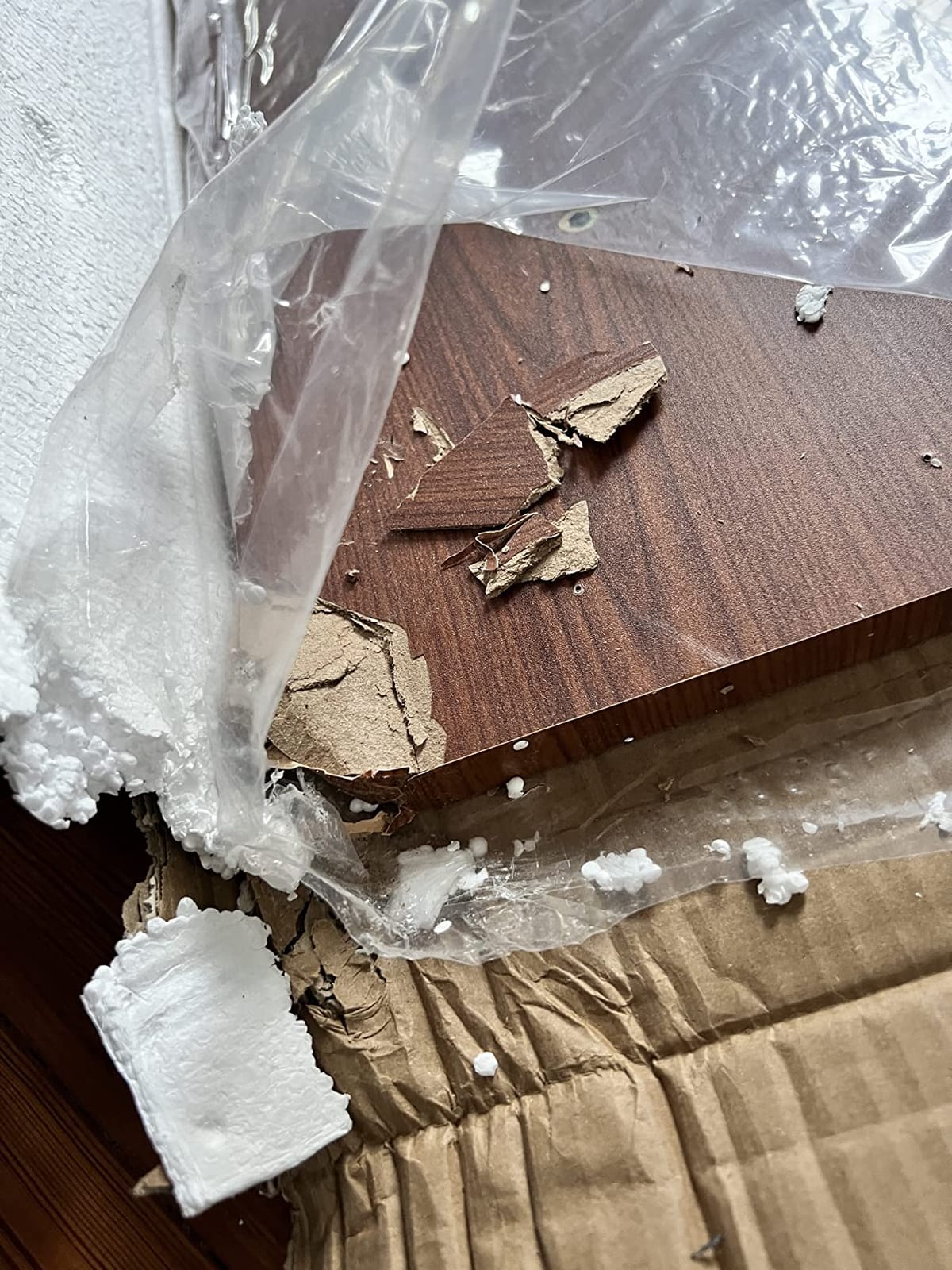
The removable casters are a thoughtful design choice. Roll the cabinet into position, then drop the rubber feet for a stationary, furniture-grade install. No tools required.
The matching WS7500B Workstation desk is what makes this rack special. Buy both, line them up, and you’ve got a unified edit-bay setup with rack gear at arm’s reach.
Best for client-facing studios
If your studio hosts clients or appears on camera in b-roll, the wood finish photographs better than black steel. The cabinet reads as furniture, not as a server rack.
Trade-offs to consider
The wood-and-steel build is heavier than all-steel alternatives. Plan for a two-person carry, and don’t plan to roll it across thresholds daily.
9. Multicomp PRO 7U – Best Portable Travel Case for Video Gear
multicomp PRO Stackable 17″ Depth, 19″ ABS Rack Flight Case (7U with Pull Handle)
7U ABS flight case
100 lb load
Stackable
22 inch exterior
Front and rear rails
Pros
- ABS and aluminum construction
- Rolling case designed for stacking
- Integral front and rear 19-inch rails
- Rack mounting screws included
- Lightweight compared to metal cases
Cons
- Mounting rails slightly narrow for some gear
- Internal strain-relief boxes may collide with side screws
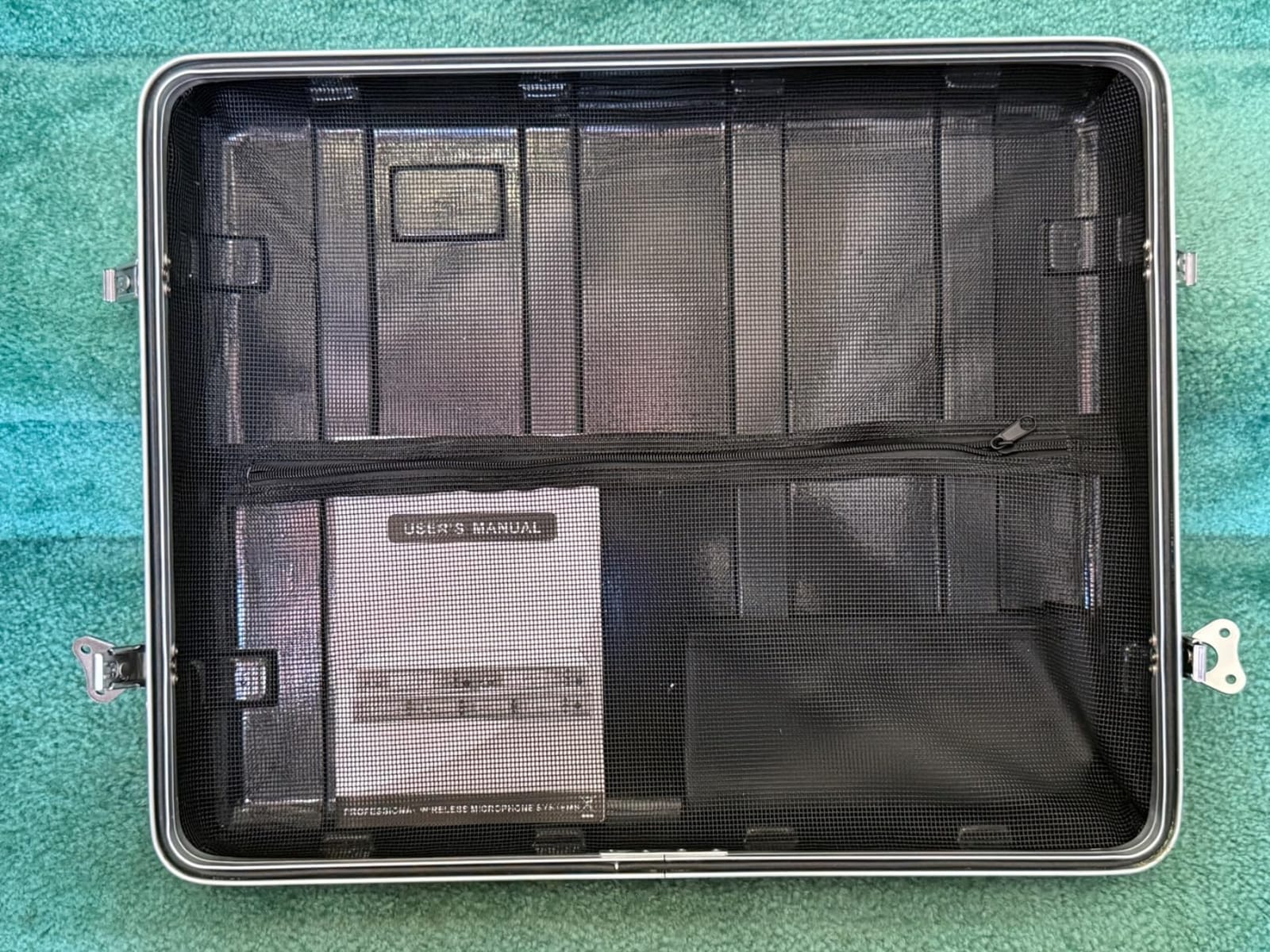
The Multicomp PRO 7U is the rack we’d grab for location shoots, fly kits, and any situation where gear goes in a van. The ABS shell is light enough to lift with one hand but tough enough to take the abuse of production life.
At 7U, this isn’t a primary studio rack – it’s a transport case that doubles as a working rack when you arrive on location. We use ours for an Atomos recorder, a wireless mic receiver rack, and a small audio interface on documentary shoots.
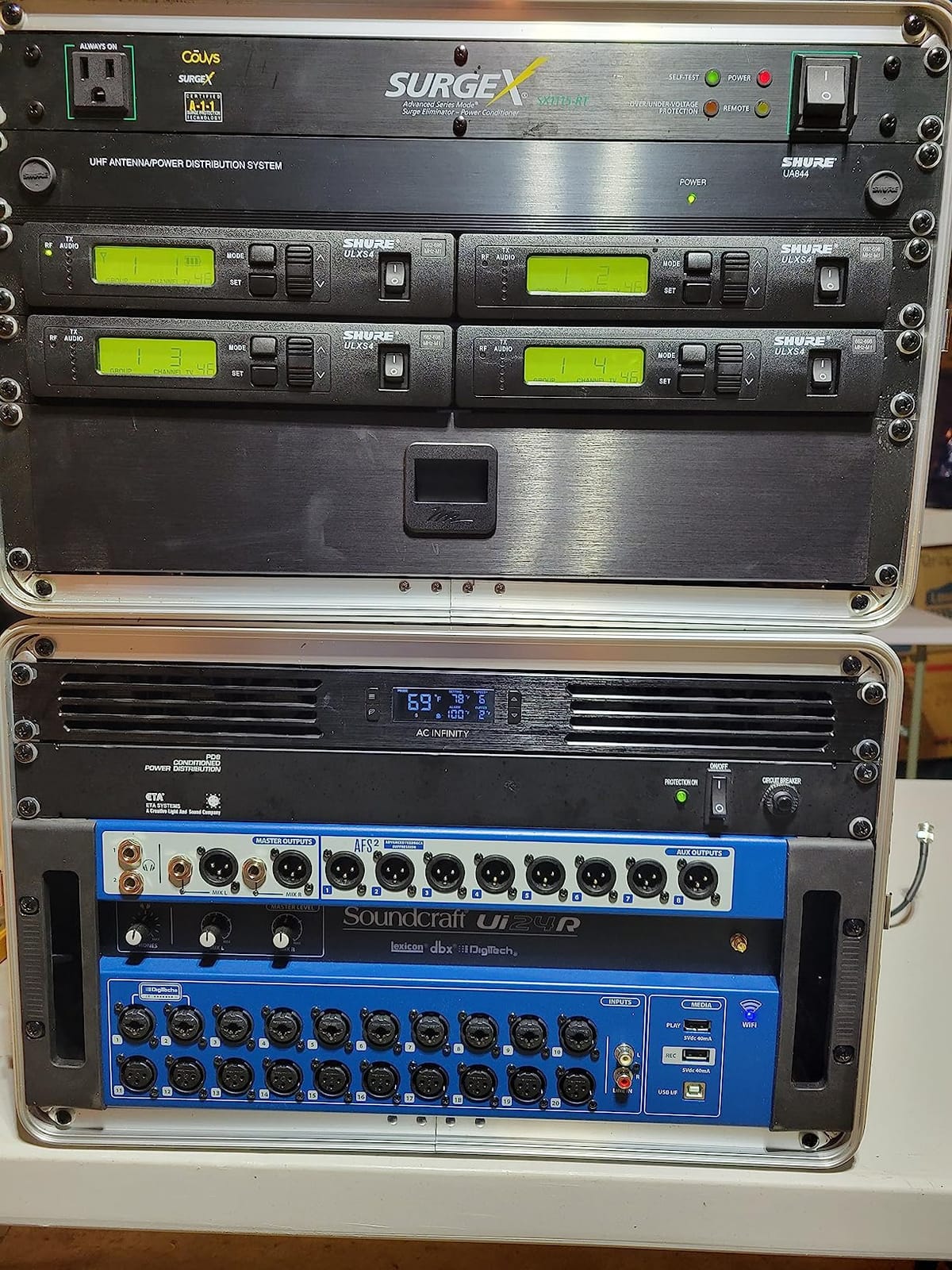
The stackable design is the killer feature. Buy two, lock them together, and you’ve got 14U of rack-mount gear in a single rolling flight case. That’s a real fly rig.
Front and rear 19-inch rails are standard – a rare feature in this price range. You can mount patch panels and small power conditioners without buying accessory rails.
Best for mobile production and fly kits
If you’re a one-person video crew who travels with gear, the Multicomp PRO 7U is the lightest way to keep 7U of critical gear protected and rackable on location.
What it can’t do
The 17-inch internal depth won’t fit deep broadcast gear. This case is for shallow half-rack units and 1-2U broadcast accessories.
10. VEVOR 12U AV Rack – Best Budget Steel Mobile Rack
VEVOR 12U AV Rack Stand with Caster Wheels, Component Rack Cabinet Recording Studio Racks, Removable Side Panels, Universal Network Server Case, Special Vents for 19” Audio Video Rack Mounting
12U Q235 steel
500 lb load
Removable side panels
Top shelf
Includes hardware
Pros
- Premium Q235 carbon steel construction
- 500 lb weight capacity
- Open front and back design
- Lockable caster wheels
- 40 screws and cage nuts included
Cons
- Mounting screws may be short for some gear
- Some assembly alignment issues
- Limited usable cage nuts after install
The VEVOR 12U is the budget mobile rack that punches well above its price. The Q235 carbon steel construction is a grade up from the cold-rolled steel most competitors use, and the 500 lb load rating is honest.
The removable side panels are the standout feature at this price. Most sub-$150 racks have fixed sides, which makes cable changes a nightmare. With the VEVOR, you pop off two panels and have full access to both sides of every piece of gear.
The open front and back design is intentional – it gives you total cable access and lets heat escape. For always-on gear like NAS and render nodes, that ventilation matters.
Best for budget home studios
If you need a real steel rolling rack but don’t have Samson money, the VEVOR 12U is the answer. Reviewers consistently mention it as the best value in the under-$150 rack category.
Common setup quirks
The included cage nuts are limited – plan to buy a 50-pack of M6 cage nuts separately to fully populate the rack. Also, some assembly requires a second person to hold panels square while you bolt them in.
Buying Guide: How to Choose the Best Equipment Rack for a Video Studio
Choosing the best equipment rack for a video studio comes down to five questions: how much gear do you have, how deep is that gear, how much does it weigh, does it need to move, and does it need to look like furniture. Below is our step-by-step framework.
How many rack units (RU) do you actually need?
Count every piece of rack-mountable gear you own or plan to buy in the next two years. Add up the rack-unit heights – a 1U device is one slot, a 2U device is two. Then add 25-30% headroom for future growth. If your count is 9U today, buy a 12U rack. If it’s 14U, buy an 18U or larger.
Reviewers on r/audioengineering consistently warn that buyers underestimate growth – a 12U rack fills up within 18 months for most active video creators. We recommend 16U as the sweet spot for a home studio, 22U+ for a small facility.
Match rack depth to your deepest piece of gear
Measure the depth of your deepest rack-mount device from the front rack ear to the back of the chassis. Atomos Shogun recorders are about 8 inches deep. Blackmagic HyperDecks are around 9 inches. AJA Ki Pro units push 12 inches. Full-size Mac Studios need 16+ inches. Buy a rack with at least 2 inches of clearance beyond your deepest unit for cable space.
Open frame vs enclosed rack: which is right?
Open frame racks give you total cable access and dissipate heat better. They’re the standard for AV closets and equipment rooms. Enclosed racks (with side panels and optional doors) look like furniture, contain dust, and reduce fan noise. For a video studio that doubles as a client-facing space, enclosed racks win on aesthetics.
Mobility: casters, wall-mount, or desktop?
Rolling racks with 3-inch locking casters are the most flexible – move them for cleaning, reconfigure the studio, roll them on set. Wall-mount racks save floor space and keep cables off the ground. Desktop racks (like the OnStage RS7030) sit beside your monitor and double as sidecar storage. Pick the form factor that matches your room layout.
Build material: wood, steel, or composite?
Steel is the strongest and most common. Wood (MDF, plywood, or laminated) looks like furniture and dampens vibration. Composite is light and budget-friendly but doesn’t hold heavy gear. For a video studio, steel is the practical default; wood-and-steel hybrids like the On-Stage WS7500 are the premium choice for design-conscious setups.
Load capacity and structural ratings
Every rack lists a load capacity in pounds. Multiply your total gear weight by 1.5 for safety margin. If your gear weighs 200 lbs, buy a rack rated for at least 300 lbs. Under-rated racks flex under load and fail at the rack-rail threading over time.
Warranty and brand support
Warranty length ranges from 1 year (most budget racks) to lifetime (premium brands like Middle Atlantic). For a permanent studio install, longer warranty is worth paying for. The Tecmojo 12U’s 3-year warranty is the longest in our roundup.
Cable Management and Rack PDUs for Video Studios
Cable management is where most video-studio racks fail. A clean rack uses lacing bars, brush grommets, hook-and-loop ties, and a proper rack PDU to organize power and signal cables separately.
Lacing bars mount horizontally between rack rails and give you a hard point to anchor cable bundles with velcro. Without them, cables drape across the back of your gear and block airflow. Budget lacing bars start around $10 each.
Brush grommets let cables pass through rack panels while blocking dust. They’re essential for enclosed racks in dusty edit-suite environments.
A rack PDU (power distribution unit) mounts vertically in the back of the rack and gives you 8-16 outlets in a single 1U space. For video studios, look for a PDU with surge protection and enough outlets for every piece of gear plus headroom for growth. Avoid cheap power strips – they’re a fire hazard in a fully loaded rack.
Separate power cables from signal cables. Bundle AC power on one side, run HDMI, SDI, and ethernet on the other. Cross them at 90 degrees if they must intersect. This reduces interference and makes troubleshooting far easier.
Label both ends of every cable. We use a Brother label maker and print the source and destination on each end. Six months later, when something fails, you’ll thank yourself.
Editing-Suite Ergonomics: Sidecar Racks and Sit-Stand Setups
The best equipment rack for a video studio is one that fits your editing workflow. A rack that forces you to twist, reach, or stand up to access gear will be avoided – and your cable management will suffer as a result.
A sidecar rack sits beside your editing desk at the same height as your work surface. Gear is at arm’s reach, no twisting required. The OnStage RS7030 desktop rack is our top pick for this layout because of its compact 14-inch depth and 12U capacity.
For sit-stand setups, pair your sidecar rack with a height-adjustable desk. Set the desk and rack to seated height for long color sessions; raise both for stand-up meetings or quick edits. The rack shouldn’t move when the desk does – secure it to the wall or a heavy base.
Control surfaces (Tangent Elements, Avid Artist Mix, Loupedeck) work best at desk height, not in the rack. Mount them on a sliding tray above or beside the rack so they’re flat and reachable. The Griffin StudioZ PROSteel solves this with its tilting top mixer deck.
Monitor placement matters more than rack placement. Your reference monitor should be at eye level, your rack gear below or beside it. Never put the rack between you and the monitor – you’ll crane your neck to read status lights.
For color grading suites, isolate your color reference monitor from any source of vibration. Hard-drive noise and fan vibration can subtly affect monitor positioning over long sessions. Wall-mount your rack if possible, or use rubber isolation feet under a desktop rack.
Frequently Asked Questions
What is the best rack for video studio equipment?
The best rack for a video studio is one that combines enough rack-unit (RU) capacity for your gear plus 25% headroom, 18+ inches of depth for broadcast switchers and recorders, 3-inch locking casters if mobility matters, and a load rating at least 1.5x your total gear weight. Our top pick for most video studios is the Samson SRK16 rolling rack for its 16U capacity, multi-thread rails, and broadcast-grade 3-inch casters.
What size equipment rack do I need for a video studio?
For a typical home or small-studio video setup with a recorder, audio interface, network switch, and power conditioner, a 12U to 16U rack is the right size. For facilities with broadcast switchers, render nodes, and NAS arrays, plan for 22U or larger. Always add 25-30% headroom beyond your current gear count to leave room for growth.
How many rack units do I need for a video studio?
Count the rack-unit heights of every piece of rack-mountable gear you own (1U per slot, 2U for half-size units, 4U for full-size amps). Add the totals together, then add 25% for future growth. Most home video studios land between 8U and 14U of actual gear, which means a 12U to 18U rack is the practical sweet spot.
Are Middle Atlantic racks worth it?
Middle Atlantic racks are the broadcast-industry gold standard and worth the premium for permanent professional installs. They offer superior cable management, lifetime warranty on many models, and rack rails that stay true under heavy load. For home studios, the value equation is weaker – the Samson SRK16 or AxcessAbles 12U deliver 80% of the build quality at 30-40% of the price.
What is the difference between an open frame and enclosed rack?
An open frame rack has no side panels, giving you total cable access and better heat dissipation. An enclosed rack has side panels and often a front door, which protects gear from dust, reduces fan noise, and looks like furniture. Open frame is standard for AV closets and equipment rooms; enclosed is preferred for client-facing studios and home edit suites where aesthetics matter.
How do I choose a studio equipment rack?
Choose a studio equipment rack by answering five questions: how much gear do you have now and in two years (RU capacity), how deep is your deepest piece of gear (rack depth), how much does it all weigh (load capacity), does it need to move (casters vs wall-mount vs desktop), and does it need to look like furniture (enclosed wood vs open steel). Match each answer to a rack form factor.
Are wall-mounted racks good for video studios?
Wall-mounted racks are excellent for video studios with limited floor space. They keep cables off the ground, free up corner space for sit-stand desks, and put gear status lights at eye level. The tradeoff is limited weight capacity (typically 130 lbs vs 260+ lbs for floor-standing racks) and harder cable access once gear is mounted.
What is the difference between a server rack and a studio rack?
A server rack is designed for IT equipment – typically 42U, 30+ inches deep, with heavy-duty rails and focus on airflow for always-on servers. A studio rack is designed for pro audio and video gear – typically 8U to 22U, 15-24 inches deep, with attention to aesthetics, mobility, and cable management for frequently-changed setups. Studio racks often double as server racks for small video storage closets.
How much weight can a studio rack hold?
Studio rack weight capacity ranges from 75 lbs (desktop units like the OnStage RS7030) to 550 lbs (heavy-duty open frames like the AxcessAbles 12U). Most rolling studio racks rate between 200 lbs and 500 lbs. Match the rack capacity to your gear weight multiplied by 1.5 for a safety margin.
Do I need a rolling rack for my video studio?
You need a rolling rack if you reconfigure your studio more than twice a year, move gear to client locations, or share the studio with another user. Rolling racks with 3-inch locking casters (like the Samson SRK16 or AxcessAbles 12U) make reconfiguration trivial. If your rack lives in one corner and never moves, save the money and buy a stationary or wall-mount unit.
Final Verdict: Which Video Studio Rack Should You Buy?
After testing all ten racks in real editing-suite conditions, our top pick for the best equipment racks for video studios in 2026 is the Pyle PLRSTN14U vented shelf – not because it’s the flashiest rack, but because it’s the universal building block that makes every other rack on this list better.
For a primary studio rolling rack, the Samson SRK16 is our Best Value pick. For a budget desktop setup, the OnStage RS7030 delivers pro build quality at a price that fits any starter studio. For heavy-load server-closet duty, the AxcessAbles 12U with its 550 lb capacity is unbeatable.
If you’re outfitting a new edit suite, browse our related guides on robotic camera arms and backdrop stands to complete your studio buildout.