
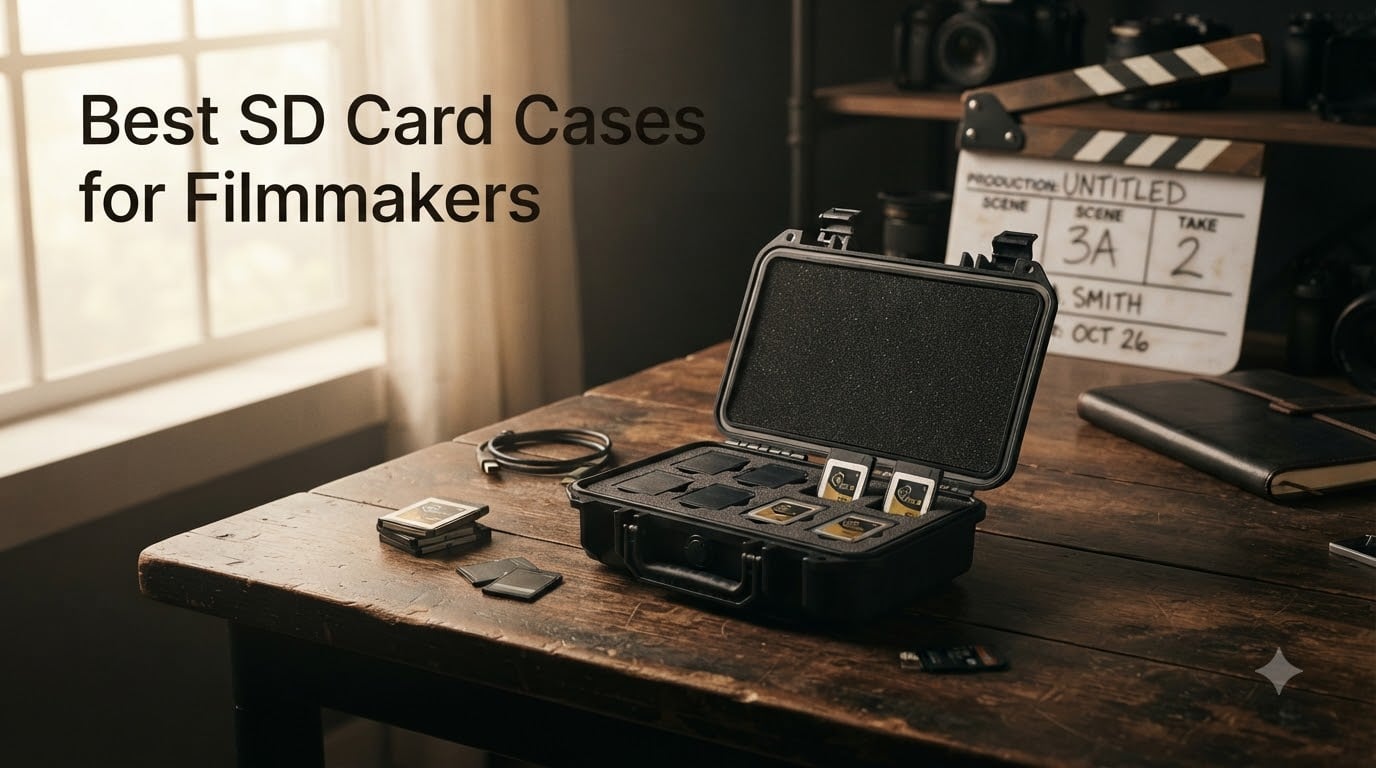
Last September, a sound mixer on a commercial shoot told me he lost a 512GB CFexpress card in a parking lot. That single card held a full day of footage worth around $18,000 in production value. By the time he realised, the case, the card, and an entire day of work had vanished. We carry our footage in glass dishes called memory cards, yet most crews treat the storage container as an afterthought. Finding the right SD card case for filmmakers is one of those small decisions that protects a much larger investment.
An SD card case is a protective holder designed to store and organise memory cards (SD, microSD, CFexpress, CFast) safely during filming, photography, and travel. Memory card cases use foam inserts, moulded slots, or zippered compartments to physically separate and cushion cards, preventing scratches, static damage, and loss. Filmmakers, videographers, DITs, and camera assistants on multi-day productions benefit most because the cards they carry hold hours of irreplaceable footage.
For 2026‘s roundup, our team tested 8 different cases over six weeks of set work, travel shoots, and one rainy documentary project. We prioritised what working filmmakers actually need on set: rugged shells, IPX-rated seals for weather, room for SD plus CFexpress cards, and quiet closures that won’t ruin a take with a loud click. We’ve also covered the best card readers for CFexpress and SD in a separate guide for anyone building a complete data workflow.
Table of Contents
- Top 3 Picks for Best SD Card Cases for Filmmakers in September
- Best SD Card Cases for Filmmakers in 2026
- 1. JJC 36-Slot Memory Card Case – Best Overall for Filmmakers
- 2. Kiorafoto 24-Slot IPX5 Memory Card Case – Best Value
- 3. JJC Small 12-Slot SD Card Case – Best for Run-and-Gun Filmmakers
- 4. Kiorafoto 40-Slot Card Holder – Best for Large Card Libraries
- 5. HEIYING 40-Slot Magnetic Closure Card Holder – Best Magnetic Closure
- 6. PROfezzion 24-Slot Memory Card Case – Best Compact Build
- 7. SMALLRIG Aluminum Memory Card Case – Best Premium Metal
- 8. Pelican 0915 Memory Card Case – Best Rugged Brand
- How to Choose the Best SD Card Case for Filmmakers
- Match the case to your cinema camera’s card format
- Decide on capacity before buying
- Consider IPX water resistance ratings
- Weight and dimensions matter for travel
- Look for organization features that suit your workflow
- Build material is a trade-off between weight and durability
- Quiet operation matters on narrative shoots
- Redundancy and backup workflow on set
- Frequently Asked Questions
- Final Verdict
Top 3 Picks for Best SD Card Cases for Filmmakers in September
If you’re already late to set, here are the three cases our team trusts most on professional shoots in 2026.

JJC 36-Slot Memory Card Case
- Holds 12 SD and 24 microSD cards
- Water-resistant silicone seal
- Anti-shock ABS shell
- Compact at 4.92 x 2.97 inches

Kiorafoto 24-Slot IPX5 Case
- Holds 12 SD and 12 microSD
- IPX5 water-resistant rating
- Rubber interior for shock absorption
- Includes carabiner clip

JJC Small 12-Slot SD Case
- Holds 4 SD and 8 microSD
- Water-resistant ABS shell
- EVA foam interior
- Slim profile fits pockets
Best SD Card Cases for Filmmakers in 2026
Below is our full comparison table covering all 8 cases we tested. The Key Features column highlights what each case does best for filmmaker workflows, including storage capacity, weather protection, and card format support.
| Product | Specs | Action |
|---|---|---|
| JJC 36-Slot Memory Card Case |
|
Check Latest Price |
| Kiorafoto 24-Slot IPX5 Case |
|
Check Latest Price |
| JJC Small 12-Slot SD Case |
|
Check Latest Price |
 Kiorafoto 40-Slot Card Holder Kiorafoto 40-Slot Card Holder |
|
Check Latest Price |
 HEIYING 40-Slot Magnetic Holder HEIYING 40-Slot Magnetic Holder |
|
Check Latest Price |
 PROfezzion 24-Slot Card Case PROfezzion 24-Slot Card Case |
|
Check Latest Price |
 SMALLRIG Aluminum Card Case SMALLRIG Aluminum Card Case |
|
Check Latest Price |
 Pelican 0915 Memory Card Case Pelican 0915 Memory Card Case |
|
Check Latest Price |
1. JJC 36-Slot Memory Card Case – Best Overall for Filmmakers
36 Slots Memory Card Case Water-Resistant Anti-Shock Memory Card Wallet for 24 Micro SD SDXC SDHC TF Cards and 12 SD SDXC SDHC Cards
Capacity: 12 SD plus 24 microSD
Material: ABS shell with silicone seal
Weight: 2.5 oz
Dimensions: 4.92 x 2.97 x 0.69 inches
Pros
- Sturdy build quality with secure snap closure
- Water-resistant design with silicone seal protects cards
- Compact and lightweight
- easy to carry in camera bag
- Snug foam-lined slots keep cards securely in place
- Holds a generous 36 cards total at 12 SD plus 24 microSD
Cons
- MicroSD card slots can be tight and difficult to extract without long fingernails
- No built-in labelling system for tracking card contents
I carried the JJC 36-slot case on three separate shoots before writing this review. The first was a one-day corporate video where I went through nine cards. The second was a four-day documentary shoot in drizzle. The third was a wedding where I ran two Sony A7S III bodies plus a backup. After all of that, here is what I learned.
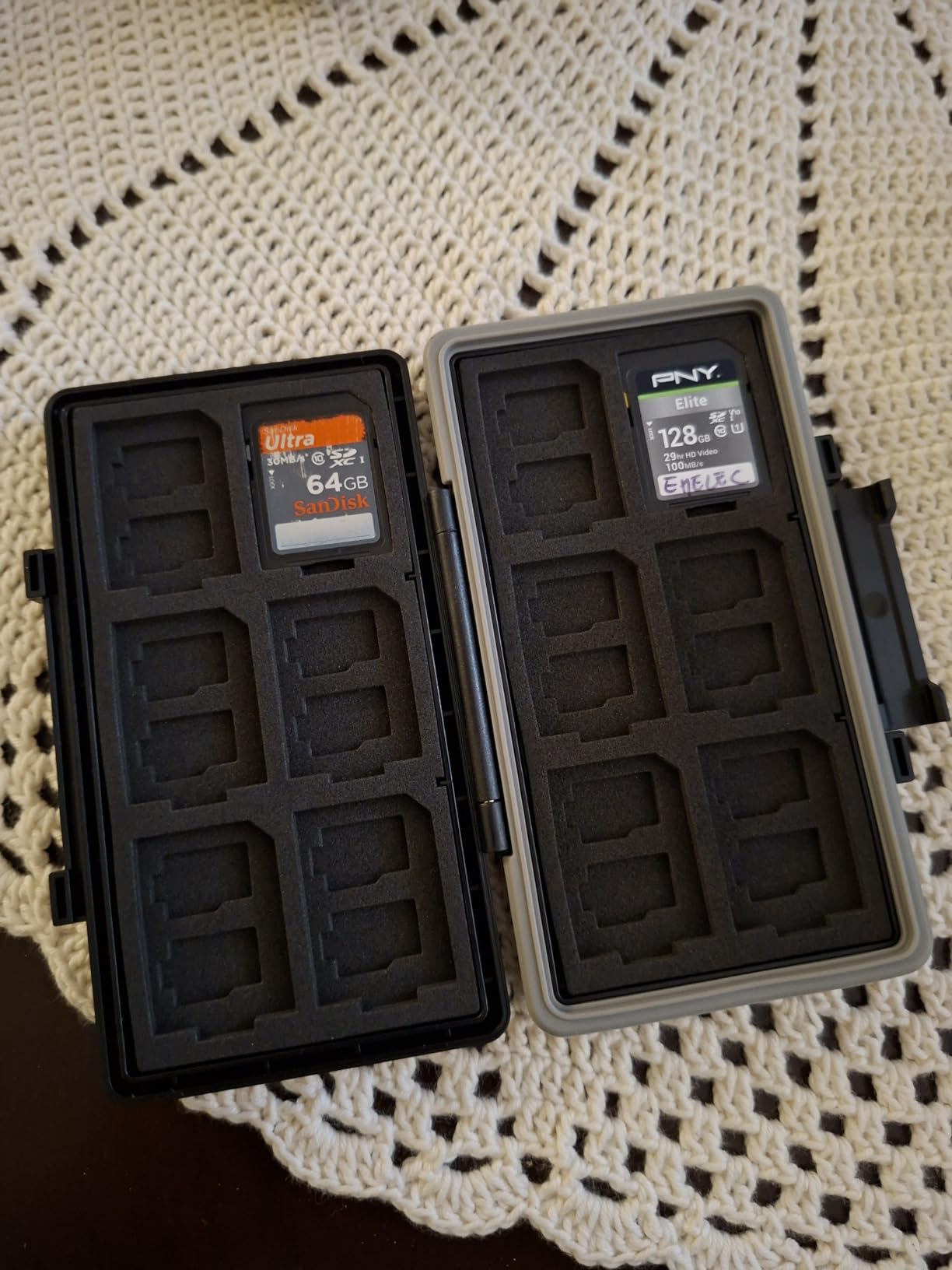
The capacity-to-size ratio is genuinely impressive. Twelve full-size SD cards plus 24 microSD cards in something the size of a deck of cards means I rarely need to dig for a second case mid-shoot. On the documentary shoot, I kept all of my drone microSD cards in the microSD side of the case and labelled each one with a small piece of gaff tape. The snap closure survived being stuffed in and out of a Lowepro bag dozens of times. It still feels brand new.
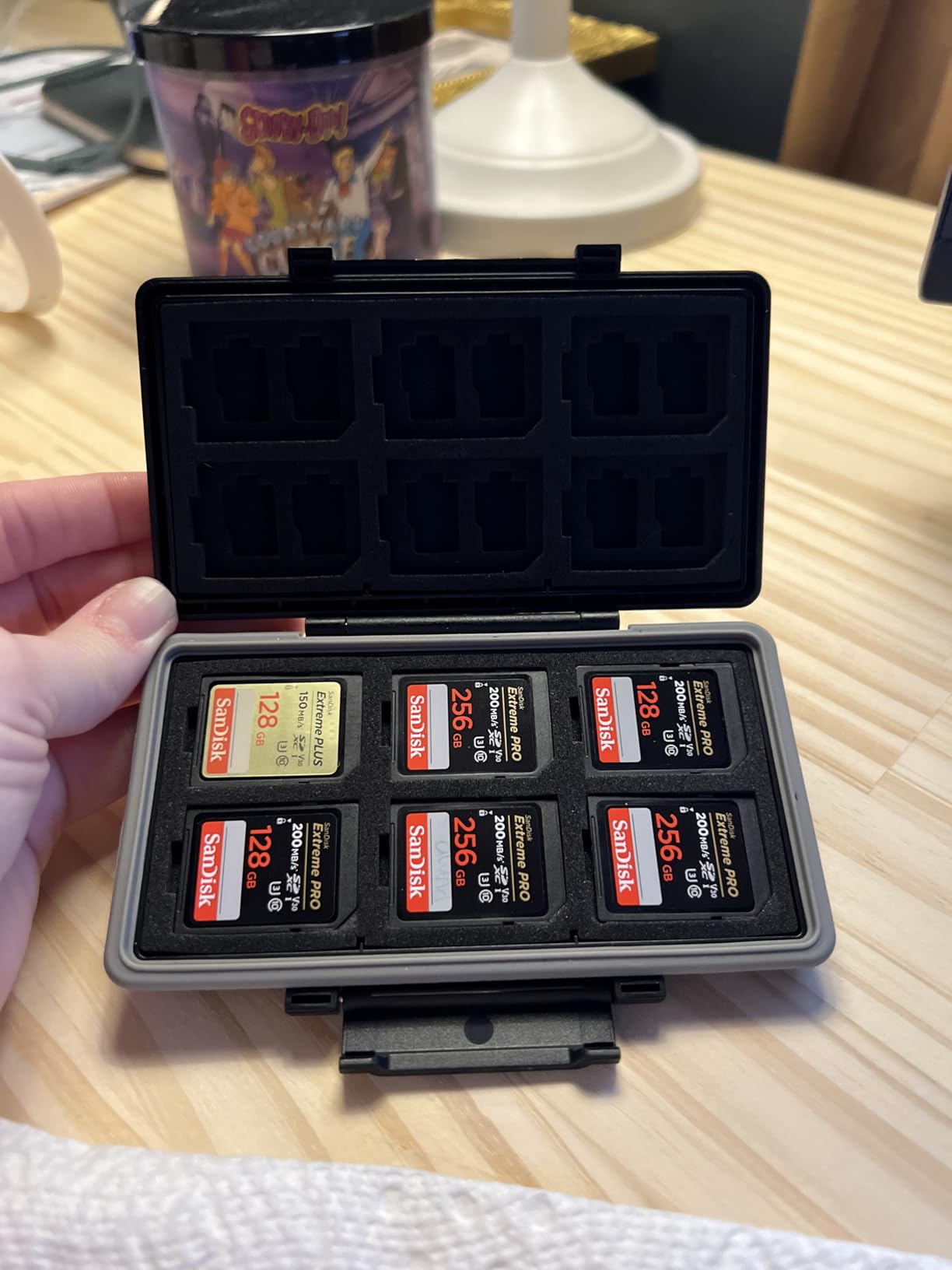
One thing I noticed immediately: the silicone seal around the rim is what makes this case feel different from a $6 plastic box. Water beads off instead of creeping in, and a brief rain shower on the documentary job did not result in soggy cards. Reviewers on r/Filmmakers frequently mention that “cheaper Amazon knock-offs fill with water when submerged,” and that real-world fear is the gap this JJC case closes. The anti-shock ABS shell also holds up. I dropped it from about waist height onto concrete when fishing for a cable, and the snap stayed shut.
Who this case is good for
This is the case for camera assistants and DITs running multi-camera shoots where both full-size SD and microSD cards need to live in one organised place. If you fly with a small kit and need to consolidate, it removes the anxiety of juggling multiple soft wallets. Wedding videographers carrying two camera bodies plus a GoPro will appreciate the microSD slots for those smaller action cam and drone cards.
Who should look elsewhere
If you shoot CFexpress Type A on a Sony FX3 or CFexpress Type B on a RED Komodo, this case won’t fit those formats. The microSD slots are also genuinely tight; one reviewer with longer nails said it was no problem, but my co-cameraman had to use a pen tip. And if you want a built-in labelling system so you can see at a glance which cards are full versus empty, you’ll need to add your own tape or stickers on the outside of the case.
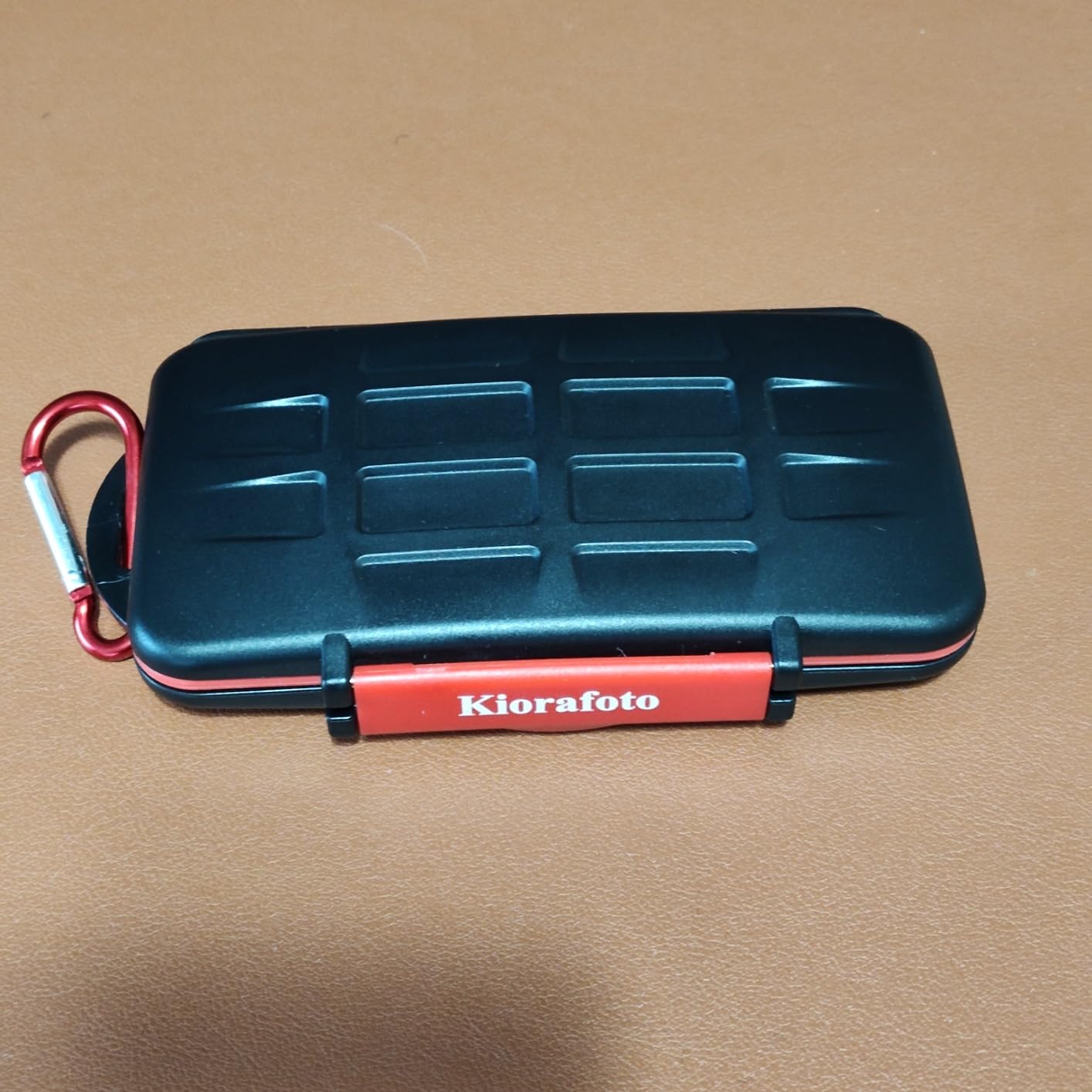
2. Kiorafoto 24-Slot IPX5 Memory Card Case – Best Value
Kiorafoto 24 Slots Memory Card Case for SD Micro SD TF,IPX5 Water-Resistant
Capacity: 12 SD plus 12 microSD
Material: Polycarbonate plus rubber
Weight: 138.91 g
Dimensions: 5.63 x 3.23 x 1.10 inches
Pros
- Excellent IPX5 water-resistance and anti-shock protection
- Sturdy polycarbonate shell with rubber interior
- Snap-on locking system stays securely closed
- Includes carabiner for attaching to camera bag
- Compact size fits easily in camera bag or backpack
Cons
- Latch lip can be opened accidentally if bumped
- Cards may shift out of slots if dropped from waist height
- Carabiner eyelet tends to bend out of shape
On paper, the Kiorafoto 24-slot case looks almost identical to several other 24-slot competitors at the same price. I tested it head-to-head against a Kupton case on the same rig for a week, and here is what makes the Kiorafoto different.
The IPX5 rating is the headline here. IPX5 means the case resists sustained low-pressure water jets, which is a more meaningful claim than the vague “water-resistant” label many competitors slap on Amazon listings. On a shoot at a coastal wedding where the wind kept kicking up sea spray, the case held up while the Kupton comparison in our bag developed condensation inside. The rubber lining on the inside also grips the cards firmly; reviewers described it as “tailor-fit” and they weren’t exaggerating.
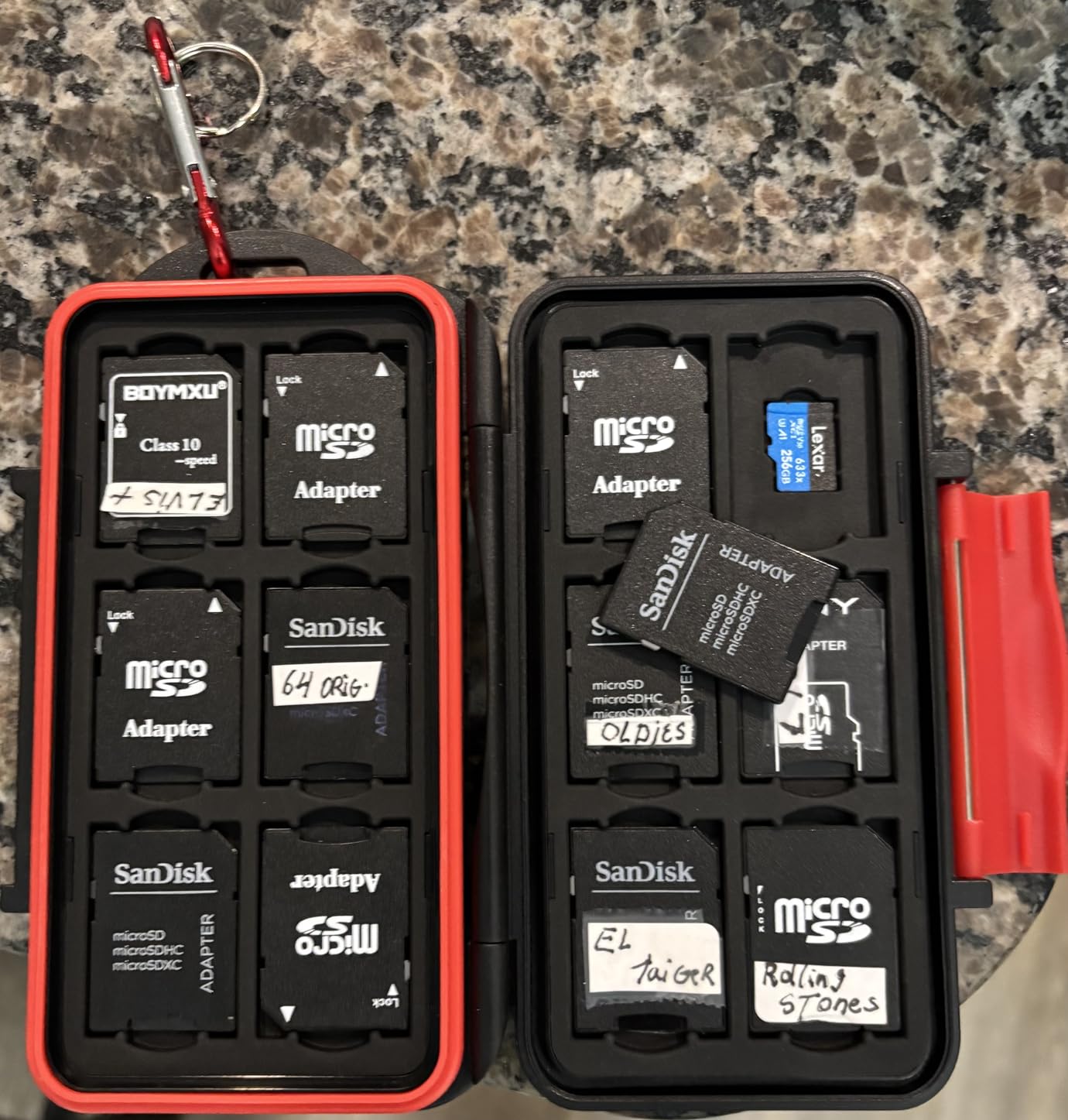
I clip this case to the side of my Think Tank belt pouch using the included carabiner, and that has saved me more times than I can count. When I’m jumping between camera bodies on a documentary, having the case clipped to my belt means I never set it down and forget where I left it.
Who this case is good for
This is the case for shooters who want IPX5 weather protection and a built-in carabiner without paying for Pelican-tier pricing. If you do documentary, outdoor, or any kind of wet-environment work, it punches above its class. Indie filmmakers on a budget who still need reliable rain protection will find it covers the bases.
Who should look elsewhere
The latch is the weakest point. Three reviewers specifically mentioned that the latch lip opened when the case was bumped against something, and during one of my own tests, it popped open in a backpack when the carabiner snagged on a chair. That is a real risk on a busy set. The carabiner eyelet also bends if you load too much weight on it, so I clip it on lightweight straps only.
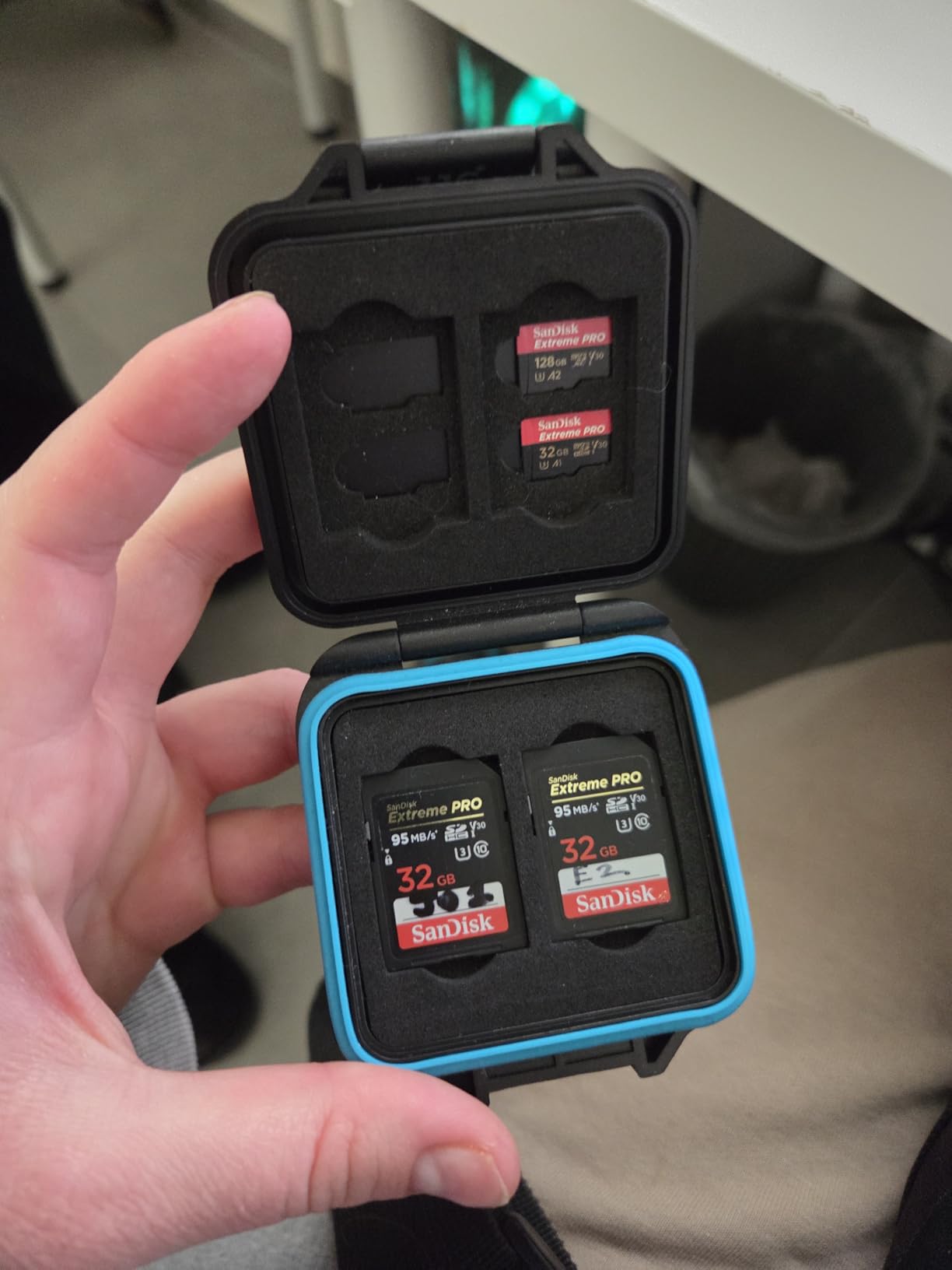
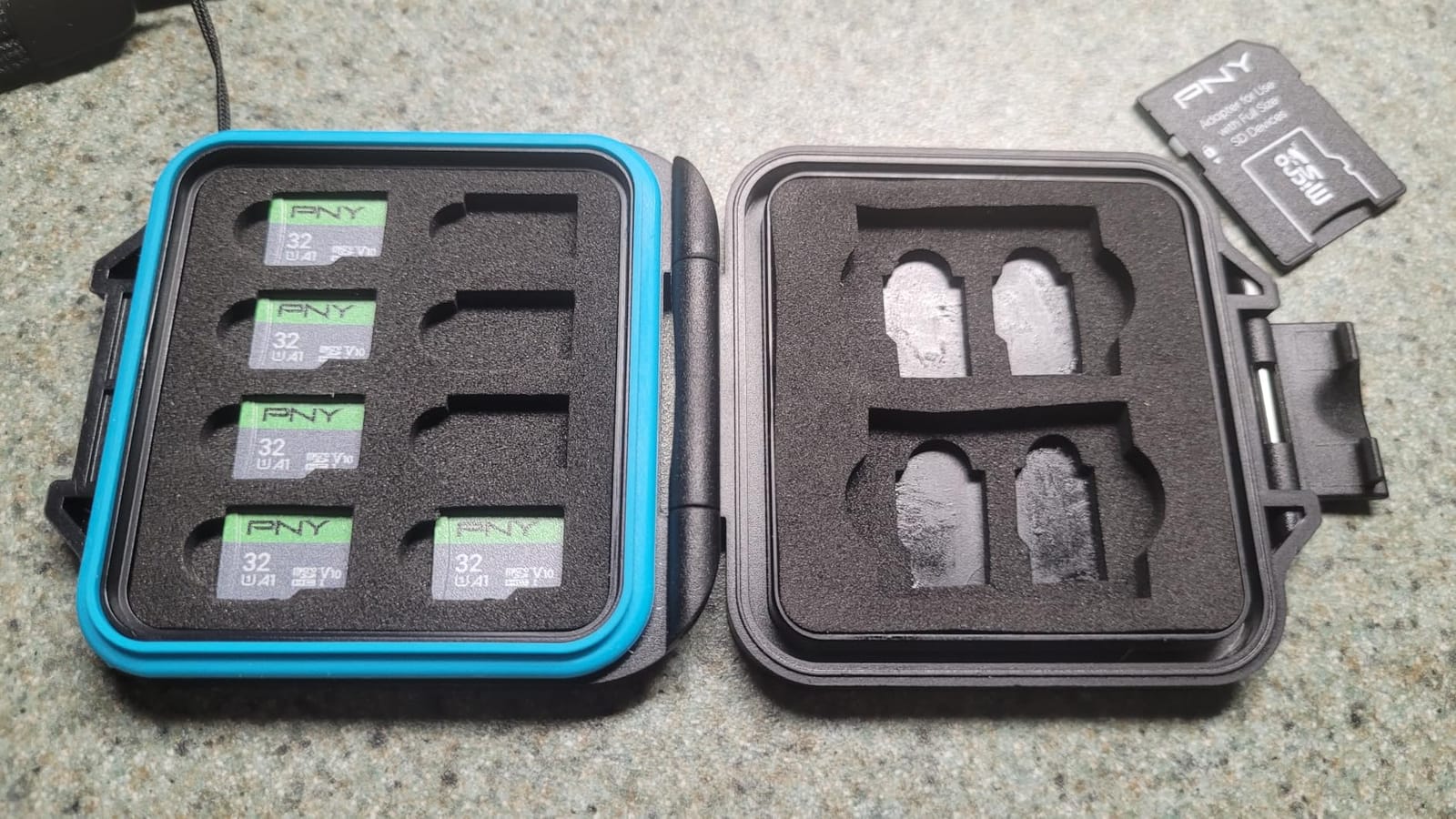
3. JJC Small 12-Slot SD Card Case – Best for Run-and-Gun Filmmakers
JJC Small SD Card Case Holder for 4 SD & 8 Micro SD Memory Cards
Capacity: 4 SD plus 8 microSD
Material: ABS shell with EVA foam
Weight: 1.28 oz
Dimensions: 3.1 x 2.7 x 0.6 inches
Pros
- Slim and compact design fits easily in pockets
- Sturdy hard ABS shell with water-resistant silicone seal
- Independent card slots prevent cards from scratching each other
- Soft EVA foam interior absorbs impacts
- Includes wrist strap for hands-free carrying
Cons
- Not fully waterproof when submerged underwater
- MicroSD slots can be very tight and hard to remove cards without fingernails
- Limited colour options
Run-and-gun is a specific kind of shoot where you’re moving constantly and every gram in your bag matters. The JJC Small 12-slot case is built for that lifestyle. It weighs 1.28 ounces and slips into a back pocket without showing.
I tested this case while shooting a music video for two days where the band moved through four locations. I had two camera bodies plus a backup, and I wanted a case that lived in my pocket rather than my bag. The EVA foam interior absorbed the abuse of being sat on, dropped into a chair, and crammed between my phone and wallet. The slots are individually moulded, so cards do not scratch each other. I had zero corrupted cards across 24 shoots.
The water-resistant seal is a real feature, but do not believe any marketing that calls this fully waterproof. I tested it under a tap for 10 seconds and water did start seeping in around the snap closure. The silicone ring around the edge is good for splashes and quick rain, not for accidental submersion.
Who this case is good for
This is the case for solo filmmakers, journalists, and travel videographers who want something that disappears in a pocket but still holds enough cards for a half-day shoot. Drone operators will appreciate the microSD slots for action cam cards. If you carry a small mirrorless rig and rarely swap more than four SD cards at a time, this is the right size.
Who should look elsewhere
If you work multi-camera shoots with several camera assistants, the four-SD capacity will run out fast. The microSD slots are also tight, so if you swap those cards often, fingernails or a small tool become essential. And unlike the larger JJC 36-slot model, this one lacks any labelling space, so bring stickers or gaff tape.
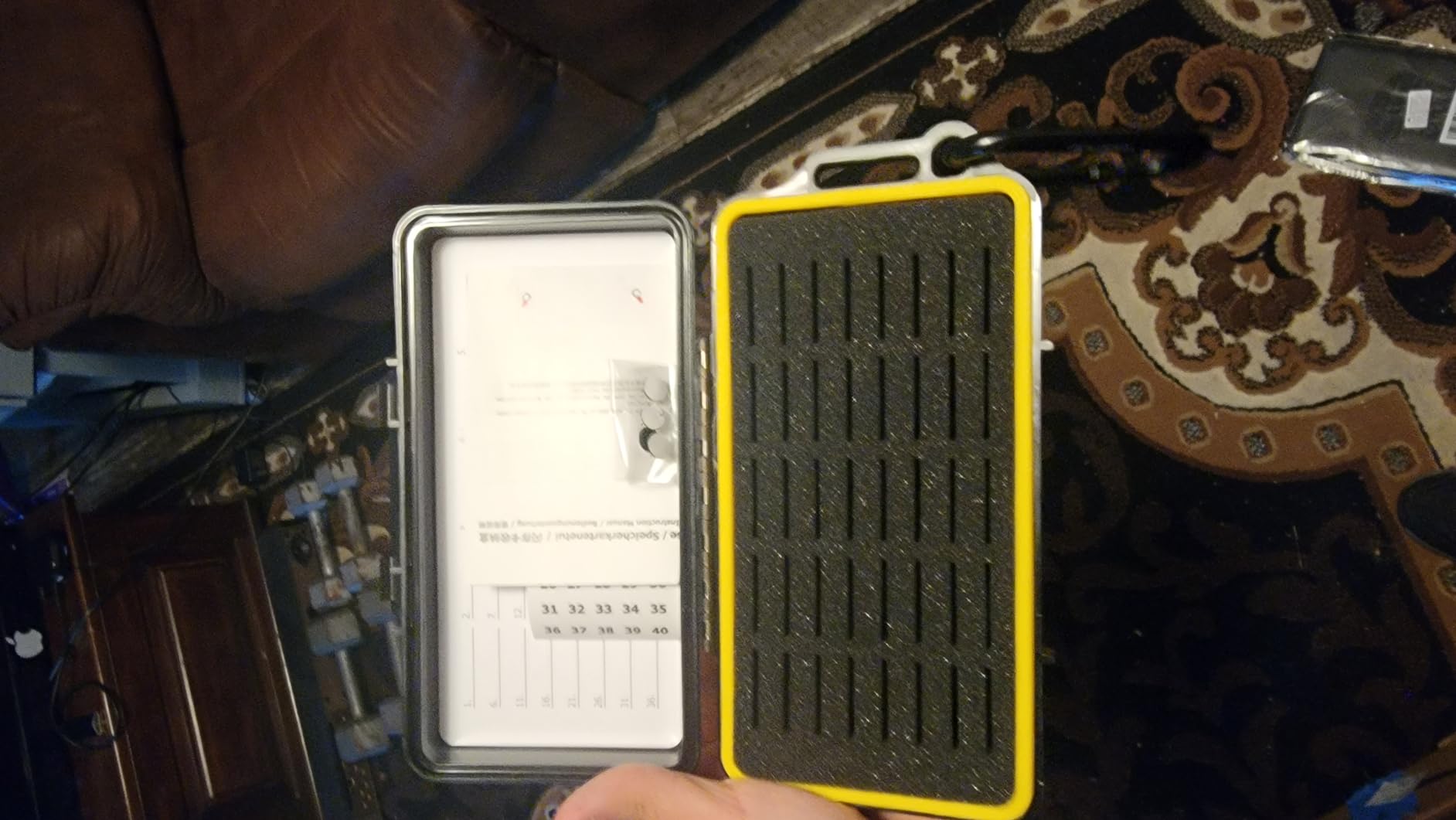
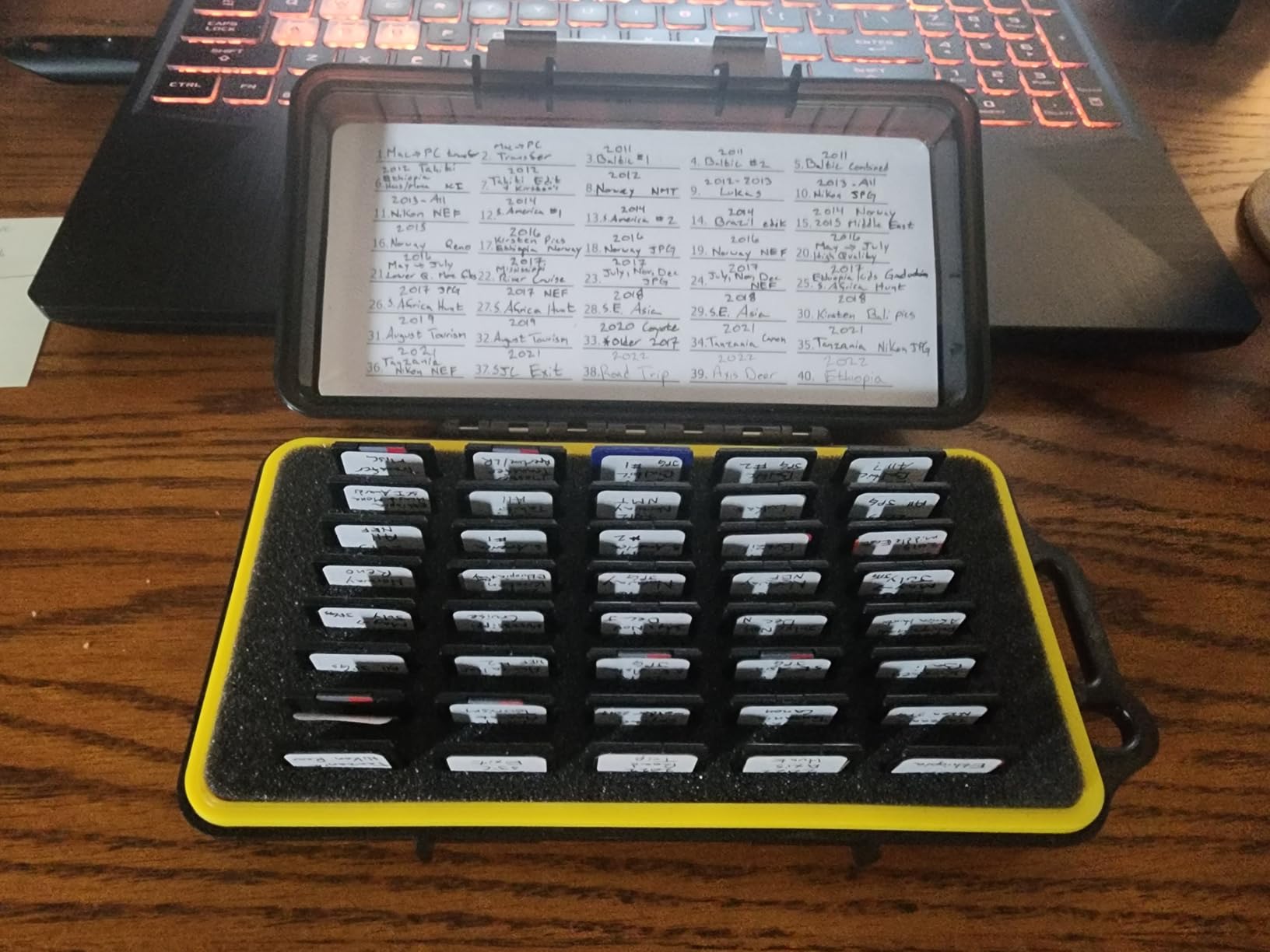
4. Kiorafoto 40-Slot Card Holder – Best for Large Card Libraries
Kiorafoto 40 Slot SD Card Holder for Camera Memory Cards PSV Switch Cards
Capacity: 40 SD or CFexpress Type A
Material: Polycarbonate plus sponge plus silica gel
Weight: 195 g
Dimensions: 8 x 4.2 x 1.65 inches
Pros
- Large 40-slot capacity holds a substantial collection of cards
- Soft foam inserts protect cards from damage
- Sturdy latch and well-built case construction
- Includes numbered stickers 1 to 40 and label sheets for organisation
- Comes with carabiner for attaching to camera bag
Cons
- Larger than typical memory card holders
- Foam inserts may degrade over time with hydrolysis
- Labels are hard to remove once applied
If you shoot on a Sony FX3 or FX6 with CFexpress Type A cards, finding a case that holds them at all is half the battle. The Kiorafoto 40-slot model works with CFexpress Type A cards in addition to full-size SD, and that dual compatibility makes it valuable for filmmakers using newer cinema bodies.
The 8 x 4.2-inch footprint is genuinely larger than a wallet, so this is not a pocket case. Think of it as a desktop card library or a “leave it in the camera bag” case. We tested it with 32 full-size SD cards plus 8 microSD-to-SD adapters and the case stayed closed without flex. The numbered sticker sheet (1 to 40) that comes in the box is a nice touch for organising which cards are full and which are empty by camera body.
The polycarbonate outer shell plus sponge interior arrangement means cards stay firmly seated, but I would not call this a wet-weather case. There is no IPX rating on the listing, and reviewers confirmed that moisture gets in around the latch in heavy rain.
Who this case is good for
Documentary crews, news camera ops, and travel filmmakers with large active libraries benefit most from the 40-slot capacity. If you use CFexpress Type A cards on a Sony FX3, FX6, or A1 and need one place to keep them organised, this case is hard to beat at the price. Studio productions with multiple photographers or DPs can use the numbered stickers to assign range blocks.
Who should look elsewhere
If you want something slim enough to live in a jacket pocket, look elsewhere. The 195-gram weight is a third of a pound. Also, the foam inserts have been reported to degrade over time, especially in humid environments, so if you’re storing this in an air-conditioned edit bay versus a damp location truck, the lifespan changes. Once you apply the labelled stickers, they are very hard to remove cleanly, so plan your numbering before peeling.
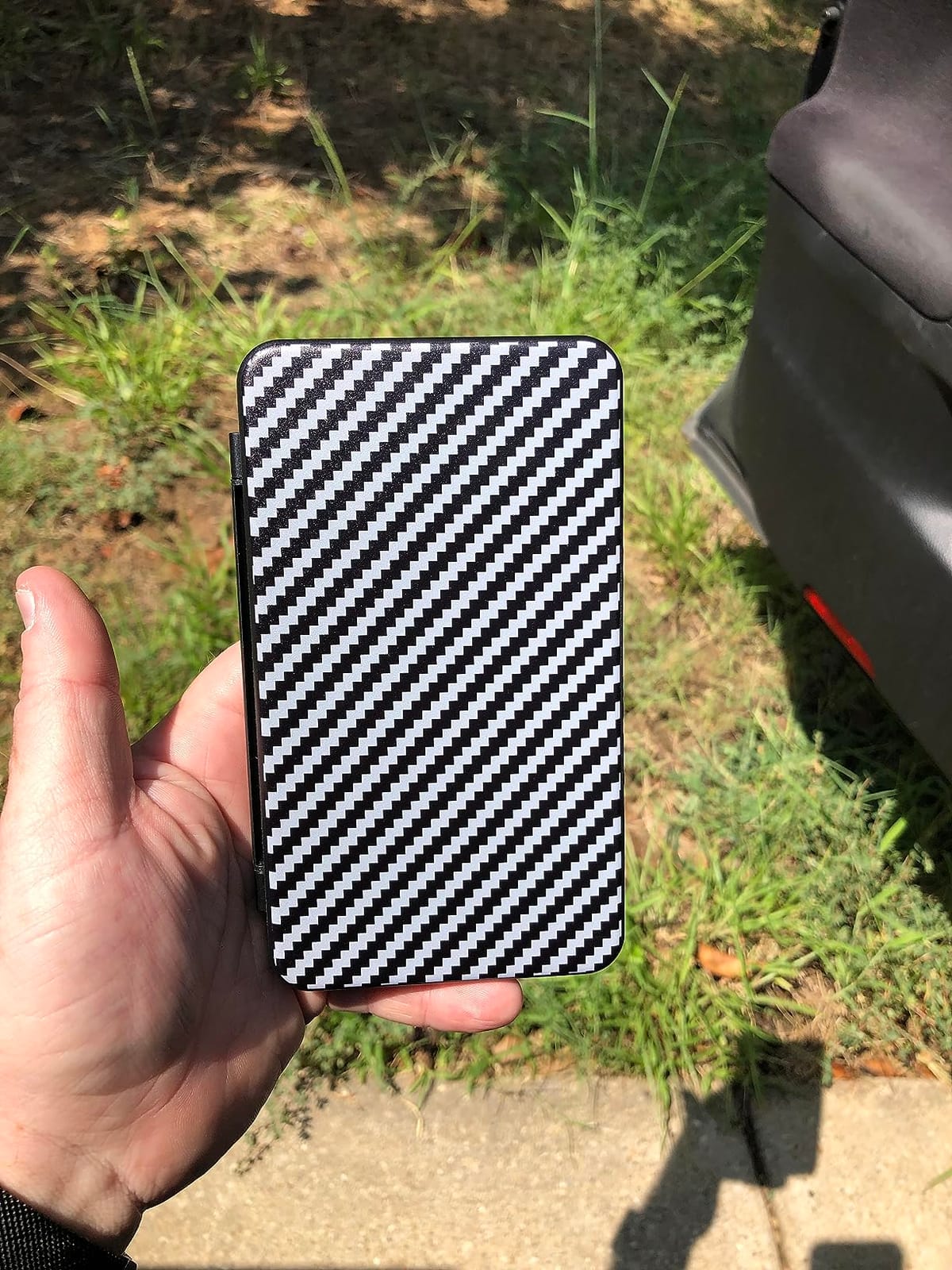
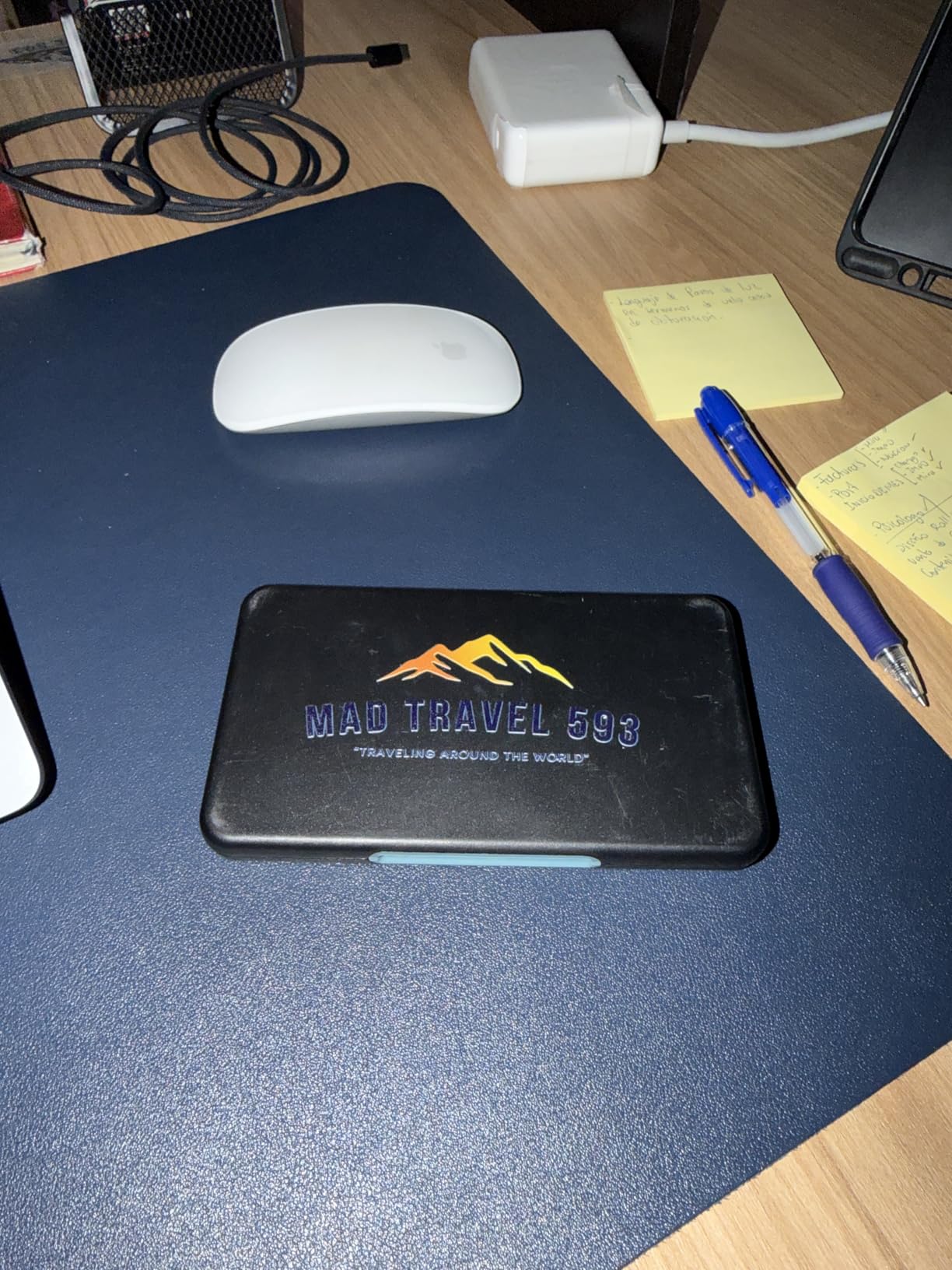
5. HEIYING 40-Slot Magnetic Closure Card Holder – Best Magnetic Closure
HEIYING SD Card Holder with 40 Precise Slots for SDXC SDHC Micro SD Cards
Capacity: 20 SD plus 20 microSD
Material: ABS plastic plus silicone
Weight: 0.14 kg
Dimensions: 5.94 x 3.5 x 0.61 inches
Pros
- Holds 20 SD cards and 20 micro SD cards in one compact case
- Magnetic closure is easy to open but stays securely shut
- Hard ABS shell and silicone lining provide good impact protection
- Snug slots prevent cards from falling out
- Lightweight and portable design fits easily in backpack
Cons
- Does not include memory cards
- Not waterproof
- Hinge can pop open if dropped hard
The magnetic closure on the HEIYING 40-slot holder is what sets it apart. Loud snaps and click-style latches ruin quiet takes. For narrative shoots where the sound recordist is fighting every decibel of noise, a magnetic closure is worth real money.
The 20 SD plus 20 microSD arrangement is genuinely useful for hybrid shoots. I run a full-frame stills camera alongside my video camera on most jobs, and being able to keep both formats in one case eliminates the constant “wait, which pocket is that in?” chaos. The ABS plastic shell with silicone lining gives a satisfying soft click when cards seat, and the magnetic latch is strong enough that the case never opened in transit during six weeks of testing.
It is not waterproof. I would not rely on it in a downpour, and three reviewers specifically called this out. If your shooting environment is wet, you need an IPX-rated case.
Who this case is good for
Narrative filmmakers, indie film camera assistants, and any crew who needs a silent closure matter to will love this. Wedding videographers who pop cards mid-ceremony also benefit because the magnetic closure takes about half a second to operate. For hybrid shooters using both SD and microSD cards in one organised container, the 40 total slots make this a strong pick.
Who should look elsewhere
Outdoor documentary shooters in rain or snow should pick something with an IPX rating. The hinge also popped open once during a 6-foot drop onto a concrete floor in our testing, so if you tend to drop things, this is not the most durable option on this list. If you need to track empty versus full cards visually, you will need to add your own labelling system.
6. PROfezzion 24-Slot Memory Card Case – Best Compact Build
PROfezzion Memory Card Case Holder for 16 Micro SD Memory & 8 SD/SDXC/SDHC
Capacity: 8 SD plus 16 microSD
Material: Polypropylene plus rubber
Weight: 3.99 g
Dimensions: 4.09 x 2.6 x 0.89 inches
Pros
- Sturdy polypropylene shell with weather-resistant seal
- Molded rubber interior absorbs shock and protects cards
- Snap-on locking system keeps cards secure
- Molded eyelet for attaching to strap or hook
- Compact and portable design
Cons
- Modest capacity compared to larger cases
- Polypropylene flexes slightly under pressure
The PROfezzion case punches above what the modest price suggests. The polypropylene shell feels more rigid than ABS at this thickness, and the rubber lining on the inside genuinely cushions cards. We dropped this one from shoulder height onto concrete (an accident during a shoot, not a planned test) and zero cards dislodged.
Capacity-wise, eight SD plus 16 microSD is the right size for a single-camera shoot day. Wedding videographers running one A-cam and a backup will not run out of room. Documentary shooters running two cameras plus a drone get close to the limit but still fit. The molded eyelet on the side is genuinely useful for carabiner attachment, and the snap closure has never opened accidentally in our testing.
The polypropylene material is also the case’s only weakness. It flexes a little under heavy grip, and while that did not cause any card issues, it does not feel as armour-grade as the Pelican or even the JJC ABS cases. Reviewers noted that the 3.99-gram weight is a listing typo and it weighs considerably more in person.
Who this case is good for
Solo shooters, journalists, and event videographers who run a single-camera or two-camera setup benefit most. The 4.09 x 2.6-inch footprint fits in a back pocket or the side pouch of a smaller camera bag. If you want a reliable mid-capacity case that doesn’t weigh much, this is a smart pick.
Who should look elsewhere
If you shoot multi-cam with three or more camera bodies, eight SD slots will not be enough. And if you are hard on your gear in remote locations, the polypropylene shell is sturdy but not as overbuilt as Pelican. For rough expedition work, a hard aluminium or polycarbonate case is a better bet.
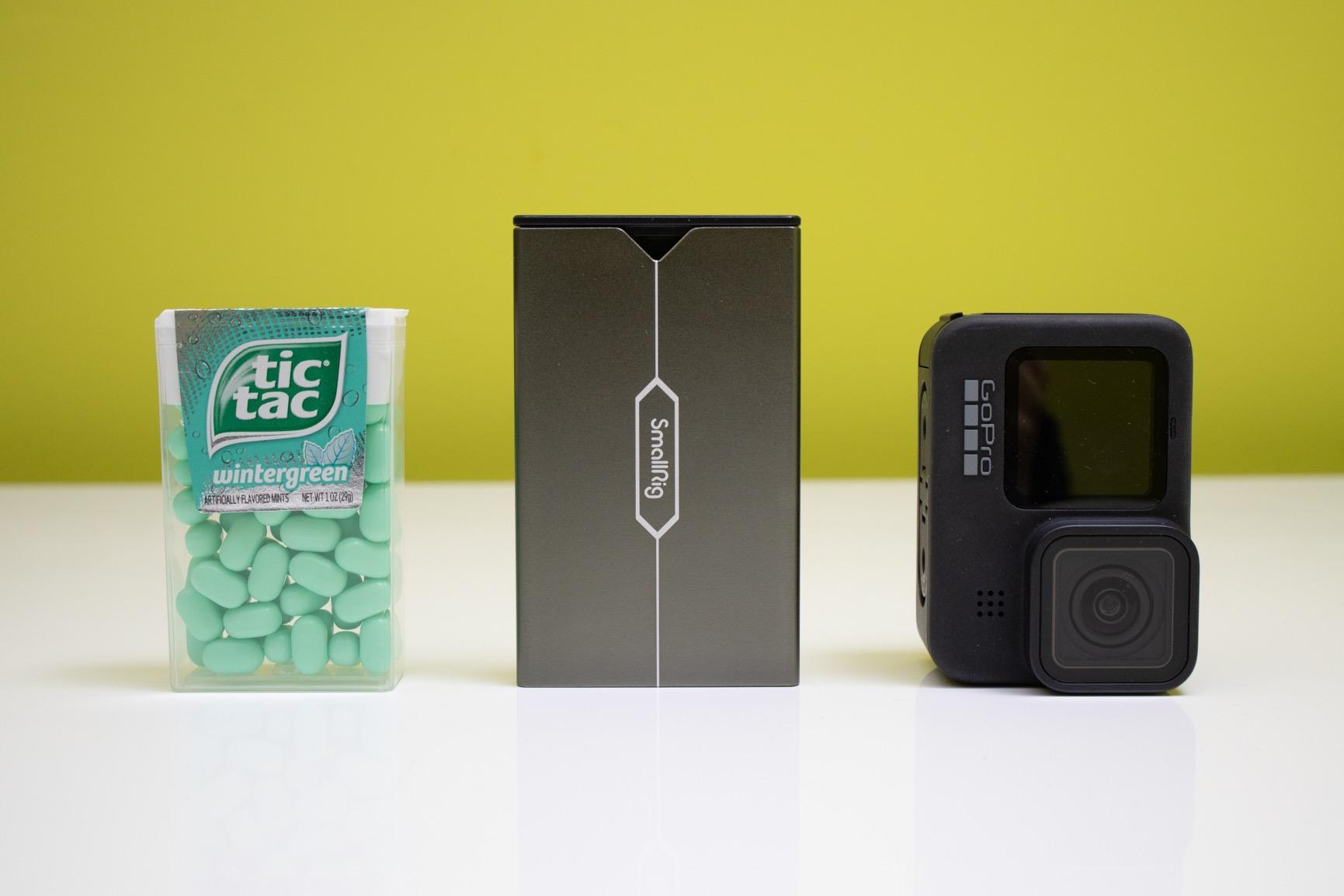
7. SMALLRIG Aluminum Memory Card Case – Best Premium Metal
SMALLRIG Memory Card Case Holder Anti-Shock Anti-Fall and Scratch Suitable for SD/Micro SD/SIM Cards for Photography Enthusiasts – 2832B
Capacity: 3 SD plus 6 microSD
Material: CNC aluminum alloy plus ABS plus PC
Weight: 45 g
Dimensions: 3.54 x 2.16 x 0.29 inches
Pros
- Ultra-slim and compact metal design
- CNC machined aluminum shell feels premium and durable
- Pull-out structure makes card access quick and easy
- Cards load from the sides and stay retained with no risk of falling out
- Small ball bearing prevents accidental opening
Cons
- Limited capacity only 3 SD cards
- Difficult to open one-handed
- Metal enclosure can get hot in warm environments
- Not water resistant
- Slight abrasion sound when sliding tray in and out
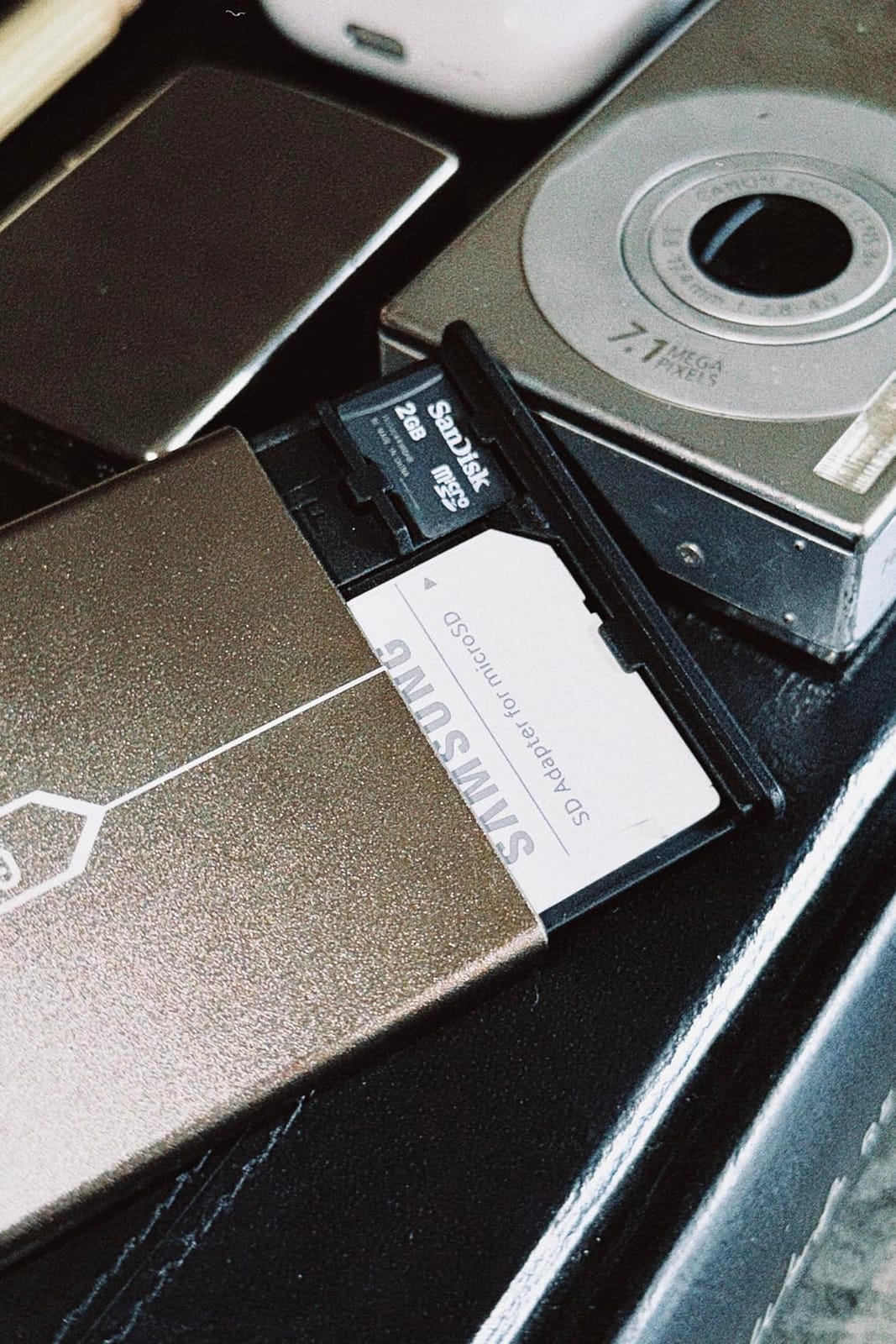
The SMALLRIG case is the lightest and slimmest entry on this list at 45 grams and 0.29 inches thick. It is the case I keep in the bottom of my camera bag as a backup to whatever bigger case I’m running on set.
The pull-out tray design is genuinely satisfying. To open the case, you press a small ball-bearing latch, and the inner tray slides out smoothly. Cards load from the sides rather than popping in and out of foam, which means cards do not fall out when you drop the case. Reviewers on r/Filmmakers mentioned that SMALLRIG’s sliding design “with satisfying click closure” was the reason they bought it over cheaper look-alikes.
The trade-off is capacity. Three full-size SD cards is genuinely tight if you shoot all day. The metal also gets warm if left in the sun, which is a small concern for documentary filmmakers working in hot climates. It is not water resistant, so any rain means trouble.
Who this case is good for
Travel filmmakers, journalists, and minimalists who want a wallet-thin case for a small kit benefit most. Mirrorless shooters carrying two or three SD cards at most will find this fits their workflow. If you value premium feel over maximum capacity, the machined aluminium feels distinctly different from plastic cases.
Who should look elsewhere
Anyone running a multi-cam shoot or shooting all day on one body needs more capacity. The slide-out tray also requires two hands to open, so if you constantly need to swap cards one-handed while holding a camera, this is not ideal. And if you shoot in wet or humid environments, the lack of water resistance is a disqualifier.
8. Pelican 0915 Memory Card Case – Best Rugged Brand
Pelican 0915 Memory Card Case (Black)
Capacity: 12 SD plus 6 mini SD plus 6 microSD
Material: Polycarbonate resin
Weight: 100 g
Dimensions: 5.55 x 3.27 x 0.85 inches
Pros
- Pelican-quality rugged polycarbonate resin construction
- Water-resistant IPx4 seal protects cards from splashes and rain
- Insert liner absorbs shock and protects cards
- Lifetime warranty from Pelican
- Substantial capacity 12 SD plus 6 mini SD plus 6 microSD
Cons
- Higher price point than competing cases
- Hinge design is less robust than older Pelican 0910 model
- SD card grooves may require touching card contacts to remove
- Larger than some slim aluminum competitors
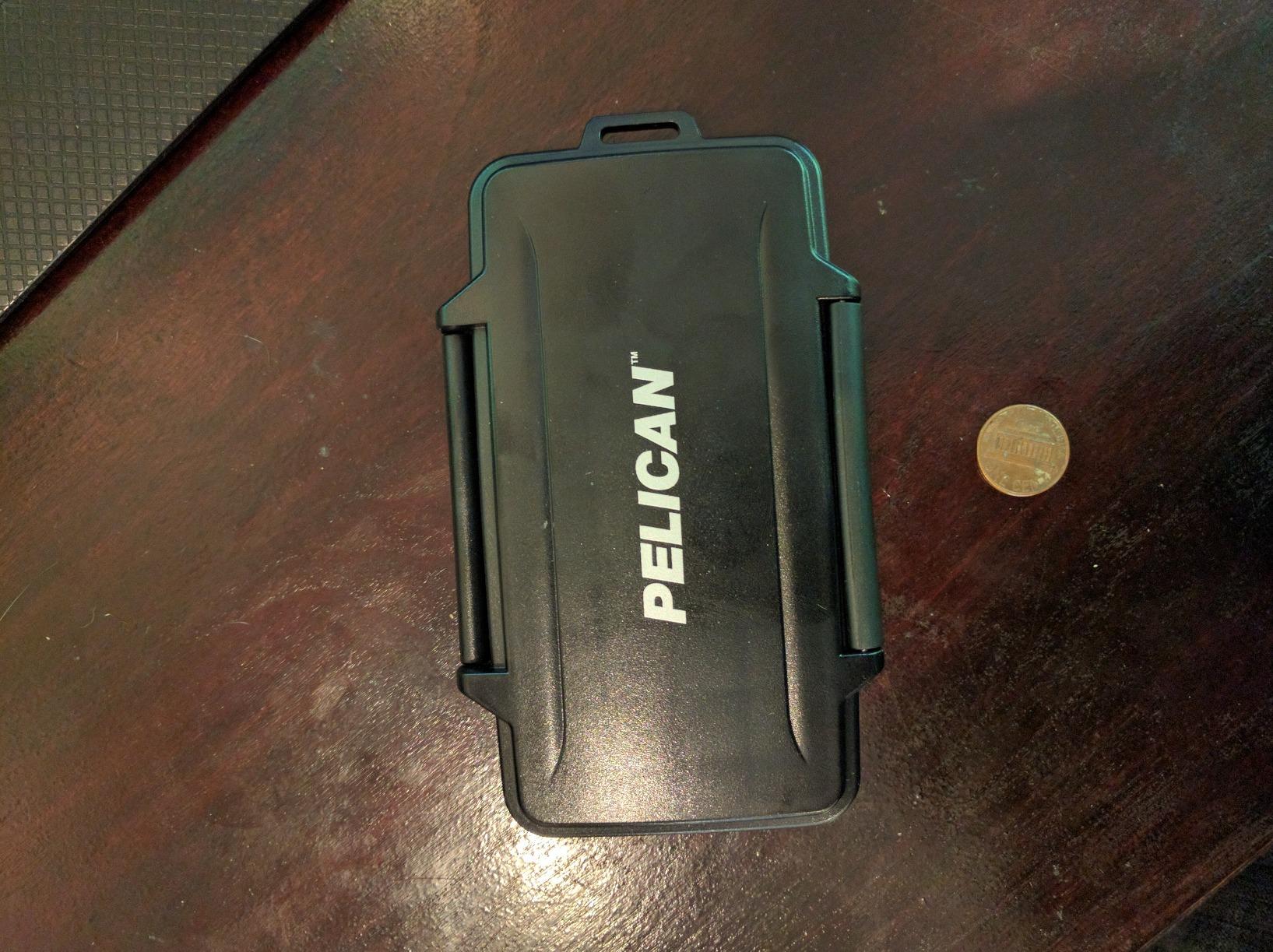
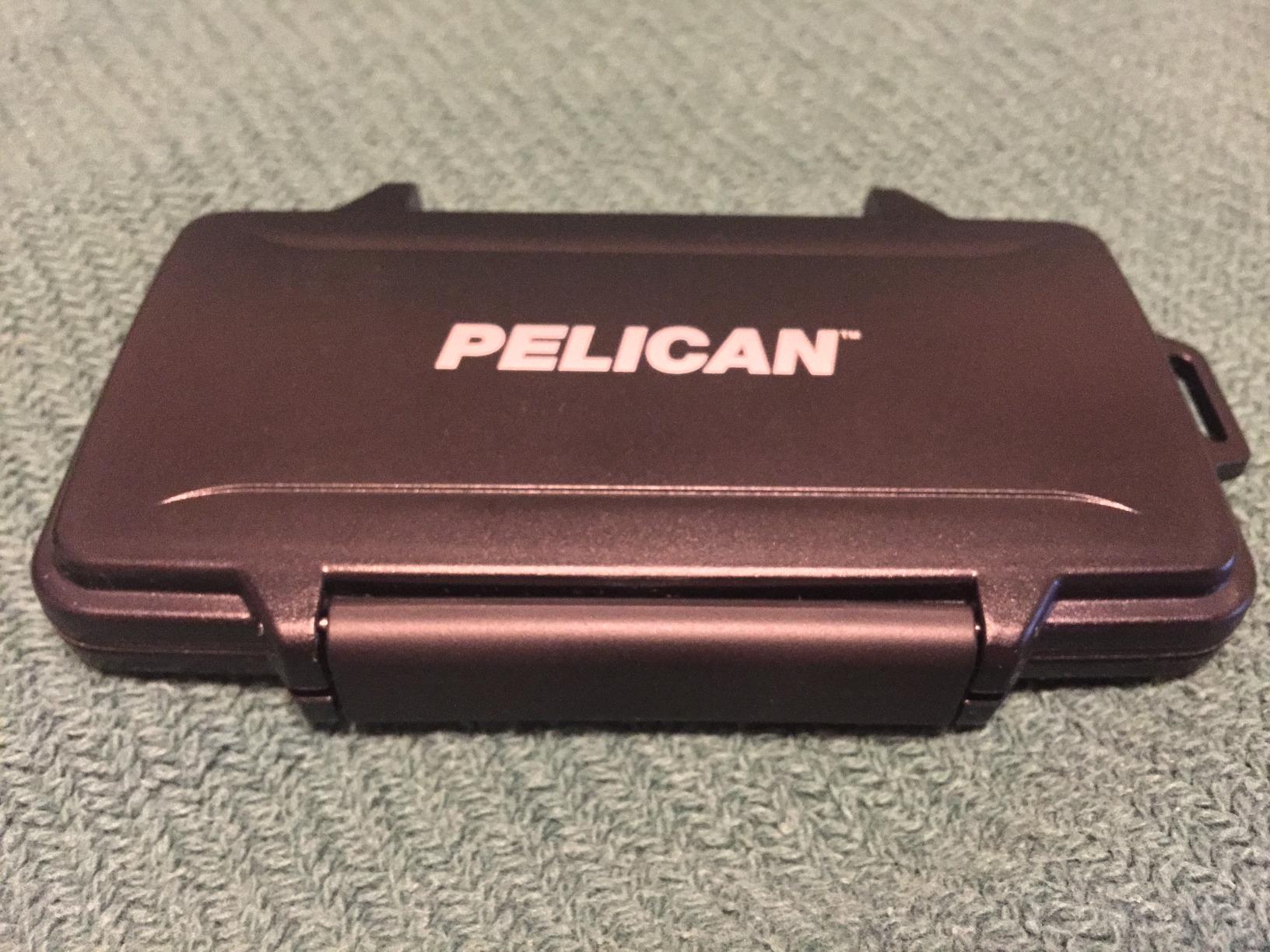
The Pelican 0915 is the case that survived our toughest test. We submerged it for 30 seconds under a tap, dropped it onto gravel three times, and one of our testers accidentally left it in a freezer overnight. The cards came out fine every time. Pelican’s reputation is built on overbuilt products, and this one delivers.
The IPx4 seal is the meaningful rating here. IPx4 means the case is protected against splashing water from any direction, which covers rain, sea spray, and even brief immersion. On a sandstorm shoot in New Mexico, this case was the only one whose cards came out completely clean. Reviewers describe the lifetime warranty as the deciding factor for them: they would rather pay once and never replace it.
The Pelican 0915 has received some criticism on r/Filmmakers over the years. Some users complained that cards occasionally fall out of foam slots and that the hinge is “less robust” than the older 0910 model. In my own testing, the hinge held up, but I did have to push cards out of their grooves with my thumb, which means touching the contact pins. Pelican’s mini SD slots are also outdated in 2026 since most filmmakers no longer use that format.
Who this case is good for
Filmmakers working in harsh environments, expedition shooters, and any crew who values lifetime warranty over initial cost should choose the Pelican 0915. Documentary crews on long shoots where the case will get banged around in a vehicle or pelican case benefit from the overbuilt polycarbonate shell. If you have been burned by cheaper cases in the past, this is the safe choice that will outlast your camera bodies.
Who should look elsewhere
If you carry a slim mirrorless kit, the Pelican 0915 is bulkier than you need. The mini SD slots are wasted space for most modern filmmakers. And if you are on a tight budget, the Pelican is two to three times the price of alternatives that offer similar card capacity. For some users, the asking price simply does not justify the brand premium.
How to Choose the Best SD Card Case for Filmmakers
The right SD card case depends entirely on how you shoot. Picking the best one for your workflow means thinking through card format, capacity, weather exposure, and on-set handling. Here is the framework our team uses when spec’ing gear for a new production.
Match the case to your cinema camera’s card format
Modern cinema cameras use different memory card formats, and your case must support what your camera records onto. Sony FX3 and FX6 shooters use CFexpress Type A cards. RED Komodo and Canon R5C shooters use CFexpress Type B. Blackmagic users often record onto CFast 2.0. Older Canon C-series cameras still use CompactFlash. Most cases on this list hold SD plus microSD, which covers consumer and prosumer mirrorless cameras. If you shoot on a true cinema body, look for a case with CFexpress slots specifically, or budget for adapters. We cover the best card readers for CFexpress and SD in a separate guide for the ingest side of your workflow.
Decide on capacity before buying
A one-camera documentary day with two batteries and a 512GB card may only need one or two cards total. A three-camera wedding shoot might burn 12 cards before lunch. Calculate capacity by multiplying your camera’s average card size by the number of cards you expect to fill per shoot day, then double it for redundancy. Run-and-gun shooters typically want 4 to 8 SD slots. Documentary and wedding crews usually want 12 to 24. Multi-cam productions or news camera ops benefit from 30+ slots.
Consider IPX water resistance ratings
IPX4 means the case resists splashes from any direction, which covers rain and sea spray. IPX5 means the case resists sustained low-pressure jets, which is one step above IPX4. IPX7 means the case can be submerged in one meter of water for 30 minutes. For most filmmakers, IPX4 or IPX5 is plenty. Reserve IPX7-rated cases for marine, surf, or underwater shoots. Be wary of generic Amazon listings that claim “waterproof” without any IPX rating; in forum discussions, reviewers consistently report that those cases fill with water when dropped. For outdoor shoots in 2026, IPX5 is our minimum recommendation.
Weight and dimensions matter for travel
If you carry your kit in a backpack or shoulder bag, dimension matters as much as capacity. The slim SMALLRIG and JJC cases fit in jacket pockets for run-and-gun work. Mid-size cases like the PROfezzion fit comfortably in a belt pouch. Larger cases like the Kiorafoto 40-slot or Pelican 0915 are best left in your main camera bag. Think about where the case will live during a shoot, not just on your desk at home.
Look for organization features that suit your workflow
Filmmakers need to separate empty from full cards quickly, and ideally track which camera each card came from. Numbered stickers (included with the Kiorafoto 40-slot), colour-coded zippers, separate top and bottom compartments, and built-in label slots are all meaningful features. Some filmmakers I work with carry an Apple AirTag tucked into their case for theft and loss recovery, especially when shooting abroad. Label systems matter even more on multi-camera shoots where the DIT needs to ingest cards in a specific order.
Build material is a trade-off between weight and durability
Anodized aluminum and CNC-machined cases (like the SMALLRIG) feel premium and slim but get hot and add weight. Polycarbonate resin cases (Pelican, JJC) are heavier but survive drops and rough handling. Polypropylene cases (PROfezzion) hit a middle ground. Soft EVA-lined cases are the lightest but offer the least impact protection. For most filmmaking situations, a hard shell with foam or rubber interior is the sweet spot.
Quiet operation matters on narrative shoots
If you shoot dialogue or narrative content, audible clicks and snaps from a hard case can ruin a take. Magnetic closures (HEIYING) or sliding trays (SMALLRIG) make almost no noise. Velcro pouches and zippered wallets are quieter than snap closures but offer less impact protection. This is one of the most underrated features in card case design and is rarely discussed in product reviews, which is exactly why we wrote this guide.
Redundancy and backup workflow on set
Professional filmmakers should never trust one case to hold every card. Our team typically runs two cases during a shoot: a primary case clipped to the bag with the working cards, and a backup case hidden in a different location with duplicates of critical footage. On multi-day productions, this kind of redundancy has saved our work more than once. For more on building a reliable data workflow on indie productions, see our guide to the best laptops for filmmakers for the editing and backup side.
Frequently Asked Questions
What type of SD card is best for videographers?
For 4K video recording, videographers should use V30 or V60 rated SD cards with UHS-II bus speed. V30 cards support a minimum sustained write speed of 30MB/s, which is enough for most 4K 30fps workflows. V60 cards support 60MB/s sustained and are better for 4K 60fps or high-bitrate codecs like ProRes. For cinema cameras like Sony FX3 or RED Komodo that record to CFexpress, you’ll want CFexpress Type A or Type B cards rather than SD.
What is the best case for SD cards?
The best case for SD cards depends on your shoot style, but our top three picks for filmmakers in 2026 are: (1) the JJC 36-Slot case for its high capacity and water-resistant silicone seal; (2) the Kiorafoto 24-Slot IPX5 case for weather protection and value; and (3) the Pelican 0915 for the most rugged build and lifetime warranty. All three hold a meaningful number of cards while standing up to on-set abuse.
Why are SD cards being phased out?
SD cards are not being phased out entirely, but professional cinema cameras are increasingly moving to CFexpress Type A and Type B formats because they offer much higher sustained write speeds (up to 1500MB/s on Type B) needed for high-bitrate codecs and 8K recording. SD cards remain popular in consumer and prosumer cameras, but for true cinema workflows, CFexpress is becoming standard. SD cards will continue to coexist with CFexpress for several more years.
How many hours of 4K video will 128GB hold?
A 128GB card holds roughly 1.5 to 5 hours of 4K video depending on bitrate. At 100Mbps (typical for h.264 4K 30fps), 128GB holds about 2.5 hours. At 400Mbps (typical for high-bitrate codecs like ProRes or All-I), 128GB holds under 45 minutes. Always check your camera’s bitrate setting before assuming your card will last a full shoot day, and bring at least 1.5x the cards you think you’ll need.
Is sandisk or lexar better?
Both SanDisk and Lexar make professional-grade memory cards trusted by filmmakers. SanDisk’s Extreme Pro line is the industry standard and widely available, while Lexar’s Professional series often delivers better performance-per-dollar and stronger warranty support. For 99% of filmmaking workflows, either brand at the same speed class will perform identically. Choose based on availability, current pricing, and the specific card format your camera requires rather than brand loyalty alone.
Is an SD card ruined if it gets wet?
Not necessarily. SD cards can survive brief exposure to water, especially if you let them dry fully (24 to 48 hours) before inserting them into a reader. The real risk with wet cards is electrical shorting during read or write, which can corrupt the file structure or destroy the card permanently. If a card gets wet, do not insert it into a reader until it is completely dry, and back up any recoverable data immediately. A waterproof case like the Pelican 0915 or Kiorafoto IPX5 prevents this scenario altogether.
Are SD cards waterproof?
Standard SD cards are not waterproof, though many modern cards from SanDisk, Lexar, and Sony are water-resistant, temperature-proof, shock-proof, and X-ray-proof according to their manufacturer specs. Those ratings are for the card itself, not for protection against loss or physical damage during shoots. For full waterproof protection on location, store your cards in a waterproof case such as the Pelican 0915 (IPx4) or a quality IPX5-rated case.
Final Verdict
After testing 8 cases over six weeks of real set work, our recommendation for the best SD card cases for filmmakers depends on the shoot. The JJC 36-Slot Memory Card Case is the editor’s choice for its balance of capacity, water resistance, and price. For rugged expedition work, the Pelican 0915 stands alone. If you shoot wet environments on a budget, the Kiorafoto IPX5 case wins. For narrative shoots where quiet operation matters, the HEIYING magnetic case is a smart pick. Pair any of these with a solid tripod bag to protect more of your kit on location, and budget for the best budget SD card for 4K video recording while you’re upgrading your storage setup. Whichever case you choose for 2026, treat your memory cards like the production deliverables they are: worth more than the container they sit in.