
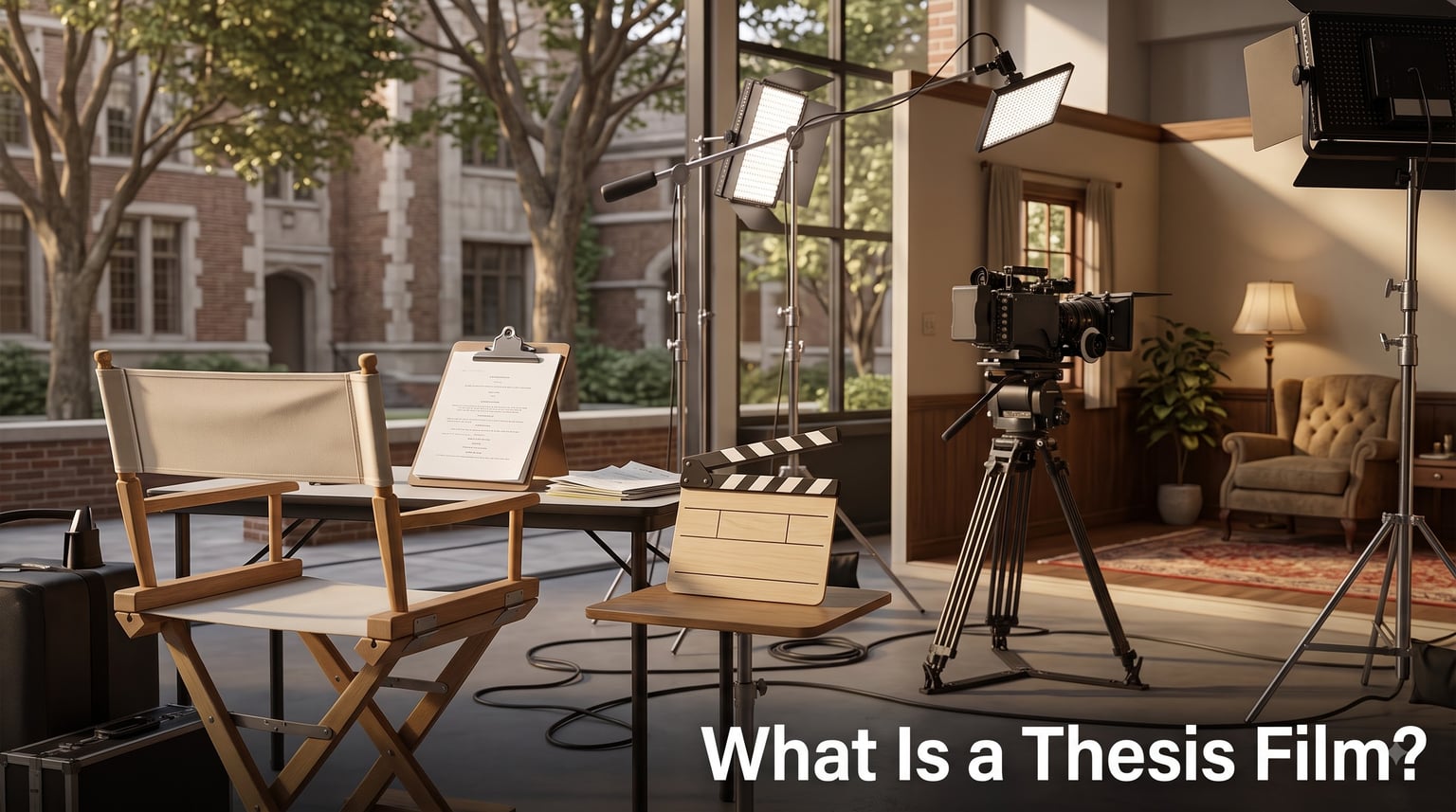
A thesis film is a major capstone project created by film students to graduate from a university or art school, serving as both a final academic requirement and a professional portfolio piece. Most students complete their thesis film during their final year of a BFA, MFA, or equivalent film program, balancing writing, casting, fundraising, filming, and editing all at once.
If you searched for “thesis film” and landed here, you might also be thinking about the 1996 Spanish thriller Tesis (translated as Thesis) directed by Alejandro Amenábar. I’ll cover both meanings clearly so you get the answer you need, whether you’re a student trying to understand your graduation requirement or a cinephile researching Amenábar’s debut feature.
In this guide, I’ll explain what a thesis film is, why it matters in film education, how it differs from a regular short film, and share practical tips from students who’ve been through the process. You’ll also find examples of famous thesis films and the answers to the most common questions students ask before starting one.
Table of Contents
- What Is a Thesis Film in Simple Words?
- Why Thesis Films Matter in Film Education
- How a Thesis Film Differs From a Regular Short Film
- Key Elements of a Thesis Film
- How Long Is a Thesis Film?
- Famous Thesis Films and Notable Examples
- The 1996 Film ‘Tesis’ (Thesis): Disambiguation
- Tips for Creating a Successful Thesis Film
- Frequently Asked Questions About Thesis Films
- Wrapping Up: What a Thesis Film Really Means
What Is a Thesis Film in Simple Words?
A thesis film is the final film project a student makes to graduate from a film school or university film program. Think of it as the film equivalent of a written thesis paper: it’s the work that proves you have mastered your craft and can produce a complete film on your own.
Here’s what makes a film qualify as a thesis film:
- It’s a graduation requirement at most film schools, BFA programs, and MFA programs
- It demonstrates your full range of skills, from writing and directing to editing and sound design
- It’s typically student-directed, though faculty mentor the project throughout
- It runs between 10 and 30 minutes for most programs, though some allow shorter or longer work
- It often serves as a portfolio piece for getting work after graduation
The phrase “thesis film” can mean two very different things depending on context. In film school, it refers to the capstone project just described. In the broader world of cinema, it sometimes refers to the 1996 Spanish film Tesis, which is literally titled “Thesis” in English. I’ll address both meanings in this article so there’s no confusion.
Why Thesis Films Matter in Film Education
Thesis films serve as the bridge between film school and the professional world. I’ve talked to dozens of graduates who say their thesis film was the single most important project they made during their degree, and the data backs them up.
Here’s why film schools invest so much in thesis films:
- Capstone requirement: Most BFA and MFA programs require a thesis film to graduate. It’s the final test of everything you’ve learned.
- Portfolio value: A finished thesis film gives you a tangible, professional-quality piece to show employers, agents, and collaborators.
- Creative freedom: Unlike earlier class assignments, your thesis film is your vision. You choose the story, the style, and the approach.
- Industry showcase: Many thesis films screen at festivals, win awards, and launch careers. The Academy of Motion Picture Arts and Sciences even runs a Student Academy Awards program specifically for thesis and student films.
- Full production experience: You learn to manage a real production, including budgeting, scheduling, casting, and post-production, exactly as you would on a professional set.
Schools like the City College of New York, USC, NYU, UCLA, and AFI all use thesis films as a graduation requirement, and the tradition goes back decades. It’s how the industry identifies emerging talent before they hit the job market.
How a Thesis Film Differs From a Regular Short Film
A thesis film is a short film, but not every short film is a thesis film. The distinction matters because the purpose, scope, and resources differ in significant ways.
Here’s a quick comparison:
- Purpose: A thesis film is a graduation requirement. A regular short film is typically a class assignment, festival submission, or independent project.
- Length: Thesis films usually run 10 to 30 minutes. Short films can be anywhere from 1 to 45 minutes.
- Resources: Thesis films often have access to school equipment, lab time, faculty mentorship, and small grants. Other short films are usually self-funded or unfunded.
- Creative control: Thesis films are almost always directed by the student. Class short films may have rotating roles or faculty-directed projects.
- Documentation: Thesis films typically require a written proposal, production book, and final defense or screening. Short films usually don’t.
- Career impact: A thesis film is a calling card. Other short films are portfolio add-ons.
The two overlap a lot in practice. A strong thesis film often becomes a festival short, and vice versa. But the academic context and the graduation stakes make a thesis film a different kind of project.
Key Elements of a Thesis Film
Every thesis film shares the same core production stages, even if the final product looks very different. Here’s the breakdown of what a typical thesis film includes:
- Written proposal or treatment: Most programs require a 5 to 15 page proposal that outlines your story, characters, visual style, and production plan before you start filming.
- Screenplay: A polished script that goes through faculty review and often peer feedback. This is the foundation of everything else.
- Pre-production: Casting, location scouting, scheduling, storyboarding, and building your crew. This phase can take months and is where most thesis films live or die.
- Production: The actual shoot, usually 5 to 20 days depending on the scope of your film. You’ll typically operate with a small crew, often fellow students.
- Post-production: Editing, sound design, color grading, music, and visual effects. Many programs give you access to lab time and editing suites for this stage.
- Final deliverables: A completed film, often a written reflection or production book, and a public screening or defense.
Some programs also require a “thesis statement” or artist statement that explains the creative intent behind your film. This is more common in MFA programs and animation-focused thesis films.
How Long Is a Thesis Film?
Most thesis films run between 10 and 30 minutes, but the exact length depends on your program and the type of film you’re making.
Here’s a rough breakdown by program type:
- BFA thesis films: Typically 10 to 15 minutes for fiction, 20 to 30 minutes for documentaries
- MFA thesis films: Often 15 to 30 minutes, with some programs allowing up to 45 minutes for ambitious projects
- Animation thesis films: Usually 5 to 10 minutes due to the time-intensive nature of animation
- Documentary thesis films: Can run 20 to 60 minutes when the subject demands longer exploration
Your program will set the official limits, and most students aim for the shorter end of the range. A tight 12-minute film is almost always more impressive than a padded 25-minute one, especially when you’re still learning.
Famous Thesis Films and Notable Examples
Some of the most celebrated directors in cinema got their start with thesis films. Here are a few examples worth knowing:
- Spike Lee’s “Joe’s Bed-Stuy Barbershop: We Cut Heads” (1983): Lee’s thesis film at NYU went on to win the Student Academy Award and helped launch his career.
- Darren Aronofsky’s “Supermarket Sweep” (1991): The Black Swan director’s Harvard thesis film, made on a tiny budget, showed his early visual style.
- Robert Zemeckis’s “A Field of Honor” (1973): The Back to the Future director’s USC thesis film, which helped him land his first Hollywood job.
- Patricia Cardoso’s “The Water Carrier” (1992): UCLA thesis film that won a Student Academy Award.
These examples show that thesis films aren’t just academic exercises. They’re often the first real proof that a student can direct a complete film, and they open doors that classroom assignments can’t.
The 1996 Film ‘Tesis’ (Thesis): Disambiguation
Before I wrap up, let me address the other meaning of “thesis film” that sometimes shows up in search results.
Tesis is a 1996 Spanish horror-thriller directed by Alejandro Amenábar, and it’s often translated simply as “Thesis” in English. The film follows a university student writing her thesis on audiovisual violence who discovers a snuff film ring operating at her school.
It was Amenábar’s directorial debut and won seven Goya Awards, including Best Film. The film is unrelated to the academic concept of a thesis film, but it shares the same word, which can be confusing when you’re searching for information. If you’re reading this because you’re researching the 1996 movie, you now have your answer.
Tips for Creating a Successful Thesis Film
After talking with students who’ve finished their thesis films and survived the process, here’s the advice that comes up over and over:
- Start small and aim high: A simple story executed well beats an ambitious story executed poorly. Pick a concept you can actually finish.
- Plan your pre-production like a job: Treat every phase professionally. The films that fall behind are almost always the ones where students treat pre-production as optional.
- Cast actors you can actually work with: Schedule conflicts derail more thesis films than bad scripts do. Lock down your cast early and confirm dates in writing.
- Manage your scope ruthlessly: Every special effect, every location, every day of shooting adds risk. Cut anything that doesn’t serve the story.
- Build a realistic schedule with buffer: Students consistently underestimate how long post-production takes. Plan for twice as much editing time as you think you need.
- Use your school’s resources: Equipment, lab time, faculty office hours, and funding opportunities exist specifically for thesis films. Don’t be shy about asking.
- Accept that it won’t be perfect: Your thesis film is a learning project, not your magnum opus. Focus on finishing strong, not finishing flawlessly.
One student I spoke with put it like this: “The thesis film isn’t about making a masterpiece. It’s about proving you can finish a film from start to finish. That’s the real skill employers want to see.”
Frequently Asked Questions About Thesis Films
What is a thesis film in animation?
An animation thesis film is a graduation project completed by animation students at the end of their BFA or MFA program. It is typically shorter than a live-action thesis film (usually 5 to 10 minutes) because animation requires more time per frame. Students handle every step themselves, including storyboarding, modeling, animating, and sound design.
How long is a typical thesis film?
Most thesis films run between 10 and 30 minutes. BFA programs usually require 10 to 15 minutes for fiction films, while MFA programs often allow 15 to 30 minutes. Animation thesis films are typically 5 to 10 minutes, and documentary thesis films can run 20 to 60 minutes depending on the subject.
What is a thesis in film school in simple terms?
A thesis in film school is a final film project that students must complete to graduate. It is the film equivalent of a written thesis paper. You write, direct, and produce a short film that demonstrates your full range of filmmaking skills, often with faculty mentorship and school resources.
What is an example of a thesis film?
Famous thesis films include Spike Lee’s Joe’s Bed-Stuy Barbershop: We Cut Heads (1983 NYU thesis), Darren Aronofsky’s Supermarket Sweep (1991 Harvard thesis), and Robert Zemeckis’s A Field of Honor (1973 USC thesis). These student films helped launch the careers of some of the most successful directors in Hollywood.
Why are thesis films important?
Thesis films matter because they serve as a graduation requirement, a professional portfolio piece, and an industry showcase. Many thesis films screen at festivals, win Student Academy Awards, and help graduates land their first jobs in the film industry. They also give students full creative control over a project for the first time.
Wrapping Up: What a Thesis Film Really Means
A thesis film is the final project that film students complete to graduate from a BFA, MFA, or equivalent film program. It combines every skill you’ve learned over your degree, from writing and directing to editing and sound design, into one polished short film that serves as both a graduation requirement and a professional portfolio piece.
If you’re a student about to start your thesis film, my advice is to start planning now. Pick a story you can actually finish, build a realistic schedule, and use every resource your school offers. The thesis film is the project that kicks off your career, and it’s worth the effort to do it right.
Whether you came here looking for a definition of a thesis film, wondering how long yours should be, or trying to research the 1996 Spanish thriller Tesis, I hope this guide gave you the clear answer you needed. If you have other questions about thesis films, drop them in the comments below and I’ll do my best to help.