
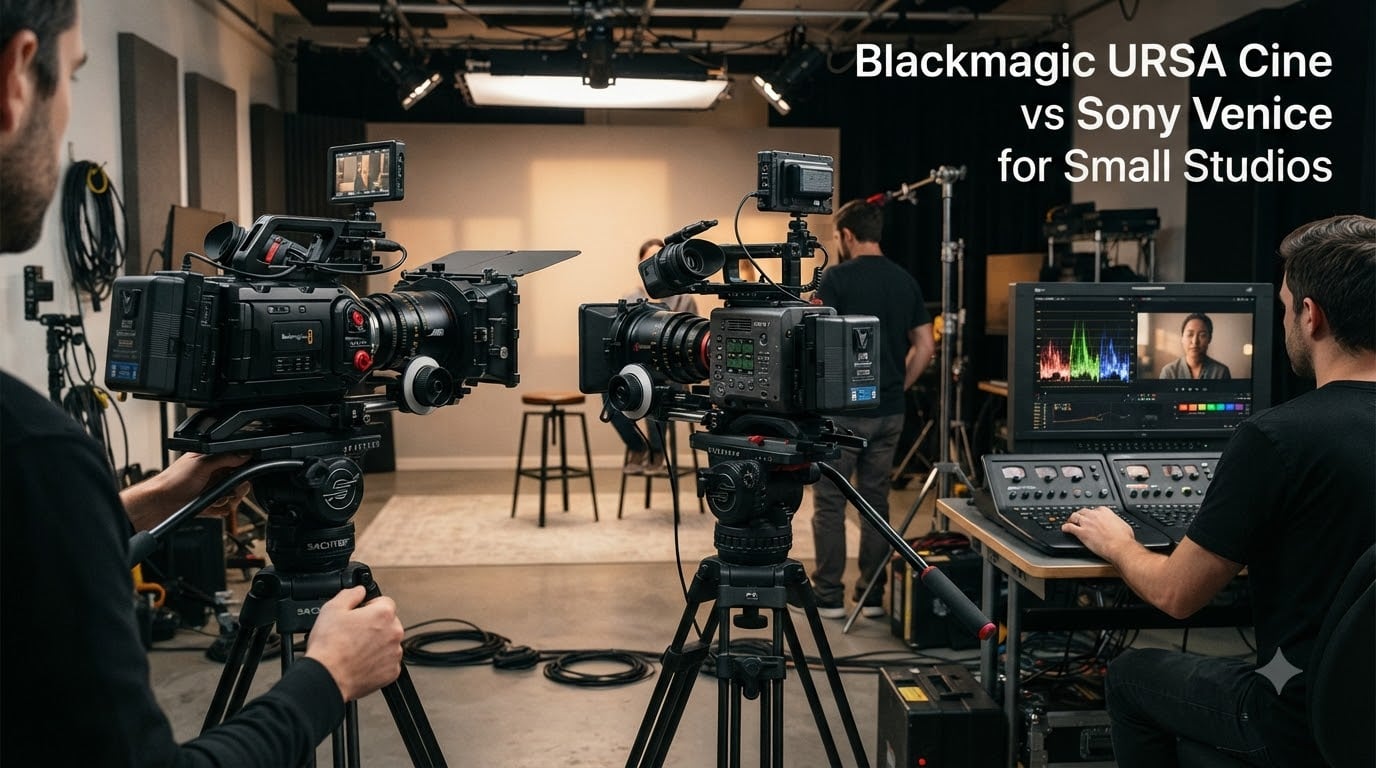
The best choice in this Blackmagic URSA Cine vs Sony Venice for small studios comparison depends less on resolution and more on how your team works. I would choose the Blackmagic URSA Cine 12K LF for a budget-conscious studio that wants high-resolution capture and an efficient DaVinci Resolve workflow. I would choose Sony Venice when dependable production support, familiar color, and client confidence matter more than initial price.
Both cameras belong in professional conversations, but they serve different business models. Blackmagic gives a small team one body, RAW recording, direct streaming, and a large-format sensor for substantially less cash upfront. Sony asks a much larger initial investment, yet brings a mature high-end cinema system and established professional support into jobs where failure is not an option.
I have not personally handled either camera, so I am not going to invent a 30-day test or pretend that forum impressions are lab results. This comparison uses the supplied camera specifications, published feature data, competitor analysis, and recurring questions from filmmaking communities. It focuses on the daily decisions a small production company faces: staffing, storage, batteries, post-production, support, and the kinds of jobs it wants to win.
Table of Contents
- Quick Decision Summary: Which Camera Fits a Small Studio?
- Blackmagic URSA Cine vs Sony Venice at a Glance for October 2026
- 1. Blackmagic URSA Cine 12K LF: The Accessible High-Resolution Option
- 2. Sony Venice: The Dealer-Only Production Alternative
- 3. Image Quality: RGBW and Resolution vs Sony’s Production Character
- 4. Resolution, Frame Rates, and Rolling Shutter
- 5. Codecs, Storage, and Post-Production
- 6. Ergonomics, Power, and Small-Crew Operation
- 7. Total Cost of Ownership for a Small Studio
- 8. Which Camera Should Your Studio Buy?
- Frequently Asked Questions
- Conclusion: Buy for the Studio You Are Building
Quick Decision Summary: Which Camera Fits a Small Studio?
Choose the Blackmagic URSA Cine 12K LF if your studio wants maximum imaging capability per dollar, shoots work that benefits from reframing or large deliverables, and already uses DaVinci Resolve. It also makes the strongest case when direct streaming and a self-contained large-format package matter.
Choose Sony Venice if your clients expect a familiar high-end system, your crews value its production behavior, and your projects need the confidence of Sony’s professional dealer and service network. It is also the easier recommendation for a studio that can place premium cinema cameras on commercial work without stretching cash flow.
My practical split is simple: Blackmagic is the value and resolution winner; Sony is the production-confidence winner. Neither is automatically better, and the wrong choice is the one that buys image quality you cannot finish, service, or support reliably.
Blackmagic URSA Cine vs Sony Venice at a Glance for October 2026
The table below separates the supplied product facts from the documented characteristics of the original Sony Venice. Because Sony Venice is not sold through Amazon, this is a technical and operational alternative assessment rather than an Amazon product listing.
| Product | Specs | Action |
|---|---|---|
 Blackmagic URSA Cine 12K LF |
|
Check Latest Price |
The headline specifications point to different strengths. Blackmagic emphasizes resolution, a custom RGBW sensor, RAW capture, and direct SRT or RTMP streaming. Sony’s position rests on full-frame cinema performance, dual base sensitivity, robust color management, internal electronic ND, and a system designed around professional crews and high-end productions.
Do not compare purchase price in isolation. A cheaper body can become expensive once you add media, batteries, plates, storage, monitoring, rigging, service plans, crew training, and color-management work. The right total-cost calculation includes the jobs you can book, the turnaround your team can support, and the time lost when equipment or support fails.
1. Blackmagic URSA Cine 12K LF: The Accessible High-Resolution Option
Blackmagic Design URSA Cine 12K LF Camera with RGBW 36 x 24mm Sensor, Mirrorless Lens Mount, and 5-Inch HDR LCD Touchscreen (Body Only, Canon EF)
12K RGBW 36 x 24mm sensor
Locking EF mount
5-inch HDR touchscreen
Pros
- High-resolution sensor
- BRAW recording
- Direct streaming
- Large-format capture
Cons
- No Amazon rating or reviews yet
- Dealer-level support needs checking
- High-resolution storage demands
The supplied product data identifies the URSA Cine 12K LF as a body with an RGBW 36 x 24mm sensor, a locking mirrorless Canon EF mount, and a 5-inch HDR LCD touchscreen. Blackmagic says the large-format design uses larger photosites and provides 16 stops of dynamic range. That is a serious specification for a small studio that wants one camera to cover interviews, branded content, short films, and premium social crops.
I see the appeal immediately in post. Twelve-kilopixel capture gives a team room to reframe a wide shot into a second composition, punch into a 4K deliverable, or stabilize more aggressively than a lower-resolution acquisition format. It is especially useful when a client asks for multiple aspect ratios but the shoot cannot justify a second camera setup.
That flexibility comes with a storage cost. Large RAW files demand careful media strategy, fast offloads, disciplined folder structure, and enough backup capacity to keep an edit moving. The supplied information confirms Blackmagic RAW support, but it does not provide recording bitrates, media capacity, or exact frame-rate limits. I would test the complete card and workstation chain before accepting a high-data-rate assignment.
The 5-inch HDR touchscreen is a useful small-studio feature because it can reduce the amount of monitoring hardware needed for a basic package. Direct SRT and RTMP streaming through Ethernet, Wi-Fi, or USB-C cellular data is also meaningful for agencies, live events, and remote review. I would treat streaming as a valuable extra rather than a reason to skip a dedicated network plan on critical work.
What the Blackmagic URSA Cine 12K LF Does Best
The camera’s strongest case is imaging headroom. A 12K source can make a 4K master look more deliberate because the editor is not forced to enlarge every crop. It can also help a small team create vertical and horizontal versions from the same setup, which is a practical advantage for agencies serving web, broadcast, and social channels.
Blackmagic RAW is another major benefit for a Resolve-led studio. The same company develops the camera and the editing, color, audio, and finishing software, so the handoff can be designed as a connected workflow. That does not mean every project is easy, but it can reduce the number of separate decisions about RAW decoding, color management, and review files.
The locking EF mount is sensible for a body in this class. A secure mechanical interface matters when a heavy zoom or cine lens is attached, and EF glass remains widely available in rental inventories. Before buying, I would verify whether your chosen lenses cover the full image circle and whether your preferred electronic features work through the mount.
What to Check Before Buying the URSA Cine
First, establish the actual recording mode your productions need. Twelve-kilopixel capture is not useful if the available frame rate, media, or edit computer forces you into a lower-resolution format on every job. Ask for a written test in the exact mode you plan to use, including record time, data rate, skin-tone grading, highlight recovery, and playback performance.
Second, budget the complete rig. The body is not the whole package. You will likely need compatible media, a high-output battery strategy, charging equipment, plates, a baseplate or shoulder system, monitoring, audio connectivity, a hard case, and insurance. The supplied data does not quantify those costs, so request dealer prices and test a full-day power plan before comparing cameras on body price alone.
Third, examine support in your region. Forum research flags Blackmagic’s service and repair network as a concern for some professional buyers. A camera that saves money at purchase can create downtime if a local technician or rental backup is unavailable. I would confirm turnaround targets, loaner policies, parts availability, and who carries the risk when a job is waiting.
2. Sony Venice: The Dealer-Only Production Alternative
Sony Venice is not an Amazon product, so it receives no Amazon shortcode here. The documented comparison material describes a flagship professional digital cinema camera distributed through specialist dealers, with a body starting around $28,000 before accessories, media, support, and tax. That dealer model is part of the product’s identity: buyers are expected to plan a professional acquisition and support relationship, not treat it like a casual marketplace purchase.
Sony Venice remains a compelling filmmaking camera. Community feedback frequently praises its color science, dynamic range, highlight behavior, and familiar production characteristics. Those impressions matter because clients and crews often know what a Venice image should look like, which can reduce uncertainty on a commercial set.
The original Venice’s full-frame sensor, dual base ISO approach, internal electronic variable ND, robust recording options, and cinema-focused controls create a strong case for narrative, commercial, and documentary work. It is designed for teams that need controlled exposure, dependable monitoring, and a camera that fits into established high-end rental packages.
For a small studio, the central question is not whether Venice is technically excellent. It is whether the camera’s additional cost produces enough client value, operational confidence, or access to work to repay itself. If the studio has a steady premium-client pipeline, the answer may be yes. If bookings are inconsistent, the same purchase can leave too little cash for crew, lenses, travel, post, and the next job.
Why Some Studios Still Choose Sony Venice
Venice’s biggest advantage is confidence. The platform has been used on demanding productions, its color and exposure behavior are familiar to many professionals, and Sony’s professional distribution model gives serious buyers a route to trained support. For a studio selling reliability rather than specifications, that is a real asset.
Internal electronic ND is especially useful for documentary, event, and fast-moving commercial work. It allows exposure changes without swapping filters, which can save time and reduce the number of accessories on a cart. That is the kind of feature that pays for itself through smoother work rather than a better lab chart.
The camera also fits a production ecosystem built around cinema crews. Physical controls, monitoring, timecode, genlock, audio, and recording behavior are designed for professional set practice. A small company that rents lenses, wireless video, and support packages may find that Venice integrates more comfortably into an existing package, even when the body is more expensive.
Where Sony Venice Is Harder for a Small Studio
The acquisition cost is the first barrier. Research documentation places the body-only starting point around $28,000, but the real system cost includes media, batteries, charging, rigging, storage, insurance, and the work needed to maintain a high-end camera. A studio should calculate those items before treating the body number as a complete budget.
Second, the buying path is not as simple as a marketplace order. Sony Venice is distributed through professional cinema dealers, and availability, package contents, and service arrangements can vary. A small team should choose its dealer with the same care it chooses lenses or an editor, because a strong relationship can shorten a repair or rental emergency.
Third, premium hardware can encourage overextended purchases. I would not buy Venice solely because a client mentioned the name, and I would not buy it before checking whether your local crews, post team, and rental partners can support the format. The camera is an excellent tool; it is not a substitute for a sustainable production plan.
3. Image Quality: RGBW and Resolution vs Sony’s Production Character
Blackmagic’s RGBW sensor is the more unusual technical story. A traditional Bayer sensor arranges color-filtered photosites, while the RGBW design adds clear or white-sensitive elements to improve light-gathering efficiency and expand the usable dynamic range. The benefit is not simply “more resolution”; it is a different way of balancing color information, sensitivity, and readout behavior.
For a small studio, the practical result could be excellent flexibility in difficult lighting and substantial latitude for color work. However, forum discussions show skepticism about how a newer RGBW design behaves in real productions. I would not infer that every scene will match a Sony render. I would request matched tests with skin tones, practical lights, mixed color temperatures, deep shadows, clipped windows, and camera-made LUTs.
Sony’s advantage is consistency and expectation. Venice color science is widely described as beautiful and tried and tested by users, which is valuable when a client asks for a proven look or when several vendors need to match cameras. Blackmagic’s higher nominal resolution gives it more framing options, but a 12K file is not automatically more attractive than a well-exposed Venice image.
Which Camera Is Better for Low Light?
Neither camera should be chosen from a headline ISO number alone. Evaluate noise structure, color retention, highlight roll-off, and how much grading is acceptable after the fact. The URSA Cine’s claimed 16 stops and large-format photosites make it a credible low-light candidate, but the supplied product data does not provide a complete measurement protocol.
Venice’s established color and dual-base approach are reassuring for crews that work regularly in dim interiors, night exteriors, or mixed lighting. Its electronic ND also helps maintain the intended shutter angle while controlling exposure. In a practical test, I would compare clean shadows, noisy midtones, skin color, and recovery of bright practicals at the same composition and exposure target.
4. Resolution, Frame Rates, and Rolling Shutter
Resolution is the clearest Blackmagic advantage. Twelve-kilopixel capture gives editors room to crop, stabilize, punch in, and create multiple deliverables. It is a powerful creative and commercial tool for a small studio, particularly when the same footage must support a broadcast master, a widescreen web version, and a vertical social cut.
Frame-rate claims are more nuanced. Blackmagic is associated with high-frame-rate capability, but the supplied record does not list the exact maximum frame rates by resolution and codec. Sony Venice is designed for demanding narrative and commercial capture, but its exact configuration also depends on sensor block, recording mode, and firmware. Confirm the figures from the dealer or manufacturer documentation for the specific body you are considering.
Rolling shutter matters in fast movement, whip pans, handheld work, and LED-heavy environments. Competitor research identifies rolling-shutter performance as a key comparison point, while community members raise concerns about both platforms. I would run the same pan, LED flicker test, handheld walking shot, and fast action pass on each camera before buying.
5. Codecs, Storage, and Post-Production
Blackmagic RAW and Sony X-OCN are both designed to preserve more control than heavily compressed delivery files, but they create different habits. BRAW is a natural fit for a studio already invested in DaVinci Resolve, while X-OCN is familiar to high-end Sony workflows and widely understood across professional post teams. The best codec is the one your editor, colorist, backup system, and archive budget can handle without drama.
Blackmagic’s ecosystem advantage is meaningful. A Resolve-based team can move from ingest to edit, color, finishing, and delivery with fewer handoffs. That can help a small company keep projects in-house and reduce the number of vendors required for a straightforward production.
Storage is where either workflow can surprise you. The URSA Cine’s high-resolution mode can produce very large files, while Sony’s RAW workflows still require disciplined media management and backup. I would size storage around simultaneous ingest, a working drive, a backup drive, and an archive target; buying a camera before buying adequate storage is a false economy.
6. Ergonomics, Power, and Small-Crew Operation
A small studio should measure the camera with its most common rig attached, not lift the body alone. The URSA Cine is described as robust and lightweight for its class, while its 5-inch HDR touchscreen and integrated body design can simplify a basic setup. Sony Venice is built around professional cinema operation, but a complete package can still become substantial once monitors, batteries, plates, wireless systems, and support hardware are added.
Power planning separates a pleasant rental from a stressful day. Forum pain points specifically flag Blackmagic cameras as power-hungry in some use cases, so I would not rely on an improvised battery collection. Sony systems can also draw heavily depending on the accessories, and dealer support matters when a proprietary or specialized power component fails.
For a two-person crew, I would test setup time, balance, audio cabling, monitor positioning, focus assistance, media swaps, and shoulder or tripod transitions. A camera that produces a beautiful image but adds 20 minutes to every setup can reduce the number of shots a small team can finish.
7. Total Cost of Ownership for a Small Studio
The body price is only the opening line. I would build a five-part ownership estimate: acquisition, essential accessories, media and storage, maintenance and insurance, and operational downtime. For the URSA Cine, the documented Amazon body price is lower than the documented starting point for Sony Venice, but the actual saving depends on the media and computer system required for 12K work.
For Sony Venice, a studio should include professional-dealer consultation, body configuration, compatible media, high-capacity batteries, chargers, monitoring, rigging, calibration, and a service relationship. Renting the camera for selected jobs can be smarter than owning it if your annual volume is low or your clients do not consistently pay for the premium system.
For Blackmagic, a studio should include enough fast storage and backup to make the 12K workflow practical. I would also include training time for crew members who know Sony or other cinema systems, plus a local repair and loaner plan. The lowest purchase price is not the lowest cost if a failed card, battery, or camera creates a missed shoot.
My recommendation is to set a maximum first-year ownership budget before comparing image tests. If the URSA Cine leaves enough cash for a second body, lenses, audio, post storage, and a rental backup, it can be the stronger financial choice. If Venice’s higher cost is covered by premium bookings and the studio needs its production support, the premium may be justified.
8. Which Camera Should Your Studio Buy?
For a young production company making short films, branded documentaries, music videos, and agency work, I would start with the Blackmagic URSA Cine 12K LF. Its 12K sensor, BRAW workflow, Resolve connection, direct streaming, and lower entry cost give a small team more room to build a complete kit and experiment with deliverables.
For an established studio that already serves high-end commercials, narrative work, or clients requesting Sony, I would shortlist Sony Venice and buy through a professional dealer. The premium buys a known production character, a mature high-end ecosystem, and a support relationship that can matter more than a higher resolution count.
For documentary teams, the decision depends on movement and lighting. Blackmagic offers resolution and creative crop flexibility, while Venice offers a proven cinema image and electronic ND that many crews appreciate. Test both in the locations and lighting conditions you actually face, not only in a controlled showroom.
Bottom Line: My Small-Studio Recommendation
The URSA Cine is the better studio purchase for most small teams that need to protect cash and deliver several formats from one production. Sony Venice is the better choice when premium-client work, established crew familiarity, and professional support justify the higher investment. I would rent both for a real job before committing if the budget allows.
Frequently Asked Questions
Is Sony Venice good for filmmaking?
Yes. Sony Venice is a professional cinema camera with full-frame capture, established color science, strong highlight behavior, electronic ND, and RAW workflows. It is particularly compelling for commercial, narrative, and documentary productions, though its high acquisition cost can be difficult for a small studio.
Is Sony Venice 2 worth the price?
It can be worth the price for a studio with premium bookings, a mature production workflow, and a need for Sony’s professional support. For a new or irregular small-studio business, the cost may not be justified when a lower-cost cinema body and rented specialty equipment cover the same client need.
Is the Blackmagic URSA good for filmmaking?
Yes. The Blackmagic URSA Cine 12K LF is a filmmaking body with a 36 x 24mm RGBW sensor, 12K capture, Blackmagic RAW recording, a locking EF mount, and a 5-inch HDR touchscreen. Its main tradeoffs are high-resolution storage demands and the need to plan accessories and local support carefully.
Is Blackmagic URSA Cine 12K Netflix approved?
The supplied research does not establish a Netflix-approved status for this exact body. Netflix camera approval is version- and workflow-specific, so confirm the current Netflix Production Technology requirements and the exact camera configuration with the appropriate production technology team before promising certification.
Which camera is better, Blackmagic or Sony?
Blackmagic is usually the better value for a small studio that wants 12K capture and a Resolve-based workflow. Sony Venice is usually the stronger production choice for teams that value established color, electronic ND, familiar high-end operation, and professional support. The best camera depends on the jobs, crew, storage, and support budget.
Who is the Blackmagic URSA best for?
The Blackmagic URSA Cine is best for independent filmmakers, small production companies, agencies, and crews that need a flexible large-format cinema body without the highest upfront camera cost. It suits teams that can manage RAW storage and have a reliable local support or rental plan.
Conclusion: Buy for the Studio You Are Building
In the Blackmagic URSA Cine vs Sony Venice decision, Blackmagic is the more accessible choice for a small studio that wants 12K capture, BRAW, direct streaming, and a connected Resolve workflow. Sony Venice remains a formidable professional camera when high-end client expectations, established color science, electronic ND, and professional dealer support justify the premium.
My final recommendation is the URSA Cine for most growing studios, provided the team funds storage, power, accessories, and local support. I would choose Venice when the work demands it and the business already has the bookings to support it. Test the exact workflow you will deliver, then buy the camera your team can finish with—not the camera with the most impressive headline specification.