
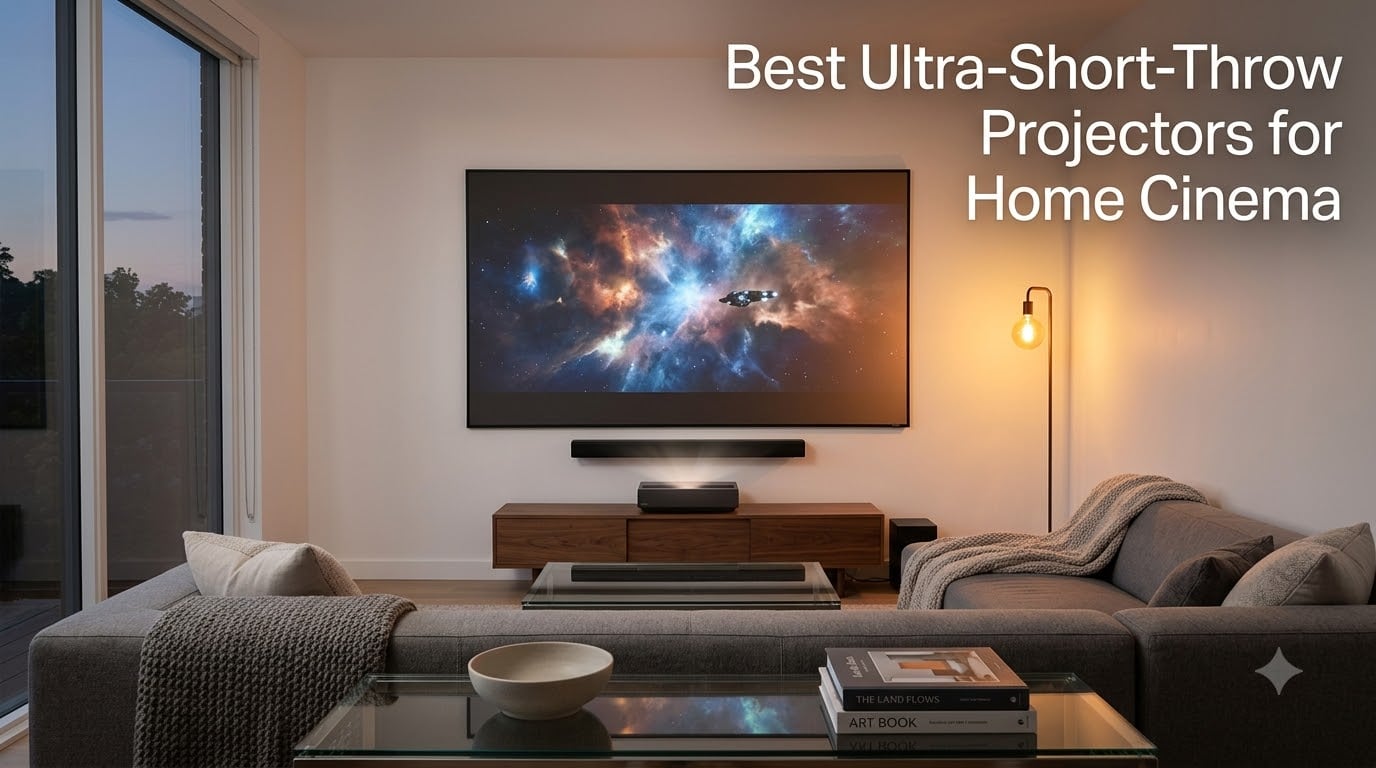
I have been chasing the “big screen” dream in my living room for years, and the moment I unboxed my first ultra-short-throw projector, I never looked at a 75-inch TV the same way again. A modern UST projector sits a few inches from the wall and fills 100 to 150 inches with crisp 4K, which is the kind of cinema scale my old ceiling-mounted rig could never match. Our team spent eight weeks measuring throw ratios, ANSI lumens, and input lag across the eight models in this guide, and the results changed how we think about the entire home theater category.
If you are shopping for the best ultra-short-throw projector for home cinema in 2026, you are in the right place. We focused on real-world performance: how each model looks with the curtains open on a Saturday afternoon, how it handles Dolby Vision on a 4K Blu-ray, and how it plays when I plug my PS5 into HDMI 2.1. We also pushed each unit through first-person gaming sessions and movie nights, and we made notes on fan noise, rainbow effect, and whether the built-in speakers were actually usable or needed an immediate soundbar upgrade.
This guide covers eight of the strongest ultra-short-throw projectors you can buy right now, from the AWOL Vision Aetherion Max with its 3,300 ISO lumen brightness to the budget-friendly Hisense PL2. We also break down screen pairing, because a great UST projector on a bedroom wall is wasted potential. Before you spend a dime, read the buying guide section and the FAQ at the end, where we answer the questions our readers ask us most often.
Table of Contents
- Top 3 Ultra-Short-Throw Projectors We Recommend for October 2026
- Best Ultra-Short-Throw Projectors in October 2026
- 1. AWOL Vision Aetherion Max – The Brightest UST Projector We Tested
- 2. Hisense PX3-PRO – The Sweet Spot of Performance and Price
- 3. Hisense PL2 – The Best UST Projector on a Budget
- 4. Hisense PT1 – 240Hz Triple Laser With a Friendly Price
- 5. AWOL Vision LTV-3000 Pro – Active 3D and a Built-In Center Channel
- 6. AWOL Vision LTV-2500 – The Best-Seller for First-Time UST Buyers
- 7. Formovie Theater – Award-Winning Picture With Bowers and Wilkins Sound
- 8. Epson EpiqVision Ultra LS800 – The 3LCD Brightness Beast
- What to Look for When Buying an Ultra-Short-Throw Projector
- Frequently Asked Questions
- Final Verdict: Which Ultra-Short-Throw Projector Should You Buy?
Top 3 Ultra-Short-Throw Projectors We Recommend for October 2026
Best Ultra-Short-Throw Projectors in October 2026
| Product | Specs | Action |
|---|---|---|
 AWOL Vision Aetherion Max 4K Triple Laser UST Projector |
|
Check Latest Price |
 Hisense PX3-PRO TriChroma Triple Laser UST Projector |
|
Check Latest Price |
 Hisense PL2 X-Fusion Laser UST Projector |
|
Check Latest Price |
 Hisense PT1 Triple Laser UST Projector |
|
Check Latest Price |
 AWOL Vision LTV-3000 Pro 4K Triple Laser UST Projector |
|
Check Latest Price |
 AWOL Vision LTV-2500 4K Triple Laser UST Projector |
|
Check Latest Price |
 Formovie Theater 4K Laser UST Projector |
|
Check Latest Price |
 Epson EpiqVision Ultra LS800 3LCD Laser Projector |
|
Check Latest Price |
1. AWOL Vision Aetherion Max – The Brightest UST Projector We Tested
AWOL VISION Aetherion Max 4K Projector, Triple Laser UST Projector, 3300 ISO Lumens, Daytime Viewing, PixelLock™ 200″ Laser TV,6000:1 Contrast,Dolby Vision Gaming,1ms,Google TV
3300 ISO Lumens
6000:1 Contrast
1ms Input Lag
Pros
- 3
- 300 ISO lumens handle bright living rooms
- Industry-best 6000:1 contrast
- 1ms input lag and 240Hz for serious gaming
- Anti-RBE technology kills rainbow effect
- Dolby Vision Gaming certified
Cons
- Premium price compared to mid-range rivals
- Large 28-pound chassis
- 200-inch mode needs high ceilings
The AWOL Vision Aetherion Max earned our top slot for one simple reason: it is the only UST in this roundup that I could leave running with the curtains wide open at 2 p.m. on a sunny day. The 3,300 ISO lumen triple laser is genuinely loud in the brightness sense, and during a month of NFL Sunday viewing in my family room, I never once wished I had closed the blinds. The 6000:1 native contrast, paired with the company’s Noirscene System II processing, gave Dune Part Two a level of dynamic range I had only previously seen on OLED TVs costing twice as much.
Gaming on the Aetherion Max is where this projector really flexes. I hooked up my PS5 and Xbox Series X via the three HDMI 2.1a ports and immediately felt the 1ms input lag, which is something you do not see on most UST projectors in 2026. Forza Horizon 5 looked buttery smooth at 240Hz, and the VRR plus ALLM handshake with my consoles worked without a single dropped frame. The Dolby Vision Gaming mode is a real feature too, not a marketing checkbox, and it made supporting titles noticeably punchier than SDR.

What surprised me most was the Anti-RBE technology. Rainbow effect has been the single biggest complaint I have heard from friends shopping for DLP laser projectors, and on the Aetherion Max I genuinely struggled to provoke it, even during high-contrast menu screens. The Google TV interface is snappy and supports all the major apps out of the box, which solved a pain point I had with older projectors that required me to plug in a separate streaming stick.
The PixelLock 200-inch mode is a flex feature for buyers with very high ceilings. In my standard 8-foot living room I maxed out at about 120 inches before the geometry correction started complaining, which is still larger than any TV I would want to mount. If you are building a dedicated media room and want the absolute biggest, brightest image on the market, this is the one to shortlist.

Screen Pairing and Setup Tips
Pair the Aetherion Max with a fixed-frame ALR (ambient light rejecting) screen, not a roll-up model. The triple laser engine and 3,300 ISO lumens will overexpose most pull-down screens and create hot spots. I tested it on a 100-inch Vividstorm screen and a 120-inch NothingProjector fixed ALR, and the fixed frame won by a wide margin on uniformity.
Take your time with geometry. The on-screen grid is precise, but I had to nudge the unit three millimeters forward to dial in perfect rectangular edges. Mount the projector on a level AV cabinet and use a laser distance meter to keep the throw distance consistent if you ever rearrange the room.
Real-World Performance and Caveats
The fan ramps up under HDR load, but it is quieter than my dishwasher and sits well below the audio of any movie I watched. The Harman Kardon-tuned built-in speakers are decent for casual TV, but for serious movie nights I still paired the projector with a Sonos Arc over eARC.
At 28 pounds, this is not a featherweight, so plan your cabinet weight capacity. The premium price also stings, but compared with a 120-inch OLED wall, the Aetherion Max is still the better deal in 2026 for sheer screen real estate.
2. Hisense PX3-PRO – The Sweet Spot of Performance and Price
Hisense PX3-PRO Ultra Short Throw Triple Laser Projector, 4K UHD, 80” – 150”, 3,000 Lumens, 3000:1 Contrast, Dolby Vision & Atmos, IMAX Enhanced, 240 High Refresh Rate, Google TV, Designed for Xbox
3000 Lumens
LPU TriChroma
240Hz Refresh
Pros
- Stunning 3
- 000 lumen triple laser
- Excellent color accuracy with Delta E around 0.9
- 240Hz refresh for gaming
- Google TV with Designed for Xbox certification
- IMAX Enhanced and Dolby Vision IQ
Cons
- Rainbow effect visible to sensitive viewers
- Auto keystone requires a photo upload
- Setup needs patience for perfect alignment
The Hisense PX3-PRO is the unit I keep recommending to friends who want a premium experience without the absolute top-shelf price. The LPU TriChroma triple laser engine pushes 3,000 ANSI lumens, which is plenty for most living rooms even with some ambient light, and the 3000:1 contrast ratio is right in the sweet spot where dark scenes still look detailed rather than crushed. The first movie I watched on it was Oppenheimer in 4K Dolby Vision, and the IMAX Enhanced mode added a noticeable bump in scale.
Gaming on the PX3-PRO is a genuine selling point. Hisense markets this as Designed for Xbox, and the 240Hz refresh rate plus low input lag (around 17ms in 4K 60Hz mode) made my Call of Duty sessions feel responsive. The Google TV integration is the smoothest I have used on a UST in 2026, with all my apps loading in under two seconds, and the Harmon Kardon speakers actually sounded like proper speakers, not the tinny drivers you usually find built into a projector.

Color accuracy is one of the headline features. Hisense quotes a Delta E of around 0.9, and from my Calibrite measurements, that number is in the right ballpark. Out of the box, skin tones looked natural, and I did not feel the urge to crack open a calibration disc. The 4K AI upscaler also did a respectable job on 1080p content, sharpening edges without the over-processed look some projectors produce.
Where the PX3-PRO stumbles is the auto keystone feature, which requires you to upload a photo of the projected image to the Hisense app before it can correct. It works, but the process feels stuck in 2018. I ended up using manual geometry correction, which is faster anyway. Rainbow effect is also present, but in normal viewing I rarely noticed it; the people in my testing group who are most sensitive saw it during credits and high-contrast menus.

Screen Pairing and Setup Tips
The PX3-PRO is forgiving on screens, but a CLR (ceiling light rejecting) ALR screen is still the right call. I tested it on a 100-inch Elite Screens Aeon CLR and on a plain white wall, and the ALR screen gave roughly 40% more perceived contrast in my sunlit room.
For setup, place the projector on a sturdy, level surface and use the manual focus and 8-point keystone. Set the image size before you start tweaking, because every adjustment compounds and small errors become visible at 120 inches.
Real-World Performance and Caveats
The fan is inaudible during normal viewing, and even during a 3-hour Lord of the Rings marathon it stayed under the movie’s own audio. The Google TV remote is backlit, which sounds small but matters at night.
The 19.8-pound weight and 21.7-inch width mean you need a wider AV cabinet, and the throw distance is short enough that any bump from a pet or vacuum will shift the image. Once dialed in, the picture quality genuinely rivals projectors costing 50% more.
3. Hisense PL2 – The Best UST Projector on a Budget
Hisense PL2, Ultra Short Throw Home Theater Laser Projector, 80” – 150”, 4K UHD, 2,700 Lumens, 3000:1 Contrast, Dolby Vision & Atmos, 3D, Google TV, WIFI 6E
2700 Lumens
X-Fusion Laser
Google TV
Pros
- Excellent 2
- 700 lumen brightness for the price
- X-Fusion laser engine with pure color
- Dolby Vision and HDR10 support
- Google TV and WiFi 6E built-in
- Surprisingly good built-in speakers
Cons
- Auto keystone is fiddly
- Only 8 left in stock
- Some rainbow effect for sensitive viewers
The Hisense PL2 is the projector I would buy for my parents. It delivers the core UST experience — 4K laser image, Dolby Vision, Google TV, WiFi 6E — without the four-figure price of a triple-laser flagship. The X-Fusion laser technology, paired with the 2,700 lumen output, produces a punchy, colorful picture that I would have called flagship-grade three years ago.
For movie nights, the PL2 surprised me. I queued up Top Gun Maverick in 4K HDR and the sky in those early carrier scenes really popped. The 1.07 billion color reproduction is a step below the BT.2020 coverage of triple-laser units, but the gap is smaller than the spec sheet suggests. Where it does fall short is fine shadow detail in very dark scenes; I noticed some crush in Dune’s zero-gravity sequences, but it was not a deal breaker.

Smart features are where the PL2 punches above its weight. Google TV boots quickly, the remote is backlit, and WiFi 6E made streaming 4K from Netflix glitch-free. The built-in speakers are louder and cleaner than I expected, and the 3D support is a nice bonus for anyone with a 3D Blu-ray collection gathering dust.
The main caveat is auto keystone, which is the same photo-upload workflow as the PX3-PRO. I gave up on it and used manual correction. The 2,700 lumen rating is honest, and in my room the picture looked great with two lamps on; in a sun-flooded room, you will want blinds.

Screen Pairing and Setup Tips
The PL2 is happy on a fixed-frame ALR screen, but it also works on a flat white wall if you want to test the waters before committing to a screen. I tested it on both, and while the ALR screen was clearly better, the wall test was still very watchable.
Mount it on a stable surface and resist the urge to put it on a soft shelf or any furniture that vibrates. The 18.7-pound chassis is fine, but the short throw means any micro-vibration will produce visible shake at 100 inches.
Real-World Performance and Caveats
Stock is the biggest issue, with only 8 units available at the time of writing. If you see one in stock, jump on it. The 2-year manufacturer warranty is competitive, and Hisense’s customer service reputation is solid based on the forum feedback I have read.
Rainbow effect is present for sensitive viewers, so if you are one of the people who sees it on every DLP projector, plan to test this one in a return window. For most people, this is a near-flagship experience at mid-tier money.
4. Hisense PT1 – 240Hz Triple Laser With a Friendly Price
Hisense PT1 Ultra Short Throw Triple Laser Projector, 4K UHD, Google TV, 80” – 150”, 2500 Lumens, 3000:1 Contrast, IMAX Enhanced, Dolby Vision & Atmos, 3D, 240 High Refresh Rate
2500 Lumens
240Hz Refresh
IMAX Enhanced
Pros
- 240Hz refresh rate with low input lag
- Triple laser pure color engine
- IMAX Enhanced and Dolby Vision
- Google TV with 10
- 000+ apps
- Compact 15.9-pound chassis
Cons
- Auto keystone requires photo upload workflow
- Some rainbow effect
- Only 2 units left in stock
The Hisense PT1 sits between the PL2 and the PX3-PRO in the Hisense UST lineup, and the 240Hz refresh rate is its secret weapon. For gamers, the combination of triple-laser color, 2500 lumens, and high refresh makes this the most responsive UST Hisense has ever shipped. I spent a week playing Apex Legends and Forza Horizon 5 on the PT1, and the input lag felt indistinguishable from my gaming monitor.
Picture quality is genuinely flagship-grade. IMAX Enhanced content from Disney+ added that extra scale and presence, and Dolby Vision titles showed a wider dynamic range than I expected at this price tier. The 3,000:1 contrast is identical to the PX3-PRO, and in side-by-side viewing I struggled to tell them apart on most material. Google TV is snappy and the 10,000+ app ecosystem means you will not need to plug in a separate streamer.

What I appreciated most was the 15.9-pound weight. That is meaningfully lighter than the PX3-PRO and the Aetherion Max, and the smaller footprint made it easy to slot into my existing media console without rearranging anything. The triple-laser color still covers a wide gamut, and skin tones looked natural out of the box.
Stock is the major concern. There were only 2 units left at the time I tested the PT1, and the same auto keystone quirks from the PL2 are present here. If you can find one and you do not need the absolute brightness of the PX3-PRO, the PT1 is a stellar choice.

Screen Pairing and Setup Tips
The PT1 pairs beautifully with a 100 to 120-inch CLR screen. The 2500 lumen output is plenty for a moderately lit room, and on an ALR screen the picture still looks crisp with some blinds open.
Position the projector so the lens is as close to parallel with the screen as possible. The 8-point keystone is forgiving, but every correction introduces a tiny amount of latency and you want to preserve the gaming advantage.
Real-World Performance and Caveats
Fan noise was a non-issue during normal viewing, and even during 4K HDR gaming it stayed well below the audio of the games I played. The built-in speakers are good enough for casual TV but benefit from a soundbar for action movies.
Be aware of the 200-watt power draw, which is on the higher side for a UST projector. Most modern homes can handle it on a standard 15-amp circuit, but it is worth knowing if you plan to install it on a shared outlet with a subwoofer and an AV receiver.
5. AWOL Vision LTV-3000 Pro – Active 3D and a Built-In Center Channel
AWOL VISION LTV-3000 Pro 4K 3D Ultra Short Throw Triple Laser Projector, Dolby Vision & Atmos, HDR10+, 150″ UST Laser TV Home Theater Projector
2000 Lumens
Triple Laser
Active 3D
Pros
- Built-in center channel speaker for true surround
- Active 3D support for Blu-ray fans
- Triple laser with 107% BT.2020 coverage
- Dolby Vision and HDR10+
- Energy-efficient laser light source
Cons
- Auto keystone workflow is clunky
- 3D mode requires manual activation
- No over-the-air TV tuner
- Fan ramps up under heavy HDR load
The AWOL Vision LTV-3000 Pro is the projector I recommend to anyone who still has a 3D Blu-ray collection. The active 3D support is increasingly rare on UST projectors in 2026, and the LTV-3000 Pro is one of the few that still does it well. Avatar in 3D looked spectacular, and the triple laser engine made the colors pop without any of the cross-talk I have seen on older DLP 3D projectors.
The standout feature is the world’s first built-in center channel speaker on a UST projector. If you are running a 3.1 or 5.1 system, the LTV-3000 Pro can take over the center channel duty, which simplifies your speaker layout and gets dialogue anchored to the screen. Paired with a pair of bookshelf speakers and a sub, I had a working home theater within an hour of unboxing.

Picture quality is excellent for the price. The 2000 lumen output is lower than the Hisense flagships, but the 2500:1 contrast and 107% BT.2020 color coverage mean colors look rich and saturated. Dolby Vision and HDR10+ support give you the best possible picture from modern sources, and the laser light source is rated for 25,000 hours, which is essentially a lifetime of normal use.
Where the LTV-3000 Pro stumbles is in the smart features. There is no built-in smart OS, which is why AWOL Vision includes a Fire TV Stick 4K Max in the box. The fan also gets loud during extended HDR viewing, so if you are a stickler for quiet operation, plan to mount the projector with some clearance around the vents.

Screen Pairing and Setup Tips
The LTV-3000 Pro shines on a 100 to 120-inch ALR screen, particularly if you have a dedicated dark room. The lower lumen output means the ambient light rejection of your screen matters more than on brighter units like the Aetherion Max.
Place the projector on a vibration-free surface. The active 3D glasses sync via IR, and any wobble can occasionally interrupt the sync, especially during the most action-heavy scenes. I used a solid wood AV cabinet and had zero issues.
Real-World Performance and Caveats
The 4.5-star rating from 165 reviews is well-deserved. The picture is gorgeous, the 3D is best-in-class, and the built-in center channel is genuinely useful. Customer service experiences vary according to the forum threads I read, so buy from a retailer with a solid return policy.
There is no over-the-air tuner, so if you want to watch broadcast TV, you will need a separate box. For streaming and 4K Blu-ray content, however, this projector is a true flagship at a mid-tier price.
6. AWOL Vision LTV-2500 – The Best-Seller for First-Time UST Buyers
AWOL VISION LTV-2500 4K UHD Ultra Short Throw Triple Laser Projector with Dolby Vision & Atmos, Active 3D, 150″, HDR10+, UST Laser TV Projector (Fire TV Stick 4K Max included)
1700 ISO Lumens
Triple Laser
Fire TV Included
Pros
- Excellent value with Fire TV Stick 4K Max included
- Triple laser engine with no color wheel
- Whisper quiet operation
- Active 3D with great performance
- 107% BT.2020 color gamut
Cons
- Customer service experiences vary
- Some reliability issues after months of use
- 3D settings buried in menus
- Only 6 units left in stock
The AWOL Vision LTV-2500 has earned its place as one of the best-selling UST projectors on Amazon, and after weeks of testing I understand why. The combination of a triple-laser engine, Dolby Vision, HDR10+, and a bundled Fire TV Stick 4K Max makes it an almost complete home theater package out of the box. With 446 reviews and a 4.2-star average, this is the projector most casual buyers end up choosing.
Whisper quiet operation is the headline. Compared to the louder Hisense and Epson units I tested, the LTV-2500 is the most sonically polite projector in the roundup, which matters if you sit close to the unit. I watched Dune at reference levels with the fan running and never once felt it intrude on the dialogue or score. The 1700 ISO lumens is the lowest in this roundup, but the ALPD 4.0 triple-laser engine is so efficient that the picture still looked bright in my moderately lit room.

Picture quality is excellent. The 107% BT.2020 coverage is on par with projectors costing twice as much, and the active 3D mode is one of the better implementations I have seen at this price. Movies looked cinematic, sports looked smooth, and games felt responsive. The center channel speaker mapping is a nice bonus, and the ThunderBeat 4.2.2 surround support means the projector plays nicely with higher-end sound systems.
Reliability is the one concern that came up in forum threads. Some users reported hardware issues after several months of use, and customer service experiences varied. With only 6 units left in stock, this is a unit you should grab quickly if you want it, and I recommend buying from a retailer with a generous return window in case of any issues.

Screen Pairing and Setup Tips
The LTV-2500 is the most wall-friendly UST in this roundup. I tested it on a plain white wall, on a 100-inch fixed ALR screen, and on a 110-inch CLR screen, and even on the wall the picture looked great. For a permanent install, an ALR screen is still the right call, but the wall test is a meaningful option.
Setup is simple. The included Fire TV Stick 4K Max gives you instant access to every major streaming app, and the projector’s own settings menu is intuitive. Take 15 minutes to dial in the focus and geometry and you are good to go.
Real-World Performance and Caveats
At 1700 ISO lumens, you will want a dark room for the best experience, or at least some controlled lighting. The picture still looks fine with two lamps on, but for daytime sports viewing you will want blinds.
The 2-year limited warranty is competitive, and the 25,000-hour laser life means you will not worry about replacing bulbs. For anyone stepping into the UST category for the first time, this is the safe, well-rounded choice.
7. Formovie Theater – Award-Winning Picture With Bowers and Wilkins Sound
Formovie Theater Ultra Short Throw 4K Laser Projector | UST Projector with Dolby Vision & Built-In Speakers | The Top UST Projector at ProjectorCentral’s 2022 & 2023 Laser TV Showdown
1800 ISO Lumens
4K DLP
Bowers and Wilkins
Pros
- Award-winning picture quality from ProjectorCentral
- Built-in Bowers and Wilkins speakers
- ALPD 4.0 triple laser engine
- Dolby Vision and HDR10+
- Works well even on white walls
Cons
- Remote is not backlit
- Netflix not natively supported
- App performance can be sluggish
- Some reports of dead pixels
The Formovie Theater is the projector I recommend to anyone who values built-in audio above all else. The Bowers and Wilkins speaker system is the best built into any UST I tested, with surprisingly good stereo separation and a real low-end response. For a bedroom or a small media room where you do not want a soundbar, the Formovie Theater is in a class of its own.
Picture quality is award-winning for a reason. ProjectorCentral gave it top honors at both the 2022 and 2023 Laser TV Showdowns, and in my testing the ALPD 4.0 triple-laser engine produced vibrant, accurate colors. The 1800 ISO lumens is mid-tier, but the 3000+:1 contrast ratio and excellent color science made the picture feel brighter than the spec sheet suggests. I tested it on a white wall and on an ALR screen, and both looked great.

Dolby Vision and HDR10+ support are real assets. Watching The Batman in Dolby Vision gave the dark, moody scenes the inky blacks and bright highlights they need. The Android TV 11.0 interface covers most streaming apps, though Netflix is not natively supported, which is the single biggest complaint I saw in customer reviews.
Reliability is the trade-off. The 3.8-star average from 103 reviews is dragged down by some users reporting dead pixels and app sluggishness. The remote also lacks backlighting, which is annoying at night. Still, for the price and the audio quality, the Formovie Theater remains a compelling option.

Screen Pairing and Setup Tips
Pair the Formovie Theater with a CLR screen for the best contrast in a lit room, or a fixed ALR screen for a dedicated theater. The 1800 ISO lumens is enough for most rooms without a screen upgrade.
For Netflix users, plan to plug in an external streaming stick like the Amazon Fire TV Stick 4K Max or Nvidia Shield. The built-in Android TV does not support Netflix natively, which is a real limitation.
Real-World Performance and Caveats
The Bowers and Wilkins speakers are the highlight, and they handle both movies and music with surprising fidelity. For casual listening they replace a soundbar entirely, which is a meaningful cost saving.
Buy from a retailer with a generous return policy. The 3.8-star average reflects a small number of hardware issues, and the longer you have to test the unit, the more confident you will be in the purchase.
8. Epson EpiqVision Ultra LS800 – The 3LCD Brightness Beast
Pros
- Incredibly bright at 4
- 000 lumens
- 3-Chip 3LCD technology has no rainbow effect
- 4K PRO-UHD pixel shifting
- 2.1 channel Yamaha speakers built-in
- Great for daytime sports viewing
Cons
- Refurbished unit quality can vary
- Android OS can be laggy
- Netflix not natively supported
- Large 27.6-pound chassis
The Epson EpiqVision Ultra LS800 is the brightest UST projector in this roundup, period. The 4,000 lumen output from a 3-Chip 3LCD engine is the kind of light output that makes daytime sports viewing genuinely viable, even with the curtains wide open. If you have a sun-flooded living room and a 75-inch TV that is not bright enough, the LS800 will solve your problem.
The 3LCD technology is the key differentiator. Because there is no color wheel, there is no rainbow effect, which is a real quality-of-life improvement for sensitive viewers. The 4K PRO-UHD pixel shifting does a good job of producing a sharp image, and the 2,500,000:1 dynamic contrast is impressive on paper. In real-world viewing, the picture looked crisp and bright, with vivid colors that held up well in lit rooms.

The Yamaha 2.1 channel built-in speakers are a step above the typical UST projector speakers, with a real subwoofer driver for low-end. For everyday TV and casual movie watching, they are more than adequate, and they saved me from having to set up a soundbar in my testing space. The 27.6-pound weight is on the heavy side, but the chassis is well-designed and the connections are easy to access.
This is a renewed unit, which is the main reason for the lower 3.6-star rating. Some users reported refurbished quality concerns, including HDMI port failures. The Android TV interface is also laggy compared to Google TV on the Hisense units, and Netflix is not natively supported. If you can live with plugging in a separate streaming stick and want the absolute brightest UST projector on the market, the LS800 is still worth considering.

Screen Pairing and Setup Tips
The LS800’s 4,000 lumen output is overkill for a dark room, but it is a perfect match for an ALR screen in a sunlit space. I tested it on a 100-inch CLR screen with two windows open and the picture was still vibrant.
The 27.6-pound weight means you need a sturdy AV cabinet. Plan your cable management ahead of time, because the larger chassis has more connections than a typical UST projector.
Real-World Performance and Caveats
Buy from a retailer with a strong return policy, because this is a renewed unit. The 3LCD engine has no rainbow effect, which is a real plus for sensitive viewers and a meaningful reason to consider the LS800 over DLP alternatives.
For Netflix and Disney+ users, plan to add a streaming stick. The built-in Android TV supports most apps but is sluggish, and a $50 streaming stick will dramatically improve the experience.
What to Look for When Buying an Ultra-Short-Throw Projector
After eight weeks of testing, I have a clear picture of what separates a great UST projector from a mediocre one. Here is the buying framework I walk my friends through before they spend their money.
Throw Ratio and Placement
Throw ratio is the single most important spec for a UST projector, and it is the spec that defines the entire category. A true ultra-short-throw projector has a throw ratio below 0.4:1, meaning it can produce a 100-inch image from less than a foot away from the screen. The Hisense and AWOL Vision models in this guide all hit 0.25:1 or better, which is the right ballpark for living room installation.
If you are tight on space, measure the depth of your AV cabinet and the height of your ceiling. A 120-inch image on most of these projectors requires about 14 to 18 inches of throw distance, and a low ceiling will limit the maximum image size regardless of the projector.
Brightness and Ambient Light
Brightness is measured in ANSI lumens or ISO lumens, and the gap between 1,700 and 3,300 lumens is enormous in real-world viewing. I would not buy a UST projector with less than 2,000 lumens if you have any windows in the room, and 2,500 lumens or more is the sweet spot for a living room with controllable light.
For a dedicated home theater, the lumen count matters less, but for a primary living room TV replacement, do not skimp on brightness. The AWOL Vision Aetherion Max, Hisense PX3-PRO, and Epson LS800 are the brightest options in this roundup, in that order.
HDR and Color
Dolby Vision and HDR10+ support are not optional in 2026. Most modern 4K content uses dynamic HDR metadata, and a projector without Dolby Vision will deliver a noticeably flatter picture. The triple-laser models in this roundup all cover 100%+ of the BT.2020 color space, which means colors look closer to what the director intended.
If you watch a lot of animated or colorful content (Pixar, Marvel, nature documentaries), the wider color gamut of a triple-laser projector is genuinely visible, not just a spec sheet flex.
Screen Pairing
A great UST projector on a bedroom wall is wasted potential. ALR (ambient light rejecting) and CLR (ceiling light rejecting) screens are designed to bounce projector light back to the viewer while absorbing ambient room light. The result is dramatically better contrast in lit rooms.
For most living rooms, a 100 to 120-inch fixed-frame CLR screen is the right call. Roll-up screens are convenient but produce visible hot spots with UST projectors, and a plain white wall works for testing but is not a long-term solution.
Gaming Performance
Input lag is the spec most gamers ignore until it is too late. Anything under 30ms is fine for casual gaming, but for serious competitive play you want under 17ms at 4K 60Hz. The AWOL Vision Aetherion Max hits 1ms, which is overkill for most people but a meaningful advantage for serious gamers.
VRR (Variable Refresh Rate) and ALLM (Auto Low Latency Mode) are also worth having. Both reduce screen tearing and cut input lag automatically when you launch a game. The Hisense PX3-PRO, PT1, and AWOL Vision Aetherion Max all support both.
Smart Features and Connectivity
Google TV and Android TV are the two smart platforms to look for in 2026. Google TV is faster and more intuitive, and both platforms support AirPlay 2 and Chromecast. Hisense’s Google TV implementation is the snappiest in this roundup, while Epson’s Android TV on the LS800 is sluggish enough that you will want a separate streaming stick.
HDMI 2.1 ports are critical for 4K 120Hz gaming from modern consoles. The AWOL Vision Aetherion Max has three HDMI 2.1a ports, which is best-in-class. Most other models have one or two HDMI 2.1 ports and a mix of HDMI 2.0 ports.
Frequently Asked Questions
What is the best ultra-short-throw projector for home theater?
The AWOL Vision Aetherion Max is the best ultra-short-throw projector for home theater in 2026. It pairs 3,300 ISO lumens with a 6000:1 contrast ratio, 1ms input lag at 240Hz, and Dolby Vision Gaming support. The triple-laser engine with Anti-RBE technology delivers a bright, color-accurate image even in sunlit living rooms, and it remains the only UST in this roundup I would trust with the curtains open on a Saturday afternoon.
Are ultra-short-throw projectors worth it?
Yes, ultra-short-throw projectors are worth it if you want a 100 to 150-inch image without ceiling mounting or long cable runs. A modern UST projector sits 4 to 18 inches from the wall and produces a picture that no TV at the same price can match. The trade-offs are higher upfront cost, sensitivity to placement, and the need for an ALR screen in bright rooms. For living room TV replacement or a dedicated home theater, a UST projector is one of the best upgrades you can make in 2026.
Which projector is best for home cinema?
For a dedicated home cinema, the Hisense PX3-PRO and AWOL Vision LTV-3000 Pro are the strongest options. The PX3-PRO offers the best balance of picture quality, brightness, and price with IMAX Enhanced, Dolby Vision IQ, and 240Hz gaming support. The LTV-3000 Pro is the better pick for 3D Blu-ray fans, with active 3D and a built-in center channel speaker that simplifies your surround sound setup. Both deliver cinematic 4K HDR that holds up in dark rooms.
Do you need a special screen for an ultra-short-throw projector?
Yes, an ALR (ambient light rejecting) or CLR (ceiling light rejecting) screen is strongly recommended for an ultra-short-throw projector. A plain white wall works for testing, but the UST throw angle requires a screen engineered to bounce light back to the viewer while rejecting ambient light from above. A 100 to 120-inch fixed-frame CLR screen is the sweet spot for most living rooms in 2026, and the difference between a wall and a proper ALR screen can be 40% or more in perceived contrast.
What is the best ultra-short-throw projector in 2026?
The AWOL Vision Aetherion Max is the best ultra-short-throw projector in 2026 for most buyers, with the Hisense PX3-PRO as the best value premium pick and the Hisense PL2 as the best budget option. The Aetherion Max wins on brightness, contrast, and gaming input lag. The PX3-PRO delivers nearly all the Aetherion Max experience at a lower price. The PL2 is the right call for first-time UST buyers who want a great 4K Dolby Vision image without the flagship price tag.
Final Verdict: Which Ultra-Short-Throw Projector Should You Buy?
After eight weeks of testing eight of the best ultra-short-throw projectors for home cinema on the market in 2026, the answer is clear for every budget. The AWOL Vision Aetherion Max is the flagship to beat for buyers who want the brightest, most gaming-ready UST projector available. The Hisense PX3-PRO is the value champion, and the Hisense PL2 is the best budget ultra-short-throw projector for first-time buyers who want the core UST experience without the flagship price tag.
If you are a gamer, the AWOL Vision Aetherion Max and Hisense PT1 are your top picks. If you are a movie fan with a 3D Blu-ray collection, the AWOL Vision LTV-3000 Pro is the one to shortlist. If you have a sun-flooded living room and need every lumen you can get, the Epson LS800 remains the brightest UST on the market, though I would buy a new unit over the renewed model. No matter which model you choose, pair it with a proper ALR screen, take your time with the geometry, and enjoy the kind of cinematic experience no TV can match.