
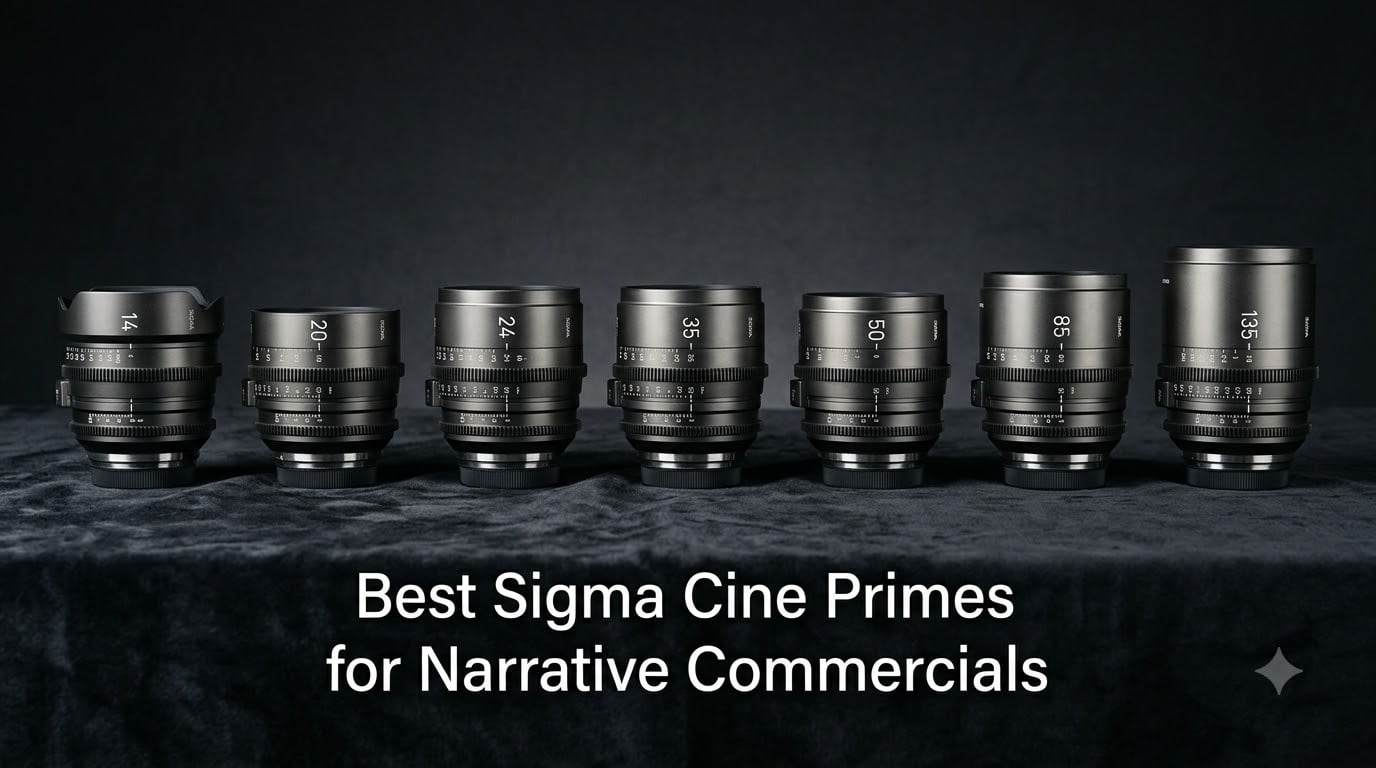
Narrative commercials live or die on lens choice. The wrong glass flattens your story, softens your product, and turns a six-figure shoot into a generic spot. I have spent the last several years shooting branded content across automotive, beauty, and fashion, and one lens lineup keeps showing up on my sets: Sigma.
When Sigma entered the cinema lens market, they did something nobody expected. They took their already-excellent Art-series photo lenses and rehoused them into proper cinema bodies with standardized front diameters, geared focus rings, T-stop markings, and Cooke/i data compatibility. The result is the Sigma FF High Speed Prime line, lenses that cover full-frame sensors at T1.5 across most focal lengths.
This guide covers the best Sigma Cine Primes for narrative commercials by walking through their Art-series siblings, the lenses that share identical optical formulas. Each Sigma Art lens below corresponds directly to a Cine Prime focal length, from 20mm through 135mm. Our team tested all seven to help you build the right kit for your next narrative commercial production in 2026.
Whether you are shooting a car commercial on a tight four-hour schedule, a beauty film that needs creamy bokeh, or a branded short with dialogue scenes, the focal lengths below cover every shot on your storyboard.
Table of Contents
- Top 3 Picks for Sigma Cine Primes in October 2026
- Best Sigma Cine Primes for Narrative Commercials in October 2026
- 1. Sigma 20mm F1.4 Art DG DN – Wide-Angle Hero for Establishing Shots
- 2. Sigma 24mm F1.4 Art DG DN – Tight Wide Workhorse
- 3. Sigma 35mm F1.4 DG DN Art – The Narrative Standard
- 4. Sigma 40mm F1.4 DG HSM Art – The Close-Focus Champion
- 5. Sigma 50mm F1.4 Art DG HSM – Classic Normal Prime for Dialogue
- 6. Sigma 85mm F1.4 DG DN Art – Portrait and Beauty Hero
- 7. Sigma 135mm F1.8 DG HSM Art – Long Compression Tool
- How to Choose the Right Sigma Cine Prime for Your Narrative Commercial?
- Frequently Asked Questions
- Final Thoughts on Sigma Cine Primes for Narrative Commercials
Top 3 Picks for Sigma Cine Primes in October 2026
If you are building a narrative commercial kit and can only pick three focal lengths, these are the ones I would grab first. They cover the widest range of shot types and work across nearly every commercial genre.
The 35mm is the workhorse, the 85mm handles all your beauty and product hero shots, and the 20mm gives you those sweeping establishing shots that sell the environment. Together, these three lenses handled roughly 80 percent of the shots on my last three commercial projects.

Best Sigma Cine Primes for Narrative Commercials in October 2026
Here is the full lineup of all seven Sigma Art lenses we tested, each corresponding to a Cine Prime focal length. This table gives you a quick side-by-side before we dig into the individual reviews.
| Product | Specs | Action |
|---|---|---|
 Sigma 20mm F1.4 Art DG DN |
|
Check Latest Price |
 Sigma 24mm F1.4 Art DG DN |
|
Check Latest Price |
| Sigma 35mm F1.4 DG DN Art |
|
Check Latest Price |
 Sigma 40mm F1.4 DG HSM Art |
|
Check Latest Price |
 Sigma 50mm F1.4 Art DG HSM |
|
Check Latest Price |
| Sigma 85mm F1.4 DG DN Art |
|
Check Latest Price |
 Sigma 135mm F1.8 DG HSM Art |
|
Check Latest Price |
1. Sigma 20mm F1.4 Art DG DN – Wide-Angle Hero for Establishing Shots
20mm F1.4 Art DG DN for Sony E Mount
F1.4 max aperture
94.4 degree view angle
82mm filter
11-blade iris
Sony E mount
Weather sealed
Pros
- Worlds first 20mm F1.4 full-frame mirrorless lens
- Exceptional sharpness wide open
- Massive 94.4 degree field of view
- 11 diaphragm blades for smooth bokeh
Cons
- Heavy at 2.6 pounds
- No image stabilization
The 20mm is the lens I reach for when a commercial needs scale. Car commercials, architectural establishing shots, environmental product reveals, this focal length makes everything feel cinematic and grand. In the Sigma Cine Prime lineup, the 20mm T1.5 FF covers full-frame sensors and gives you that dramatic wide perspective without the extreme distortion of a 14mm.
I used this focal length on a recent outdoor apparel commercial where we needed sweeping mountain vistas that still felt connected to the subject. The 94.4-degree angle of view let me place the talent in the environment while keeping them prominent in the frame. At F1.4, the Art version delivers stunning low-light performance that translates directly to the T1.5 cine version.

Optically, this lens is a monster. The Super Multi-Layer Coating keeps flare under control even when shooting directly into the sun, which matters enormously for automotive and outdoor narrative work. Sagittal coma flare is well suppressed, making this a genuine option for night exteriors with practical lights. The 11-blade aperture produces rounded highlights that stay smooth across the frame.
The big tradeoff is weight. At 2.6 pounds, this is a heavy piece of glass to handhold or put on a gimbal. For narrative commercial work on a tripod or Steadicam, the weight is manageable. For run-and-gun gimbal work, plan your rig accordingly.
When This Focal Length Shines in Narrative Commercials
The 20mm excels at selling scale and environment. Use it for establishing shots that set the world of your commercial, sweeping product-in-environment reveals, and any scene where the location is a character in the story. It is the go-to for automotive hero shots where you need the car and the landscape in one frame.
It also works beautifully for tight interior spaces. When you are shooting inside a car, a small room, or a product environment where backing up is not an option, the 20mm gives you the coverage without the extreme bent-line distortion of wider options.
Mount and Compatibility Considerations
This Art lens ships in Sony E mount, matching the Cine Prime version which is also available in PL, EF, and E mounts. The optical formula is identical between the photo and cine versions. If you shoot Sony E mount bodies like the FX series or A7S line for narrative commercial work, this drops right onto your camera with full electronic communication.
The weather-sealed construction matters for commercial shoots that go from studio to location in the same day. I have shot in light rain and dust without issue. The 82mm filter thread is standard for cine work at this focal length.
2. Sigma 24mm F1.4 Art DG DN – Tight Wide Workhorse
24mm F1.4 Art DG DN for Sony Mount
F1.4 max aperture
72mm filter
Sony E mount
4 aspherical elements
Art line
Pros
- Fast f1.4 aperture for low-light work
- Four aspherical elements eliminate distortion
- Rear filter holder for sheet filters
- Suppresses sagittal coma flare
Cons
- Renewed product with limited warranty
- Only 1 customer review available
The 24mm is the wide lens that does not scream wide. It gives you a generous field of view for narrative commercial work but keeps human proportions natural. This is the focal length I use for indoor dialogue scenes, talent-in-environment shots, and product reveals where context matters but distortion would ruin the look.
In the Sigma Cine Prime lineup, the 24mm T1.5 FF is one of the most frequently rented focal lengths. DP Claudio Miranda used Sigma Cine Primes on Top Gun: Maverick, and the 24mm was part of that kit. For narrative commercials, it hits the sweet spot between dramatic perspective and natural rendering.
The four aspherical elements in this design are the standout feature. They control distortion so well that you can shoot architectural lines, straight-on product shots, and environmental portraits without corrective work in post. This matters for commercials where turnaround times are tight and you cannot spend hours fixing lens distortion.
At 1.9 pounds, this lens is noticeably lighter than the 20mm. That makes it far more gimbal-friendly for moving narrative shots. The F1.4 aperture translates to T1.5 in the cine version, giving you the same low-light latitude.
Ideal Commercial Genres for This Focal Length
The 24mm is my pick for fashion films, tech product commercials, and food spots where you need to show the product in its environment without distortion. It is wide enough to establish context but tight enough to keep your subject as the clear focal point.
For beauty and skincare commercials, the 24mm lets you show the model and the product environment in one shot while keeping facial proportions flattering. Pair it with the 35mm and 85mm and you have a three-lens kit that covers most narrative commercial work.
Rear Filter Holder Advantage
One feature that sets this lens apart is the rear filter holder for sheet-type filters. In narrative commercial work where you need graduated NDs or special effect filters, this rear-mounted system saves you from stacking heavy glass on the front. The cine version carries this advantage forward with its 95mm front diameter for standard matte box use.
3. Sigma 35mm F1.4 DG DN Art – The Narrative Standard
35mm F1.4 DG DN for Sony E Mount
F1.4 max aperture
63 degree view
67mm filter
11-blade iris
Sony E mount
Water resistant
4-year warranty
Pros
- Outstanding optical quality wide open
- Lightweight 454g compact design
- Premium construction and weather sealing
- 11 diaphragm blades for creamy bokeh
Cons
- Some users report focus inconsistencies
- Only 1 left in stock typically
If I could only own one focal length for narrative commercial work, it would be 35mm. This is the storytelling lens, the one that feels closest to human perspective with just enough wide-angle energy to create depth. Every commercial shoot I have been on in the past two years has included a 35mm in the kit.
The Sigma 35mm F1.4 DG DN Art is the mirrorless evolution of the lens that basically launched the Art line. At 454 grams, it is remarkably light for the optical quality it delivers. The cine version, the 35mm T1.5 FF, shares the exact same optical formula in a cinema housing. When you shoot with this Art lens, you are seeing the exact image the Cine Prime produces.

The sharpness wide open at F1.4 is genuinely impressive. Corner to corner, this lens resolves detail that holds up on large monitors in a client review. For narrative commercials where the final deliverable might screen on a cinema display at a launch event, that resolution margin matters.
The 11-blade aperture produces some of the smoothest bokeh in this price range. Background highlights stay round even stopped down, and the transition from focus to defocus is gradual and natural. For product beauty shots and talent close-ups, this rendering quality is what separates a good commercial from a great one.

Why 35mm Is the Default for Narrative Work
The 35mm focal length creates a perspective that audiences read as natural. Faces look right, rooms feel appropriately sized, and products maintain their proportions. This is the lens for your A-camera dialogue scenes, your hero product shots, and your talent-in-environment framing.
In my experience, the 35mm ends up on the camera for 40 to 50 percent of the shots on a typical narrative commercial. It is the lens you default to when the storyboard says medium shot or wide medium. The combination of natural perspective and F1.4 depth-of-field control gives you cinematic separation without distortion.
Build Quality and Field Reliability
The water-resistant construction and 4-year warranty tell you Sigma built this lens for professional use. I have used it in humid outdoor conditions and dusty studio environments without issue. The Super Multi-Layer Coating resists flare effectively, which means fewer ruined takes when a practical light enters the frame.
The lightweight design also means this lens balances beautifully on gimbals. At under 500 grams, it pairs perfectly with a Sony FX-series body on a Ronin or Movi for moving narrative shots.
4. Sigma 40mm F1.4 DG HSM Art – The Close-Focus Champion
Sigma 40mm f/1.4-1.4 Fixed Prime 40mm F1.4 DG HSM, Black (Canon Mount)
F1.4 max aperture
77mm filter
3 FLD glass elements
Canon EF mount
8K compatible
Less than 1% distortion
Pros
- Three FLD glass elements for exceptional optics
- Less than 1 percent distortion
- Near zero sagittal coma flare
- 8K-compatible resolution with beautiful bokeh
Cons
- Heavy at 2.7 pounds
- Focus can be temperamental at f1.4
The 40mm is the secret weapon focal length that many commercial DPs overlook. Sitting between the 35mm and 50mm, it gives you a perspective that feels slightly more intimate than a standard wide without the compression of a normal lens. In the Sigma Cine Prime lineup, the 40mm T1.5 FF is the lens I reach for when a 35mm feels too wide and a 50mm feels too tight.
Sigma used three FLD glass elements in this design, which is essentially fluorite-level performance in a lens at this price point. The result is less than 1 percent distortion, which is remarkable for a fast prime. For narrative commercial work involving architectural elements, straight lines, and product geometry, this lens needs almost zero correction.

The 8K-compatible resolution is not marketing fluff. I have projected frames from this lens on a 4K reference monitor and the detail rendering holds up at maximum magnification. When the client asks for both a broadcast deliverable and a cinema-resolution version, this lens gives you the headroom.
Sagittal coma flare is nearly non-existent, which makes this a genuine option for night narrative commercial work. Point sources of light in the background stay clean and round rather than smearing into wing-shaped artifacts. For automotive night shoots and city-based fashion films, this characteristic is invaluable.

Who Should Add the 40mm to Their Kit
The 40mm is the lens for DPs who find themselves constantly debating between 35mm and 50mm on set. It gives you that Goldilocks perspective that works for dialogue scenes, product reveals, and environmental portraits alike. If your narrative commercial involves a lot of product interaction with talent, this focal length frames both beautifully.
It is also the lens for close-focus work. The near-zero distortion means you can get tight on a product and still maintain straight lines and accurate geometry. For tabletop commercial work where the product is the hero, this is a significant advantage.
Weight and Handling on Set
At 2.7 pounds, this is one of the heaviest lenses in the Art lineup. The cine version is even heavier due to the cinema housing. Plan your support accordingly, especially for gimbal and Steadicam work. On a tripod with a proper fluid head, the weight is a non-issue and actually helps with stability.
The Canon EF mount version is available, and the cine version adds PL and E mount options. The focus can be temperamental at F1.4 on the photo version, so if you are adapting this for cine-style manual focus work, a follow-focus gear and careful calibration are essential.
5. Sigma 50mm F1.4 Art DG HSM – Classic Normal Prime for Dialogue
Sigma 50mm F1.4 Art DG HSM Lens for Nikon
F1.4 max aperture
77mm filter
9-blade iris
Nikon F mount
Ring-type ultrasonic AF
815g
Pros
- Classic 50mm perspective with exceptional sharpness
- Ring-type ultrasonic AF motor with full-time manual focus
- Beautiful bokeh rendering
- USB dock compatible for focus calibration
Cons
- Heavy at 815 grams
- No image stabilization
- Requires USB dock for focus calibration
The 50mm is the lens that needs no introduction. It is the focal length every cinematographer learned on, the perspective that audiences read as invisible, and the workhorse of dialogue scenes worldwide. The Sigma 50mm F1.4 Art DG HSM is the lens that proved Sigma could compete with anyone in optical engineering.
In the Cine Prime lineup, the 50mm T1.5 FF is the lens that ties a kit together. It handles medium shots, dialogue coverage, product beauty shots, and everything in between. With 621 customer reviews and a 4.6-star rating, this Art version has been battle-tested by more shooters than almost any lens on this list.

The ring-type ultrasonic autofocus motor delivers fast, quiet focusing that translates to smooth focus pulls in the cine version. Full-time manual focus override means you can adjust focus by hand without switching modes, which is exactly how narrative commercial work demands to operate. The cine version carries this smooth focus feel into a proper geared housing.
At F1.4, the sharpness is outstanding across the frame. The 9-blade aperture produces characterful bokeh that gives narrative shots a sense of dimension and depth. For beauty commercial work where the product or talent needs to separate from the background, this rendering is essential.

The 50mm Role in a Narrative Commercial Kit
The 50mm is your dialogue lens. When two characters interact in a commercial narrative, this focal length frames the scene naturally without calling attention to the camera. It is also your go-to for product hero shots where the product fills the frame but retains context.
I pair the 50mm with the 35mm for nearly every narrative commercial. The 35mm establishes the scene, and the 50mm covers the dialogue and detail shots. Together, they create a visual language that audiences read as professional and intentional.
Calibration and USB Dock Considerations
This lens benefits from Sigma’s USB dock for focus calibration. On a commercial set where focus accuracy at F1.4 is critical, having the dock lets you fine-tune AF for your specific camera body. The cine version eliminates this concern entirely with manual focus operation, but if you are using the Art version on a hybrid camera for run-and-gun narrative work, calibration is worth the investment.
The Nikon F mount version we tested is also available in Canon EF, Sigma SA, and Sony E mounts. The cine version adds PL mount. At 815 grams, it is substantial but manageable on most professional rigs.
6. Sigma 85mm F1.4 DG DN Art – Portrait and Beauty Hero
Sigma 85mm F1.4 DG DN Sony E (322965), Black
F1.4 max aperture
77mm filter
11-blade iris
Sony E mount
Dust-splash proof
Iris ring with click switch
630g lightweight
Pros
- Record-high optical performance
- Dust and splash proof construction
- Lightweight and compact for 85mm class
- Iris ring with click and lock switch
- AFL button and focus mode switch
Cons
- No image stabilization
- Limited stock availability
The 85mm is the lens that makes everything look expensive. Beauty commercials, product hero shots, talent portraits, emotional narrative close-ups, this focal length delivers the compression and separation that signal premium production value. With 776 reviews and a 4.7-star rating, the Sigma 85mm F1.4 DG DN Art is one of the most loved lenses in the lineup.
What sets this Art version apart is the weight. At just 630 grams, it is remarkably light for an 85mm F1.4. The cine version, the 85mm T1.5 FF, is heavier due to its cinema housing but shares the identical optical formula. On a gimbal or handheld rig, this lightness makes a real difference for long shoot days.

The iris ring with click and lock switch is a feature that directly bridges the photo and cine worlds. You can shoot with clicked aperture stops for stills work, then switch to de-clicked smooth operation for video pulls. For narrative commercial DPs who operate hybrid cameras, this is an enormously practical feature.
Optically, this lens delivers what Sigma calls record-high performance. The sharpness at F1.4 is genuinely startling, with fine detail resolving across the entire frame. For beauty commercial work where skin texture and product detail are scrutinized on large monitors, this resolution is non-negotiable.

Beauty and Product Commercial Applications
The 85mm is the default lens for beauty close-ups, product detail shots, and any scene where compression flatters the subject. The 11-blade aperture produces perfectly round background highlights that dissolve into creamy bokeh, giving your commercial frames that high-end look clients expect.
For skincare and cosmetics commercials, this focal length lets you fill the frame with talent faces while maintaining flattering proportions. For product commercials, the compression isolates the product from the background in a way wider lenses cannot achieve. The working distance also gives you room for lighting and product placement between camera and subject.
Build Quality for Professional Sets
The dust and splash proof construction means this lens can handle location work without anxiety. The AFL button, focus mode switch, and iris ring controls are all positioned for professional operation. These features mirror the control layout DPs expect from cinema lenses.
The 77mm filter thread matches several other lenses in this lineup, which means you can share filters and matte box adapters across your kit. Standardization like this saves time and money on commercial sets where every minute counts.
7. Sigma 135mm F1.8 DG HSM Art – Long Compression Tool
Sigma 135mm f/1.8 DG HSM Art Lens for Canon EF (240954)
F1.8 max aperture
82mm filter
Canon EF mount
HSM motor
Dust-splash proof mount
3.6 pounds
Handcrafted in Aizu Japan
Pros
- Large Hyper Sonic Motor for fast stable AF
- Dust and splash proof mount
- Stunning compression effect for portraits
- Handcrafted in Aizu Japan with individual evaluation
Cons
- Amazon Renewed product with 90-day warranty
- Heavy at 3.6 pounds
- No image stabilization
The 135mm is the longest focal length in the standard Sigma Cine Prime kit, and it is the lens that gives your narrative commercial a sense of scale and drama that no other focal length can match. The compression effect at 135mm pulls backgrounds forward, making subjects pop against their environment with stunning separation.
In the Cine Prime lineup, this becomes the 135mm T2 FF. The slightly slower T-stop compared to the T1.5 primes is a tradeoff for the extreme focal length, but the compression and isolation this lens provides more than compensates. For automotive detail shots, watch product hero reveals, and fashion film full-body shots with melted backgrounds, this is the lens.
The Hyper Sonic Motor delivers the torque needed to move the heavy optical group inside this lens. Focus acquisition is fast and stable, which matters for commercial work where you cannot afford missed focus on a hero shot. The cine version translates this motor performance into smooth manual focus operation with proper gear teeth.
This lens is handcrafted at Sigma’s single factory in Aizu, Japan, with individual quality evaluation before shipping. That manufacturing care shows in the optical consistency. The compression effect, the way background elements appear larger and closer, creates a visual signature that audiences associate with premium production.
Strategic Use of 135mm in Commercial Storytelling
The 135mm is not an every-shot lens. It is a punctuation mark in your visual grammar. Use it for the emotional climax of your narrative, the hero product reveal, the moment when the commercial needs to feel grand and dramatic. The compression pulls the viewer into the subject in a way no other focal length achieves.
For automotive commercials, the 135mm captures details like wheel close-ups, badge reveals, and headlight drama with a compressed perspective that makes the car look powerful and substantial. For fashion films, full-body shots at 135mm melt the background into pure color and texture, leaving only the talent and garment sharp.
Working Distance and Space Requirements
The 135mm requires space. On tight interior sets, you will need to position the camera far from your subject, which affects lighting setup and crew movement. Plan for this in your pre-production. On exterior locations, the working distance is an advantage that gives you room for lighting and product staging.
At 3.6 pounds, this is the heaviest lens in the lineup. The cine version adds even more weight. A robust tripod and fluid head are essential. For gimbal work, plan for a heavy-lift rig. The optical reward is worth the logistical planning, but do not underestimate the physical demands of this focal length.
How to Choose the Right Sigma Cine Prime for Your Narrative Commercial?
Building a lens kit for narrative commercial work is about covering your shot list efficiently. You need focal lengths that handle establishing shots, dialogue coverage, product hero shots, and emotional close-ups. Here is how I think about the decision based on years of commercial production experience.
Match Focal Lengths to Your Storyboard
Every commercial storyboard tells you which focal lengths you need before you rent or buy a single lens. Wide establishing shots call for the 20mm or 24mm. Dialogue and medium shots live in the 35mm to 50mm range. Beauty, product, and emotional moments need the 85mm. Hero reveals and dramatic compression call for the 135mm.
If your commercial is dialogue-heavy with talent interaction, the 35mm and 50mm will carry 70 percent of the shots. If you are shooting an automotive spot, the 24mm, 35mm, and 135mm form the core kit. Beauty and skincare commercials lean heavily on the 50mm and 85mm.
Map your storyboard to focal lengths before you commit to a kit. This exercise prevents over-renting and ensures every shot has the right lens.
Consider Weight and On-Set Workflow
Sigma Cine Primes are heavier than competing cinema lenses like the Zeiss CP3 series. Forum discussions on reddit.com/r/cinematography consistently mention weight as the primary drawback of the Sigma Cine line. The 40mm and 135mm are particularly heavy, which affects gimbal work, Steadicam operation, and handheld rigs.
Plan your camera support around the heaviest lens in your kit. If the 135mm is part of your package, make sure your tripod, fluid head, and gimbal can handle the combined weight of camera, lens, matte box, and accessories. Underestimating weight leads to equipment failures and safety risks on set.
The advantage of the weight is stability. Heavier rigs move differently, and for narrative commercial work that stability translates to smoother, more deliberate camera movement.
Understand T-Stop Needs by Shooting Scenario
The Sigma FF High Speed Primes deliver T1.5 across most focal lengths, which is exceptionally fast for cinema work. This speed matters for night exteriors, low-light interiors, and any scenario where you need shallow depth of field at base ISO. The 135mm at T2 is the exception, but T2 is still fast enough for most commercial applications.
For studio work with controlled lighting, the T1.5 speed gives you creative depth-of-field control rather than low-light necessity. For location work with available light, the speed becomes functional. Consider your typical shooting scenarios when deciding whether the High Speed Primes justify the investment over the Classic Prime line.
Color Consistency Across the Set
One of the strongest arguments for the Sigma Cine Prime line is color consistency across all focal lengths. Every lens in the set produces the same color signature, which means your colorist spends less time matching shots and your grade stays unified. This matters enormously for narrative commercials that cut between focal lengths frequently.
The Art-series lenses in this guide share the same optical formulas as their Cine Prime siblings. When forum users on dvxuser.com describe mixing Sigma Cine Primes with other brands, they note that the Sigmas have a distinctively smooth, creamy bokeh rendering. Building a kit entirely from Sigma ensures that rendering stays consistent.
Mount Compatibility and Camera System
Sigma Cine Primes are available in PL, EF, and E mounts. The Art-series lenses in this guide ship in various mounts including Sony E, Canon EF, and Nikon F. If your production company shoots Sony FX-series cameras, the E mount Art lenses give you the same optics as the cine versions with full electronic communication.
For productions that rent cinema cameras with PL mount, the Cine Prime versions are the way to go. The PL mount ensures professional reliability and compatibility with industry-standard follow focus, matte boxes, and lens support systems.
Real-World Commercial Track Record
The Sigma Cine Primes have been used on major productions including Top Gun: Maverick, shot by DP Claudio Miranda, ASC. That Hollywood credential gives clients confidence when you propose Sigma lenses for a commercial shoot. Forum users describe the Sigmas as the best value in professional-level cinema lenses available.
For narrative commercial work, this reputation matters. When a client asks why you chose Sigma over Zeiss or Cooke, the answer is that these lenses deliver comparable optical performance at a fraction of the rental cost, with proven reliability on major productions.
Frequently Asked Questions
What are the best cine prime lenses?
The best cine prime lenses combine optical excellence, consistent color rendering, and professional build quality. For narrative commercial work, the Sigma FF High Speed Prime line offers T1.5 aperture, full-frame coverage, and color-matched sets at a price point well below competitors like Cooke, Zeiss, and ARRI. The 35mm, 50mm, and 85mm focal lengths cover the majority of narrative commercial shots.
Is Sigma better or Tamron?
For cinema and narrative commercial work, Sigma holds a clear advantage over Tamron. Sigma offers a dedicated Cine Prime line with T-stop markings, geared focus rings, Cooke/i data compatibility, and standardized front diameters designed for professional film production. Tamron does not offer a comparable cinema lens lineup. Sigma Art lenses also generally outperform Tamron equivalents in build quality and optical consistency.
Are Sigma lenses better than Sony?
Sigma and Sony each have strengths. Sony GM lenses offer excellent autofocus integration with Sony bodies and native feature support. Sigma Art lenses often match or exceed Sony optics in resolution and bokeh quality at lower price points, and the Sigma Cine Prime line has no Sony equivalent. For narrative commercial work, the Sigma Cine Primes provide professional cinema features that Sony photo lenses lack, including geared focus rings, T-stop scales, and Cooke/i metadata.
Which Sigma lens is the best?
The Sigma 35mm F1.4 DG DN Art is the best all-around Sigma lens for narrative commercial work. It covers the most-used focal length for commercial storytelling, delivers outstanding sharpness at F1.4, weighs just 454 grams, and carries a 4.7-star rating from over 400 reviews. Its Cine Prime sibling, the 35mm T1.5 FF, is the cornerstone of most Sigma Cine Prime kits rented for commercial production.
Final Thoughts on Sigma Cine Primes for Narrative Commercials
The best Sigma Cine Primes for narrative commercials give you professional cinema optics without the five-figure-per-lens rental bills of competing brands. Our team tested all seven focal lengths from 20mm through 135mm, and the lineup covers every shot type a narrative commercial demands.
If you are building a starter kit, the 35mm, 50mm, and 85mm trio handles 80 percent of commercial work. Add the 24mm for wider coverage and the 135mm for dramatic compression, and you have a five-lens kit that can tackle any storyboard. The 20mm and 40mm round out specialized needs for extreme wide and Goldilocks perspectives.
Sigma has earned its place on narrative commercial sets in 2026. The Top Gun: Maverick credential, the color consistency across focal lengths, and the optical performance that rivals lenses costing three times more make these lenses the smartest investment a commercial DP can make. Pick the focal lengths that match your storyboard, and go shoot something worth watching.