
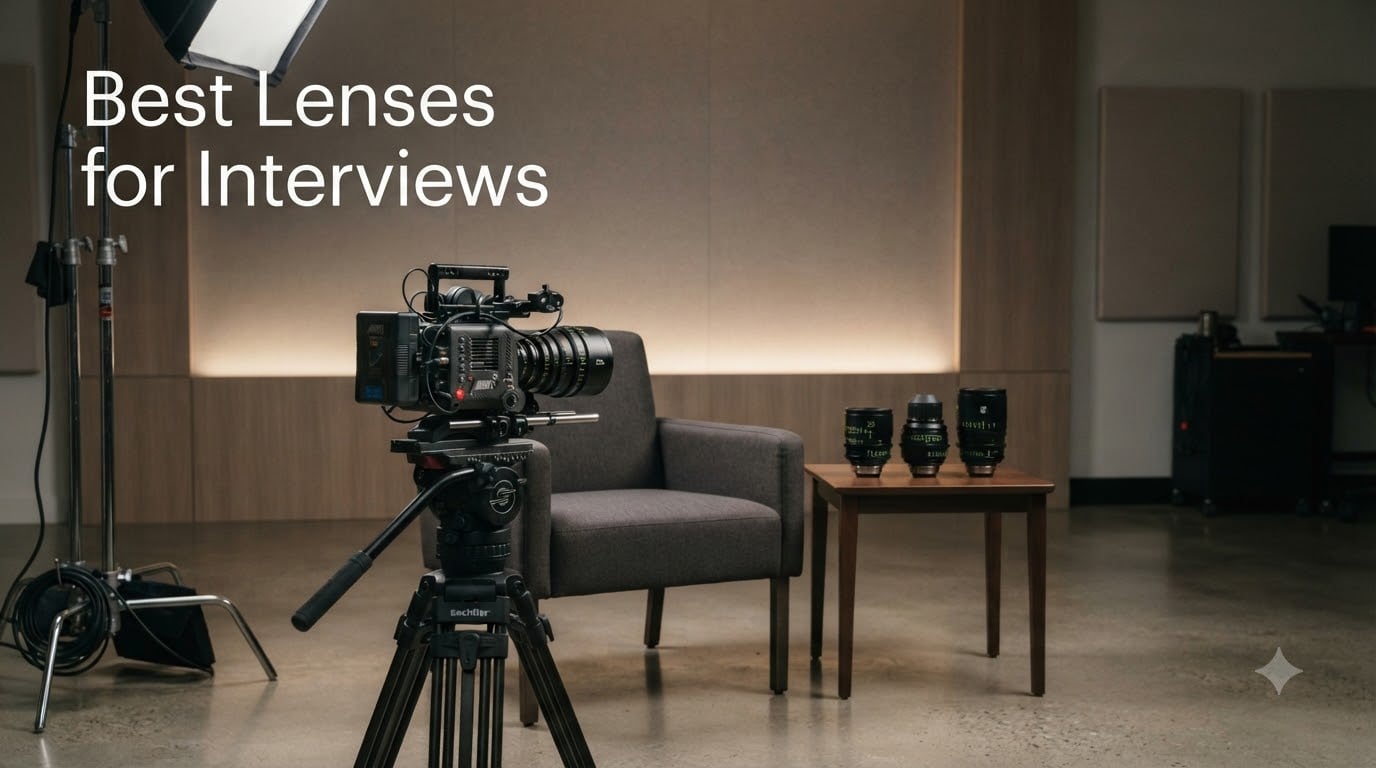
When I plan a sit-down interview, the lens is rarely the first thing I discuss with a client. I start with the story, the room, the subject, and the available light; then I choose glass that supports the shot rather than calling attention to itself.
The best lenses for interviews sit mostly between 35mm and 85mm on full frame. A 50mm is the flexible middle ground, a 35mm helps in tight rooms, and an 85mm creates a more intimate, compressed view with stronger background separation. The right choice also depends on sensor size, aperture, autofocus, and whether you are flying solo or running a two-camera production.
I compared eight real lenses across Canon, Sony, and Nikon systems, using the supplied specifications, review summaries, and user-reported strengths. I also carried over the practical lessons repeated in videography forums: lighting and sound matter more than expensive glass, most interviews work well between f/2 and f/4, and a lens that is easy to use in a small room can beat a technically more impressive lens that forces you to back into a wall.
Table of Contents
- Top 3 Picks for Best Lenses for Interviews for October 2026
- Best Lenses for Interviews in October 2026
- 1. Canon EF 50mm f/1.8 STM — Best Value
- 2. Canon RF50mm F1.8 STM — Best Compact EOS R Prime
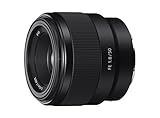
- 3. Sony FE 50mm F1.8 — Best Affordable Full-Frame Prime
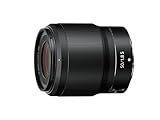
- 4. Nikon NIKKOR Z 50mm f/1.8 S — Best for Video-First Nikon Z
- 5. Sigma 56mm f/1.4 — Best APS-C Portrait Look
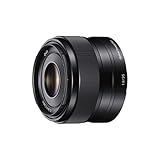
- 6. Sony SEL35F18 — Best for Tight Rooms
- 7. Canon RF 85mm F2 Macro IS STM — Best Stabilized Medium Telephoto
- 8. Sony SEL-85F18 — Best Lightweight 85mm
- Buying Guide: How to Choose the Best Lenses for Interviews?
- Frequently Asked Questions
- Conclusion: The Right Interview Lens for Your Setup
Top 3 Picks for Best Lenses for Interviews for October 2026
Best Lenses for Interviews in October 2026
| Product | Specs | Action |
|---|---|---|
 Canon EF 50mm f/1.8 STM |
|
Check Latest Price |
 Canon RF50mm F1.8 STM |
|
Check Latest Price |
 Sony FE 50mm F1.8 |
|
Check Latest Price |
 Nikon NIKKOR Z 50mm f/1.8 S |
|
Check Latest Price |
 Sigma 56mm f/1.4 |
|
Check Latest Price |
 Sony SEL35F18 |
|
Check Latest Price |
 Canon RF 85mm F2 Macro IS STM |
|
Check Latest Price |
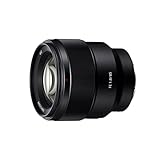 Sony SEL-85F18 |
|
Check Latest Price |
1. Canon EF 50mm f/1.8 STM — Best Value
Canon EF 50mm f/1.8 STM Lens, Black, Compatible with Canon EOS DSLR Cameras
50mm f/1.8
STM autofocus
5.6 oz
Pros
- Very affordable
- Sharp and fast
- Quiet STM autofocus
Cons
- No stabilization
- Not weather sealed
I would reach for this lens when a Canon EOS DSLR crew needs a reliable talking-head prime without turning a small production budget into a line item. Its 50mm view is natural enough for a seated subject, while f/1.8 gives useful low-light flexibility and gentle background blur.
On a camera body with stabilization, the lack of optical stabilization is less concerning because the body can steady the image. The STM motor is quiet and smooth for video, which helps when the subject shifts slightly or the operator needs a discreet focus correction.
The main compromise is the plastic, unsealed construction. It is also a prime, so changing framing means moving the camera or the subject rather than turning a zoom ring. For many interview days, that is a useful discipline because it keeps the setup simple and consistent.
For whom it is good
This is my pick for a beginner or a one-camera corporate shoot that values dependable results over weather resistance. It is especially sensible when the interview is controlled, the camera has IBIS, and the room can support a 50mm working distance.
For whom it is bad
I would not choose it for a handheld operator who needs lens stabilization on a non-stabilized DSLR, or for a production that expects to shoot in rain, dust, or rough location conditions. A zoom and a weather-sealed body would be the safer tool.
2. Canon RF50mm F1.8 STM — Best Compact EOS R Prime
Pros
- Compact body
- Native RF mount
- Quiet STM AF
Cons
- No optical stabilization
- Plastic construction
The RF version gives Canon mirrorless shooters the same practical 50mm interview formula in a body that feels at home on an EOS R. I like the control ring because it lets an operator adjust exposure without leaving the support or losing sight of the subject.
It is sharp wide open and its f/1.8 aperture is useful when a room has windows, practical lamps, or limited placement options. The 5.6-ounce weight also makes a gimbal or handheld setup easier to balance.
The trade-off is the same as on most affordable primes: no optical stabilization, and the all-plastic design is not built for bad weather. I would use the camera’s digital or in-body stabilization where available, then keep the lens on a tripod or stable support during a long sit-down.
For whom it is good
This lens is a strong fit for EOS R owners who want a light native prime for corporate interviews, portraits, and short documentary segments. I would pair it with a camera that offers in-body stabilization when the operator is moving between setups.
For whom it is bad
I would avoid treating it as an all-weather cinema optic. It is also less attractive if you need to reframe constantly, because the fixed 50mm perspective requires camera movement rather than a quick zoom adjustment.
3. Sony FE 50mm F1.8 — Best Affordable Full-Frame Prime
Sony – FE 50mm F1.8 Standard Lens (SEL50F18F/2), Black
50mm f/1.8
Seven-blade aperture
6.6 oz
Pros
- Sharp images
- Fast autofocus
- Compact full-frame lens
Cons
- No stabilization
- No AF/MF switch
For a Sony E-mount camera, the FE 50mm f/1.8 is a straightforward way to get the natural perspective that most interview crews want. I find 50mm forgiving in a medium-sized room while still giving enough subject separation when I step back and use a clean background.
The lens is compact, produces good color and contrast, and the seven-blade aperture creates smooth bokeh. Fast autofocus is helpful for a solo operator who cannot always stand beside the camera, although the supplied review notes mention that the motor can be noisy in some video situations.
There is no image stabilization and no physical AF/MF switch. I would lock exposure and focus carefully, use a tripod when the composition allows it, and verify audio for any autofocus noise rather than assuming the motor will be silent in every body combination.
For whom it is good
I recommend it to a Sony full-frame shooter who wants a small, affordable first interview prime. It is a good match for controlled talking-head work, indoor portraits, and B-roll that benefits from a normal field of view.
For whom it is bad
It is not my first choice for handheld work on a body without stabilization. It is also not ideal for a crew that changes framing rapidly or expects professional weather sealing from a lightweight all-plastic lens.
4. Nikon NIKKOR Z 50mm f/1.8 S — Best for Video-First Nikon Z
Nikon NIKKOR Z 50mm f/1.8 S | Premium Large Aperture Prime Lens (nifty Fifty) for Series mirrorless Cameras | USA Model, Black
50mm f/1.8 S
Weather sealed
Minimal focus breathing
Pros
- Edge-to-edge sharpness
- Quiet AF
- Minimal distortion
Cons
- Heavier and larger
- Relies on body stabilization
The Nikon Z 50mm f/1.8 S is the premium option in this group, and its video-friendly details justify the extra size for a serious production. I care most about the virtually zero distortion, quiet stepping motor, and minimal focus breathing when a subject moves or a pull is required.
The metal focus ring can be customized, and the weather-sealed unibody construction gives me more confidence on location. Its optical performance is edge-to-edge, so a close interview frame can retain detail without relying on a very soft center to hide imperfections.

At 14.56 ounces, it is not the lightest interview prime, and it has no optical VR. On a Nikon body with in-body five-axis stabilization, I would use that system and reserve the lens’s strengths for color, distortion control, and focus behavior rather than expecting the lens to stabilize a moving shot.

For whom it is good
This is my choice for a Nikon Z filmmaker who values controlled focus, robust construction, and consistent rendering on a two-camera interview. It is particularly useful when a 50mm full-frame look matches both the A-cam and B-cam frames.
For whom it is bad
The price and weight may be hard to justify for a beginner or a crew that shoots one short interview a year. I would rent it first if the project does not need its weather sealing and low focus breathing.
5. Sigma 56mm f/1.4 — Best APS-C Portrait Look
Sigma 56mm for E-Mount (Sony) Fixed Prime Camera Lens, Black (351965)
56mm f/1.4
85mm APS-C equivalent
9-blade aperture
Pros
- Excellent sharpness
- Beautiful bokeh
- Quiet AF
Cons
- APS-C only
- No stabilization
- Prime only
On Sony APS-C, 56mm behaves like an 85mm on full frame, which is a strong recipe for a polished talking head. I would use it when the room allows a comfortable distance and I want the background to fall away without forcing the subject into a cramped frame.
The f/1.4 maximum aperture is the standout feature. It gives strong low-light performance, shallow depth of field, and a smooth nine-blade rendering that suits portrait-style interviews and documentary portraits.

It is not a full-frame lens, and its lack of stabilization means a tripod or stabilized body is helpful. I would also watch for flare when a strong light is just outside the frame, since the supplied review summary notes that a hood can make a difference.

For whom it is good
I would buy this for a Sony APS-C documentary or portrait kit where 85mm equivalent framing is the default. It is a particularly good lens for one subject at a time, controlled facial movement, and a background with enough distance to create separation.
For whom it is bad
It is a poor match for a small room, a moving presenter, or anyone who wants one lens to cover both wide interviews and telephoto B-roll. A 35mm APS-C prime is more forgiving when the camera-to-subject distance is limited.
6. Sony SEL35F18 — Best for Tight Rooms
Sony SEL35F18 35 mm f/1.8 Prime Fixed Lens
35mm f/1.8
52.5mm APS-C equivalent
OSS
Pros
- Optical stabilization
- Compact 155g body
- Silent AF
Cons
- APS-C only
- Chromatic aberration wide open
This is the lens I would carry into a small office or a home interview where I cannot place the camera far from the subject. On APS-C, 35mm gives a 52.5mm equivalent view, a useful compromise between the environmental view of a 24mm and the more compressed look of a 50mm.
Optical SteadyShot is a meaningful benefit for a solo operator, especially when the camera is handheld or supported on a monopod. The f/1.8 aperture also helps indoors, and the supplied reviews praise its silent focusing for movies.
The trade-off is that 35mm can exaggerate facial features if I get too close. I would step back, use a longer working distance, and test focus at f/1.8; the supplied review summary notes possible longitudinal chromatic aberration and bokeh fringing in high-contrast scenes.
For whom it is good
I recommend it for Sony APS-C creators filming interviews in apartments, offices, and documentary locations. It is also a strong travel and B-roll companion because stabilization and a moderate field of view make it more flexible than a 50mm prime.
For whom it is bad
It is not a full-frame option, and I would not place it inches from a subject’s face. Wide apertures still need accurate focus, particularly when the subject leans toward the camera.
7. Canon RF 85mm F2 Macro IS STM — Best Stabilized Medium Telephoto
Pros
- Image stabilization
- Sharp wide open
- Useful macro mode
Cons
- AF can be noisy
- No weather sealing
The RF 85mm F2 is a compelling interview lens when I want a medium-telephoto perspective and the freedom to stabilize a handheld or moving setup. Canon rates its optical system for up to five stops of correction, and the Hybrid IS helps near the minimum focusing distance.
At f/2, it is sharp and contrasty with attractive portrait bokeh. The 0.5x magnification ratio is not essential for an interview, but it makes the lens useful for product cutaways, inserts, and detail B-roll after the main conversation.

Some supplied reviews report noisy autofocus in video, so I would monitor the audio and use manual focus for a locked sit-down frame. The lens also lacks weather sealing, which makes a rain cover and careful location planning sensible.

For whom it is good
I would choose it for an EOS R documentary or branded production that needs an 85mm look plus stabilization and detail-shot capability. It suits a three-camera plan where the A-cam is medium and the B-cam needs a tighter angle.
For whom it is bad
I would not buy it for a cramped room or a subject who moves across the frame. I would also audition the autofocus on the exact camera body if the microphone is close to the lens.
8. Sony SEL-85F18 — Best Lightweight 85mm
Sony SEL-85F18 Portrait Lens Fixed Focal 85mm F1.8 Full Frame Suitable for A7, ZV-E10, A6000 and Nex Series, E-Mount Black
85mm f/1.8
371g
Nine-blade circular aperture
Pros
- Excellent sharpness
- Quiet linear AF
- Full-frame compatible
Cons
- No built-in stabilization
- Longitudinal CA wide open
The Sony SEL-85F18 is a compact 85mm prime for full-frame and APS-C E-mount cameras. I would use it when I want the flattering compression of 85mm without the weight and cost of a much larger professional lens.
Its f/1.8 aperture, nine circular blades, and ED glass produce strong portraits with smooth bokeh and controlled aberration. The linear motor is fast and quiet, which is useful for a single operator who needs dependable autofocus.

There is no built-in stabilization, and the supplied review summary notes some longitudinal chromatic aberration at wide apertures. I would close the aperture slightly for high-contrast skin and lights, then use the camera body or a support when the shot moves.
For whom it is good
This is an excellent 85mm interview lens for a Sony filmmaker who values light weight, quiet AF, and full-frame flexibility. It works well for corporate interviews, portraits, and B-roll that benefits from a telephoto field of view.
For whom it is bad
I would not pick it for a small room where 85mm cannot be framed comfortably. A 35mm or 50mm is more practical when the subject and operator are only a few feet apart.
Buying Guide: How to Choose the Best Lenses for Interviews?
Start with focal length, not brand loyalty
The short answer is that 50mm is the most versatile full-frame interview lens, 35mm is best for tight spaces, and 85mm is best for flattering close-ups. These are equivalent starting points, not hard rules; crop factor changes the actual view.
On an APS-C camera, a 35mm lens is often described as roughly 52.5mm in full-frame terms, while a Sigma 56mm behaves like an 85mm equivalent. I would calculate the equivalent view before choosing a lens, especially when matching an A-cam and B-cam with different sensors.
Choose an aperture that protects focus
For a moving presenter, f/2.8 or f/4 is often a better starting point than f/1.8 because the extra depth of field makes small forward-and-back movements less risky. f/1.8 is valuable in dim rooms, but I would use face detection or manual focus and watch the monitor closely.
When two cameras use different sensors, matching depth of field takes more than setting the same f-stop. I would use equivalent focal lengths, match the subject’s size in frame, and compare the background separation on a test card before recording.
Use a prime for consistency and a zoom for speed
A prime is smaller, often sharper at its chosen focal length, and encourages a deliberate camera position. I would take a prime for a controlled corporate or documentary interview where I can plan the composition in advance.
A zoom is better for a solo operator, a run-and-gun day, or a two-camera setup where repositioning is difficult. The community’s recurring recommendation of a 24-70mm f/2.8 makes sense when one lens must cover wide coverage and B-roll.
Plan one, two, or three cameras around the workflow
For one camera, I would use a 50mm prime when the room allows it and a 35mm when space is tight. I would mark the camera position, focus point, and subject eyeline so setup changes remain predictable.
For two cameras, I would place the A-cam at 50mm or 85mm for the main frame and the B-cam at 35mm or 50mm for a complementary angle. Matching focal length is easier than trying to make radically different views look like one scene.
For three cameras, I would dedicate one wide safety shot, one medium A-cam, and one tight close-up. This works for a panel or multi-subject interview, but I would keep all three camera positions and exposure settings consistent.
Remember lighting, audio, filters, and stabilization
A clean, soft key light and good audio will improve an interview before any lens upgrade. I would expose the face first, place the microphone carefully, and use a background light only after the spoken performance is recorded cleanly.
An ND filter is useful when I want to keep a shallow depth of field under bright lights, but it cannot fix harsh lighting or bad focus. For a stable interview, stabilization matters mainly when the camera moves; a locked tripod often makes optical stabilization irrelevant.
Decide whether to rent or buy
I would buy a 35mm or 50mm prime if interviews are a regular part of your work. If the project is occasional, rent an 85mm or a premium 50mm first, test it in the actual room, and then decide whether the weight and handling suit your kit.
Frequently Asked Questions
What lens should I use for interviews?
Use a 50mm prime on full frame for the most versatile interview setup. Choose 35mm in a tight room and 85mm for a tighter, more flattering view when you have enough space.
Is f 2.8 or f 4 better for interviews?
f/2.8 is useful for low light and more background separation, while f/4 gives greater depth of field and more room for a moving subject. Start at f/2.8 to f/4 rather than opening every lens to its maximum aperture.
Is 35mm or 50mm better for video?
35mm is better in small rooms and shows more of the environment. A 50mm gives a more natural, subject-focused view and is usually the better all-around interview focal length when space is available.
What are the best focal lengths for taking interviews?
The most useful full-frame interview range is 35mm to 85mm. Use 35mm for tight spaces, 50mm for versatility, and 85mm for close-ups with more background compression and a more intimate look.
What is the best camera lens to use for taking interviews?
The best camera lens is usually a quiet 50mm prime with a wide enough aperture for the available light. Add lens or camera stabilization when the camera moves, and use a 35mm prime if the room is cramped.
Conclusion: The Right Interview Lens for Your Setup
The best lenses for interviews are the ones that let you frame the subject comfortably, protect focus, and keep the production moving. I would start with a 50mm prime for a normal full-frame room, a 35mm for tight spaces, or an 85mm when the distance and background support a more intimate look.
For a budget Canon DSLR, the EF 50mm f/1.8 STM is hard to beat. For an EOS R kit, the RF 50mm f/1.8 STM is compact and practical; for Sony APS-C, the Sigma 56mm f/1.4 gives a strong 85mm-equivalent portrait look; and for a polished 85mm Sony setup, the SEL-85F18 stays light and quiet.
Choose the lens that matches your camera, room, crew, and subject—not the lens with the most impressive specification list. Then spend the remaining attention on light, sound, focus, and a clean performance, because those are the parts viewers notice first.