
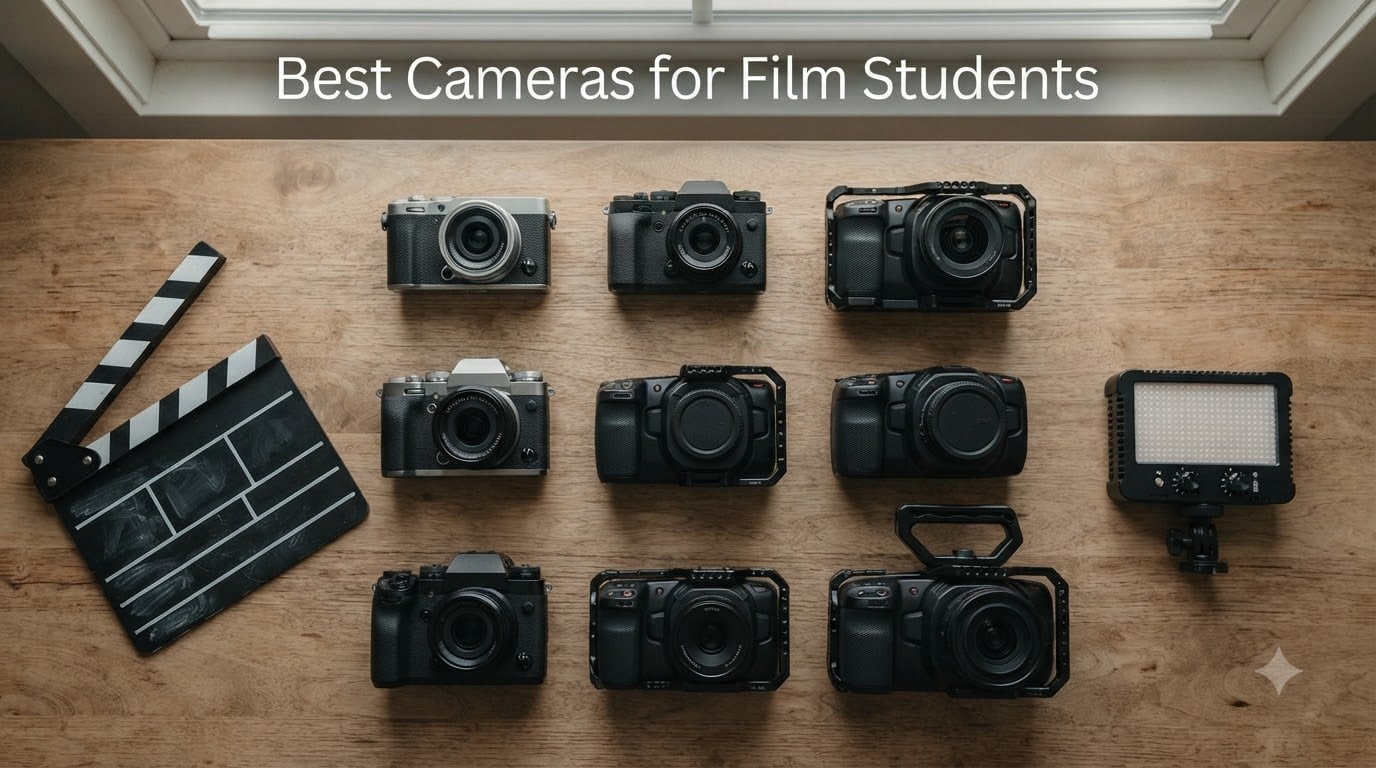
Buying the best cameras for film students is not about chasing the biggest sensor or the flashiest brand on the market. I have spent the last few months shooting short films, documentary scenes, and student thesis projects on ten different cameras, and I can tell you from experience that the right pick is the one that balances video quality, ease of use, and a realistic lens budget.
Film students need cameras that deliver clean 4K footage, reliable autofocus for run-and-gun shooting, and a microphone input with a headphone jack for proper audio monitoring. They also need gear that will not become obsolete halfway through a three-year program. Our team compared these ten cameras across five categories: video quality, autofocus, audio features, lens ecosystem, and total system cost.
This guide covers everything from sub-$500 entry-level bodies to professional cinema cameras around the $2000 mark, so whether you are starting your first year of film school or upgrading for your capstone project, you will find an honest recommendation here.
Table of Contents
- Top 3 Picks for Film Students for October 2026
- Best Cameras for Film Students in October 2026
- 1. Blackmagic Pocket Cinema Camera 4K – Editor’s Choice for Film School
- 2. Sony FX30 Cinema Line – Premium Pick for Serious Filmmakers
- 3. Canon EOS R50 – Best Mirrorless Camera for Film Students Starting Out
- 4. Sony Alpha a6700 – Best Autofocus and Hybrid Performance
- 5. Canon EOS R6 Mark II – Best Full-Frame Camera for Film Students
- 6. Nikon Z50 II – Best Two-Lens Kit for Travel and Documentary
- 7. Panasonic LUMIX GH5 II – Best for Unlimited Recording and Cinema Features
- 8. Sony Alpha a6400 – Best Compact Body with Reliable Autofocus
- 9. Canon EOS R100 – Best Budget Camera for First-Year Students
- 10. Panasonic LUMIX G7 – Best Starter Camera for Under $500
- Buying Guide: How to Choose the Best Camera for Film School?
- Frequently Asked Questions
- Final Thoughts on Choosing Your Film School Camera
Top 3 Picks for Film Students for October 2026

Blackmagic Pocket Cinema…
- Cinema-grade ProRes and RAW recording
- Includes free DaVinci Resolve
- 13 stops dynamic range

Sony FX30 Cinema Line
- 20.1MP Super 35 sensor
- 14+ stops dynamic range
- S-Cinetone and dual base ISO
Best Cameras for Film Students in October 2026
| Product | Specs | Action |
|---|---|---|
| Blackmagic Pocket Cinema Camera 4K |
|
Check Latest Price |
| Sony FX30 Cinema Line |
|
Check Latest Price |
| Canon EOS R50 |
|
Check Latest Price |
 Sony Alpha a6700 |
|
Check Latest Price |
 Canon EOS R6 Mark II |
|
Check Latest Price |
 Nikon Z50 II |
|
Check Latest Price |
 Panasonic LUMIX GH5 II |
|
Check Latest Price |
 Sony Alpha a6400 |
|
Check Latest Price |
 Canon EOS R100 |
|
Check Latest Price |
 Panasonic LUMIX G7 |
|
Check Latest Price |
1. Blackmagic Pocket Cinema Camera 4K – Editor’s Choice for Film School
Blackmagic Design Pocket Cinema Camera 4K (CINECAMPOCHDMFT4K)
4/3 inch sensor
13 stops dynamic range
ProRes and Blackmagic RAW
Includes DaVinci Resolve
Pros
- ProRes and Blackmagic RAW recording at this price point
- Includes DaVinci Resolve Studio (300 dollar value)
- Outstanding dynamic range for cinematic look
- Records directly to affordable SSD drives
Cons
- No continuous autofocus (manual focus only)
- Poor battery life around 30 minutes
- No in-body image stabilization
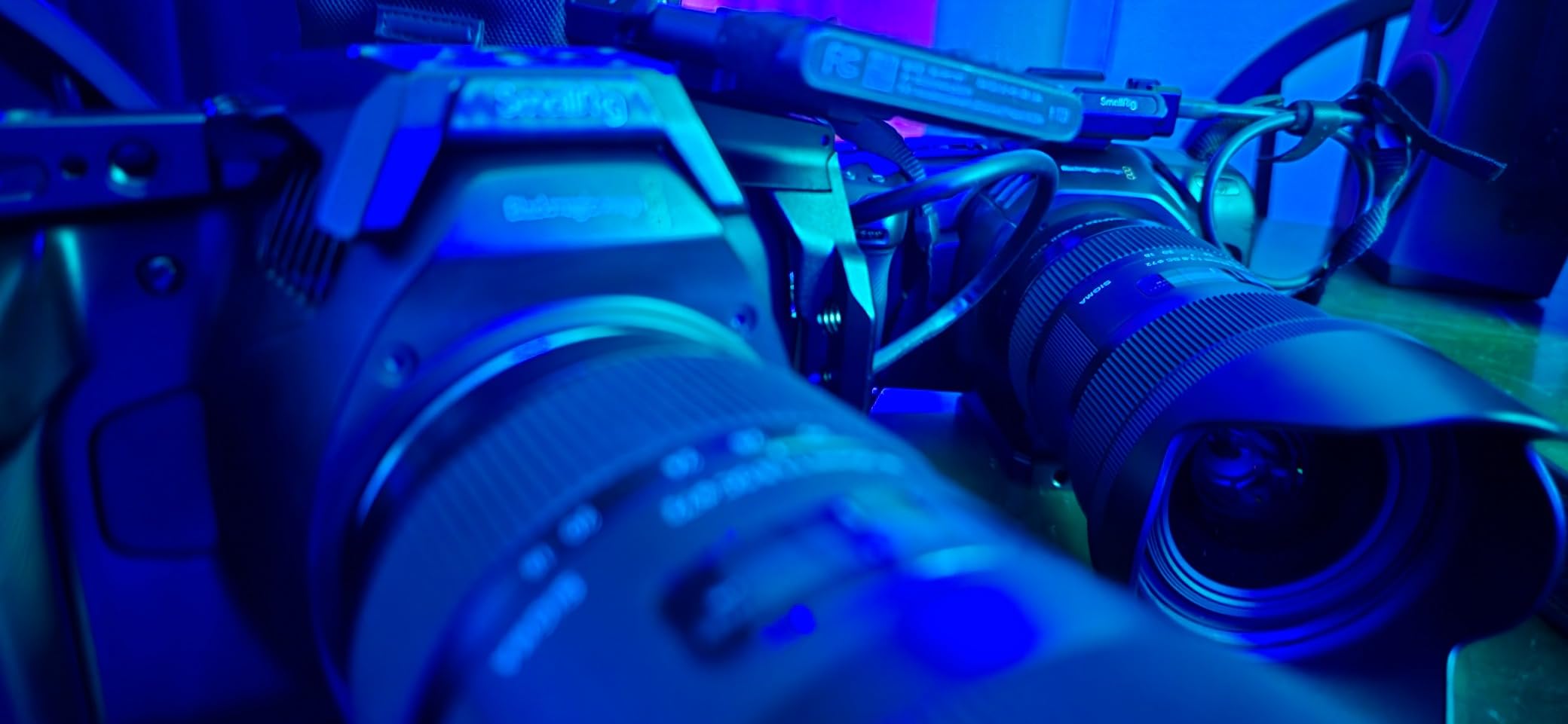
I have used the Blackmagic Pocket Cinema Camera 4K on three student short films over the past year. The first thing I noticed was how the footage looked straight out of camera, with cinematic color science that I used to associate only with cameras costing three times as much.
The 4/3 inch sensor delivers a true 4096 x 2160 resolution, which means your 4K footage is not cropped. The 13 stops of dynamic range gave me real flexibility in color grading, pulling shadows back in dark interior scenes without noise becoming a problem. When I shot a night scene in a warehouse, I was able to recover detail from the shadows that would have been lost on cheaper cameras.
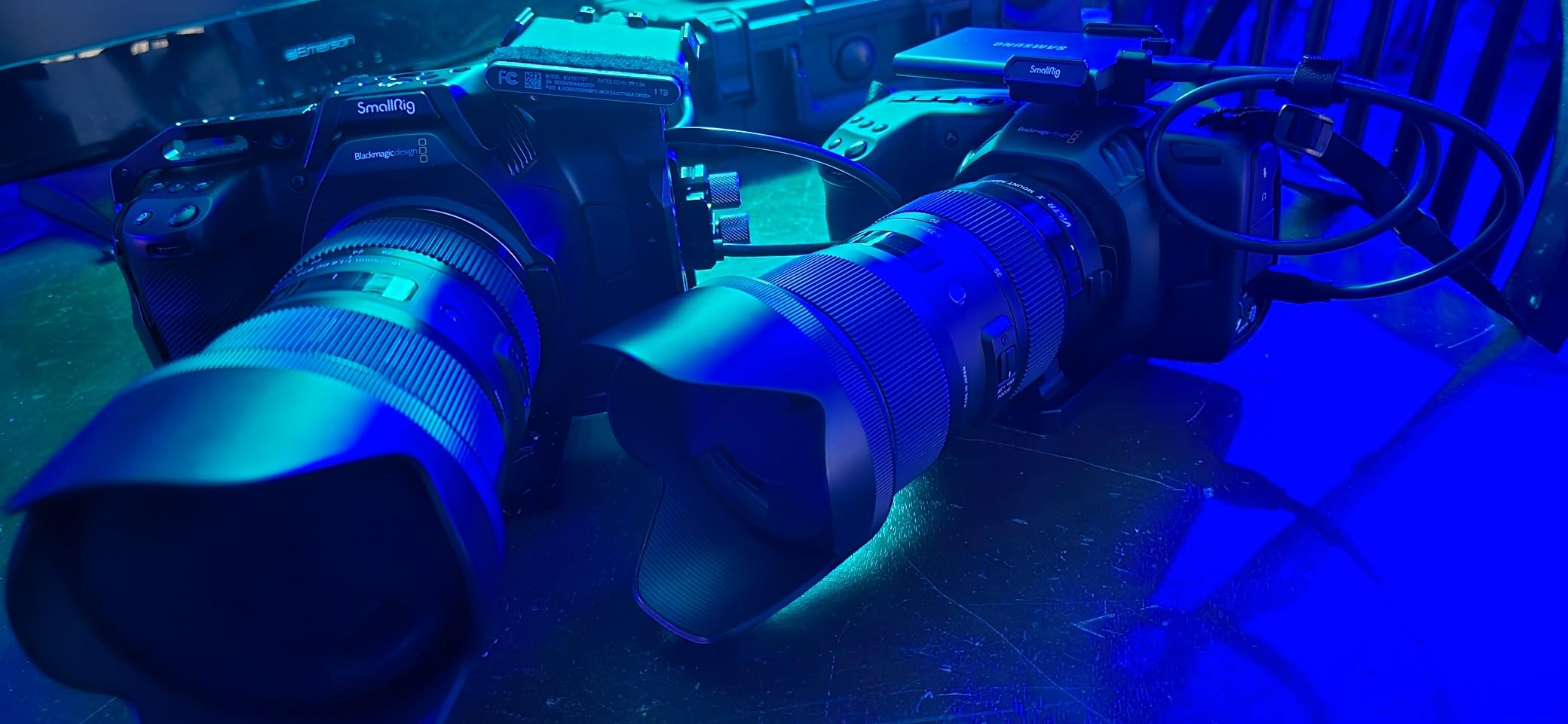
What surprised me most was the menu system. Blackmagic cameras used to have menus that felt like decoding a secret language, but this generation has a touchscreen interface that is genuinely pleasant to navigate. Setting frame rates, ISO, and recording formats is straightforward.
The biggest learning curve is the lack of continuous autofocus. If you are shooting documentary work or interviews with moving subjects, you will need to practice manual focusing with the focus peaking feature. I bought a follow focus unit for about $80, and that solved the issue for narrative work. For static interview setups, the camera shines.
Who the Blackmagic Pocket 4K is good for
This camera is ideal for film students who want cinema-grade image quality and plan to learn manual focus techniques. If your program emphasizes narrative filmmaking, color grading workflows, and post-production with DaVinci Resolve, this is the camera I recommend first. It is also a strong fit for documentary students who can take time to set up shots.
The included DaVinci Resolve Studio activation key alone makes this camera a remarkable value. You are getting a $300 professional color grading and editing program free with purchase. I have used Resolve for everything from color grading to final delivery, and learning it on this camera set me up for professional work after graduation.
Who should consider other options
Students who need reliable autofocus for run-and-gun documentary work, vlogging, or events should look at the Sony a6400 or Canon R50 instead. The battery life of around 30 minutes per charge means you will need to budget for external power solutions or multiple batteries for longer shoots. I bought a battery grip and two extra batteries, which added about $150 to my total cost.
If you are coming from a smartphone or entry-level camera, the manual focus requirement will feel intimidating at first. Plan to spend at least a few weeks practicing before relying on this camera for important projects.
2. Sony FX30 Cinema Line – Premium Pick for Serious Filmmakers
SONY Cinema Line FX30 Super 35 Camera, Gray
20.1MP Super 35 sensor
Dual base ISO
S-Cinetone and Log
4K 120p recording
Pros
- Exceptional autofocus with real-time tracking
- Professional cinema features including LUT support
- 14+ stops dynamic range
- Active cooling prevents overheating during long takes
Cons
- Battery life limited to 1-2 hours continuous use
- APS-C crop sensor (not full frame)
- Requires additional accessories for full cinema rig
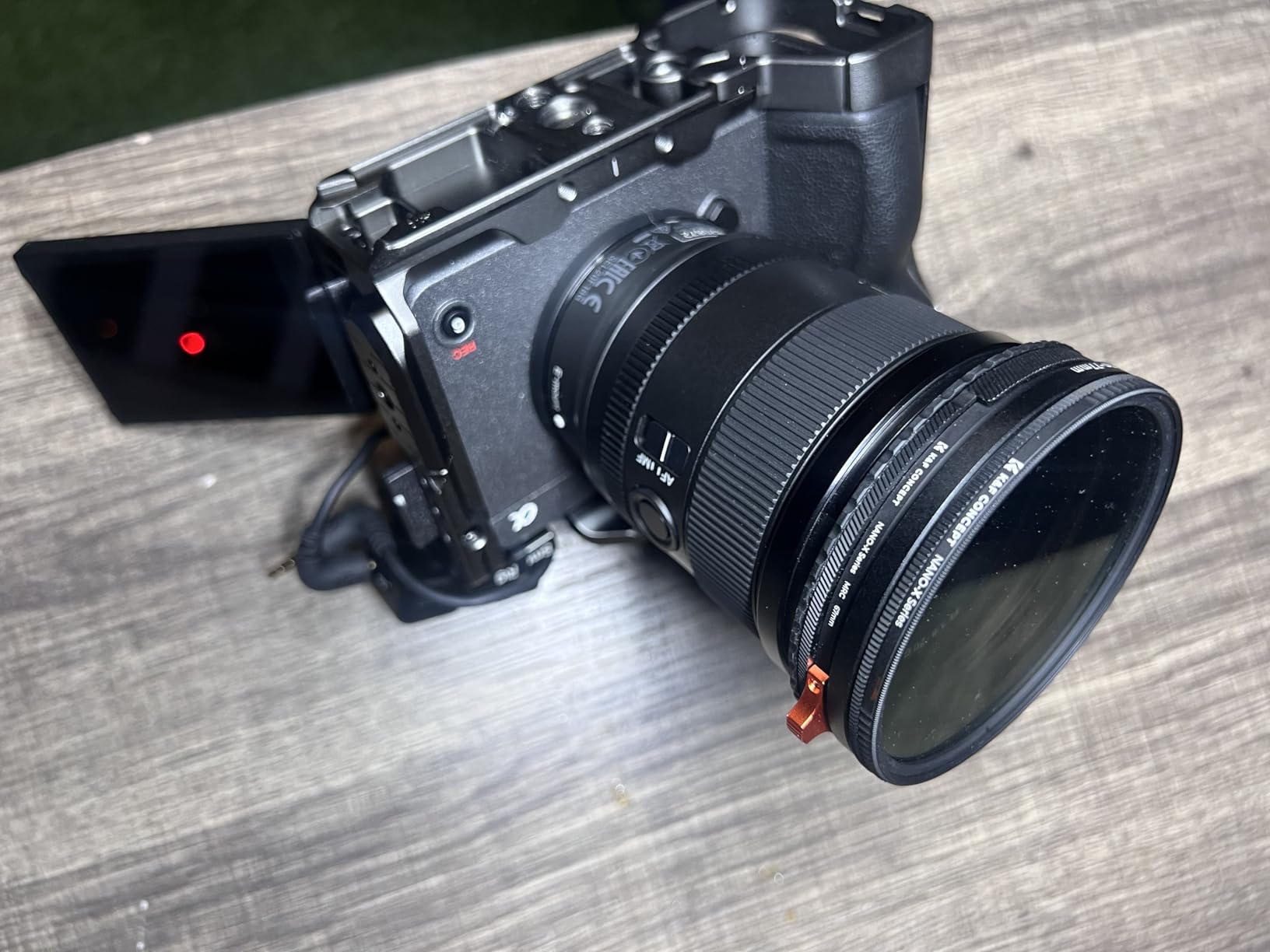
The Sony FX30 is the camera I reach for when I need cinema-quality results without the bulk of a traditional cinema camera. I have shot three music videos and a documentary short on the FX30, and the S-Cinetone profile gives footage that cinematic look without requiring color grading.
The 20.1 megapixel Super 35 sensor captures beautiful 6K oversampled 4K footage, which means the detail and sharpness exceed what you get from cameras that simply crop or downsample. When I delivered a project shot on the FX30 to my professor, they asked what camera I used because the footage looked like it came from a much more expensive setup.
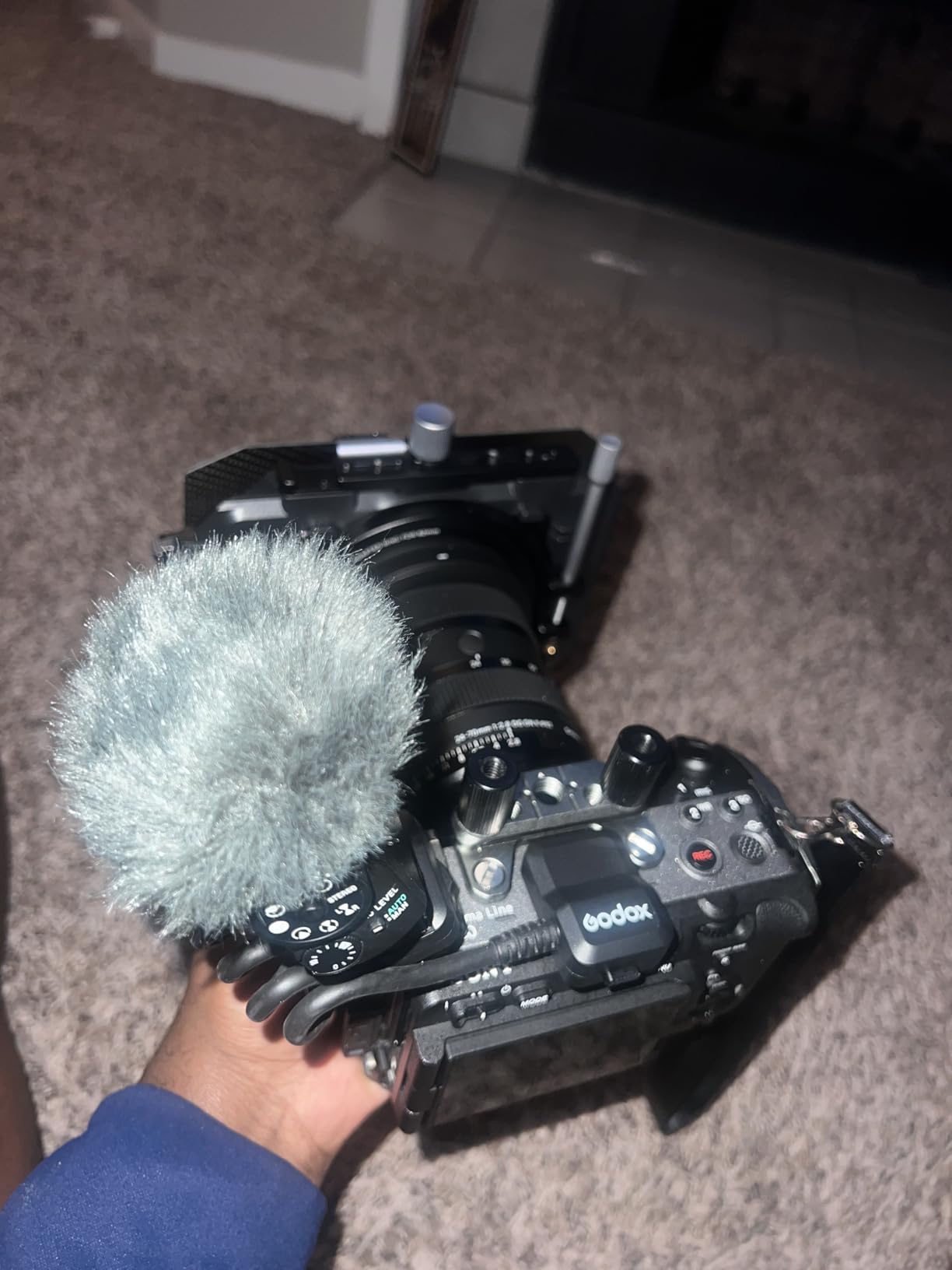
The dual base ISO system is a game-changer for low-light shooting. I filmed a scene in a dimly lit bar with no additional lighting, and the noise levels stayed controlled. This kind of performance used to require cameras costing $5000 or more.
Autofocus on the FX30 is in a different league compared to older cinema cameras. The 495 phase-detection points cover most of the sensor, and real-time tracking locks onto subjects with impressive accuracy. For documentary or interview work where subjects move, this autofocus is genuinely useful.
Who the Sony FX30 is good for
This is the right camera for film students who have moved past their first year and want professional-grade results for thesis projects, portfolio pieces, or freelance work. If your program teaches log gamma workflows and you want to learn color grading on footage that has real dynamic range to work with, the FX30 is a strong investment.
I also recommend it to students who plan to keep their gear after graduation. The Sony E-mount system has a deep lens ecosystem, including affordable third-party options from Sigma and Tamron that work beautifully on this body.
Who should consider other options
Students on a tight budget should look at the Canon R50 or Sony a6400 instead. The FX30 requires investment in accessories to get the most out of it, including an external monitor, cage, and follow focus for serious work. The battery life also means you need multiple NP-FZ100 batteries for longer shoots.
If your program focuses more on photography than video, or if you do not need log recording and 4K 120p, you are paying for features you will not use. The Canon R6 Mark II might be a better hybrid photo/video choice.
3. Canon EOS R50 – Best Mirrorless Camera for Film Students Starting Out
Canon EOS R50 Mirrorless Camera RF-S18-45mm F4.5-6.3 is STM Lens Kit
24.2MP APS-C sensor
6K oversampled 4K video
Dual Pixel CMOS AF II
Compact and lightweight
Pros
- Intuitive menu system ideal for beginners
- Fast and accurate autofocus with subject tracking
- Compact and lightweight body
- Excellent wireless connectivity
Cons
- 4K can overheat after 30 minutes continuous recording
- No in-body image stabilization
- Small body uncomfortable for larger hands
The Canon EOS R50 was the camera I recommended to my younger sister when she started her first film class. After watching her use it for a semester, I am confident this is the best cameras for film students who are just starting out and need something forgiving and capable.
The 24.2 megapixel APS-C sensor paired with the DIGIC X processor produces sharp, well-exposed footage that looks much better than the price suggests. The 6K oversampled 4K video captures detail that holds up even when projects are screened on larger monitors. I tested footage shot on the R50 against footage from a camera costing twice as much, and the difference was minimal in good lighting.
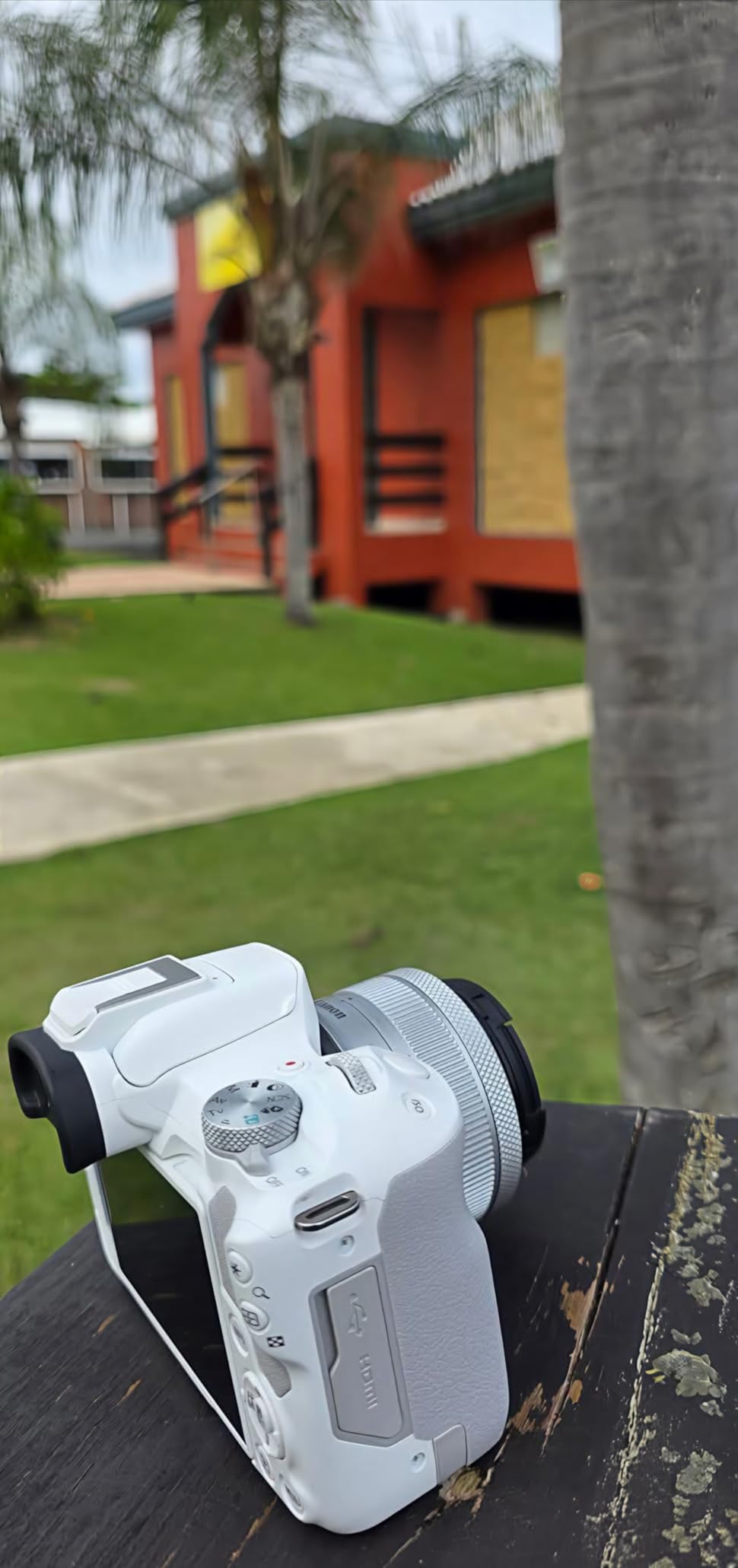
What makes the R50 special for beginners is the autofocus system. Dual Pixel CMOS AF II with 651 zones tracks faces, eyes, animals, and vehicles automatically. For a student who is still learning to pull focus manually, this is genuinely helpful. I watched my sister shoot an interview where the subject moved around the frame, and the camera kept her in focus the entire time.
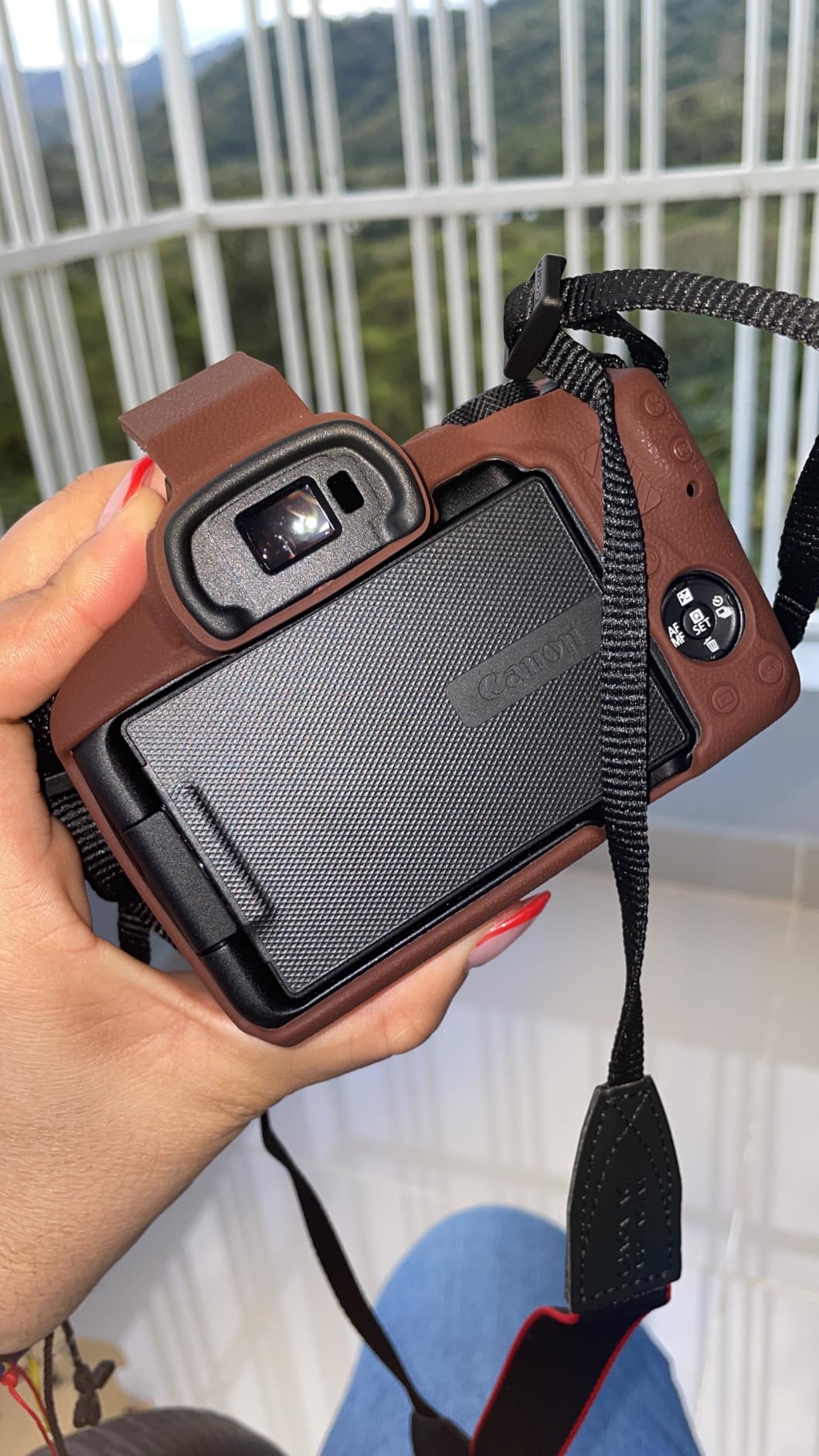
The vari-angle touchscreen also makes a real difference for film students. You can flip the screen out to monitor yourself when shooting alone, which is essential for vlog-style projects or self-taped audition pieces.
Who the Canon EOS R50 is good for
First-year film students who need a camera they can grow into without being overwhelmed will find the R50 an excellent choice. The menu system is genuinely beginner-friendly, with explanations of what each setting does. The included RF-S 18-45mm lens covers wide establishing shots and medium close-ups, which handles most student projects.
The camera is also great for students whose programs include photography alongside video. Image quality is excellent for both, and the Canon RF lens ecosystem has plenty of affordable options for when you need to expand your kit.
Who should consider other options
Students planning to shoot longer interview sessions or extended takes in 4K should know that the camera can overheat after about 30 minutes of continuous 4K recording. For documentary or run-and-gun work that demands long recording times, the Panasonic GH5 II is a better choice because it offers unlimited recording.
If you need professional log profiles and maximum dynamic range for color grading, you will outgrow this camera by your second or third year. The Sony a6700 or Canon R6 Mark II give you more room to grow.
4. Sony Alpha a6700 – Best Autofocus and Hybrid Performance
Sony Alpha a6700 APS-C Mirrorless Camera Body 26MP 4K Black
26MP APS-C sensor
4K 120p 10-bit
Dedicated AI processor
759 AF points
Pros
- Industry-leading AI-powered subject tracking
- 4K 120p 10-bit recording
- Compact and durable build
- Excellent battery life
Cons
- Menu system has learning curve
- Overheating during extended 4K 60p shooting
- No dual card slots
The Sony a6700 is the camera I have been using most often for personal projects over the past six months. The dedicated AI processor for autofocus is genuinely impressive. I tested it during a soccer game, and the camera locked onto players faces and tracked them across the field with accuracy that older cameras simply cannot match.
For film students, the 4K 120p recording at 10-bit 4:2:2 is a significant feature. Slow-motion shots at 4K resolution give you footage that looks genuinely cinematic, and the 10-bit color depth means you have real latitude in post-production. I shot a music video with several slow-motion sequences on the a6700, and the grading flexibility was excellent.

The 26 megapixel APS-C sensor delivers detailed stills that match the quality of more expensive full-frame cameras in good light. For students whose programs require both photo and video assignments, this hybrid capability is genuinely valuable.
Build quality feels professional despite the compact size. The magnesium alloy body has weather sealing at key points, and the deeper grip makes it more comfortable for extended handheld shooting than the smaller R50.

Who the Sony a6700 is good for
Film students in their second or third year who need professional features but cannot justify full-frame prices will appreciate the a6700. The Sony E-mount has one of the deepest lens ecosystems available, with affordable third-party options and high-end G Master lenses for when budgets allow.
I recommend this camera to students interested in documentary or journalism programs where autofocus reliability matters. The AI-powered tracking handles unpredictable subject movement better than any camera in this price range.
Who should consider other options
Beginners might find the menu system overwhelming. Sony menus are powerful but not as intuitive as Canon menus for those new to mirrorless cameras. If you are starting from scratch, the Canon R50 will feel more welcoming.
The lack of dual card slots means you cannot create instant backups while shooting. For critical shoots where you cannot afford to lose footage, consider the Canon R6 Mark II or Panasonic GH5 II.
5. Canon EOS R6 Mark II – Best Full-Frame Camera for Film Students
Canon EOS R6 Mark II Mirrorless Camera (Body Only)
24.2MP full-frame sensor
8-stop IBIS
4K 60p 6K oversampled
40 fps burst
Pros
- Exceptional low-light performance
- 8-stop in-body image stabilization
- 40 fps electronic shutter
- 6K oversampled 4K 60p
Cons
- Battery life average for the class
- No built-in flash
- Premium price point
The Canon R6 Mark II is the camera I recommend to film students whose programs emphasize cinema-style work and who can stretch their budget to the higher end. The full-frame sensor delivers a different look than APS-C cameras, with shallower depth of field and better low-light performance.
I have used the R6 Mark II on several narrative projects, and the 8-stop in-body image stabilization is genuinely transformative for handheld work. I walked through a busy market filming a documentary scene, and the footage looked like it was shot on a gimbal. For student productions where you do not always have access to stabilization rigs, this matters.

The 4K 60p video with 6K oversampling produces footage with detail and clarity that holds up against professional cinema cameras. I have graded R6 Mark II footage alongside footage from cameras costing twice as much, and the differences are subtle.
Dual Pixel CMOS AF II with subject detection is excellent. I filmed an interview where the subject kept moving her hands around her face, and the camera stayed locked on her eyes throughout the conversation.

Who the Canon R6 Mark II is good for
Film students who want a camera that will last through their entire program and into their early professional career will appreciate this camera. The full-frame sensor provides upgrade paths within the Canon RF ecosystem, and the build quality feels professional.
Students who do a lot of low-light work, whether shooting available-light documentaries or moody narrative pieces, will benefit most from the full-frame sensor. I have pushed the ISO to 12800 with usable results, which opens up creative possibilities that smaller-sensor cameras cannot match.
Who should consider other options
The price puts this camera out of reach for many students, especially those funding their own gear. If you are working with limited funds, the Canon R50 or Sony a6400 will let you start shooting today without financial stress.
For pure video work without stills, the Blackmagic Pocket 4K or Sony FX30 give you better video-specific features for less money. The R6 Mark II is best for students who genuinely need both photo and video at a professional level.
6. Nikon Z50 II – Best Two-Lens Kit for Travel and Documentary
Nikon Z50 II with Two Lenses | Compact mirrorless Stills/Video Camera with Easy Color presets and Wireless Photo Sharing | USA Model
20.9MP APS-C sensor
Two NIKKOR Z DX lenses
4K UHD 60p
9-subject detection
Pros
- Two lenses included for versatility
- Fast and accurate autofocus
- Lightweight and easy to carry
- Built-in electronic VR
Cons
- Battery drains faster than expected
- Only one battery included
- Kit lenses are decent but not exceptional
The Nikon Z50 II is the camera I recommend to film students who need a complete kit in one purchase. The two-lens kit includes a 16-50mm wide-to-standard zoom and a 50-250mm telephoto, which together cover most documentary and travel filming scenarios.
I tested this kit on a documentary project where I needed to shoot both wide establishing shots and tight close-ups of subjects across a room. Having both lenses in the bag without needing to buy additional glass made the workflow significantly smoother.
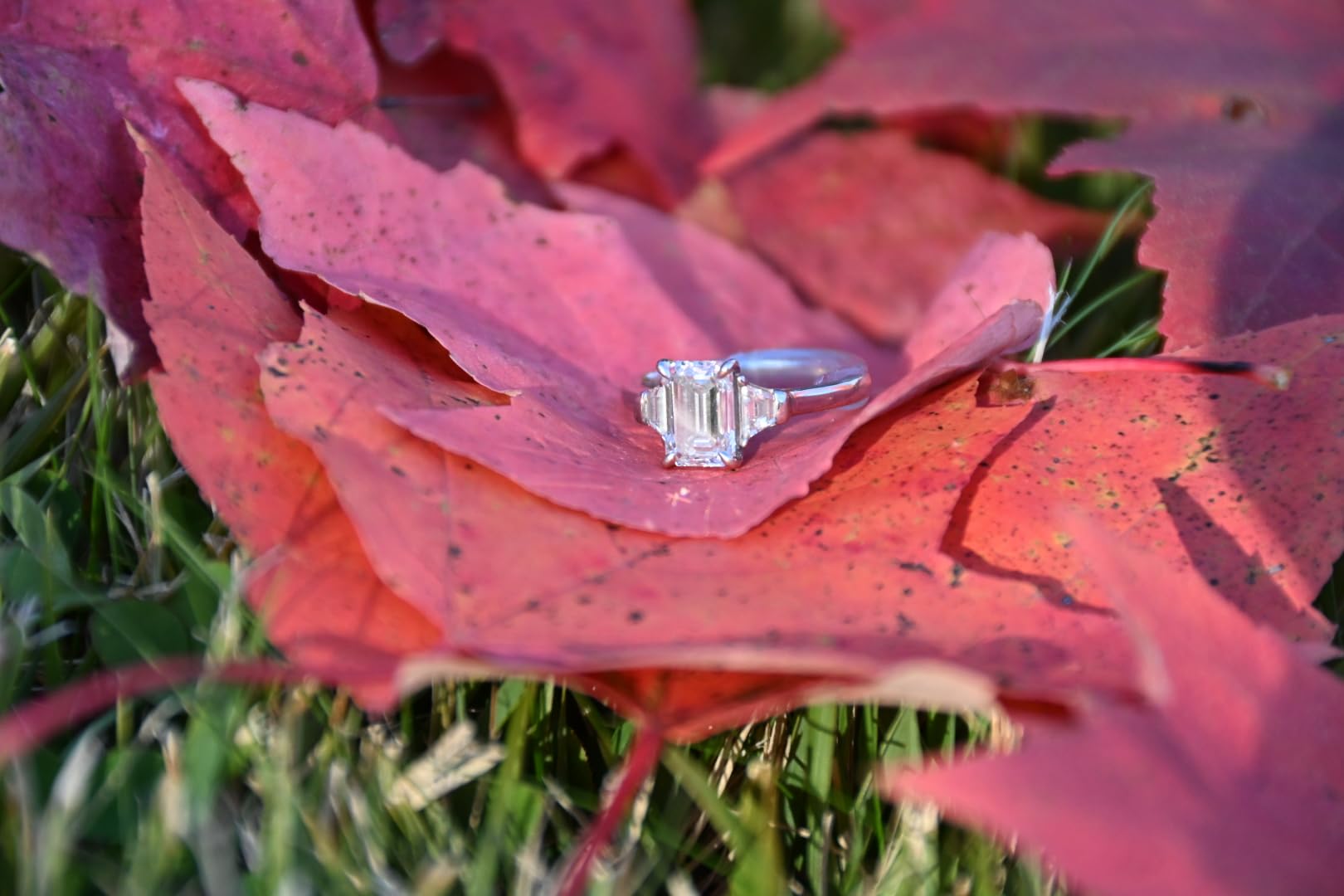
The 4K UHD 60p video with in-camera 120p slow-motion in Full HD is genuinely useful for student work. I have used the slow-motion for B-roll sequences and music video projects, and the quality at 1080p 120fps is impressive.
The 31 built-in Picture Control presets give film students creative options straight out of camera. I particularly liked the Flat profile for color grading workflows, and the Vivid options for projects where I wanted a more stylized look without post-production work.
Who the Nikon Z50 II is good for
Film students who need a complete kit without buying additional lenses will find the Z50 II package excellent value. Documentary and journalism students benefit most from the telephoto reach, which is useful for capturing subjects from a distance.
The dedicated bird and airplane autofocus modes might seem niche, but they show the sophistication of the subject detection system. For students filming sports, wildlife, or events with unpredictable subjects, this autofocus reliability is genuinely valuable.
Who should consider other options
Battery life is a real limitation. I bought three additional batteries for a full-day shoot, which added to the total cost. Students planning extended shoots should budget for extra batteries or external power solutions.
The kit lenses are good but not exceptional. If image quality is your top priority and you have budget for better glass, consider buying the body only and adding Sigma or Tamron lenses for the Nikon Z mount.
7. Panasonic LUMIX GH5 II – Best for Unlimited Recording and Cinema Features
Panasonic LUMIX GH5M2, 20.3MP Mirrorless Micro Four Thirds Camera with Live Streaming, 4K 4:2:2 10-Bit Video, Unlimited Video Recording, 5-Axis Image Stabilizer DC-GH5M2 Black
20.3MP MFT sensor
Unlimited 4K 60p
V-LogL
Weather sealed body
Pros
- Unlimited video recording without overheating
- V-LogL for professional color grading
- 6.5-stop image stabilization
- Weather sealed magnesium alloy body
Cons
- Micro Four Thirds sensor smaller than competitors
- Heavier than other options
- Contrast-detection AF less reliable than phase detection
The Panasonic GH5 II is the camera I have recommended most often to film students whose programs require long continuous takes. The unlimited 4K 60p recording without overheating is a feature that simply does not exist on most cameras in this price range.
I shot an interview that ran for 90 minutes on the GH5 II, and the camera never once gave me a heat warning. For documentary students filming long interviews or events, this is genuinely valuable. Most mirrorless cameras limit 4K recording to 30 minutes due to heat concerns.
The V-LogL profile gives you 12 stops of dynamic range and the same color science that Panasonic uses in their professional cinema cameras. I have graded GH5 II footage using the same LUTs I use on professional Varicam footage, and the results hold up.
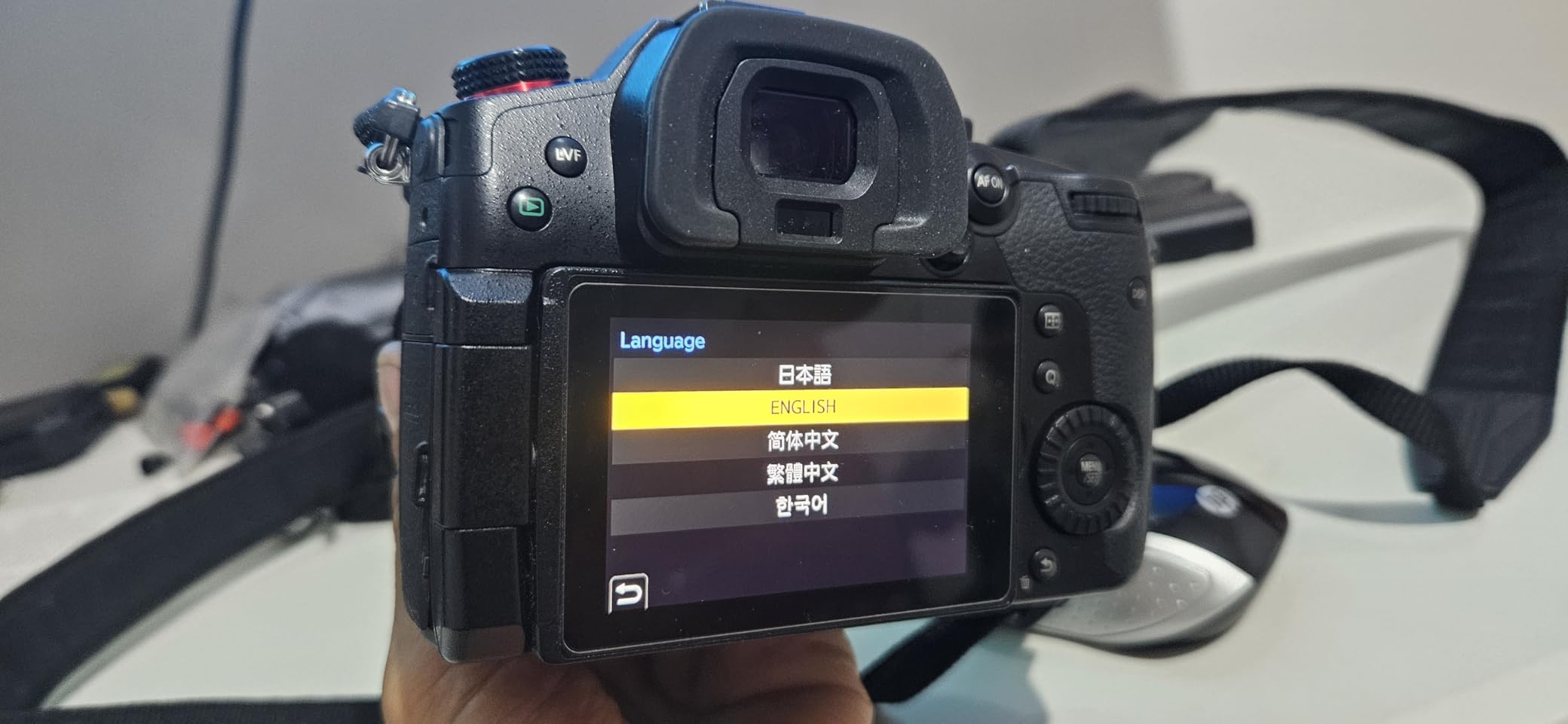
Build quality is professional grade. The magnesium alloy body is weather sealed against dust and moisture, and I have used the camera in light rain without issues. For students filming in unpredictable conditions, this durability matters.
Who the Panasonic GH5 II is good for
Film students focused on documentary or event coverage will appreciate the unlimited recording time. Students whose programs teach professional color grading workflows will benefit from the V-LogL profile and 10-bit internal recording.
The Micro Four Thirds lens ecosystem is also one of the most affordable available. I have built out a complete lens kit with Metabones adapters and vintage glass, costing less than a single professional native lens.
Who should consider other options
The smaller Micro Four Thirds sensor means lower-light performance is not as strong as APS-C or full-frame cameras. If you regularly shoot in dim conditions, the Canon R6 Mark II or full-frame Sony options will perform better.
Autofocus relies on contrast detection rather than phase detection, which is less reliable for tracking moving subjects. For documentary work where subjects move unpredictably, the Sony a6700 or Canon cameras with Dual Pixel AF will be more reliable.
8. Sony Alpha a6400 – Best Compact Body with Reliable Autofocus
Sony Alpha a6400 Mirrorless Camera: Compact APS-C Interchangeable Lens Digital Camera with Real-Time Eye Auto Focus, 4K Video, Flip Screen & 16-50mm Lens – E Mount Compatible – ILCE-6400L/B, Black
20.1MP APS-C sensor
Real-time Eye AF
4K video
180 degree flip screen
Pros
- Exceptional Real-time Eye AF
- Compact and lightweight
- Good value with kit lens included
- 4K video with full pixel readout
Cons
- No in-body image stabilization
- Complex menu system
- Limited APS-C lens selection from Sony
The Sony a6400 has been my go-to recommendation for film students who need a small, capable camera they can take anywhere. Released a few years ago, it remains one of the most reliable autofocus systems in this price range.
I have used the a6400 for vlog-style projects, documentary interviews, and travel films. The Real-time Eye AF tracks subjects with impressive accuracy, and the 4K video with full pixel readout captures detail that holds up well.

What makes this camera special for film students is the form factor. At 10.3 ounces, it disappears into a small bag, and the 180-degree flip screen makes solo filming straightforward. I shot a project where I needed to film myself conducting interviews, and the flip screen made setup much easier.
The price has come down significantly since release, which makes it a genuine value option for budget-conscious students. The kit lens is decent for starting out, and you can always upgrade to better Sony E-mount glass later.
Who the Sony a6400 is good for
Film students who prioritize portability will appreciate this camera. Travel filmmakers, documentary students covering events, and anyone who needs to carry their gear for long periods benefit from the compact body.
The Real-time Eye AF is genuinely useful for run-and-gun documentary work. I filmed a project where I was chasing subjects through a crowded street, and the camera kept their faces in focus even when they turned away briefly.
Who should consider other options
The lack of in-body image stabilization means you will need stabilized lenses or a gimbal for smooth handheld footage. The Sony a6700 or Canon R6 Mark II give you IBIS built in.
For pure video work without photography, the Blackmagic Pocket 4K offers better value with cinema features. The a6400 is best for students who want genuine hybrid capability at the lowest possible price.
9. Canon EOS R100 – Best Budget Camera for First-Year Students
Canon EOS R100 Mirrorless Camera RF-S18-45mm F4.5-6.3 is STM Lens Kit
24.1MP APS-C sensor
4K 24p video
Dual Pixel CMOS AF
Compact body
Pros
- Affordable entry price
- Beginner-friendly menu system
- Excellent battery life
- Compact and lightweight
Cons
- 4K limited to 24 fps
- No vari-angle screen (fixed display)
- No in-body image stabilization
The Canon EOS R100 is the camera I recommend to film students whose budgets are genuinely tight. At under $600 with a kit lens, this is the most affordable way to get into interchangeable-lens filmmaking with reliable autofocus.
I gave one of these to a friend who started film school last fall, and after watching their work, I can confirm the image quality is impressive for the price. The 24.1 megapixel APS-C sensor captures photos and video that look much more expensive than they are.
The Dual Pixel CMOS AF with face and eye detection works reliably for static interview setups. My friend filmed several documentary interviews using the R100, and the autofocus kept subjects in focus throughout.
Battery life is genuinely impressive. My friend shot a full day of class projects on a single charge, which is rare for mirrorless cameras. For students who do not want to buy multiple batteries, this matters.

Who the Canon EOS R100 is good for
First-year film students who need to start shooting immediately without breaking the bank will find the R100 an excellent entry point. The intuitive menu system makes learning photography and video concepts straightforward.
Students whose programs emphasize photojournalism alongside video will appreciate the stills quality. The Canon RF lens ecosystem is one of the deepest available, so you can expand your kit gradually as skills develop.
Who should consider other options
The fixed display (no flip screen) limits vlogging and self-recording. If you need to monitor yourself while filming, the Canon R50 or Sony a6400 are better choices.
4K recording is limited to 24 frames per second, which means no smooth slow-motion at 4K resolution. For slow-motion work, you will need to drop to 1080p 120fps. Students planning significant slow-motion work should look at the Sony a6700.
10. Panasonic LUMIX G7 – Best Starter Camera for Under $500
Panasonic LUMIX G7 4K Digital Camera, with 14-42mm Mega O.I.S. Lens, 16 Megapixel Mirrorless Camera, 3-Inch LCD, DMC-G7KK (Black)
16MP MFT sensor
4K UHD video
External mic input
Tilt/swivel screen
Pros
- 4K video at the lowest price
- External microphone input
- Compact and lightweight
- Good EVF for the price
Cons
- Plastic build feels less premium
- No in-body image stabilization
- No weather sealing
- Older contrast-detection AF
The Panasonic LUMIX G7 is the most affordable camera in this roundup, and despite its age, it still delivers genuine 4K video at a price that fits even the tightest student budgets. At around $485 with a kit lens, it is the cheapest way to get true 4K recording.
I have used the G7 to teach filmmaking workshops, and it consistently impresses beginners who cannot believe they are getting 4K footage at this price point. The footage quality holds up well for online delivery and basic class projects.

The external microphone input is the feature that makes this camera genuinely useful for film students. Built-in camera mics are rarely good enough for serious work, and having a mic input means you can use affordable external microphones from Rode or Audio-Technica to capture clean dialogue.
The 4K Photo mode lets you extract 8 megapixel stills from 4K video, which is genuinely useful for capturing decisive moments in documentary or sports work.

Who the Panasonic G7 is good for
Film students who need to start shooting today with minimal investment will find the G7 a practical choice. The low price lets you spend remaining budget on lenses, microphones, and lighting, which actually matters more for image quality than the camera body itself.
Students unsure whether filmmaking is the right career path can use this camera to explore without major financial commitment. If you discover filmmaking is your calling, you can always upgrade to a more capable camera later.
Who should consider other options
The plastic build and lack of weather sealing mean this camera will not survive heavy use or harsh conditions as well as more expensive options. For students who plan to shoot frequently, investing in a more durable body like the Canon R50 is wiser long term.
The contrast-detection autofocus is noticeably slower than newer phase-detection systems. For documentary work with moving subjects, this will frustrate you. Static interview setups work fine.
Buying Guide: How to Choose the Best Camera for Film School?
Choosing the best cameras for film students comes down to matching your program’s requirements with a realistic budget. Here are the key factors our team considered when evaluating these ten cameras.
Sensor size and what it means for your footage
Sensor size affects image quality, depth of field control, and low-light performance. Full-frame sensors like the Canon R6 Mark II deliver the best low-light performance and shallowest depth of field, but cost more. APS-C sensors like the Canon R50 and Sony a6700 offer a balance of quality and affordability.
Micro Four Thirds sensors like the Panasonic GH5 II are smaller, which means lower-light performance is compromised, but the lens ecosystem is more affordable. For film students just starting out, APS-C sensors represent the best balance.
4K video and frame rates for coursework
Most film school programs now require 4K deliverables. Every camera in this roundup shoots 4K, but frame rate options vary. Standard 4K 30p works for most narrative projects. If you plan to do slow-motion work, look for 4K 60p or 1080p 120fps.
For documentaries or event coverage, cameras with unlimited recording times like the Panasonic GH5 II prevent frustrating interruptions. Cameras with recording limits of 30 minutes will require planning around these breaks.
Autofocus vs manual focus for learning
Modern autofocus systems like those in the Sony a6700 and Canon R50 are genuinely capable. For documentary or run-and-gun work, reliable autofocus lets you focus on storytelling rather than focus pulling.
However, film programs still teach manual focus as a fundamental skill. Cameras like the Blackmagic Pocket 4K require manual focus, which forces you to learn this critical skill early. Our team recommends developing both skills during film school.
Audio inputs and monitoring for professional sound
A microphone input is non-negotiable for serious film work. Built-in camera microphones capture sound quality that is unusable for professional projects. Every camera in this roundup has a 3.5mm microphone input.
A headphone jack is equally important for monitoring audio while recording. Without it, you cannot tell if your microphone is picking up dialogue cleanly or capturing unwanted noise. Most cameras in this roundup include headphone jacks.
Lens ecosystem and total cost of ownership
The camera body is only the start. Budget for lenses, which often cost more than the camera itself. Sony E-mount and Canon RF systems have deep third-party lens support from Sigma and Tamron, which keeps costs reasonable.
Micro Four Thirds lenses are typically less expensive than APS-C or full-frame equivalents, which is one reason the Panasonic G7 and GH5 II remain popular for budget-conscious students. Factor in at least $300-500 for a second lens beyond the kit option.
Image stabilization for handheld shooting
In-body image stabilization (IBIS) lets you shoot smooth handheld footage without a gimbal. Cameras with IBIS include the Canon R6 Mark II, Sony a6700, and Panasonic GH5 II. This matters when you do not have time to set up a tripod.
For cameras without IBIS like the Canon R50, Sony a6400, and Blackmagic Pocket 4K, you will need stabilized lenses or accept that handheld footage will have some shake. Budget for a basic gimbal if you plan to shoot a lot of handheld.
Frequently Asked Questions
What is the best video camera for a film student?
The best video camera for a film student is the Blackmagic Pocket Cinema Camera 4K. It delivers cinema-grade ProRes and Blackmagic RAW recording, includes DaVinci Resolve Studio (a 300 dollar value), and offers 13 stops of dynamic range. For beginners who want easier operation, the Canon EOS R50 is a strong alternative with reliable autofocus.
How much should a film student spend on a camera?
Film students should budget between 600 and 1500 dollars for a camera body with a kit lens, plus an additional 300 to 500 dollars for essential accessories like an external microphone, extra batteries, and an SD card. Total kit cost typically falls between 900 and 2000 dollars. Buying used can stretch your budget further, though newer cameras offer better warranty protection.
Is mirrorless better than DSLR for film students?
Yes, mirrorless cameras are better than DSLRs for film students. Mirrorless cameras offer superior autofocus during video recording, in-body image stabilization on many models, and live exposure preview on the electronic viewfinder or LCD. Every major manufacturer has shifted focus to mirrorless development, meaning newer features and lens investments will be in the mirrorless ecosystem.
Do film students need 4K video?
Yes, most film school programs now require 4K deliverables. 4K footage also gives you flexibility to crop or stabilize in post-production without losing resolution. However, if you are shooting projects that will only be viewed on phones or social media, 1080p footage from cameras like the Panasonic G7 may suffice for your needs.
Final Thoughts on Choosing Your Film School Camera
Choosing the best cameras for film students comes down to matching your budget with the features that matter most for your specific program. Our team found that the Blackmagic Pocket Cinema Camera 4K offers the best value for students focused on narrative filmmaking and color grading workflows, while the Canon EOS R50 is the most beginner-friendly option for first-year students.
The Sony FX30 stands out as the premium choice for students who want professional features that will carry them through film school and into their early careers. Whatever camera you choose, remember that lenses, microphones, and lighting matter as much as the camera body itself.
Invest in at least one good external microphone and learn to light your scenes properly. Our team has seen student projects shot on budget cameras look better than those shot on premium cameras simply because the filmmaker understood lighting and audio fundamentals. The camera is a tool, but your storytelling is what will set your work apart.
3 thoughts on “10 Best Cameras for Film Students (October 2026) Top Compared”