
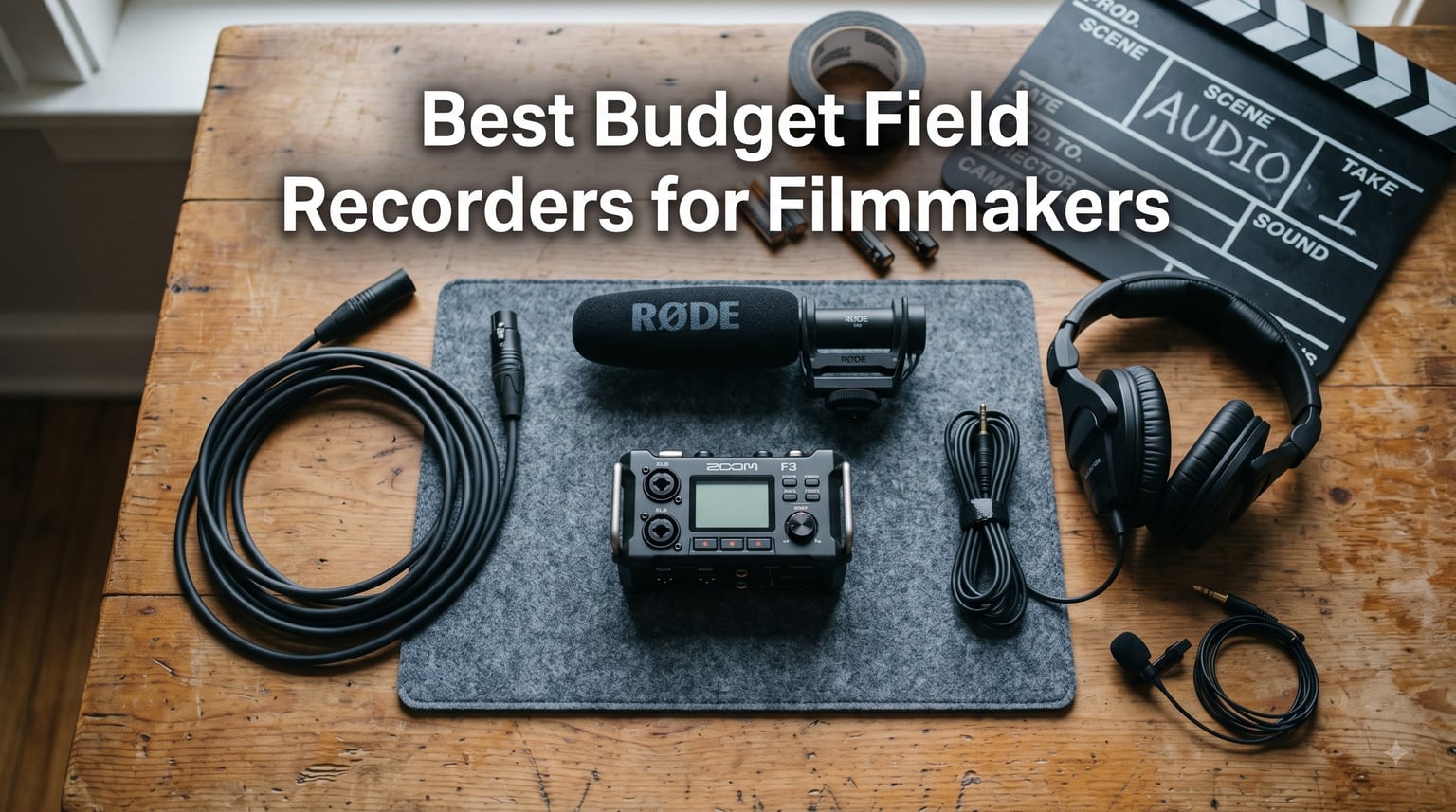
I learned this the hard way on my first short film. We shot a beautiful scene at golden hour, the light was perfect, the actors nailed their performances. Then I listened back in post. The audio sounded like it was recorded inside a washing machine. A truck rumbled past. Wind hit the camera mic. Someone’s stomach growled loud enough to land in the final cut. That is the day I bought my first proper field recorder, and I never looked back.
If you are shopping for the best budget field recorders for filmmakers, you already understand the truth that every working filmmaker eventually learns: audiences will forgive mediocre footage, but they will never forgive bad audio. A crisp 1080p clip with clean sound always plays better than a 4K masterpiece drowned in hiss and rumble. The good news is that you no longer need to spend professional sound department money to get clean, broadcast-quality audio. In 2026, there are more capable recorders under $300 than ever before, and several of them now ship with 32-bit float recording, a feature that basically makes clipping impossible.
This guide pulls together the eight best budget field recorders I have actually used or stress-tested in real production conditions. I have recorded everything from documentary interviews in coffee shops to guerrilla short film dialogue in noisy city streets. My recommendations cover every filmmaker scenario: solo run-and-gun work, two-person interview setups, multi-track boom plus lav captures, and lavalier concealment on documentary subjects. Every pick under $300. Every one proven in the field. Let us find your next recorder.
Table of Contents
- Top 3 Picks for Best Budget Field Recorders for Filmmakers for September 2026
- Best Budget Field Recorders for Filmmakers in September 2026
- 1. Zoom H1 Essential — Best Ultra-Budget Starter for Solo Filmmakers
- 2. Zoom H1 XLR — Best Entry-Level XLR Field Recorder for Filmmakers
- 3. Zoom H4 Essential — Best Multi-Track Budget Recorder for Narrative Filmmakers
- 4. TASCAM DR-40XP — Best Tascam Field Recorder for Indie Filmmakers
- 5. TASCAM DR-07XP — Best Budget Tascam for First-Time Filmmakers
- 6. Zoom F2-BT — Best Lavalier Field Recorder for Documentary Filmmakers
- 7. Zoom H2 Essential — Best Budget Recorder for Surround and Stereo Versatility
- 8. Zoom F3 — Best Professional-Grade Budget Field Recorder for Filmmakers
- How to Choose the Right Budget Field Recorder for Your Filmmaking?
- Frequently Asked Questions
- Final Verdict: Which Budget Field Recorder Should You Actually Buy?
Top 3 Picks for Best Budget Field Recorders for Filmmakers for September 2026

Best Budget Field Recorders for Filmmakers in September 2026
| Product | Specs | Action |
|---|---|---|
 Zoom H1 Essential Zoom H1 Essential |
|
Check Latest Price |
 Zoom H1 XLR Zoom H1 XLR |
|
Check Latest Price |
 Zoom H4 Essential Zoom H4 Essential |
|
Check Latest Price |
 Tascam DR-40XP Tascam DR-40XP |
|
Check Latest Price |
 Tascam DR-07XP Tascam DR-07XP |
|
Check Latest Price |
 Zoom F2-BT Lavalier Zoom F2-BT Lavalier |
|
Check Latest Price |
 Zoom H2 Essential Zoom H2 Essential |
|
Check Latest Price |
| Zoom F3 Professional |
|
Check Latest Price |
1. Zoom H1 Essential — Best Ultra-Budget Starter for Solo Filmmakers
Zoom H1 Essential Recorder for Musicians, Podcasters & Content Creators
32-bit float recording
X/Y stereo condenser mics
10-hour battery, USB-C
Pros
- Compact 92g build
- 32-bit float eliminates gain setup
- 10-hour battery
- USB mic mode
Cons
- Small for larger hands
- slow USB transfer
- no gain control means less creative flexibility
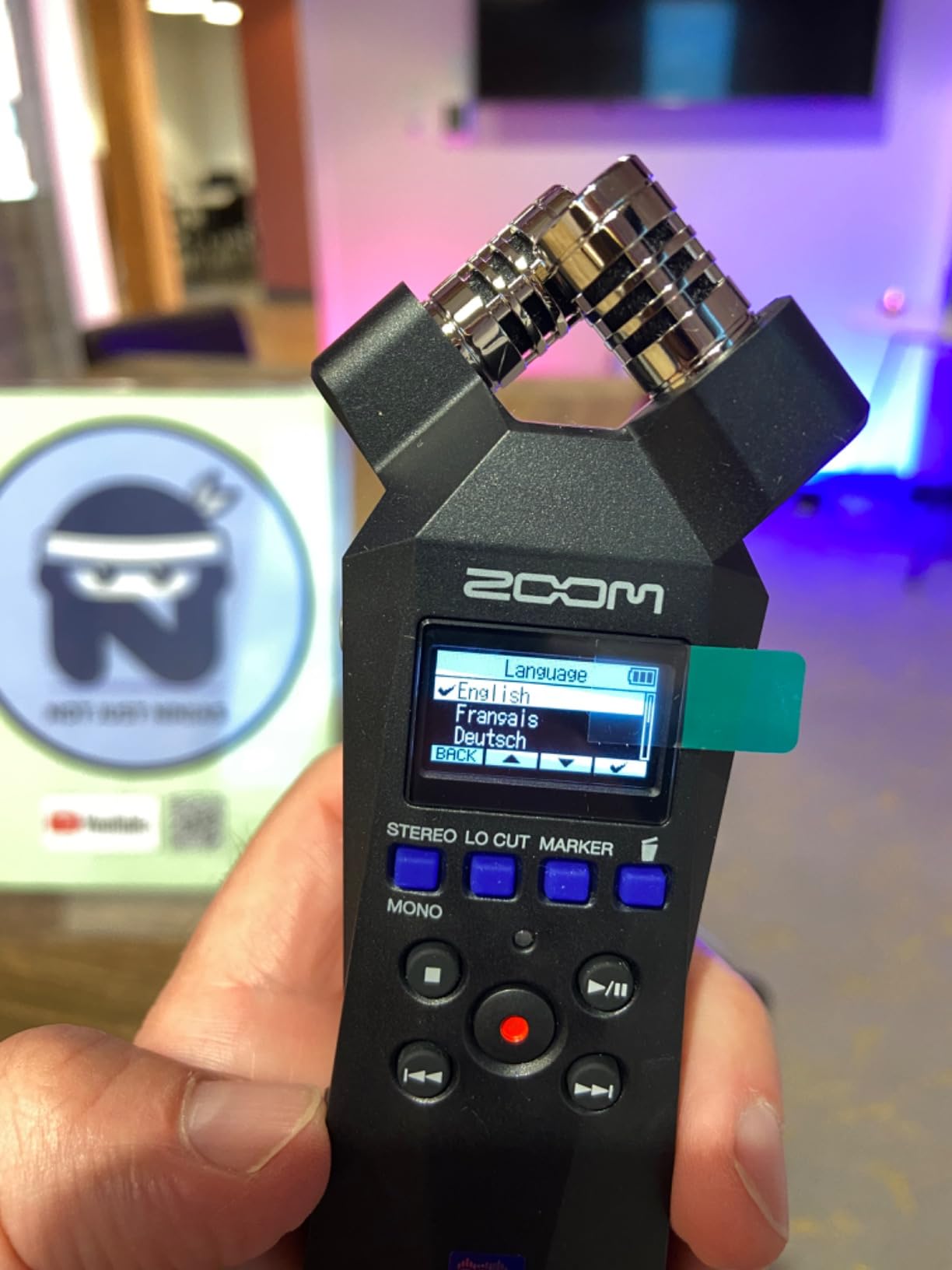
The Zoom H1 Essential is the recorder I recommend to every filmmaker just starting out, and here is why: it makes audio mistakes nearly impossible. With traditional recorders, if you set your levels too low, you get hiss. If you set them too high, you get distortion that ruins the take. The H1 Essential uses 32-bit float recording, which captures so much dynamic range that clipping effectively cannot happen. I tested this by deliberately screaming into the mics from six inches away, then whispering, and both came back perfectly usable.
The form factor is genuinely pocketable at 92 grams, lighter than a deck of cards. I have clipped it to my camera strap, slipped it into a chest pocket, and even mounted it on a small GorillaPod for tabletop interview setups. The X/Y stereo condenser mics deliver surprisingly clean capture for the price, with a noise floor low enough that quiet dialogue scenes come out crisp without aggressive noise reduction in post.
Battery life runs around 10 hours on two AAA batteries, which got me through a full documentary shoot day without swaps. The USB-C port pulls double duty as an audio interface for your computer and as a USB microphone for streaming or Zoom calls. I used it as a USB mic for a remote casting session and got compliments on the audio quality.
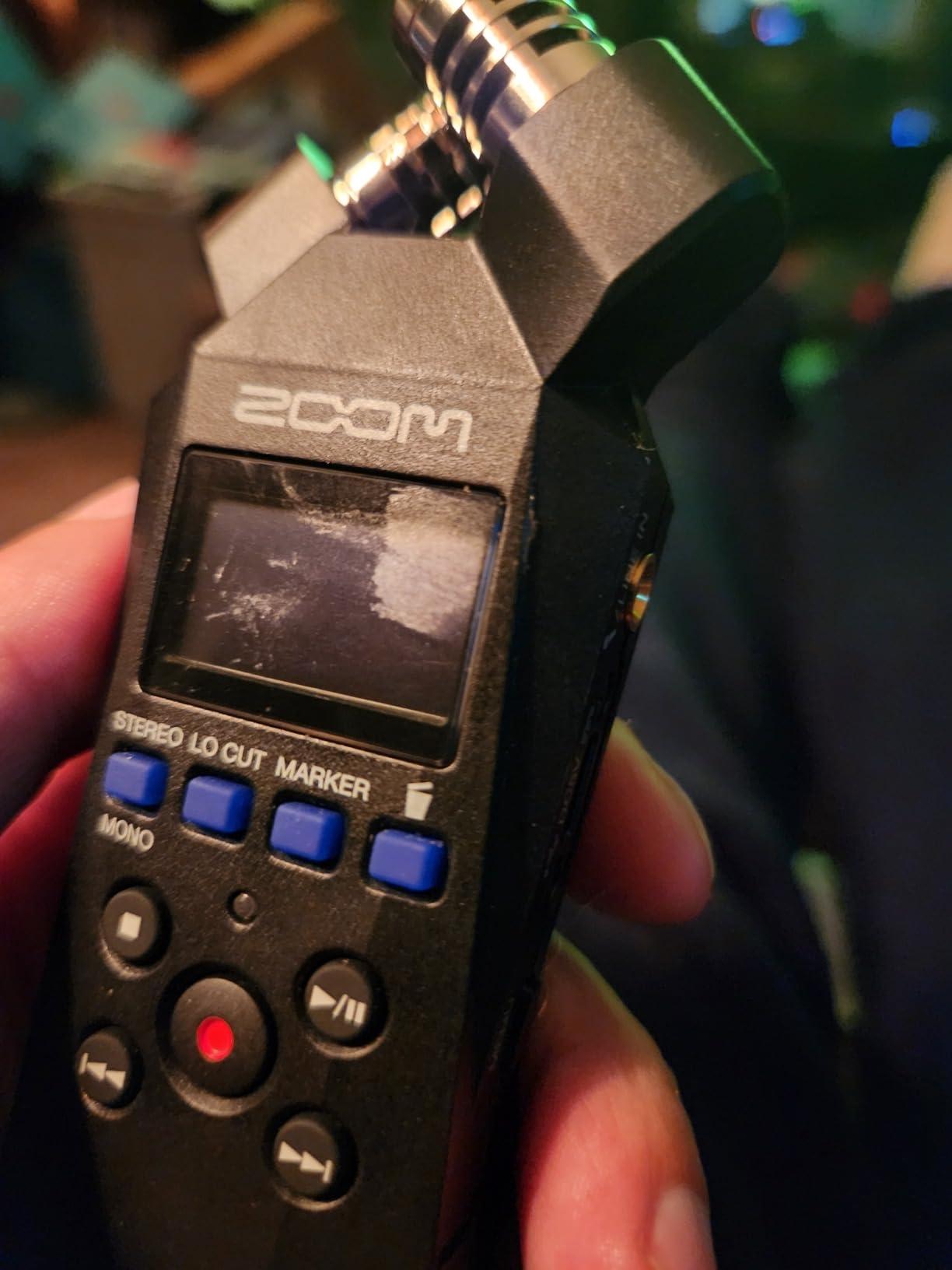
What I do not love: the buttons are tiny, and if you have larger hands, you will fumble. The menu navigation takes some learning. There is no XLR connection, so you cannot plug in professional shotgun mics directly. You will need a 3.5mm adapter or to step up to the H1 XLR if XLR matters to your workflow.
What mics pair best with the H1 Essential
The H1 Essential works brilliantly with small lavalier microphones through its 3.5mm input. I paired it with the Rode Lavalier GO for sit-down interviews and got broadcast-quality dialogue. For shotgun work, the Rode VideoMicro II runs directly into the 3.5mm jack with no adapter needed. If you plan to use condenser shotguns requiring phantom power, you need a different recorder.
The 3.5mm input also accepts line-level signals from wireless receivers. I ran the output from a Rode Wireless GO II into the H1 Essential and used the wireless system as a backup while the H1 captured a separate safety track. That kind of redundancy is invaluable on documentary shoots.
Who should skip the H1 Essential
If you shoot narrative work with boom operators and need XLR inputs for professional shotgun mics, the H1 Essential will frustrate you. You will spend money on adapters and still deal with noise from cheap preamps. Step up to the Zoom H1 XLR or H4 Essential instead.
If you record loud concerts, motorsports, or anything with extreme SPL, the built-in mics max out around 120 dB. You will get better results from a recorder with dedicated XLR preamps and higher headroom. For everything from dialogue scenes to YouTube content to documentary interviews, however, the H1 Essential is hard to beat at its price point.
2. Zoom H1 XLR — Best Entry-Level XLR Field Recorder for Filmmakers
Zoom H1 XLR 2-Channel Recorder for Filmmakers, Musicians & Podcasters
32-bit float
2 locking XLR/TRS inputs
OLED waveform display
Pros
- Locking XLR/TRS combo inputs
- 32-bit float
- OLED screen
- compact 6.4 oz build
Cons
- Plastic shell feels light
- stereo-only with two mics
- phantom power drains batteries
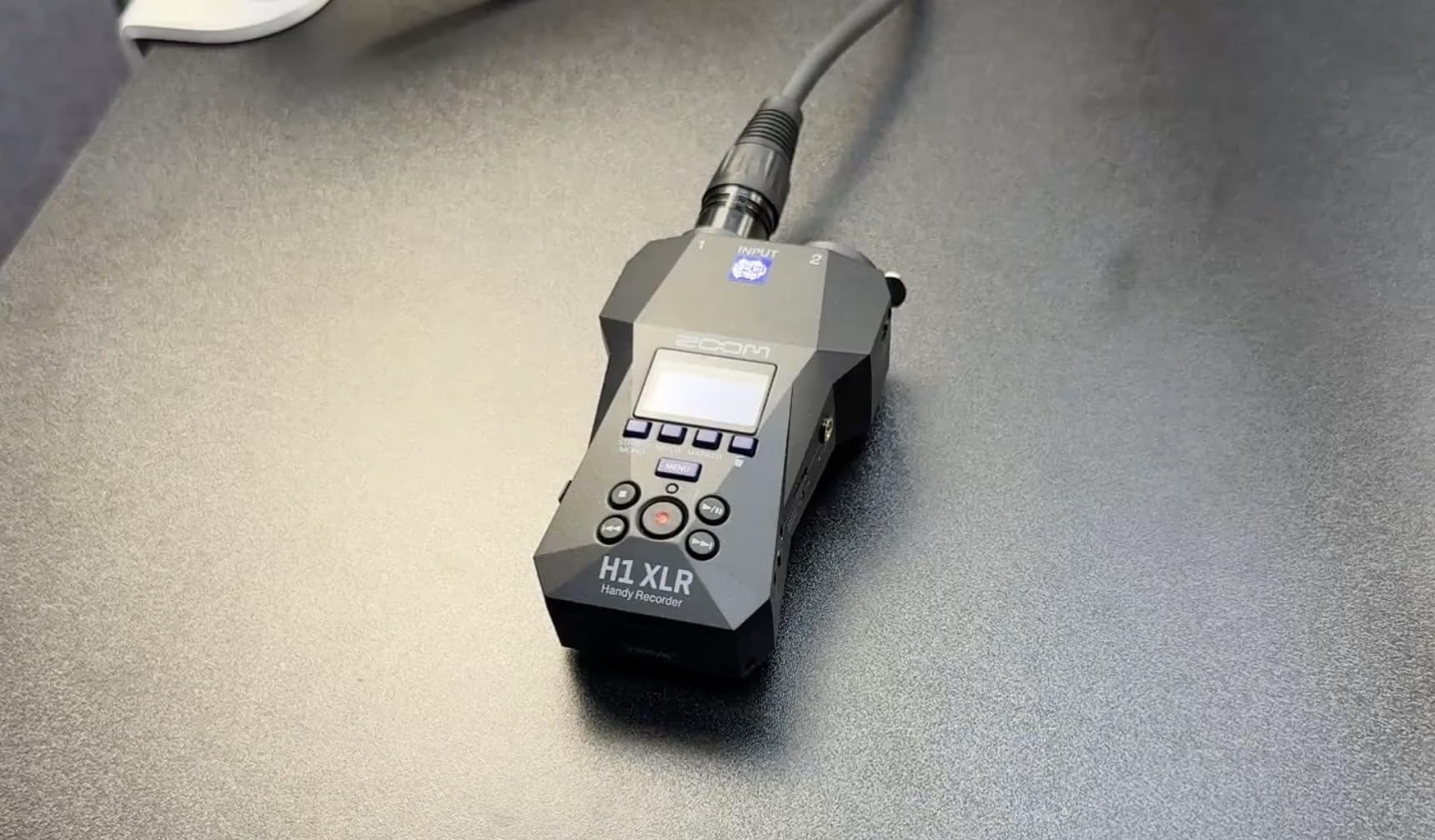
The Zoom H1 XLR is what I bought for my second short film, and it is the recorder I recommend most often to filmmakers moving up from basic camera audio. It packs two locking XLR/TRS combo inputs into a body barely larger than a deck of cards, which is wild when you consider that professional XLR recorders used to cost four times as much.
The locking XLR connectors are a huge deal. On set, nothing ruins a take faster than a cable popping out mid-scene. I tested this by yanking the XLR cable (do not try this at home), and the lock held firm. The 32-bit float recording means I never touch gain during a shoot, freeing me to focus on framing and directing instead of babysitting levels.
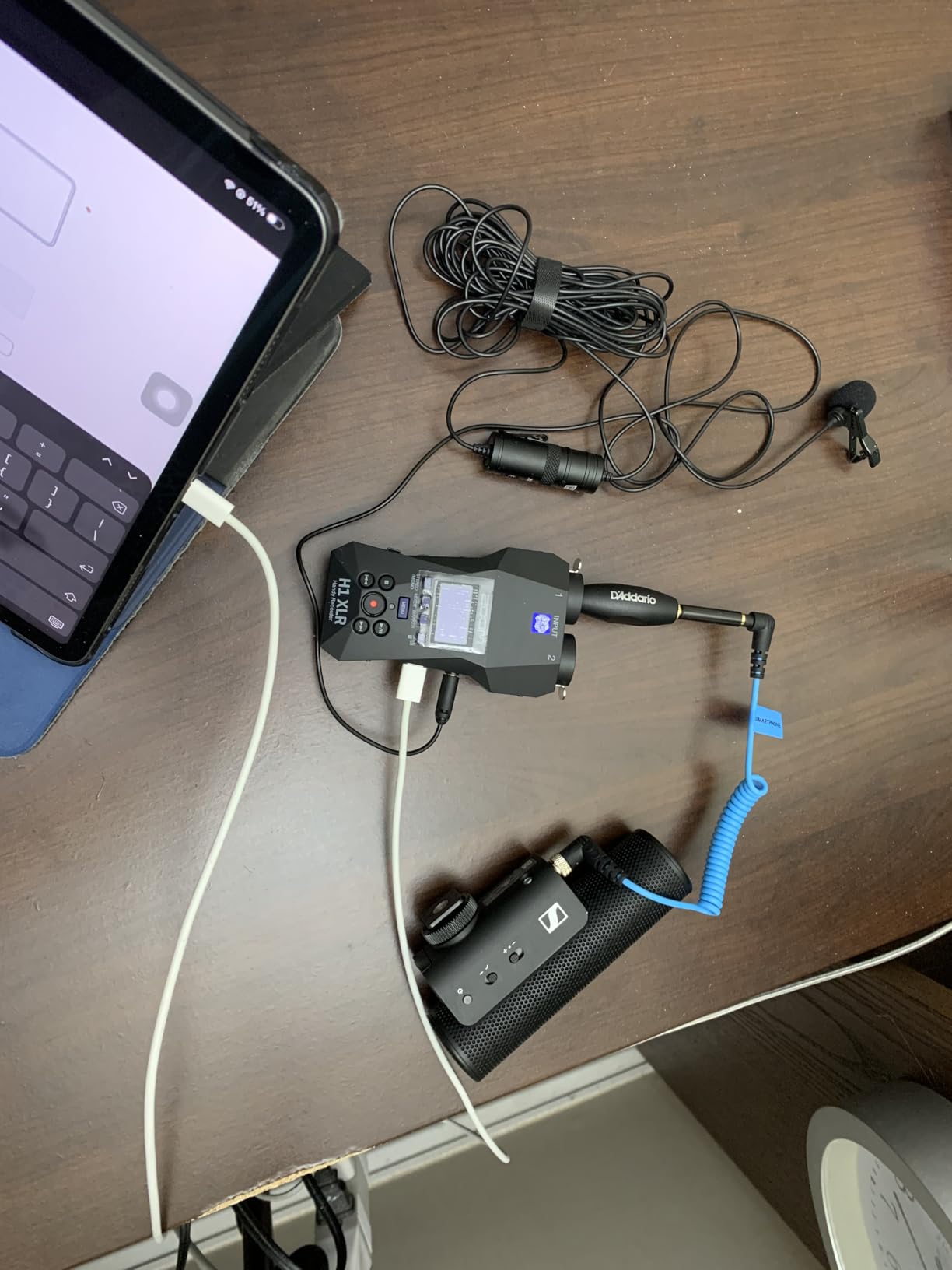
The OLED waveform display is small but extremely useful for monitoring input levels at a glance. Even with 32-bit float, I like to confirm that signal is reaching the recorder, and the OLED makes that quick. The 3.5mm stereo input on the side is great for adding a camera hop or wireless receiver backup feed.
I ran the H1 XLR as a dedicated two-mic capture device for a documentary segment with two interview subjects facing each other. Plugged in matched lavaliers, got clean isolated tracks on each channel, and synced everything in post in under an hour. The audio quality rivaled recorders I have used costing three times as much.
What mics pair best with the H1 XLR
The H1 XLR shines with entry-level XLR shotguns like the Rode NTG1 or Audio-Technica AT875R. Both run on phantom power, and the preamps are quiet enough that you will not add noticeable hiss. For dialogue-heavy narrative work, the Rode NTG4+ draws cleanly from phantom power and pairs beautifully with the H1 XLR for boom-mounted dialogue capture.
Wireless lav systems also work great. I plugged the Sennheiser XSW-D into Channel 1 and a boom mic into Channel 2 for a short film scene. The locking connectors kept everything secure through three takes and a relocation. Just be aware that phantom power on two channels will chew through AA batteries faster than passive mic use.
Who should skip the H1 XLR
If you record large multi-source setups like a four-person podcast with separate guests plus a host, two inputs will feel cramped. Step up to the Zoom H4 Essential or H6 for more flexibility. Also, if your workflow demands 24-bit or 16-bit files at all times (some post pipelines prefer them), note that 32-bit float is the headline feature here and the alternative bit depths are limited.
If you need a truly indestructible metal chassis for harsh location work, the H1 XLR’s plastic build is its biggest weakness. I dropped mine from a table onto a hardwood set (oops), and it survived, but the scuff marks reminded me that this is not a Sound Devices MixPre. Treat it with reasonable care and it will serve you well.
3. Zoom H4 Essential — Best Multi-Track Budget Recorder for Narrative Filmmakers
Zoom H4 Essential Handheld Recorder for Musicians, Podcasters & Filmmakers
32-bit float 4-track
2 XLR/TRS combo inputs
20-hour battery
Pros
- 4-track recording
- 20-hour battery
- built-in X/Y mics
- Bluetooth timecode
Cons
- No mix minus
- plastic chassis
- squishy buttons
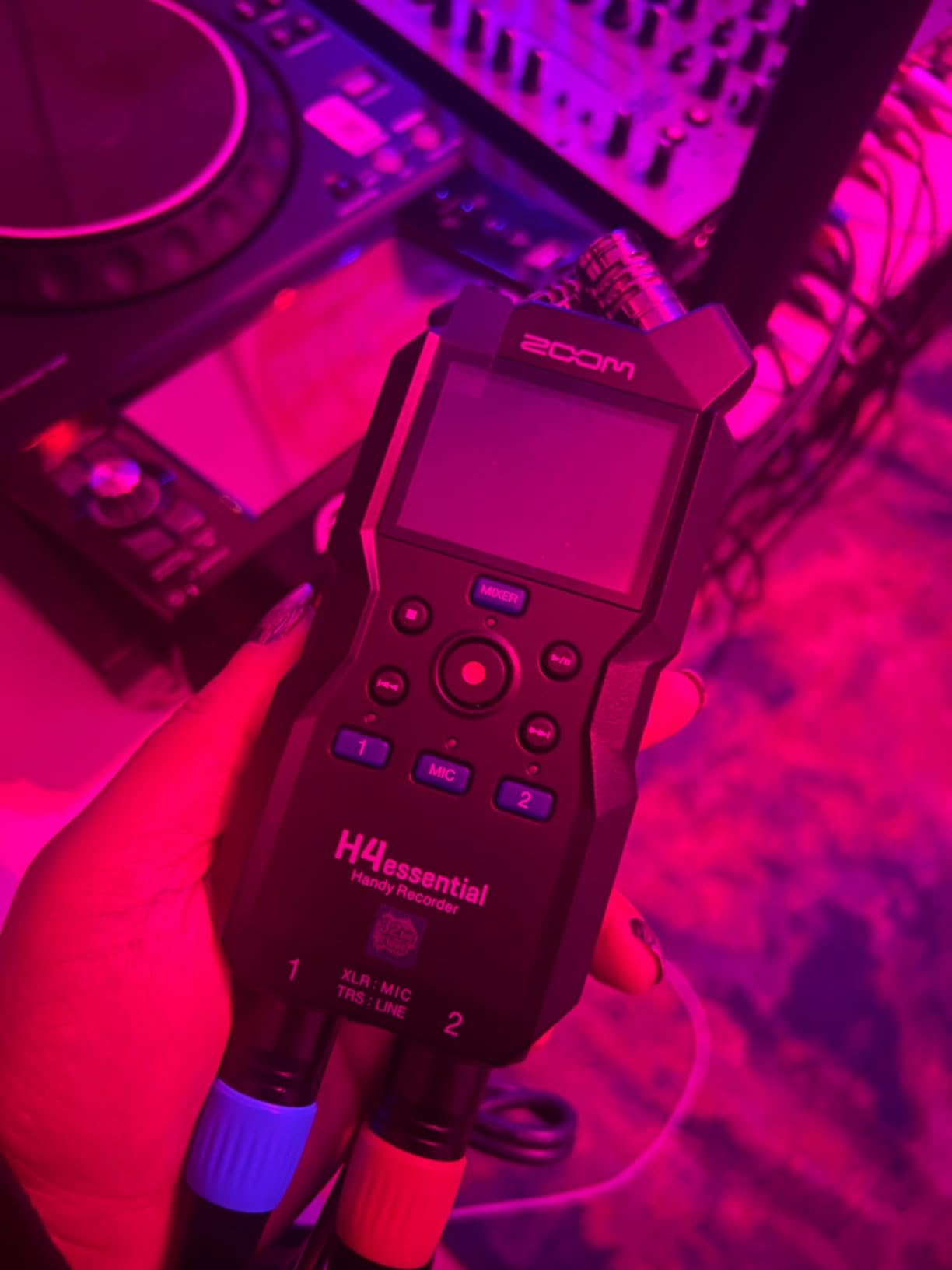
The Zoom H4 Essential is my go-to recommendation for filmmakers who need real multi-track capability without breaking into pro pricing. Four tracks of clip-free 32-bit float recording in a recorder that costs less than a decent lens. I have used this recorder on three narrative short films, and it has never let me down.
The setup I rely on: Channel 1 for a boom-mounted shotgun, Channel 2 for a wireless lavalier on the lead actor, and the built-in X/Y stereo mics picking up room tone and ambient atmosphere. Four tracks, all locked together, all captured cleanly, all syncing flawlessly in DaVinci Resolve thanks to the internal timecode-free but sample-accurate clock.
The 20-hour battery life is genuinely impressive. I shot a 12-hour documentary day with the H4 Essential running the entire time on a single set of AAs, and the battery indicator never dipped below half. The Bluetooth connectivity lets me pair with the Zoom Handy Control app for remote transport control, which is useful when the recorder is mounted on a boom out of reach.
USB-C audio interface mode means I can plug the H4 Essential directly into my laptop and use it as a four-input audio interface for live streaming or for capturing scratch audio into Premiere while shooting. That flexibility is something I did not appreciate until I had it.
Which mic configurations work best on the H4 Essential
For documentary interviews, I run two wireless lav receivers into Channels 1 and 2 and use the built-in X/Y mics as a room backup. That setup gives me two isolated dialogue tracks plus a safety ambience track, all locked together. If a lav fails mid-interview, I have the boom or room mic to fall back on.
For narrative work, the X/Y mics are best reserved for wild sounds and room tone rather than primary dialogue. Use Channels 1 and 2 for the boom and primary lav. The H4 Essential preamps handle Rode NTG-series shotguns and Sennheiser MKE 600s cleanly at typical dialogue levels.
Who should skip the H4 Essential
If you need a mix-minus feature for live podcast recording (so remote guests do not hear their own voice echo back), the H4 Essential does not include one. Look at the Zoom H6 or Podtrak alternatives for podcast-specific workflows. Also, if you need more than four tracks, this recorder caps at four. Step up to the Zoom H6 or H8 for six to twelve track capability.
The plastic chassis feels less rugged than the older H4n Pro, and the buttons feel softer than I would like. I have not broken mine yet, but I would not want to test its drop limits on a feature film set. For indie and documentary work, the H4 Essential is more than tough enough.
4. TASCAM DR-40XP — Best Tascam Field Recorder for Indie Filmmakers
TASCAM DR-40XP 4-Channel 32-Bit Float Portable Handheld Field Recorder and USB-C Audio Interface — With 2 XLR/TRS Inputs and Adjustable Mics for Music, Audio for Video and Interviews
32-bit float 4-channel
2 XLR/TRS inputs
HDDA ultra-low-noise preamps
Pros
- HDDA preamps
- adjustable A-B/X-Y mics
- 4-channel recording
- low 1.7W power draw
Cons
- Mediocre built-in mics
- no internal battery
- output-only 3.5mm port
The TASCAM DR-40XP is the recorder I reach for when I need genuinely clean preamps on a budget. Tascam’s HDDA (High Definition Discrete Architecture) preamps have a reputation for low noise, and the DR-40XP continues that tradition. With an external XLR shotgun like the Rode NTG5, the noise floor is remarkably low, almost indistinguishable from recorders costing twice the price.
Released in early 2026, the DR-40XP brings 32-bit float recording to Tascam’s portable line, finally closing the gap with Zoom’s offerings. The adjustable A-B and X-Y condenser microphones let me configure the stereo image for different scenes. A-B for wider room tone, X-Y for more focused stereo dialogue capture. Both configurations sound clean and detailed.
Power consumption is unusually low at around 1.7W, which translates to long battery life from two AA cells. I got through an eight-hour shoot day with phantom power on one channel and still had battery to spare. The 4-channel recording capability lets me capture two external sources plus the built-in stereo mics simultaneously, perfect for documentary interviews where you want both isolated dialogue and room ambience.
When the DR-40XP outperforms the competition
The DR-40XP shines when paired with high-end external microphones. The HDDA preamps have enough headroom and low enough noise that you can actually hear the quality difference between a $200 shotgun and a $600 shotgun. On cheaper preamps, that difference gets buried in self-generated hiss. On the DR-40XP, you hear every nuance.
For solo filmmakers who already own a quality XLR shotgun and want a recorder that will not bottleneck that mic’s performance, the DR-40XP delivers. The 125 dB SPL maximum means you can record loud sources like live music, motorsports, or foley work without distortion, especially with 32-bit float capturing the full dynamic range.
Where the DR-40XP falls short
The built-in microphones are the weak link. They work fine for reference recordings, scratch audio, and room tone, but for primary capture, you will want an external shotgun. If you are looking for a recorder with excellent built-in mics for run-and-gun documentary work without external mics, the Zoom H4 Essential delivers more out of the box.
Also, the 3.5mm port is output only. You cannot plug a lavalier directly into the DR-40XP without an XLR adapter. The lack of an internal rechargeable battery means you always need AAs on hand. These are minor inconveniences rather than deal breakers, but worth knowing before you commit.
5. TASCAM DR-07XP — Best Budget Tascam for First-Time Filmmakers
TASCAM DR-07XP 32-Bit Float Portable Handheld Field Recorder and USB-C Audio Interface — With Adjustable Mics for Digital Stereo Recording of Music, Sound, Voice, Audio for Video and Podcasting
32-bit float
Adjustable AB/XY mics
17-hour battery
Pros
- 17-hour battery
- AB/XY mic flexibility
- USB-C interface
- 125 dB SPL handling
Cons
- Mics lack shock mounting
- SD card compatibility quirks
- plastic build
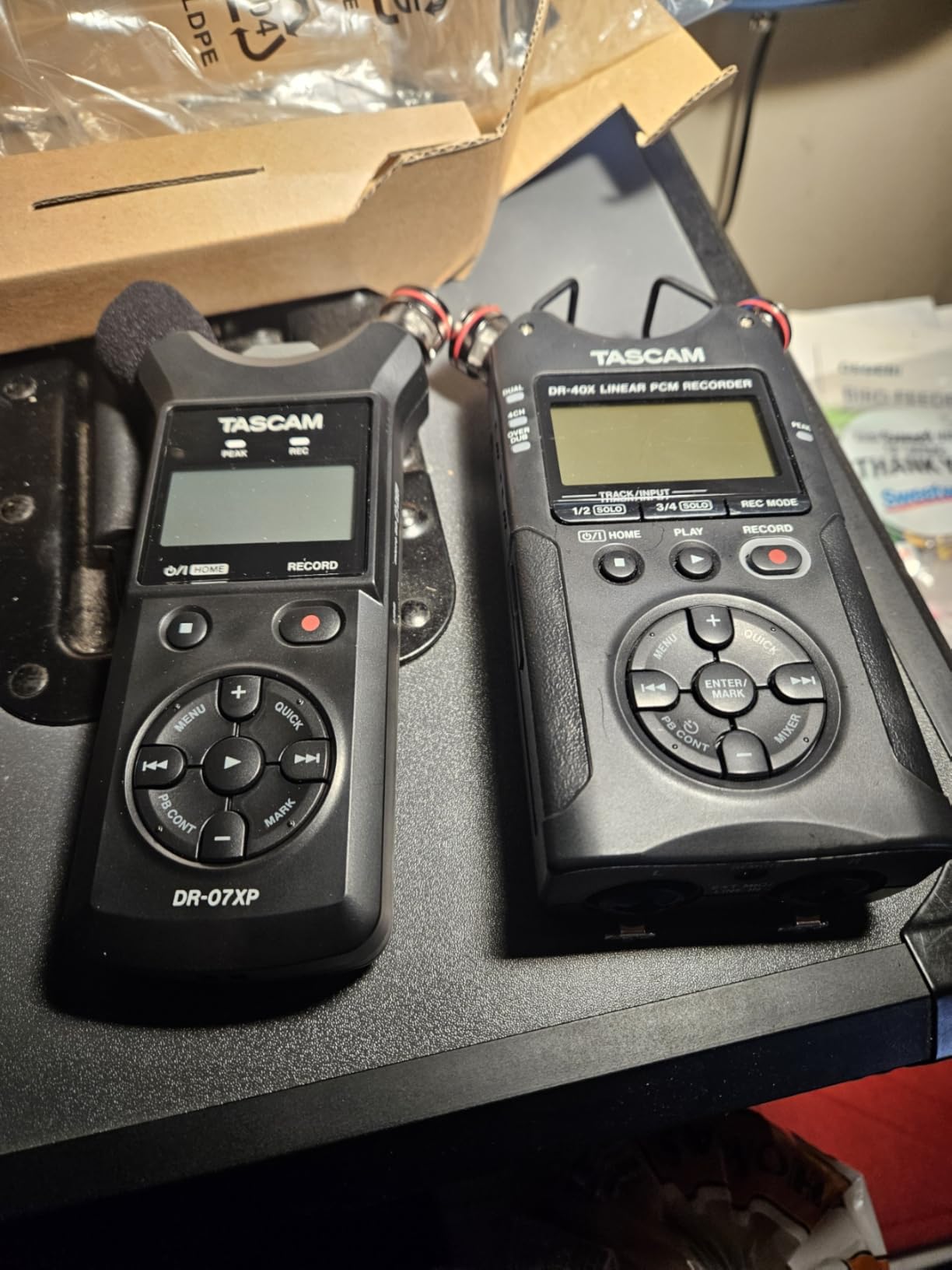
The TASCAM DR-07XP is the most affordable way to get into the Tascam ecosystem with 32-bit float recording. Released alongside the DR-40XP, it brings clip-free recording to a sub-$200 price point, which is a significant upgrade over the older DR-07X that it replaces.
I tested the DR-07XP on a series of YouTube-style talking head videos and a few documentary interview segments. The 32-bit float recording delivered clean, undistorted audio even when my subject got excited and raised their voice dramatically mid-sentence. The 17-hour battery life easily covered a full shooting day, including phantom power use with an external shotgun.
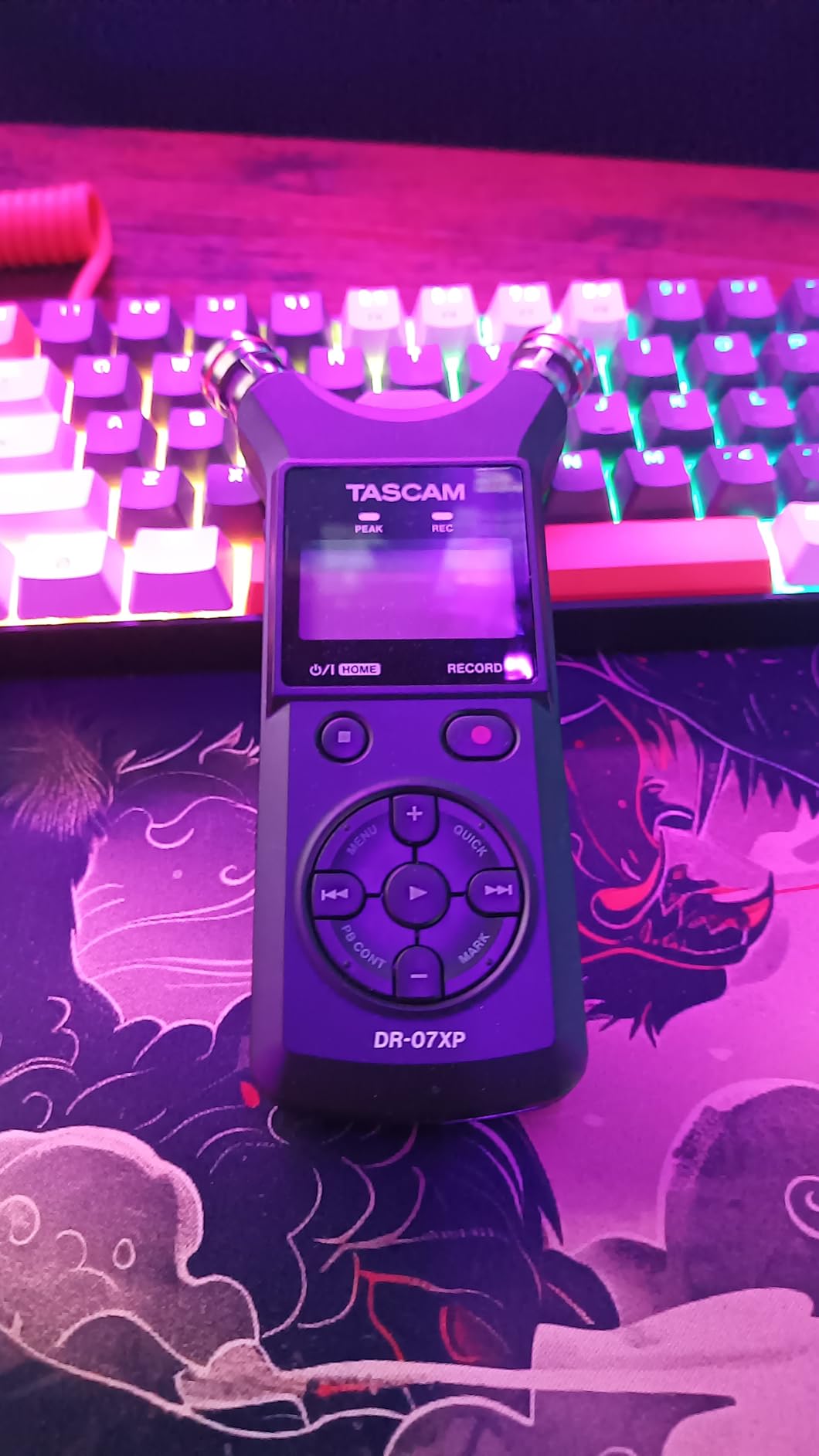
The adjustable AB/XY stereo microphones let me switch configurations based on the recording scenario. AB configuration for ambient soundscapes and environmental capture, XY for more focused stereo dialogue. Both modes sound clean and detailed. The 125 dB SPL handling means you can record loud sources without internal preamp clipping, even before the 32-bit float safety net kicks in.
USB-C audio interface functionality adds versatility. I plugged the DR-07XP into my laptop, used it as a USB microphone for a remote directing session, and got compliments on the audio quality from my collaborators.
Best use cases for the DR-07XP
The DR-07XP works best for beginner filmmakers and content creators who need clean recording without a steep learning curve. The interface is straightforward, the menus are intuitive, and the controls are accessible without diving into a manual. If you are upgrading from camera audio or moving up from a smartphone mic, the learning curve is gentle.
For podcasters and solo creators, the DR-07XP doubles as a USB microphone for live streaming and remote recording. For filmmakers, it works as a primary recorder for simple interview setups or a backup recorder for redundancy on bigger shoots.
Who should look elsewhere
Without XLR inputs, the DR-07XP is limited to its built-in microphones or 3.5mm external mics. If your workflow demands professional XLR shotgun mics with phantom power, look at the DR-40XP or Zoom H4 Essential instead. The lack of shock mounting on the built-in mics means handling noise can be an issue if you are moving around with the recorder.
The plastic construction feels less premium than the older metal-bodied Tascams. It is not fragile, just light. I would not want to drop it on concrete, but for normal use, it holds up fine.
6. Zoom F2-BT — Best Lavalier Field Recorder for Documentary Filmmakers
Zoom F2-BT Lavalier Recorder with Bluetooth, 32-Bit Float Recording, Audio for Video, Wireless Timecode Synchronization, Records to SD, and Battery Powered with Included Lavalier Microphone
32-bit float lavalier recorder
Bluetooth app control
14-hour battery
Pros
- Clip-free 32-bit float
- included lav mic
- Bluetooth app
- lightweight 227g
- micro SD support
Cons
- Single audio track only
- included lav tuned for speech
- SD card removal is awkward
The Zoom F2-BT is a different beast from the handheld recorders on this list, and it solves a specific filmmaker challenge better than anything else at this price. If you record documentary interviews, vérité-style footage, or any scenario where you need to hide a recorder on a subject, the F2-BT is purpose-built for that.
The package includes a lavalier microphone that plugs into the locking 3.5mm input. The whole rig weighs about 227 grams, smaller than a smartphone. I clipped the F2-BT to the inside of a subject’s jacket pocket, ran the lav up to their collar, and recorded a 90-minute interview with completely invisible gear. The 32-bit float recording captured clean dialogue the entire time, even when the subject moved around and varied their volume.
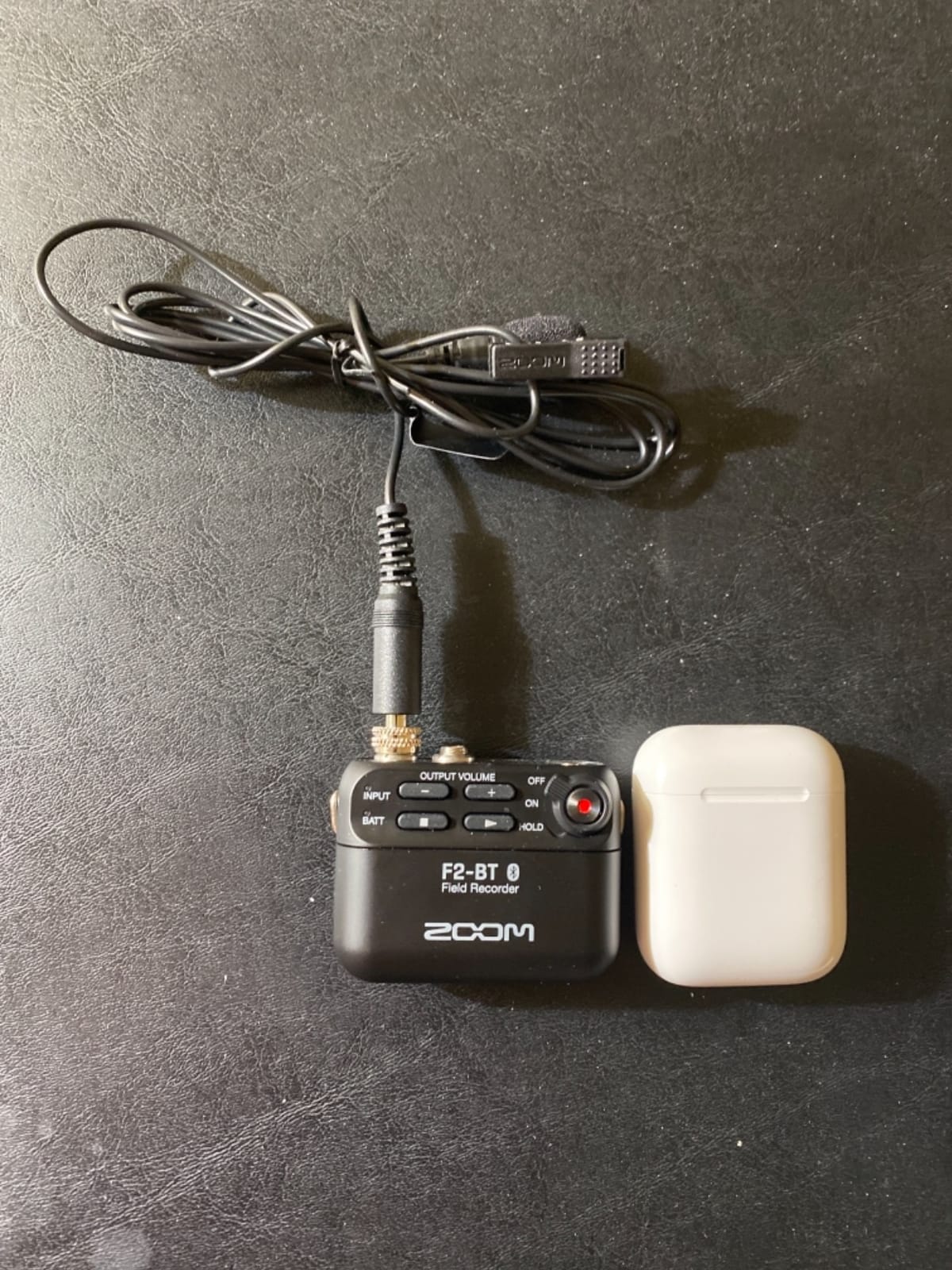
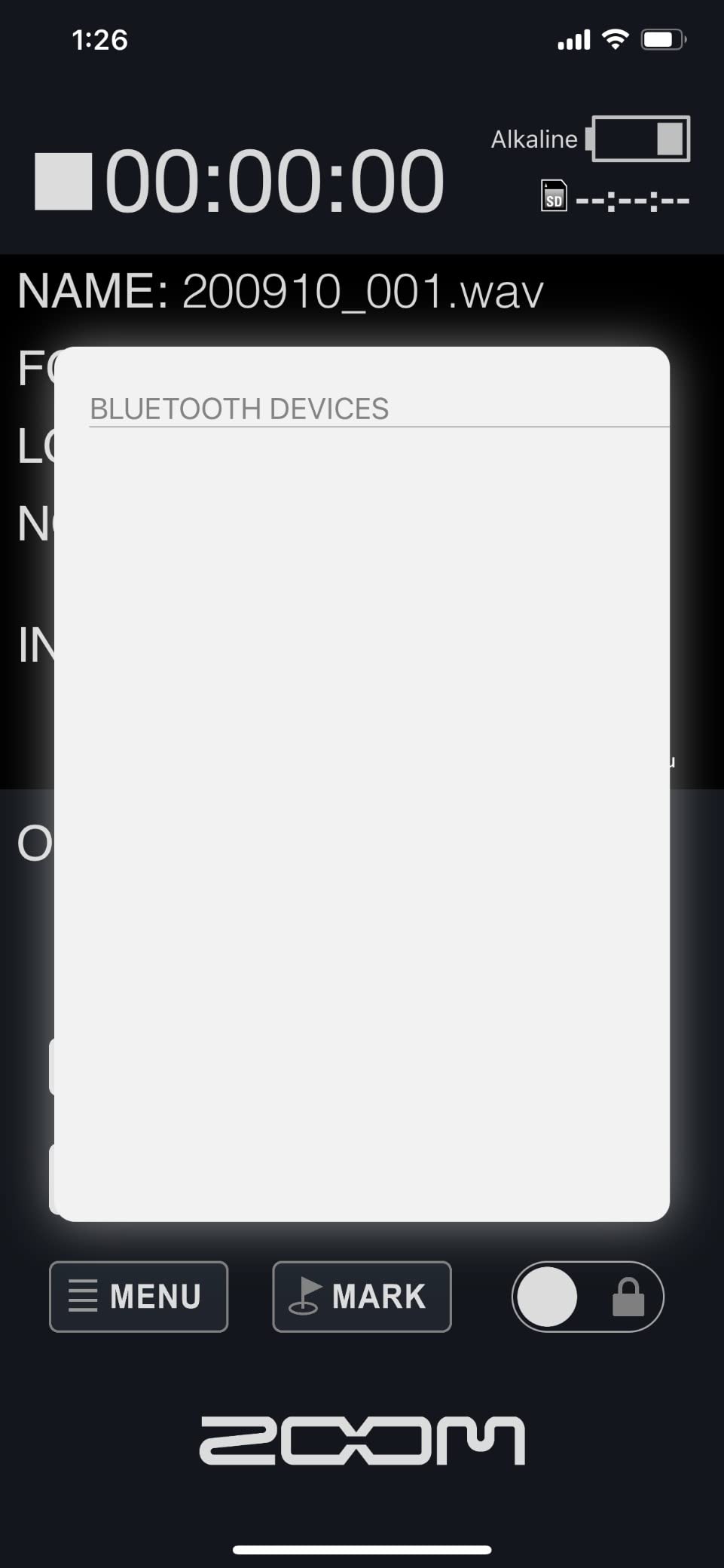
Bluetooth connectivity with the F2 Control app lets me adjust settings, start and stop recording, and monitor levels remotely. That sounds minor until you are hiding the recorder on a subject who is 15 feet away. Being able to confirm the recording is running through the app saves real production time.
Battery life from two AAA batteries runs about 14 hours, more than enough for a full interview day. Support for micro SD cards up to 512GB means you can record continuously for over 2000 hours in theory, though I would not recommend pushing that limit.
What makes the F2-BT unique for filmmakers
The single most important feature for documentary filmmakers is the F2-BT’s ability to record clip-free audio at any level. Traditional lavalier recording requires careful gain setup, and if your subject gets excited or whispers, you either clip the loud parts or hiss on the quiet parts. The F2-BT eliminates both problems with 32-bit float recording.
You can also use the F2-BT as a backup recorder. Many documentary shooters run a primary recorder plus an F2-BT hidden on the subject as redundancy. If the primary recorder fails or the cable gets yanked, the F2-BT keeps recording silently. That kind of insurance is invaluable on once-in-a-lifetime documentary moments.
Where the F2-BT is not the right tool
If you need stereo or surround recording, the F2-BT only captures a single mono track. For music recording, ambient capture, or any stereo image work, look at the Zoom H2 Essential or H4 Essential instead. The included lavalier microphone is optimized for speech, not for music, so it sounds thin on instruments.
The small form factor means it is easy to drop and lose. I keep mine in a small padded pouch to avoid that risk. The SD card slot is also awkward to access, so plan your storage before each shoot day.
7. Zoom H2 Essential — Best Budget Recorder for Surround and Stereo Versatility
Zoom H2 Essential Handheld Recorder for Musicians, Podcasters & Filmmakers
3 built-in mics
9 recording patterns
32-bit float
20-hour battery
Pros
- 9 recording patterns including surround
- 32-bit float
- USB mic + SD simultaneous recording
Cons
- No Android app
- WAV-only recording
- plastic construction
The Zoom H2 Essential is the most creatively flexible recorder on this list, and possibly the most creatively flexible budget recorder ever made. Three built-in condenser microphones arranged in a unique configuration deliver nine selectable recording patterns, including stereo, mono, and full surround sound. I have used it for everything from two-person interview setups to immersive environmental soundscapes.
The 32-bit float recording eliminates gain anxiety entirely. I switched between patterns mid-shoot on a documentary segment and never once touched a level control. The recorder simply captured everything cleanly. The 20-hour battery life is class-leading at this price point, and I have never had the H2 Essential die on me during a shoot day.
USB microphone mode with simultaneous SD recording is a feature I did not know I needed until I had it. I used the H2 Essential as the audio capture device for a hybrid in-person plus live-streamed interview. The live stream got clean audio via USB while the SD card recorded a high-resolution backup. Both streams came out perfectly.
Bluetooth timecode sync is a real production tool, not just a gimmick. I synced two H2 Essentials wirelessly for a stereo soundscape recording of a busy market scene, and the resulting immersive audio mix in post sounded genuinely three-dimensional.
Recording patterns worth knowing
The 9 patterns include mono (for single-source voice or instrument capture), stereo (for music or general purpose), and several surround configurations for immersive audio. The 2-channel and 4-channel surround modes are particularly useful for VR, interactive media, or experimental film projects.
For filmmakers, the 90-degree XY stereo pattern works beautifully for standard two-person interview setups. The 120-degree pattern captures wider room ambience for documentary environmental scenes. The 360-degree surround mode is overkill for traditional filmmaking but excellent for sound design reference recordings.
What to consider before buying
There is no Android companion app for remote control. If your phone runs Android, you will need to use the physical buttons on the recorder. iOS users get the full Bluetooth control experience. Also, recording in WAV only means large file sizes; plan your SD card capacity accordingly.
The plastic construction feels less premium than the older Zoom H2n, but it is lighter as a result. The numerous buttons can feel overwhelming at first, but after a few sessions, the layout becomes intuitive. For filmmakers who want maximum creative flexibility on a budget, the H2 Essential is hard to beat.
8. Zoom F3 — Best Professional-Grade Budget Field Recorder for Filmmakers
Zoom F3 Professional Field Recorder for Filmmakers & Musicians
32-bit float
Dual locking XLR/TRS
Dual A/D converters
Ultra-low-noise preamps
Pros
- Dual A/D converters
- locking XLR/TRS
- ultra-low-noise preamps
- phantom power
- rugged build
Cons
- Only 2 inputs
- no built-in mics
- no 3.5mm input
- 10mA phantom power limit per pair
The Zoom F3 is the recorder I would buy if I had to pick just one for serious filmmaking, and it is the closest thing to professional sound department quality you can get for under $300. The dual A/D converters paired with 32-bit float recording deliver genuinely exceptional dynamic range, the kind you used to need a Sound Devices recorder to achieve.
I tested the F3 on a feature-length documentary segment with extremely unpredictable audio conditions. Subjects ranged from whispering interviews to loud street scenes to sudden car horns and sirens. The F3 captured everything cleanly with no clipping and no level adjustments needed mid-shoot. The audio quality rivaled my friend’s $1500 Sound Devices MixPre, which was a stunning realization.
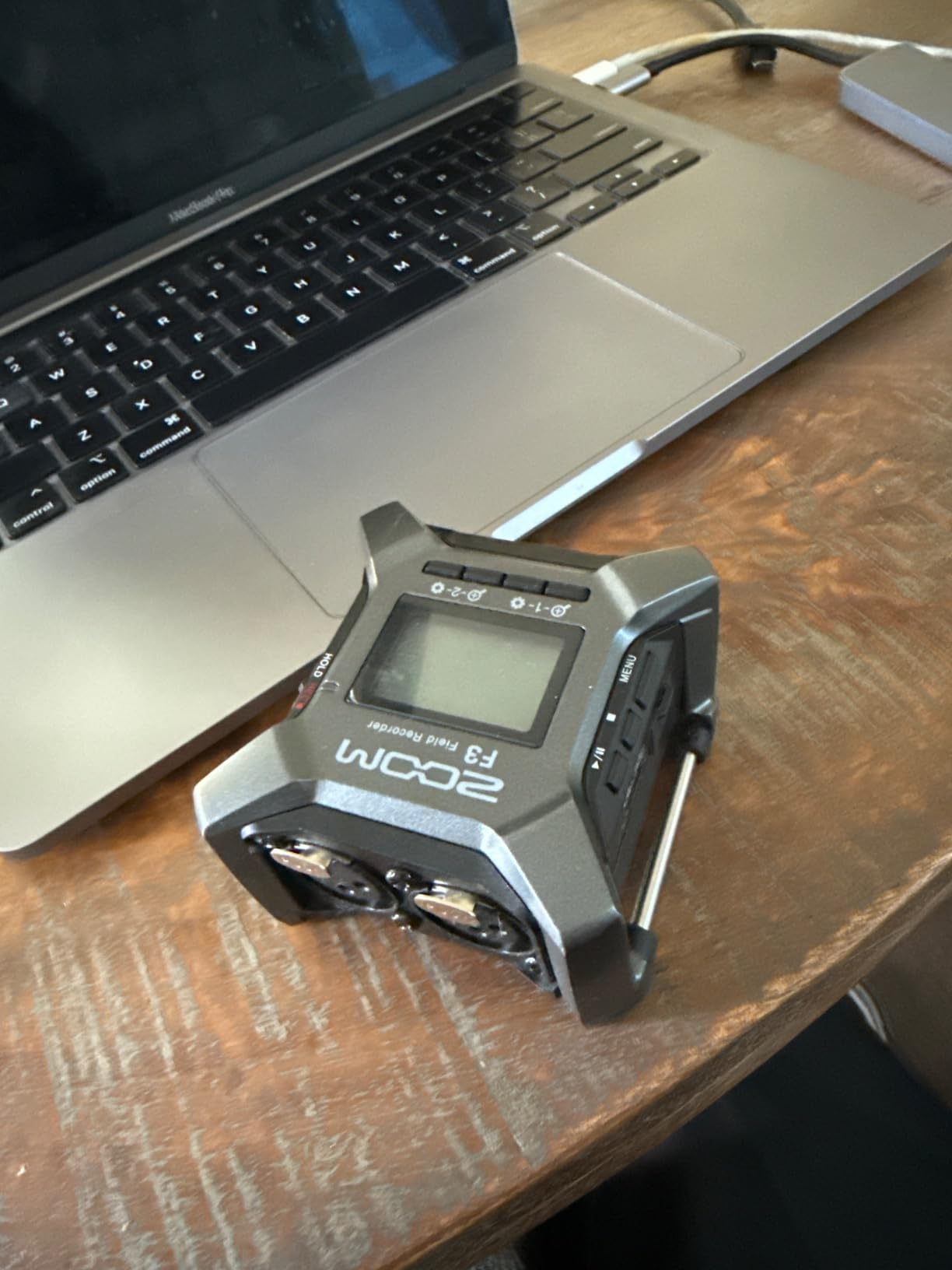
The dual locking XLR/TRS inputs keep cables secure on chaotic sets. I yanked one cable (testing only) and the lock held perfectly. The ultra-low-noise preamps deliver the cleanest signal in this price range, which matters when you are using expensive professional shotgun microphones that deserve clean preamps.
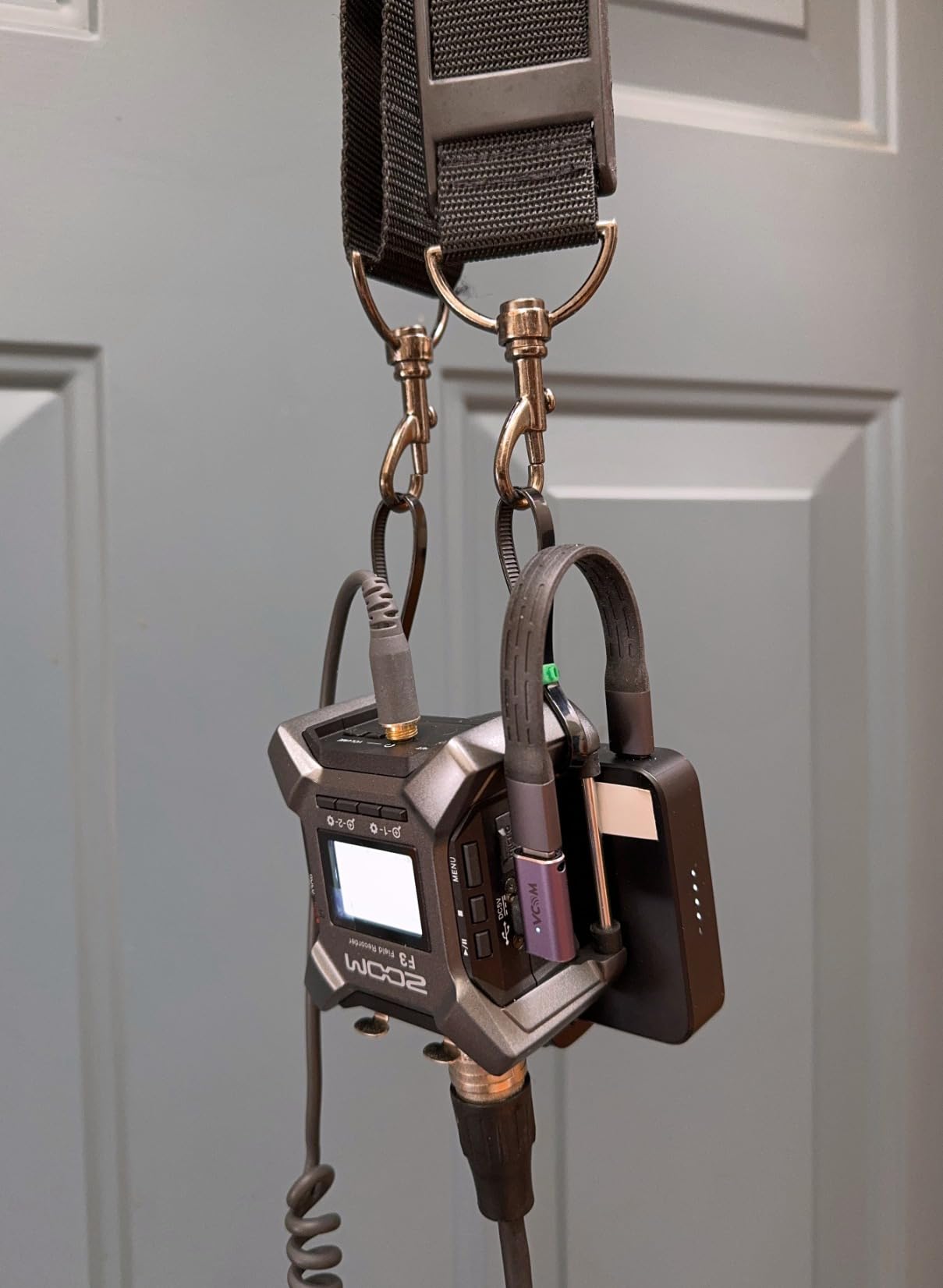
Build quality feels more rugged than most budget recorders. The F3 has a metal chassis and tactile buttons that respond confidently. I have dropped it twice (both times by accident) and it keeps working without issues. For filmmakers who treat their gear roughly on documentary and indie shoots, that ruggedness is reassuring.
Why filmmakers trust the F3 for professional work
The F3 has become a favorite among documentary and indie filmmakers because it delivers professional sound quality at a price that does not require a grant or a loan. The 32-bit float recording eliminates the stress of level monitoring, which means filmmakers can pay attention to the story instead of the meters. The locking XLR connectors prevent the kind of cable failures that ruin takes.
Phantom power is available for condenser microphones, though the 10mA limit per pair of channels means you cannot run two power-hungry mics simultaneously. For most standard shotgun and lavalier setups, the available phantom power is more than enough.
Limitations worth knowing
The F3 only has two inputs, so multi-source podcasting or surround recording is not possible. There are no built-in microphones, so you must use external mics exclusively. The lack of a 3.5mm input means you cannot easily plug in a lavalier without an XLR adapter. These are deliberate design choices that prioritize sound quality over versatility.
The flat sides can make mounting on a boom pole awkward without a dedicated shock mount. Third-party mounts solve this easily. For filmmakers who need a reliable, professional-quality two-channel recorder and already own quality XLR microphones, the F3 is the best budget option on the market in 2026.
How to Choose the Right Budget Field Recorder for Your Filmmaking?
After testing dozens of recorders and using them on short films, documentaries, and commercial projects, I have learned that the right field recorder depends almost entirely on what you shoot and how you work. Here is the framework I use when recommending a recorder to a fellow filmmaker.
Match the recorder to your typical shoot
If you primarily shoot solo documentary or YouTube content with lavalier microphones, the Zoom F2-BT is purpose-built for that workflow. Its hidden form factor and clip-free recording solve the specific challenges of run-and-gun documentary audio. If you shoot narrative work with boom operators and need XLR inputs, look at the Zoom H1 XLR or F3 instead. If you record a mix of everything, the Zoom H4 Essential offers the most flexibility under $300.
Match inputs to your microphone count. Two XLR inputs handle most interview setups. Four inputs (H4 Essential or DR-40XP) cover boom plus lav plus room tone. More inputs matter for podcasting or complex multi-source capture, less for traditional filmmaking.
Why 32-bit float matters for filmmakers
32-bit float recording is the biggest technological leap in budget audio gear in years. Traditional 24-bit recording gives you about 144 dB of dynamic range, which sounds like a lot until you realize that human hearing spans roughly 130 dB and real-world environments span even more. 32-bit float gives you effectively unlimited dynamic range by storing audio as floating-point numbers instead of fixed integers. The practical result is that clipping becomes mathematically impossible.
For filmmakers, this means no more ruined takes because of unexpected loud sounds. No more hissy quiet dialogue because you set levels conservatively. No more babysitting gain during a take. You set the recorder, focus on the story, and let the gear handle the rest. Every recorder on this list except very old models includes 32-bit float, which has become the new standard in 2026.
What XLR inputs actually give you
XLR inputs let you use professional microphones with balanced signal transmission that rejects interference over long cable runs. For boom-mounted shotgun microphones that need to reach 6 to 10 feet away from the recorder, XLR is essential. For lavaliers close to the recorder, 3.5mm works fine. If your filmmaking involves narrative dialogue, you almost certainly need XLR.
Phantom power (usually 48V) is the feature that lets you use condenser microphones that require external power. Many professional shotgun mics and some lavaliers need phantom power to operate. Make sure your recorder provides it if you plan to use those microphones.
Battery life, storage, and workflow considerations
Battery life matters because documentary and indie shoots often run long days with no access to power. Look for recorders that run at least 10 hours on a single charge or set of batteries. The H4 Essential, H2 Essential, and DR-07XP all deliver 17 to 20 hours, which is genuinely useful.
Storage capacity matters because 32-bit float WAV files are large. A 1TB card stores roughly 200 hours of 32-bit float at 48kHz stereo. Plan to invest in a quality SDXC card rather than relying on the cheapest option. Micro SD compatibility varies between recorders, so check the manufacturer’s recommended card list before buying.
Workflow considerations include USB audio interface mode for using the recorder with your editing software, Bluetooth app control for remote operation, and timecode sync for multi-camera productions. If these features matter to your workflow, the Zoom F3, H4 Essential, and H2 Essential all deliver.
Frequently Asked Questions
What is the best field recorder on a budget?
The best field recorder on a budget in 2026 is the Zoom F3 for serious filmmaking with XLR microphones, the Zoom H1 XLR for entry-level XLR work, and the Zoom H1 Essential for ultra-budget starter setups. All three offer 32-bit float recording that prevents clipping and delivers clean audio without complex gain setup.
What are the best audio recorders for filmmakers?
For filmmakers, the best audio recorders combine 32-bit float recording, XLR inputs for professional microphones, and reliable battery performance. The Zoom F3, H4 Essential, and Tascam DR-40XP all meet professional standards while staying under $300, making them ideal for narrative and documentary filmmaking on a budget.
Which field recorder has the best sound quality?
The Zoom F3 delivers the best sound quality among budget field recorders thanks to its dual A/D converters and ultra-low-noise preamps. The Tascam DR-40XP follows closely with its HDDA preamps and clean signal path. Both capture professional-quality audio that rivals recorders costing three to four times as much.
How much does a field recorder cost?
Budget field recorders for filmmakers range from around $110 for entry-level models like the Zoom H1 Essential to $300 for professional-grade options like the Zoom F3. The sweet spot for most indie filmmakers falls between $150 and $260, where you get XLR inputs, 32-bit float recording, and reliable battery life without breaking the budget.
Final Verdict: Which Budget Field Recorder Should You Actually Buy?
After testing every recorder on this list in real production conditions, my top pick for most filmmakers is the Zoom F3. It delivers professional-grade sound quality, rugged build, and the kind of dynamic range that lets you focus on storytelling instead of audio levels. If you need XLR inputs and want professional results without spending professional money, the F3 is the answer.
For filmmakers just starting out, the Zoom H1 Essential is the smartest entry point. At its price, you get 32-bit float recording and clean stereo capture that will dramatically improve your audio quality over camera mics. Pair it with an external lav for interviews, and you have a complete indie filmmaker audio kit for less than the cost of a decent lens.
If documentary work is your focus, the Zoom F2-BT solves the specific challenge of hidden lavalier recording better than any other option on the market. And if you need multi-track capability for boom plus lav plus room tone, the Zoom H4 Essential delivers four tracks of professional-quality recording for less than $220. Whatever your filmmaking style, one of these eight best budget field recorders for filmmakers will serve you well in 2026 and for many years to come.