
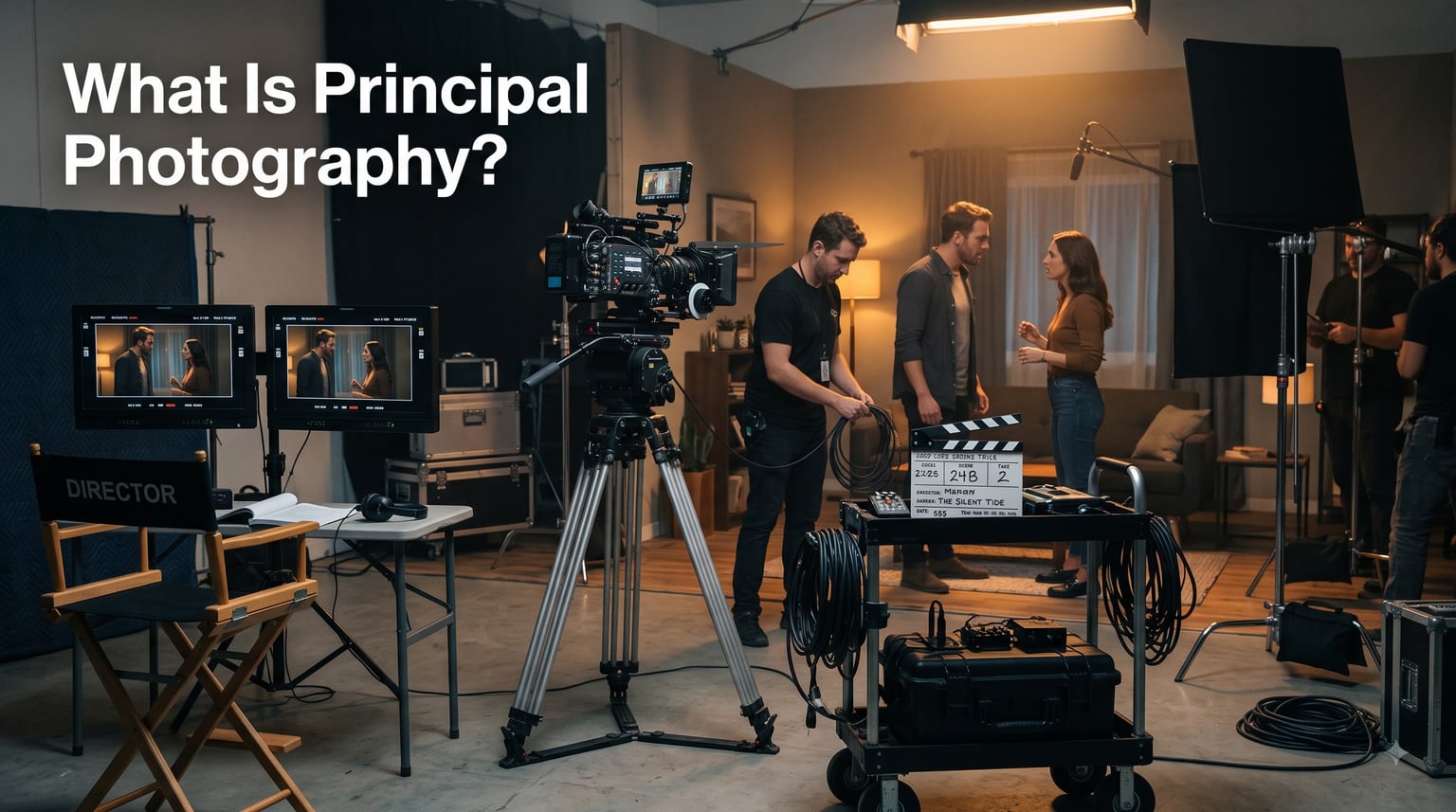
Principal photography is the main phase of film production when the bulk of shooting takes place with the principal cast and crew on set. It happens between pre-production (planning) and post-production (editing), and it is the stage where a script finally becomes captured footage on a sound stage or location.
If you are making a short film, this is the window where your actors perform, your camera rolls, and your directorial choices get locked into the footage. Everything you planned for weeks or months now has to work in real time, often against a tight schedule and a stretched budget.
Our team has sat through enough chaotic shoot days to know that understanding what is principal photography before you start can save you thousands of dollars and weeks of reshoots. In this guide we break down what happens during this phase, who is on set, how long it takes, and how short filmmakers can run it without imploding.
Table of Contents
- What Happens During Principal Photography?
- Principal Photography vs Filming: What’s the Difference?
- Where Principal Photography Fits in the Filmmaking Stages
- Who Is On Set: Crew Positions During Principal Photography
- A Day on Set: The Principal Photography Workflow
- How Long Does Principal Photography Take?
- Principal Photography for Short Films: A Different Beast
- What Happens After Principal Photography?
- Common Mistakes and Tips for a Successful Shoot
- Frequently Asked Questions
- Wrapping Up: Your Principal Photography Phase
What Happens During Principal Photography?
During principal photography, the director, actors, cinematographer, and full crew gather on location or inside a sound stage to capture every scripted scene that involves the principal cast. This is where the shot list, the storyboard, and the call sheet finally turn into recorded takes.
Each shoot day is built around a shooting schedule that lists which scenes get filmed and in what order. Scenes are rarely shot in story order. Instead, they are grouped by location, lighting setup, and actor availability to keep the production moving.
What gets captured here is the heart of the film. Dialogue scenes between lead actors, key action beats, emotional close-ups, and any shot that requires the principal cast on camera all fall under this phase. These are the takes an editor will later cut into the finished story.
What does not happen during principal photography matters just as much. B-roll like establishing skyline shots, second unit photography for stunts or inserts, and any reshoots after the main wrap all sit outside this window. Those are handled separately so the main unit can stay focused on the actors.
Principal Photography vs Filming: What’s the Difference?
The simplest way to separate the two: filming is an activity, principal photography is a defined phase of production. You can film something at any point, but principal photography refers specifically to the scheduled block where the main unit shoots the principal cast.
People on filmmaking forums ask this constantly because the terms get used interchangeably on set. A camera operator might say “we’re filming scene 12,” while a producer tracks that take as part of the principal photography schedule. Both are correct, but they describe different levels of detail.
Filming also covers work that happens outside principal photography. A second unit crew filming a car driving down a highway is filming, but it is not principal photography because the principal cast and main director are not involved. The same goes for documentary B-roll shot months later.
Where Principal Photography Fits in the Filmmaking Stages
Filmmaking breaks down into three broad stages, and principal photography is the middle one. Pre-production comes first, then principal photography, then post-production. Some models split these further into five steps, but the three-phase version is the one most short filmmakers actually use.
Pre-production is everything before the camera rolls. Casting, location scouting, shot lists, storyboards, hiring crew, building sets, and finalizing the shooting schedule all happen here. When pre-production is done well, principal photography runs smoothly. When it is rushed, the shoot pays for it in lost time and blown takes.
Principal photography is the execution phase. The planning is over, the cast is on set, and the goal is to capture the footage the editor will need. This is the most expensive and most visible part of the production timeline.
Post-production takes over once the main unit wraps. Editing, color grading, sound design, visual effects, and the final mix all happen here. Post can take longer than principal photography itself, especially on effects-heavy projects.
Who Is On Set: Crew Positions During Principal Photography
A principal photography set is organized by department, and each department has a clear chain of command. On a short film you may collapse several roles into one person, but the responsibilities still exist. Here is who shows up, grouped by what they actually do.
Directing Department
The director drives the creative vision, works with actors on performance, and approves every take. The first assistant director (1st AD) runs the set, keeps the shooting schedule on time, and calls action and cut. On short films the director often doubles as the writer, and on micro-budget shoots may even operate the camera.
Camera Department
The director of photography (DP or cinematographer) designs the look of the film, chooses camera placement, and controls the lighting strategy. The camera operator physically runs the camera, while the first assistant camera (1st AC) pulls focus and maintains the gear. A second AC slates each take with the clapperboard and manages camera reports.
Lighting and Grip Department
The gaffer is the chief lighting technician who executes the DP’s lighting plan. The key grip handles rigging, flags, diffusion, and any equipment that shapes or supports light without being electrical. The best boy on either team manages the crew and gear inventory for that department.
Sound Department
The production sound mixer records clean dialogue and monitors audio levels at a sound cart. The boom operator holds the boom pole and places lavalier microphones on actors. Bad sound is the most common reason short films feel amateur, so this team is not where you cut corners.
Art Department
The production designer owns the visual world of the film, overseeing sets, props, and dressing. A costume designer handles wardrobe, and a hair and makeup artist keeps actors looking consistent across shoot days. On a weekend short, one person might cover all three.
Production Office
The unit production manager (UPM) and line producer track the budget, schedule, and logistics. The script supervisor sits next to the director watching continuity, taking notes on which takes were good, and flagging mismatches in performance, props, or eye lines.
One thing we see constantly on indie sets: crew members wearing multiple hats. A director who also pulls focus, a producer who also runs craft services, a gaffer who also grips. That is normal for short films, but it means you need an even tighter shot list because no one has spare bandwidth to improvise.
A Day on Set: The Principal Photography Workflow
A typical shoot day follows a rhythm that most professional sets share. Short films compress it, but the sequence stays the same. Here is what a single day of principal photography actually looks like, step by step.
Step 1: Call time and crew arrival. The call sheet lists when each department arrives. Camera and lighting usually show up first to prep gear, followed by art and sound, then actors for hair and makeup.
Step 2: Blocking the scene. The director walks the actors through the space and figures out where they move. The DP and key crew watch to plan camera and lighting placement around the blocking.
Step 3: Lighting setup. The gaffer and grip teams build the lighting. This is often the longest part of the day. The DP refines the look while actors step away with stand-ins or take a break.
Step 4: Rehearsal. Once the set is lit, actors come back for a full-speed rehearsal with camera. The 1st AC checks focus marks, the boom operator finds their position, and the script supervisor notes any continuity issues.
Step 5: Shooting. The 1st AD calls for quiet, the 2nd AC slates the take with the clapperboard, and the scene is filmed. Multiple takes are standard. The director and DP review each take, often at a monitor area called video village.
Step 6: Lunch. A real break, usually six hours after call time by union rules. Craft services keeps the crew fed and hydrated throughout the day, and skipping meal breaks is the fastest way to lose a crew’s goodwill.
Step 7: Company moves and reset. When you change locations, the entire unit packs up and relocates. These company moves eat time, so smart schedulers minimize them.
Step 8: Wrap and dailies. At the end of the day, gear is packed and footage is backed up. The director and DP may review dailies, the raw footage from that day, to confirm everything is usable before the next shoot day.
A few set terms worth knowing: the martini shot is the last shot of the day, and the abby singer is the second-to-last. When someone calls “that’s a walk away,” it means the take is good and the crew can move on. Knowing this language keeps you from looking lost on your first real set.
How Long Does Principal Photography Take?
There is no single answer, because the schedule depends entirely on the scale of the project. That said, there are reliable ranges you can plan around.
For short films, indie filmmakers consistently report wrapping principal photography in 1 to 3 shoot days. A tightly scheduled 10-minute short can often be captured across a single weekend. Complex shorts with multiple locations or effects-heavy scenes might stretch to 5 or 6 days.
For indie features, a 3 to 8 week window is typical, with mid-range productions often landing around 4 to 5 weeks. Reddit users working on independent features have shared that their principal photography ran roughly 3 to 4 months, with post-production adding another 5 months on top.
For studio features, principal photography commonly runs 30 to 120 days. Big-budget films with extensive action or visual effects can stretch much longer, especially when split across multiple countries.
This is also the most expensive phase of the entire production. Every shoot day means paying cast and crew, renting equipment, feeding people, securing locations, and insuring the production. Going a single day over schedule can blow a short film’s budget entirely, which is why the shooting schedule gets so much attention during pre-production.
Principal Photography for Short Films: A Different Beast
Almost every resource on principal photography focuses on features, but short films run by different rules. If you are shooting a short, you are probably working with a tiny crew, a weekend schedule, and a budget that would not cover a single day on a studio lot. Here is how that changes the phase.
Short film schedules often mean weekend-only shooting. You shoot Saturday and Sunday, then go back to your day job Monday. That compressed window forces ruthless prioritization. You cannot afford to capture every coverage angle, so you plan the minimum set of shots that still tell the story.
The solo or DIY filmmaker approach is common here. One person may direct, operate the camera, record sound, and produce all at once. It is exhausting, but it works when the alternative is not making the film at all. The trade-off is that you have almost no margin for error, because there is no backup crew member to step in.
What you can safely cut on a short: a dedicated video village, a full grip truck, separate hair and makeup artists for a small cast, and elaborate lighting packages. What you should never cut: clean production sound, a real script supervisor (even a friend with a notebook), and backup batteries for everything.
Here is a quick comparison of how short film and feature principal photography typically differ.
- Crew size: Short film 3 to 15 people, feature 50 to 200-plus people.
- Shoot days: Short film 1 to 6 days, feature 20 to 120 days.
- Daily page count: Short film often 2 to 5 script pages a day, feature 1 to 3 pages a day with full coverage.
- Locations: Short film usually 1 to 3 locations total, feature often 20 to 60.
- Role overlap: Short film expects crew to wear multiple hats, feature has strict department separation.
- Budget per day: Short film ranges from a few hundred to a few thousand dollars, feature runs tens to hundreds of thousands per day.
The biggest mindset shift for short filmmakers is that principal photography on a short is about capturing what you absolutely need, not everything you want. Discipline here is what separates a finished short from an abandoned hard drive.
What Happens After Principal Photography?
Once the main unit wraps the final shot, the production moves into post-production. The first step is usually reviewing dailies and assembling a rough cut. The editor takes the best takes, organized by the script supervisor’s notes, and builds the first version of the film.
From there the cut gets refined through multiple passes. Color grading gives the footage its final look, sound design adds texture and clarity, and visual effects fill in anything that could not be captured on set. Music scoring and the final mix come near the end. On a short film, one person might handle most of these steps. On a feature, each is a separate department.
Two terms come up frequently once principal photography ends. Reshoots are additional shooting days scheduled after the main wrap, usually because something in the edit is not working. Pick-up shots are smaller inserts, maybe a close-up of a hand or a missing reaction shot, captured to fix gaps the editor finds.
Reshoots are standard on studio features and increasingly common on indie features too. For short films they are rarer, simply because the budget rarely allows for reassembling cast and crew. That is exactly why short filmmakers need to get principal photography right the first time. You probably will not get a second chance.
Separately, second unit photography may happen during or after the main shoot. A smaller crew captures inserts, establishing shots, stunts, or B-roll that does not require the principal cast. On a short film, second unit work often blends back into the main shoot because the crew is the same handful of people.
Common Mistakes and Tips for a Successful Shoot
The same problems show up over and over on indie sets. Forum threads from r/Filmmakers are full of filmmakers describing the same handful of avoidable disasters. Here are the most common mistakes during principal photography and how to dodge them.
Underestimating how long each setup takes. New filmmakers routinely plan for twice as many shots as they can actually capture. A realistic rule of thumb for a small crew is 1 to 2 pages of script per day with full coverage. Plan for fewer setups and you will finish with usable footage.
Skipping the shot list. Without a shot list, the crew stands around while the director decides what to shoot next. Every minute of confusion on set costs money. Build the shot list in pre-production and treat it as your daily contract.
Burning the budget on the first day. Excitement on day one leads to extra takes and overtime that eat the contingency fund. Pace yourself across the entire shoot, because the last day always needs slack.
Neglecting sound. Audiences will forgive a soft image. They will not forgive unusable dialogue. Hire or borrow a dedicated sound person if at all possible, and always record room tone.
Forgetting backup gear. Dead batteries, full memory cards, and failed cables are the three most common causes of lost shoot time. Bring doubles of everything critical.
Not communicating schedule changes. Actor conflicts and location issues will happen. The earlier you flag them and update the call sheet, the less expensive the fix.
A practical checklist before your first day of principal photography: finalize the shot list, confirm every location and its access times, charge and pack all batteries and media, print or share call sheets the night before, prep a continuity log, line up a backup for each key crew role, and build in a 20 percent time buffer for every setup.
Frequently Asked Questions
What is the meaning of principal photography?
Principal photography is the main production phase of a film when the bulk of shooting takes place with the principal cast and crew on set. It sits between pre-production and post-production and is when the scripted scenes are actually captured on camera.
What is the difference between principal photography and filming?
Filming is the activity of recording footage, while principal photography is a scheduled phase of production. You can film at any time, but principal photography refers specifically to the block where the main unit shoots the principal cast.
How long does principal photography take?
It depends on scale. Short films usually wrap in 1 to 3 shoot days, indie features run 3 to 8 weeks, and studio features range from 30 to 120 days. Effects-heavy projects can stretch even longer.
What happens after principal photography?
The project moves into post-production, where the editor assembles the footage, color grading and sound design are completed, and visual effects are added. Reshoots and pick-up shots may also be scheduled if gaps are found in the edit.
What happens during principal photography?
The cast and crew gather on location or a sound stage to shoot scripted scenes following a daily call sheet and shot list. The day typically involves blocking, lighting, rehearsal, shooting takes, and reviewing dailies at wrap.
Wrapping Up: Your Principal Photography Phase
Principal photography is the moment your short film stops being a plan and becomes real footage. It is the most expensive, most visible, and most stressful phase of production, which is exactly why preparation matters more than anything else you do.
If you take one thing from this guide: respect the schedule and the shot list, protect your sound, and build in buffers for the chaos that always shows up. The filmmakers who finish their shorts are the ones who plan for fewer setups and nail the ones they commit to.
Now that you understand what principal photography is, the next step is building your own shooting schedule, call sheet, and shot list for your next short film. Get those right and your shoot days will take care of themselves.