

An attic in midsummer can sit above 130 degrees while the air conditioner below works overtime to hold the living space at 72. A whole house fan attacks that heat from the cheapest possible direction: it pulls hot air out of the house through the ceiling, exhausts it at the attic ridge, and drags cool night air in through open windows. No compressor, no refrigerant, no ductwork to the second floor.
That idea only works in a dry climate where outdoor air genuinely gets cooler than indoor air, and only if your attic has enough net free venting to carry the air away. Get either of those wrong and the fan does nothing except warm up the roof deck. This guide covers the best whole house fans for hot attics, ranked by airflow, noise, damper quality and the honesty of the install documentation, and it flags exactly where each one falls short.
We went through nine distinct whole house fan lines, from a 2920 CFM budget model to a 6878 CFM ECM unit for large homes. The short version: the Centric Air QA-Deluxe 5500 leads because it pairs serious airflow with a sealed R-5 damper and a remote that actually works, while the QuietCool CL-4700 RF is the quietest pick and the Tamarack HV1000 wins outright if you heat with electricity in a cold winter.
Table of Contents
- Top 3 Picks for Hot Attics in 2026
- Best Whole House Fans for Hot Attics (October 2026)
- 1. Centric Air QA-Deluxe 5500: Best Overall for Hot Attics
- 2. AC Infinity CLOUDWAY T12: Best WiFi and App Control
- 3. Tamarack HV1000 R38: Best for Cold Winters and Heat Loss
- 4. QuietCool QC CL-4700 RF: Best Overall Quiet Performance
- 5. QuietCool QC ES-4700 RF: Best for Low-Wattage Overnight Running
- 6. Master Flow GAF 24 Inch Fan: Best Budget Whole House Fan
- 7. QuietCool QC ES-7000 RF: Best for Large Homes Over 3000 Square Feet
- 8. Centric Air QA-Deluxe 4800 ECM: Best for Three-Speed Control
- 9. Centric Air 4.0 Ultra Quiet: Best for Absolute Quiet Operation
- How to Size a Whole House Fan for a Hot Attic
- Net Free Attic Venting and Winter Heat Loss
- When to Run a Whole House Fan
- Smart Controls: RF Switch, WiFi App, or Wired Switch
- Common Whole House Fan Problems and How to Avoid Them
- Whole House Fan vs Attic Fan vs Solar Attic Fan
- Frequently Asked Questions
- Conclusion: Our Picks for 2026
Top 3 Picks for Hot Attics in 2026

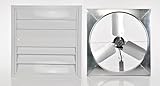
Best Whole House Fans for Hot Attics (October 2026)
The table below is the whole field in one view. Airflow figures are manufacturer-rated maximums, and noise numbers are the published values, which are measured under different conditions by different labs and should be read as a ranking rather than an absolute.
| Product | Specs | Action |
|---|---|---|
| Centric Air QA-Deluxe 5500 |
|
Check Latest Price |
 AC Infinity CLOUDWAY T12 AC Infinity CLOUDWAY T12 |
|
Check Latest Price |
 Tamarack HV1000 R38 Tamarack HV1000 R38 |
|
Check Latest Price |
 QuietCool QC CL-4700 RF QuietCool QC CL-4700 RF |
|
Check Latest Price |
 QuietCool QC ES-4700 RF QuietCool QC ES-4700 RF |
|
Check Latest Price |
| Master Flow GAF 24 Inch Fan |
|
Check Latest Price |
 QuietCool QC ES-7000 RF QuietCool QC ES-7000 RF |
|
Check Latest Price |
 Centric Air QA-Deluxe 4800 ECM Centric Air QA-Deluxe 4800 ECM |
|
Check Latest Price |
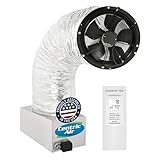 Centric Air 4.0 Ultra Quiet Centric Air 4.0 Ultra Quiet |
|
Check Latest Price |
1. Centric Air QA-Deluxe 5500: Best Overall for Hot Attics
QA-Deluxe 5500 Energy Efficient Whole House Fan 2 Speed Temp/Timer Control
5072 CFM airflow
51 dB
630 watts
120 volt ceiling mount
Pros
- Strong even airflow that cools large homes quickly
- Wireless remote with timer and thermostat
- R-5 insulated damper seals the attic when off
- Fits 16-24 inch on-center joists with no framing
- 10 year motor warranty and assembled in USA
Cons
- Audible on high
- comparable to a running air conditioner
- Installation instructions unclear on how the ducting meets the damper box
- Light foam damper flaps can be heard lifting in wind
This is the fan I would put over most 2000 to 3400 square foot homes. Owners report indoor drops of five to ten degrees in an hour or less once windows are open, and the 5500 CFM nameplate figure comes with a Title 24 rated airflow of 3945 CFM, which is the number that matters in regulated states like California.
What separates it from cheaper 24 inch models is the R-5 insulated damper box that closes off the attic opening when the fan stops. In a hot attic that sealed box is the difference between a house that stays thermally isolated from the roof and one that quietly pulls 130 degree air into the ceiling plane all night.
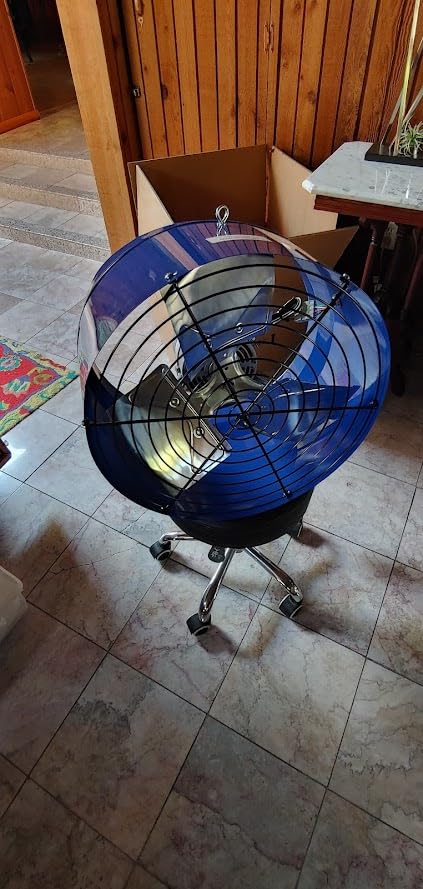
Control is a 2-speed wireless remote with timer and thermostat function, so you can start the fan from bed without running a wire down through the walls. The thermostat cutoff works, though owners describe the controls as awkward to use and the temperature sensor as only moderately reliable.
Noise lands at a published 51 dB. On low it reads as a soft hum that disappears under normal conversation. On high it is genuinely audible and several owners compared it to the compressor noise of their air conditioner, which is fair.
Will 5500 CFM clear a 130 degree attic?
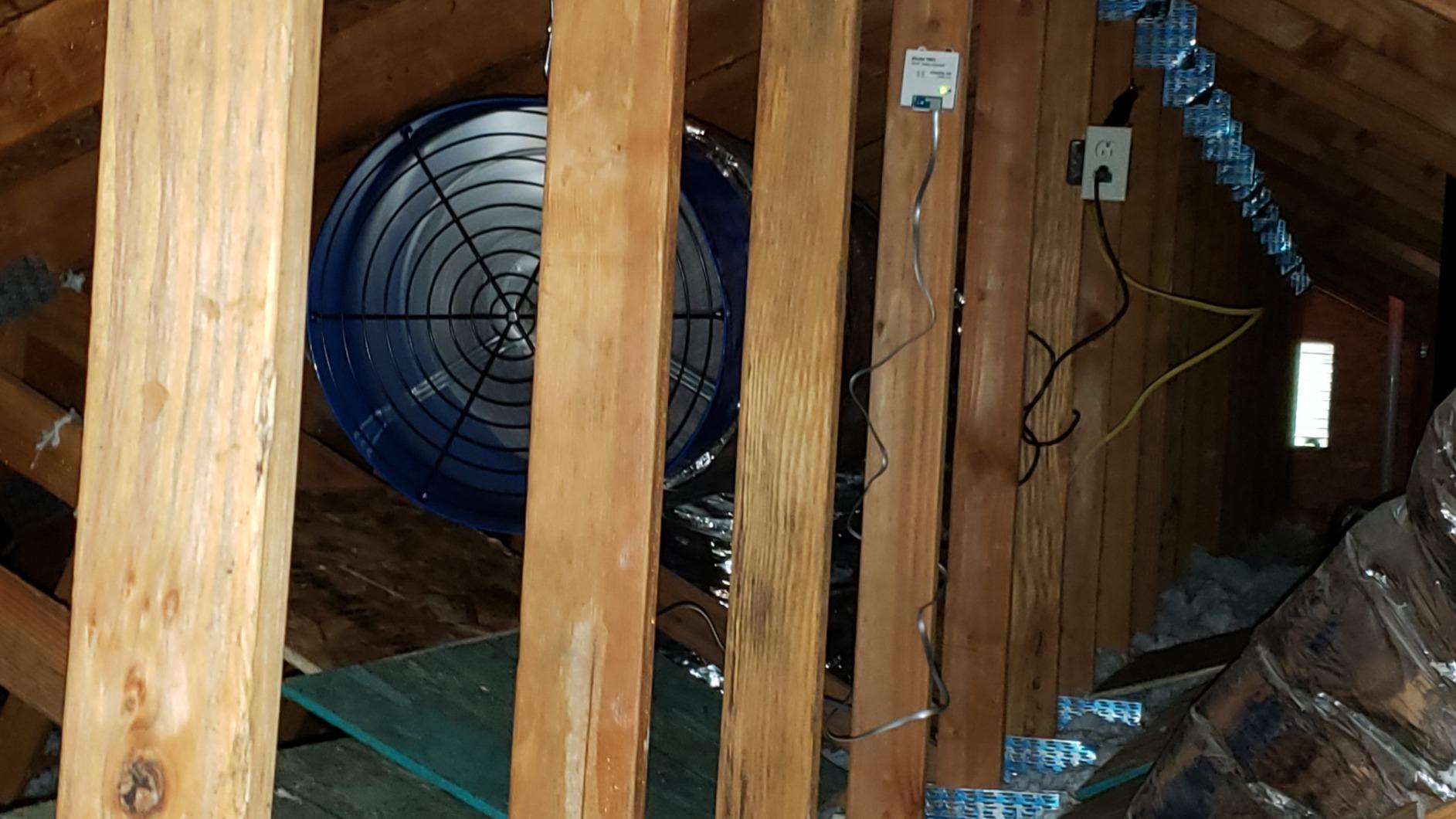
Yes, if the attic has the venting this fan requires. Centric Air rates it for homes up to 3400 square feet, and the 5500 CFM figure assumes free airflow through the roof rather than a blocked or screened ridge. In a genuinely hot attic the fan is doing double duty: cooling the house and stripping heat out of the roof cavity.
The 630 watt motor on high is the trade-off for that capacity. Run the low speed overnight, where the 2-speed design still moves a useful share of the rated flow, and the electricity cost of a night of whole house cooling stays small next to a compressor running the same hours.
Where this fan falls short
Documentation is the weak point. Printed and online instructions leave unclear how the ducting connects to the damper box and fan, and they never define what counts as an obstruction within four feet of the intake. Budget time for reading the manual twice before you cut drywall.
Owners also report light foam damper flaps that can be heard lifting and settling on windy days, and a few fans arriving with a housing that needs straightening before assembly. Neither is a deal breaker, but both point to tighter packing than the marketing copy implies.
2. AC Infinity CLOUDWAY T12: Best WiFi and App Control
AC Infinity CLOUDWAY T12, Whole House Fan with WiFI Temperature Controller
1250 CFM airflow
62 dBA
250 watt EC motor
10 blades, 11 speeds
Pros
- Only fan here with true WiFi app control and scheduling
- Temperature humidity and VPD programming in the app
- PWM-controlled EC motor for quiet efficient running
- Plug-and-play install with included flexible duct
- ABS housing rated for high-humidity spaces
Cons
- Grille does not fit 16 inch on-center joists without modification
- Included duct length and controller wire are short
- Audible above roughly 3-5 speed where air sound dominates
The CLOUDWAY T12 is the only unit in this field that talks to your phone. Temperature, humidity and VPD programming, timers, cycles, scheduling and a minimum speed setting all live in the app, and it runs on a PWM-controlled EC motor with dual ball bearings rather than the PSC motors most competitors use.
That control granularity is the appeal. Instead of two speeds, you get ten to eleven, which means you can find the exact airflow that cools the house without the noise that a higher setting produces. Owners also like that it is the only fan here originally engineered for humid environments.
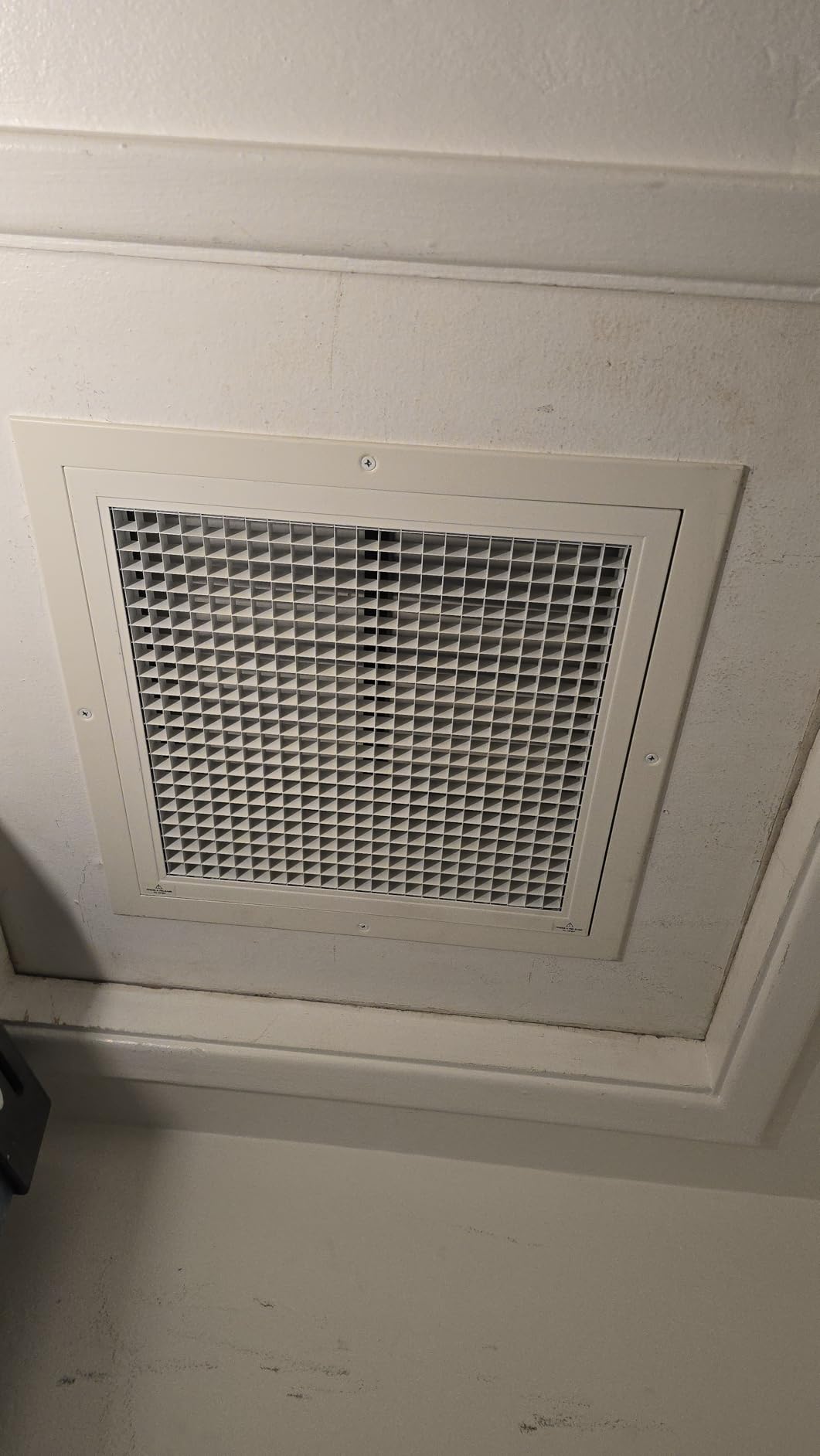
The weakness is capacity and geometry. At 1250 CFM rated airflow with a 12 inch duct, this is roughly a quarter of what the larger units move, and the housing does not drop into standard 16 inch on-center joist spacing without modifying the frame or building a custom boot.
That is why many owners run two of them, pairing a T12 with a smaller unit to approach double the airflow. The included duct and controller wire are also short, and the controller is designed to sit on a shelf rather than mount neatly on a wall.
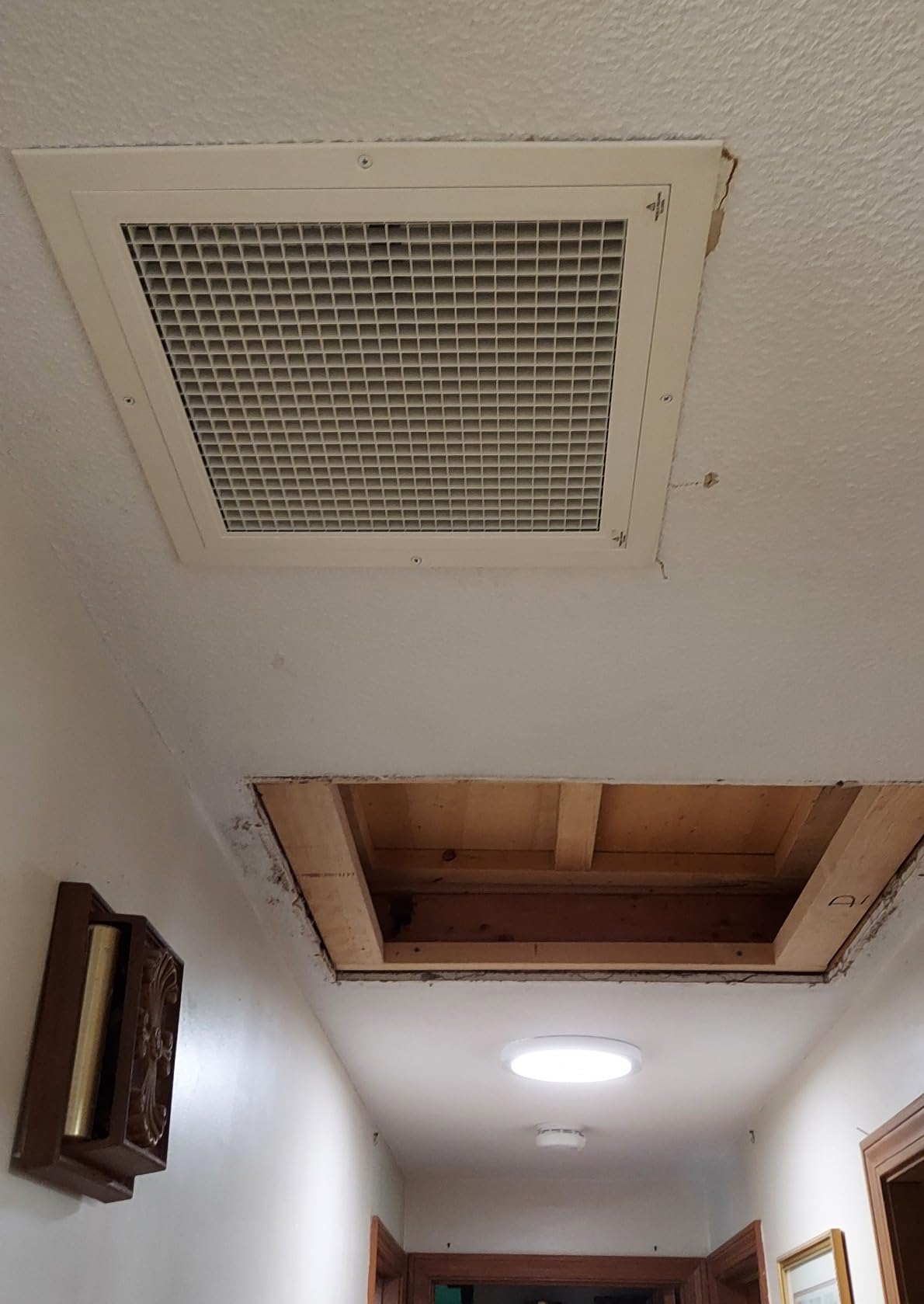
Is 1250 CFM enough for a hot attic?
For a small, well-vented home or a single floor, one unit can carry a room worth of exchange. For anything approaching 2000 square feet of conditioned space, treat 1250 CFM as one quarter of what the room needs, which is why the two-unit pairing is so common in reviews of this fan.
Noise is the other real limit. The published 62 dBA figure is the highest in this roundup, and owners report the air-moving sound, not the motor, taking over above roughly the third to fifth speed. Below that range the EC motor earns its keep.
Where this fan falls short
Reviewers are blunt that the air box design is not directly installable in a standard US ceiling. If you are not comfortable trimming a frame or fabricating a boot, this is not the fan for a first-time install.
There is also no insulated R-value damper to speak of, and the wiring exits the bottom of the controller, which makes a clean in-wall installation awkward. Budget extra time and extra material if you want this one finished properly.
3. Tamarack HV1000 R38: Best for Cold Winters and Heat Loss
Tamarack Technologies HV1000 R38 Ductless Whole House Fan with Insulated Doors
1000 CFM airflow
45 dB
250 watts
R38 self-sealing doors
Pros
- R38 self-sealing doors cut winter heat loss and infiltration
- Two speeds with strong suction from a central hallway
- Uses about 10 percent of the energy of central air conditioning
- Made in USA with a lifetime manufacturer warranty
- Mounts horizontally or vertically on 16 or 24 inch joists
Cons
- Visible ceiling grille unless painted to match
- Insulated back flaps take about a minute to open with clicking
- 1000 CFM is modest and some larger homes find it short
The defining feature here is the R38 self-sealing insulated door assembly. The doors open mechanically when the fan runs and seal shut against each other when it stops, which means a closed 1000 CFM fan is closer to an R38 hole in your ceiling than an open one.
Owners in cold climates report no measurable winter bill increase after installing one, and the design has been featured twice on Ask This Old House. The build is metal, not plastic, and it carries a lifetime manufacturer warranty rather than a ten year one.
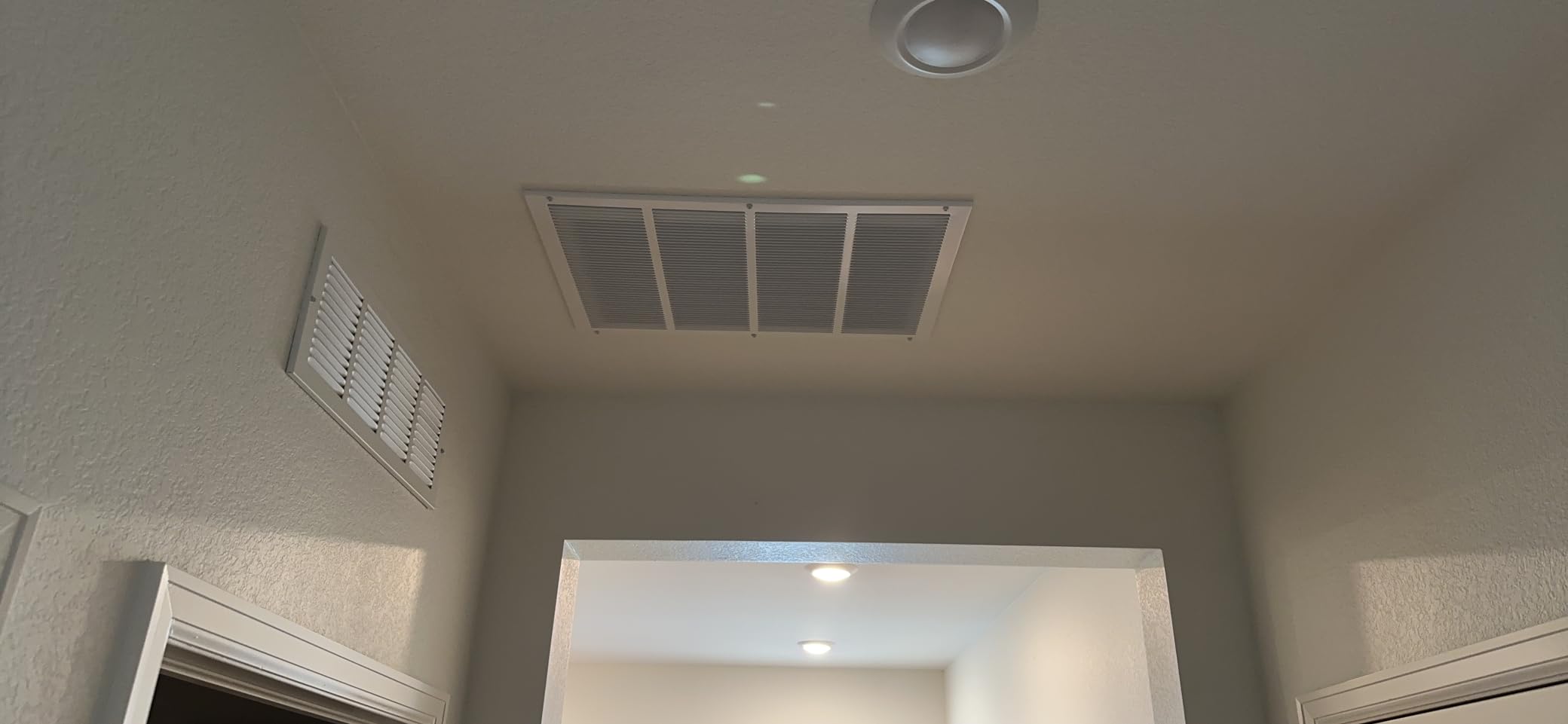
At 45 dB this is one of the quieter ductless designs, and owners consistently describe it as much quieter than older direct-mount fans they replaced. Reported evening temperature drops range from four to twelve degrees depending on home size and how central the placement is.
Placement matters more here than with a conventional grille. Put it in a central hallway and the suction effect pulls air from every room at once. Tuck it into a corner and you waste most of the 1000 CFM moving air that was already cool.
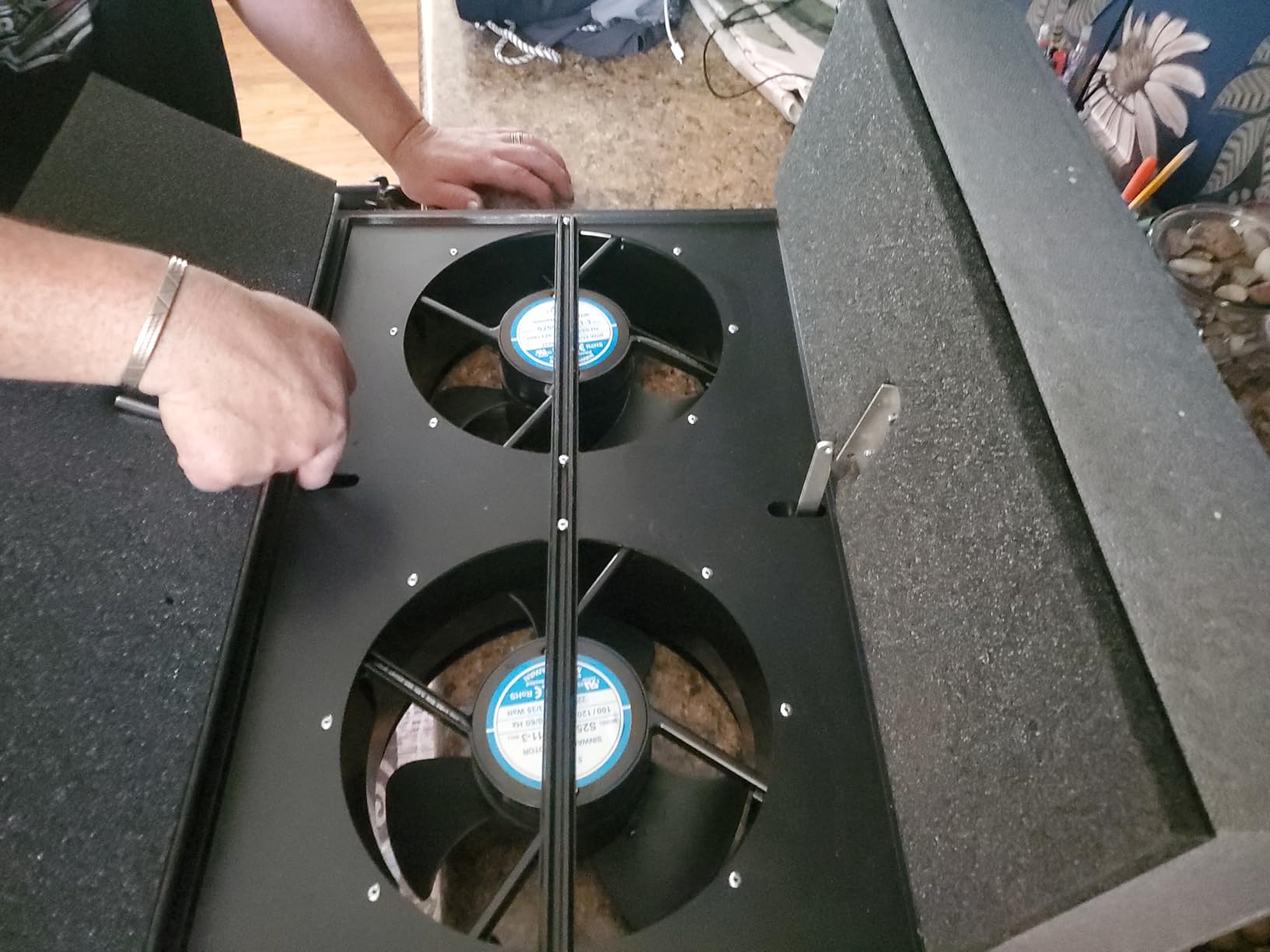
Is 1000 CFM enough for a hot attic?
For a small home under roughly 1200 square feet, yes. For a 2000 square foot house, owners report that even with extra roof and soffit vents added, 1000 CFM felt thin. The attic still gets ventilated, just not aggressively.
The flip side is that this fan is not trying to be a high-airflow machine. It targets efficiency and heat containment, and the manufacturer notes it uses roughly a tenth of the energy a central air conditioning system uses.
Where this fan falls short
The minute-long delay while the insulated flaps open, complete with audible clicking, is the most reported annoyance. It also means the fan cannot be used for quick evening cooldown when you only need ten minutes of air exchange.
Planning constraints are real too. The grille is visible unless painted to match, and the doors need room to swing fully open, so truss roof geometry has to be checked before you commit to a spot. A few owners also report needing a second electrician visit after a failure.
4. QuietCool QC CL-4700 RF: Best Overall Quiet Performance
Quietcool QC CL-4700 RF Classic Advanced Whole House Fan with Wireless Control – Up to 4415 CFM – Two Speed – Covers up to 2,208 SQFT – 10 Year Warranty – Removable Grille
4415 CFM high and 3402 low
37.2 dB
551 watts high
R5 damper doors
Pros
- Highest rated unit here with 89 percent five-star reviews
- Strong even airflow visible at open windows
- 1-2 hour install fitting 16 or 24 inch joists without framing
- RF glass wall switch with 12 hour countdown timer
- Window locks included for security while running
Cons
- High setting is a little loud for bedroom-adjacent rooms
- No printed installation instructions in the box
- 4415 CFM is stretched at about 2400 sq ft including attic
At a published 37.2 dB this is the quietest number in the roundup, and at 4.8 stars it also carries the highest average rating. Owners describe airflow you can see pulling curtains toward open windows, which is the most honest test of a whole house fan that exists.
The install story is the other reason it scores so well. It fits 16 or 24 inch on-center joists with no framing and no joist cutting, and most owners complete the job in one to two hours once there is a power source in the attic.
The R5 damper doors insulate the home from the attic when the system is not in use, and the included wireless RF kit adds a glass wall switch plus a countdown timer up to twelve hours. That means no wall wiring, which also means far less drywall damage.
Will 4415 CFM handle a hot attic?
The manufacturer rates this for homes up to 2208 square feet, and the requirement is 5.89 square feet of net free attic venting. Check that venting figure against your existing ridge and soffit vents before you order, because it is the single most common reason a fan underperforms.
Owners note that the 4415 CFM capacity is genuinely stretched at the top of its range for homes around 2400 square feet including the attic. If your conditioned space approaches that, step up to the ES-7000 rather than running this one hard all summer.
Where this fan falls short
There are no printed installation instructions in the box, only a marketing pamphlet, and the full guide has to be found online. Plan on an hour of reading before you start rather than after.
The high setting is a little loud, so most owners run high briefly to pull the heat out and then switch to the 3402 CFM low speed for the rest of the evening. The wireless switch also has a learning curve that a few owners found unintuitive at first.
5. QuietCool QC ES-4700 RF: Best for Low-Wattage Overnight Running
Quietcool QC ES-4700 RF Energy Saver Advanced Whole House Fan with Wireless Control – Up to 4195 CFM – As low as 75 watts – Two Speed – Covers up to 2,098 SQFT – 10 Year Warranty – Removable Grille
4195 CFM high and 2304 low
415 watts high, 75 on low
ECM motor
R5 damper doors
Pros
- Very quiet
- especially on the 75 watt low setting
- Metal grille and ducting that do not shake or rattle
- RF wall switch pairs easily and works reliably
- Roughly two hour install once attic power exists
- Requires 5.6 sq ft of net free attic venting
Cons
- Premium price with no smart app integration
- High speed produces a dull rushing air sound
- Gravity louvers only stay shut when mounted flat
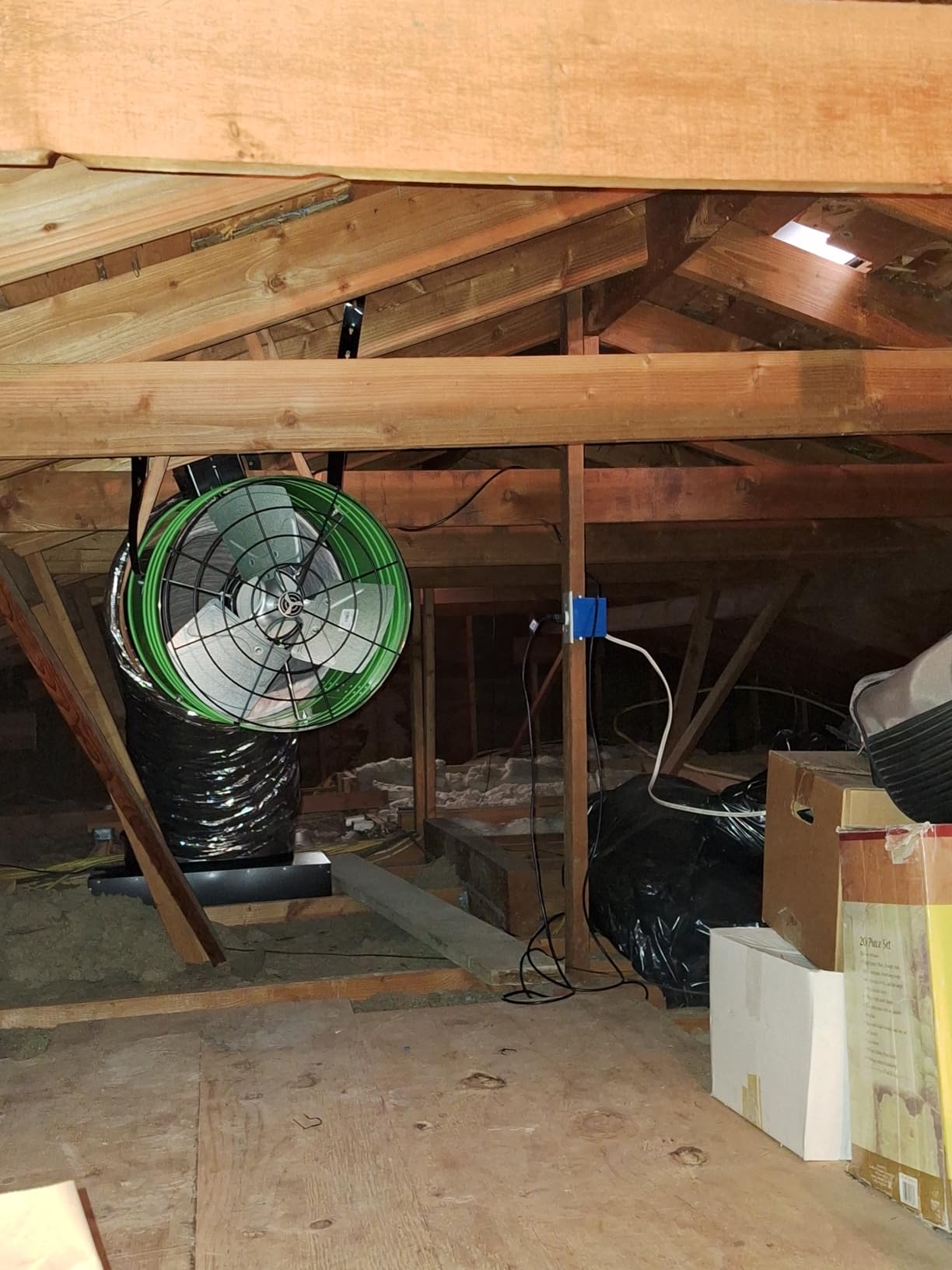
This is the energy version of the QuietCool line, and the 75 watt low speed is the number that makes it interesting. On high it draws 415 watts for 4195 CFM; on low it draws 75 watts for 2304 CFM, which is enough to keep moving air through the house all night at a fraction of the power.
Build quality is the other talking point. Owners repeatedly describe the grille and ducting as far better than big-box fan setups, specifically noting they do not rattle the way cheaper belt-driven housings do after a season of thermal cycling.
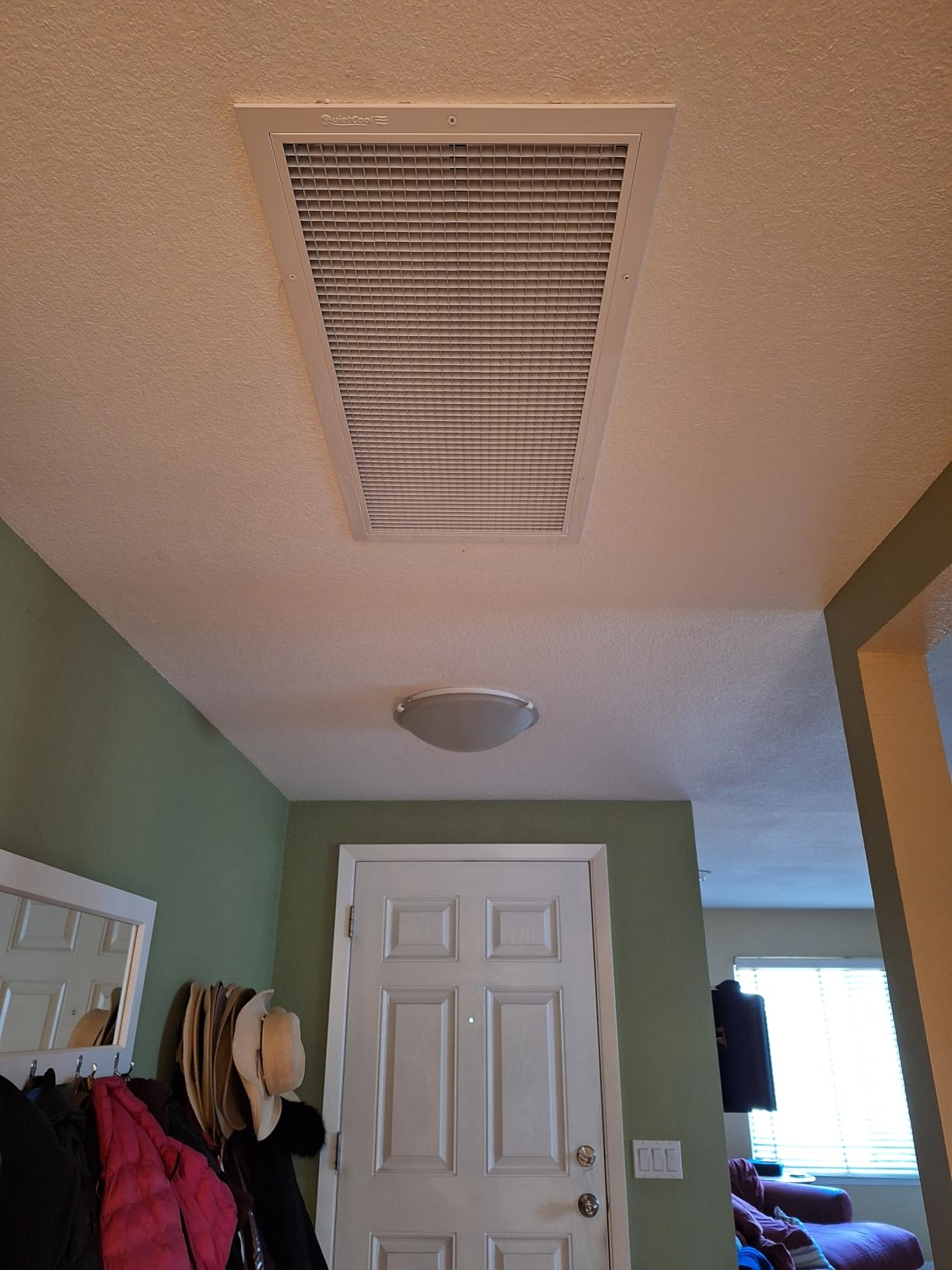
It shares the CL-4700 chassis advantages: fits 16 or 24 inch on-center joists, a one to two hour install, and the same R5 damper doors with the wireless RF kit and twelve hour countdown timer. Rated coverage is up to 2098 square feet.
That 75 watt low setting is where this fan separates itself from the PSC competitors. Running the low speed overnight is the normal use case, and at that draw the fan can run for hours without the operating cost becoming a real line item.
Is the ECM motor worth the premium over a PSC model?
For overnight low-speed use, yes. The low-speed figure is what you actually run most nights, and 75 watts at 2304 CFM is the most efficient combination in this roundup that still moves serious air.
Some owners feel the delivered temperature drop is more modest than the spec sheet implies, around a degree in their homes. If your attic venting is marginal, a more efficient motor will not fix an exhaust problem.
Where this fan falls short
There is no app integration at this level of spend, which owners notice. The RF wall switch is reliable, but it is a wall switch, not a smart home device, and there is no scheduling beyond the twelve hour countdown.
Two smaller issues. The gravity-type louvers stay open unless the unit is mounted flat on a horizontal surface, so a vertical install is awkward, and the included drywall screws are dull enough that they will not pierce sheet metal without a separate bit.
6. Master Flow GAF 24 Inch Fan: Best Budget Whole House Fan
Master Flow GAF 24″ Whole House Fan, 2920 max CFM, PSC Motor – WHFS24M
2920 CFM max airflow
1/4 HP PSC direct drive
Two-speed pull chain
Automatic shutter
Pros
- Lowest cost unit in this roundup
- Direct-drive PSC motor runs quiet for the volume
- Installs without joist cutting given a prior attic outlet
- Automatic ceiling shutter seals the attic when off
- One owner reports an identical unit lasting over 30 years
Cons
- Louvered shutter rattles loudly while running
- Uninsulated louvers leak hot attic air in winter
- Pull-chain two-speed is the least convenient control here
Nothing else in this list delivers 2920 CFM for homes up to 2000 square feet at this entry point. The quarter horsepower permanent split-capacitor direct-drive motor is a proven design, and one owner installed an identical unit that lasted more than thirty years.
Direct drive means no belt to stretch, slip or replace, and the low-vibration motor design keeps the noise reasonable for the volume of air being moved. For a first whole house fan on a tight budget, the engineering is sound.
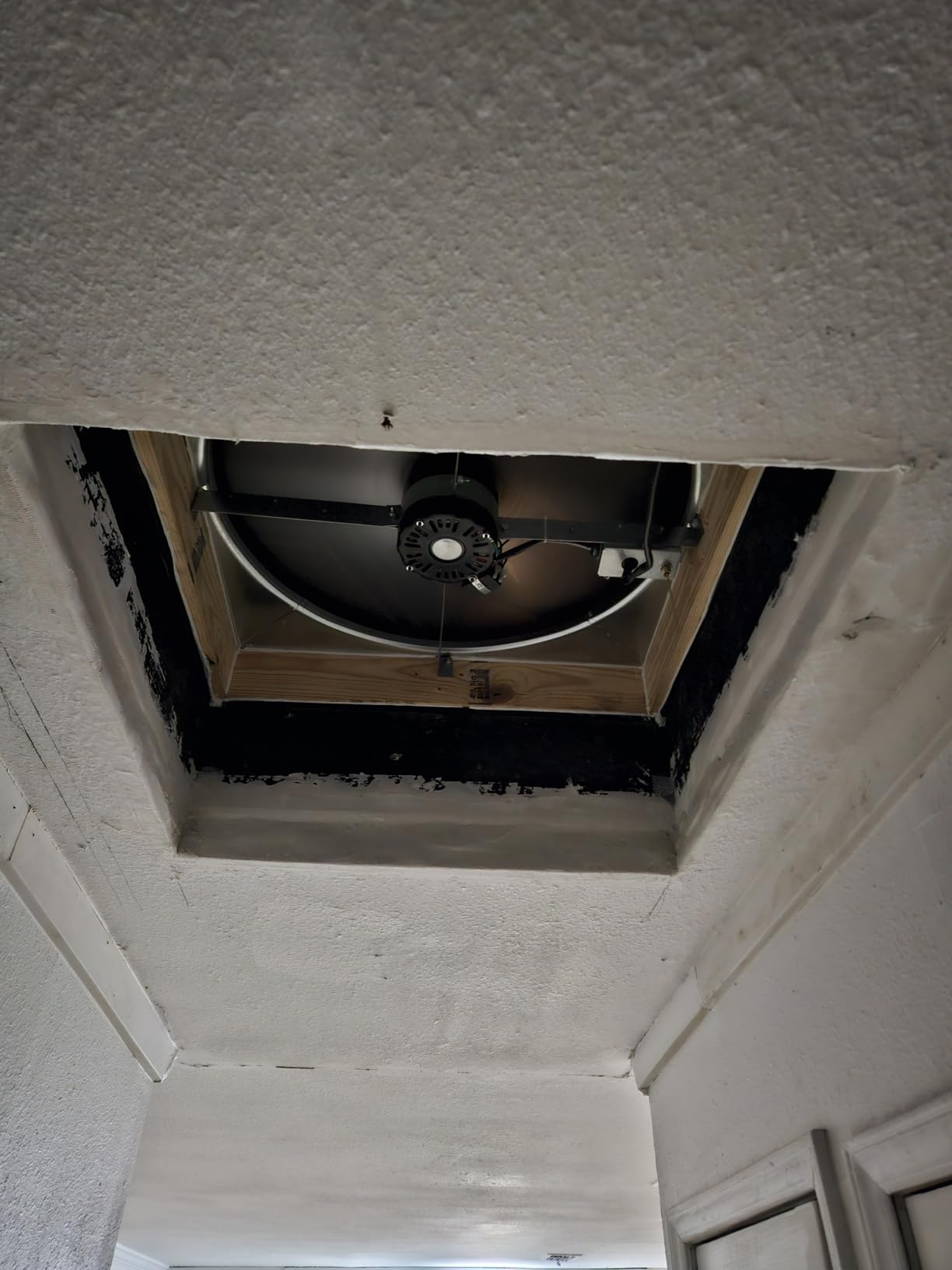
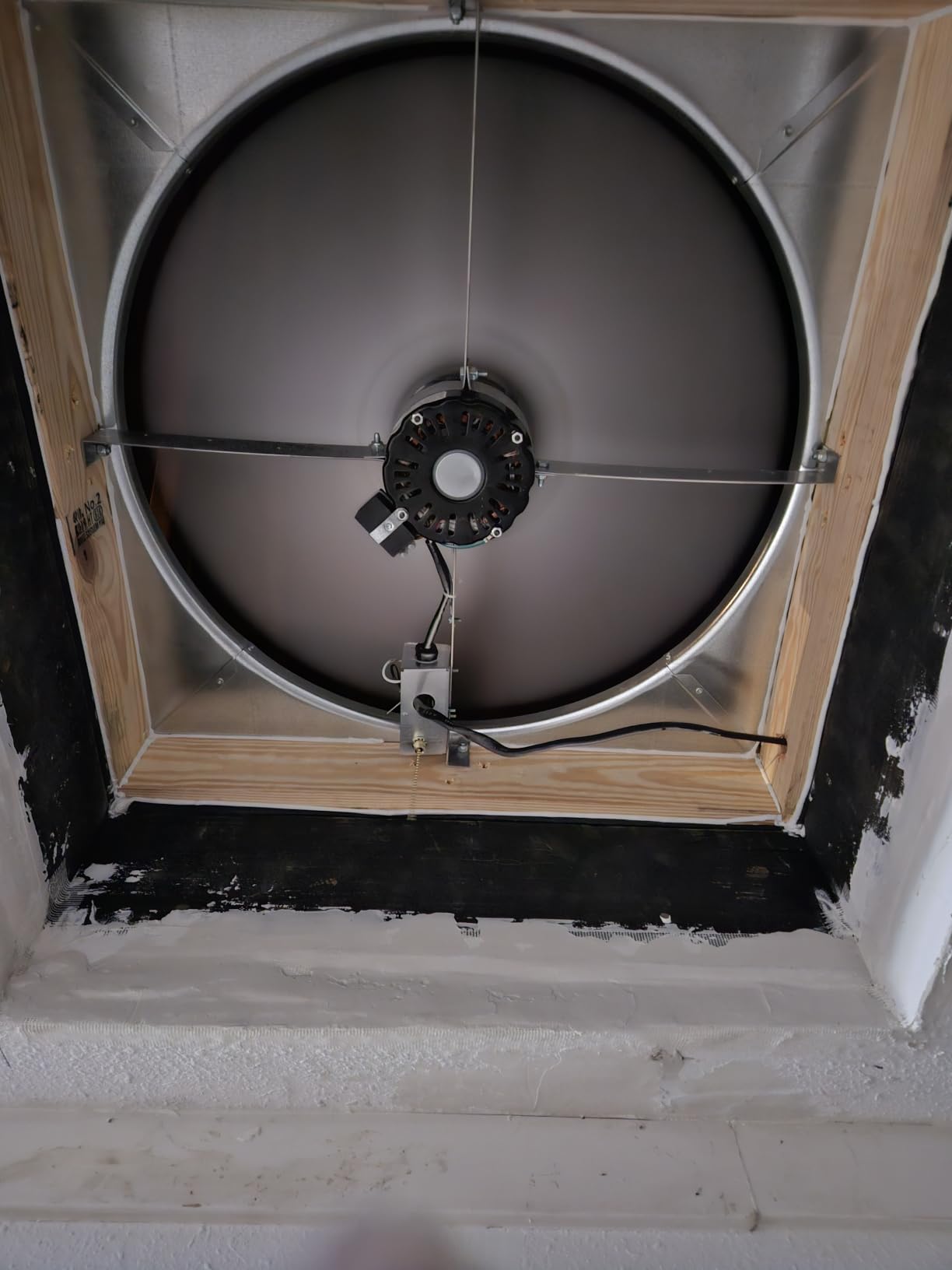
Installation is straightforward for a confident DIYer who already has an outlet in the attic. It mounts without cutting joists, and the automatic ceiling shutter closes the attic opening whenever the fan is off so you are not looking into an unconditioned cavity.
The louvers themselves are the weak point. They are not insulated, and multiple owners describe the rattle they produce while the fan runs as loud enough to be the dominant sound in a quiet house.
Does 2920 CFM vent a hot attic properly?
It does move plenty of air, and at 2920 CFM it needs a minimum of 562 square inches of attic exhaust ventilation, which is a low bar for a typical roof. The capacity is not the issue with this fan.
The issue is what happens when the fan is off. Because the louvers are uninsulated, they leak hot attic air into the living space in winter, and at least one owner built a custom insulation block to solve it. Budget for that if you are in a heating climate.
Where this fan falls short
The louvered shutter rattle is the single most repeated complaint, and it is not subtle. If you plan to run this fan in a bedroom-adjacent room overnight, expect to hear it.
Control is the other limitation. A two-speed pull chain is the least convenient interface on this list, and the unit is not as quiet as the purpose-built insulated designs from QuietCool or Centric Air. There are also isolated reports of blades contacting the shroud and bending within days, and of arriving units that were not working.
7. QuietCool QC ES-7000 RF: Best for Large Homes Over 3000 Square Feet
Quietcool QC ES-7000 RF Energy Saver Advanced Whole House Fan with Wireless Control – Up to 6878 CFM – As low as 164 watts – Two Speed – Covers up to 3,439 SQFT – 10 Year Warranty
6878 CFM high and 4304 low
727 watts high, 164 on low
ECM motor
R5 damper doors
Pros
- Highest airflow in this roundup
- up to 6878 CFM
- Low noise even on high compared with belt-drive units
- Rugged metal housing and smooth motor
- Wireless control avoids fishing wires through walls
- Requires 9.18 sq ft of net free attic venting
Cons
- Premium cost for a single unit
- Effectively a two-person install
- RF wall switch only with no app integration
If your home is genuinely large, this is the unit to look at. At 6878 CFM on high it covers homes up to roughly 3440 square feet, which is the only capacity in this roundup that reaches past the 3000 square foot mark without doubling up on fans.
Contractors report repeat purchases of this model, which is a meaningful signal for a product most people buy once. Installers also praise the suspension mount and the clarity of the instructions, and note that the wireless control reduces drywall damage by removing the need to run wire to a switch.
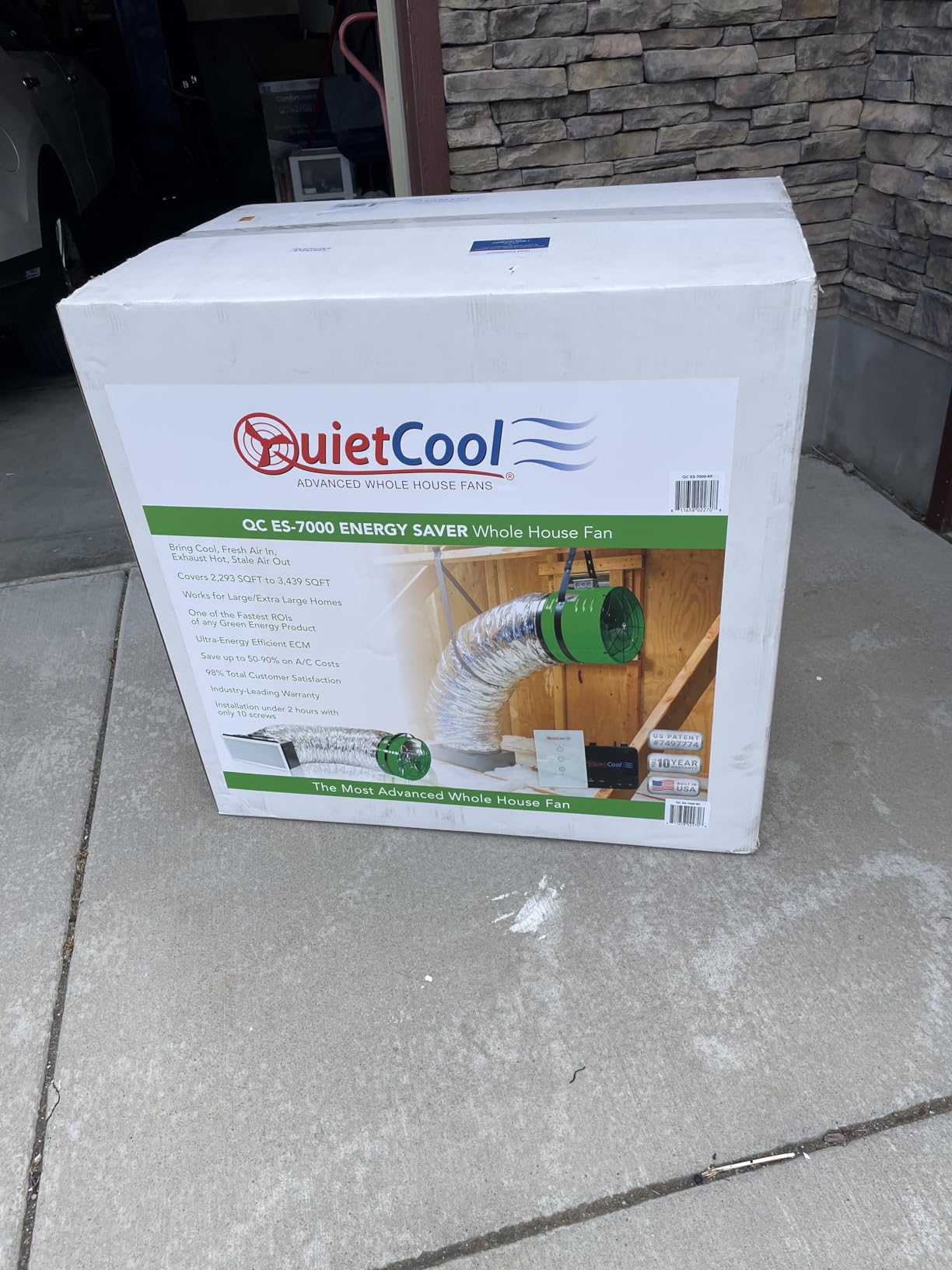
The ECM motor delivers 6878 CFM at 727 watts on high and drops to 4304 CFM at 164 watts on low. Owners report that even on high it is far quieter than the belt-driven units they replaced, which is unusual at this capacity.
It needs 9.18 square feet of net free attic venting, the largest requirement in this group. Check that number against your ridge, gable and soffit venting early, because adding that much exhaust area is often the most expensive part of the project.
Is this overkill for a typical home?
For a home under 2500 square feet, yes. Over-oversizing a fan is a real problem, because a unit that moves more air than the space can exchange simply pulls harder without cooling any faster, and the high speed becomes the loud setting nobody wants to run.
The low speed is where the ECM motor shines, and 4304 CFM on a 164 watt draw is a substantial amount of air for very little power. Owners in mild climates report cooling an entire home in minutes once windows are open.
Where this fan falls short
Size is the practical issue. This is a large, unwieldy unit going up into an attic, and installers consistently say two people are effectively required. That changes the installation from a weekend project into a scheduled one.
There is no app integration at all, only the RF glass wall switch, and there are isolated quality complaints including a fan blade shearing within a few months with a replacement that did not arrive promptly.
8. Centric Air QA-Deluxe 4800 ECM: Best for Three-Speed Control
QA-Deluxe 4800 ECM Energy Efficient Whole House Fan, 3 Speed Wall Switch
4203 CFM, 3209 Title 24
51 dB
491 watts
3-speed wall switch
Pros
- Three speeds with a low setting strong enough to run all night
- Damper box assembles with machine screws and precision-cut pieces
- Low-speed hum is not disturbing near nearby bedrooms
- 10 year motor warranty with responsive manufacturer support
Cons
- Wall switch button response lags on presses
- Thermostat cutoff does not always stop the fan at temperature
- No smart home or app connectivity
Three speeds is the practical difference here. Where most competitors give you a binary choice, the three-speed wall switch gives a low setting that owners say is strong enough to pull the house temperature down before the day’s heat arrives and then run all night without waking anyone.
Build quality is the second strength. The R-5 damper box is precision laser-cut and assembles with machine screws rather than sheet metal self-tapping screws, which is a small detail that tells you the manufacturer expects it to be taken apart and reassembled.
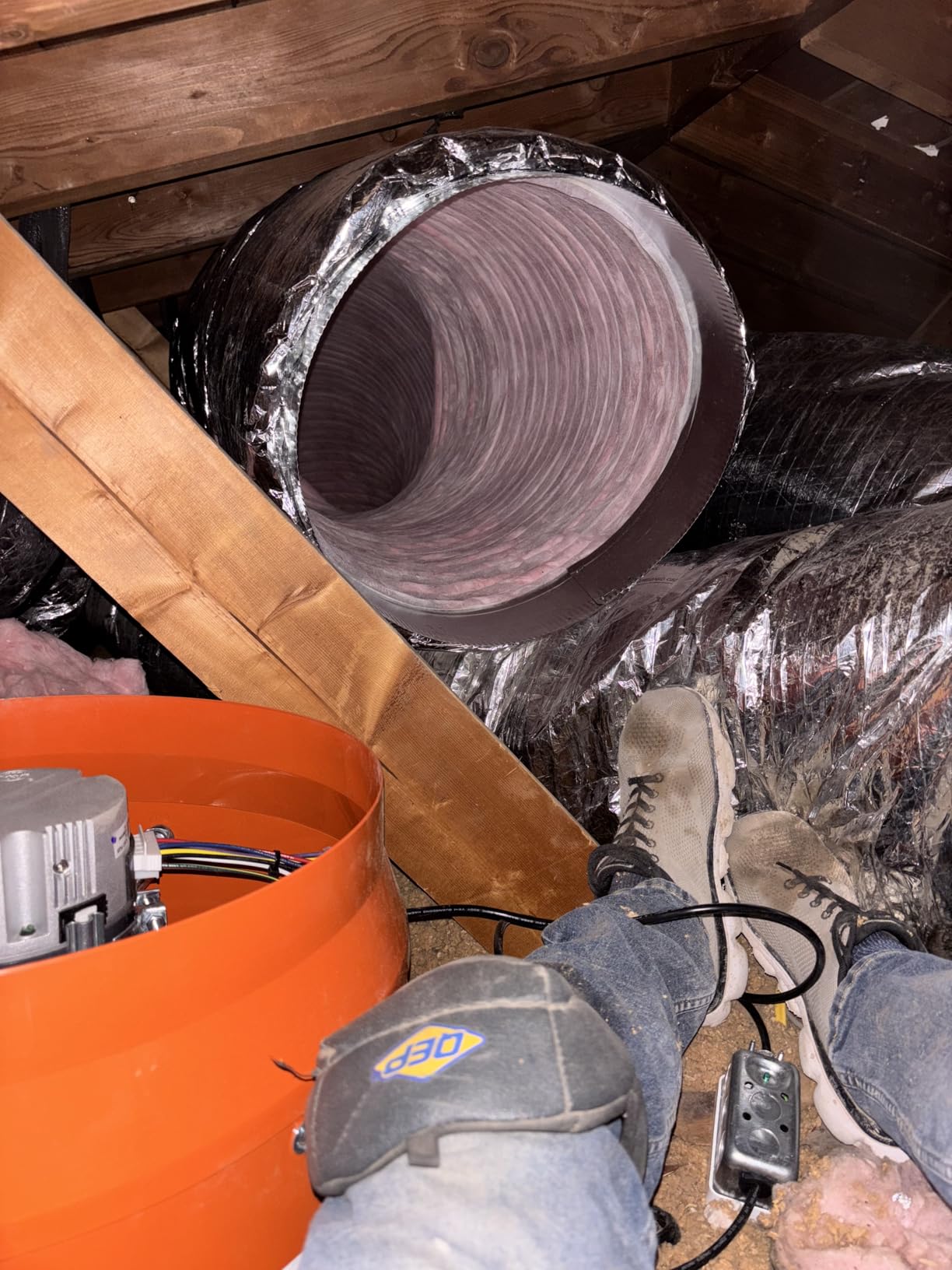
Quiet construction is deliberate: acoustical ducting, a precision-spun aluminum fan housing and rubber bushings hold the published figure to 51 dB. Rated output is 4203 CFM, or 3209 CFM under California Title 24 airflow rules, covering two-story homes up to 2800 square feet and single-story homes up to 1900.
It requires 4.0 square feet of attic ventilation, the lowest requirement in this roundup for a fan of its capacity. That makes it easier to retrofit into an existing attic with more soffit and ridge venting than you might expect.
Is a wired wall switch better than a wireless remote?
It depends on your walls. A low-voltage wired switch gives you a real thermostat cutoff and timer in the wall with no pairing to maintain, and the install is quick. A remote is easier to retrofit but always carries a small amount of latency when you press it.
Owners report the wall switch buttons lag, so inputs have to be pressed slowly, and the thermostat cutoff is inconsistent enough that some still shut the fan down manually at night. If you rely on the thermostat to stop the fan, test it before you trust it.
Where this fan falls short
There is no app or smart home connectivity, and the damper box has to be assembled before the unit goes into the attic, which adds to an install that is already awkward in tight attic spaces.
It is also worth remembering what a whole house fan can and cannot do. It cannot cool the home below outdoor temperature, and because it moves air rather than removing heat chemically, the building’s thermal mass takes many hours to cool after a hot day.
9. Centric Air 4.0 Ultra Quiet: Best for Absolute Quiet Operation
Centric Air 4.0 Ultra Quiet & Energy Saving Whole House Fan, Plug & Play
3921 HVI-916 CFM
623 watts
5-blade composite system
40,000 hour motor
Pros
- Quietest low-speed operation of any fan reviewed here
- R-5 gravity damper seals the attic when the system is idle
- German-made motor rated for 40000 hours
- Acoustical ductwork included in the box
- 15 year fan motor warranty
Cons
- Most expensive single unit we reviewed
- Install runs about six hours for a confident DIYer
- Metal ducting can squeak if not braced during install
- Moves air rather than cooling so it needs cooler outdoor air
This is the quietest fan in the roundup by owner report, and it carries the highest average rating at 4.9. The design is a precision-balanced five-blade composite system with a wing tip profile, engineered for acoustics rather than maximum airflow.
The motor is the differentiator. It is German-made and rated for 40,000 hours, with the manufacturer claiming 30 percent more power and one third less energy than industry standard fans, and it is backed by a 15 year motor warranty, the longest here.
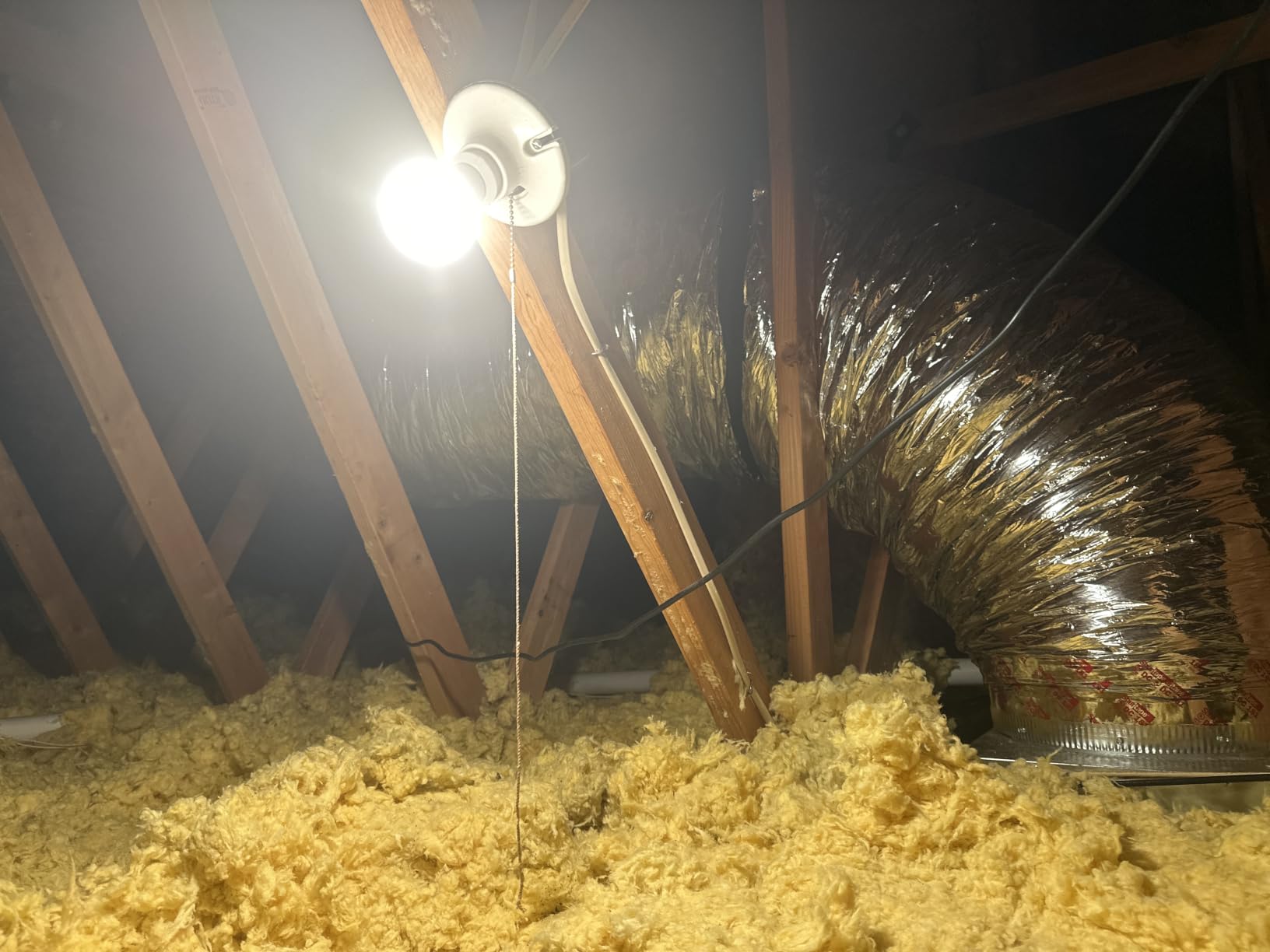
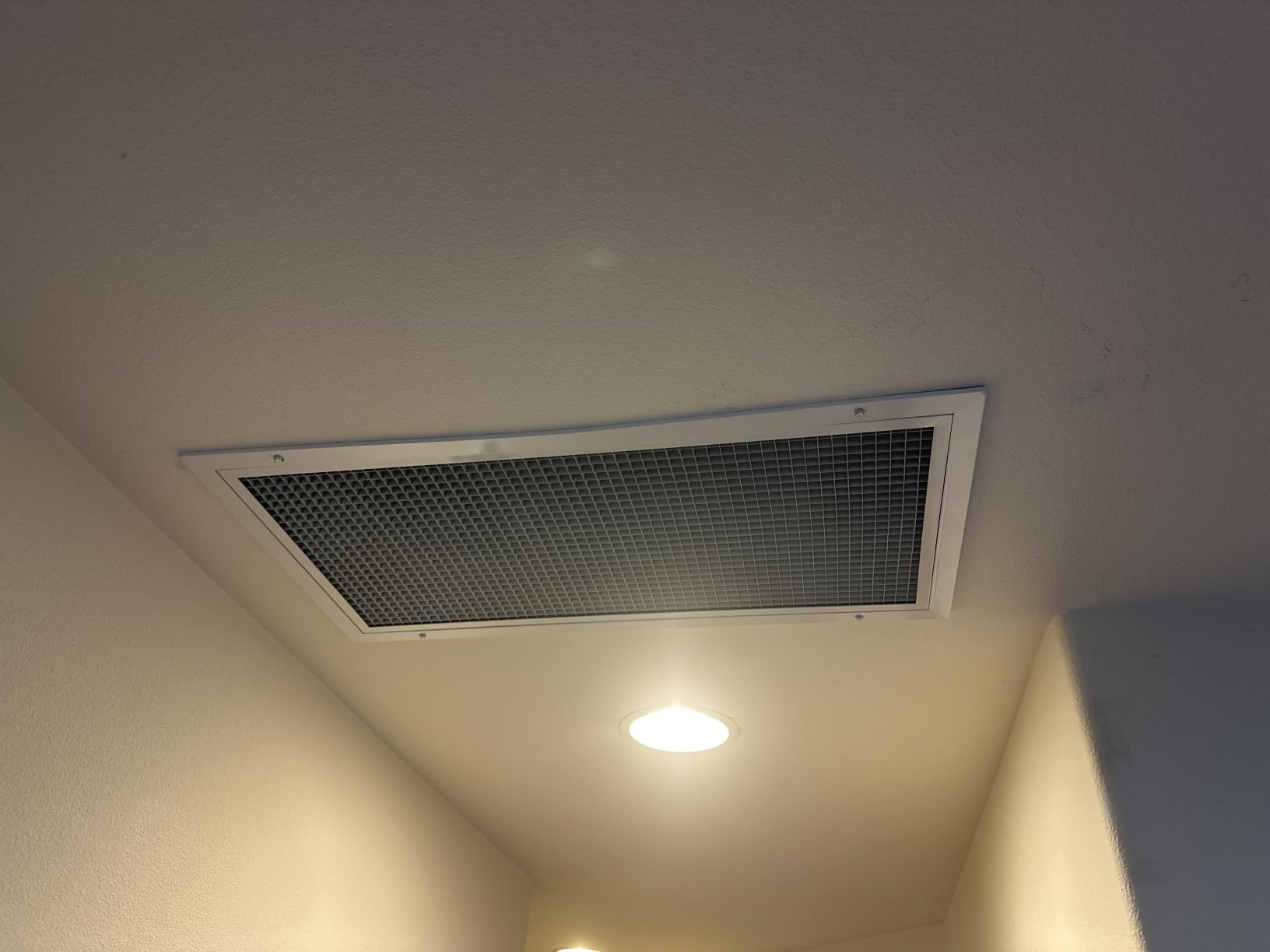
Output is 3921 HVI-916 CFM, which needs roughly 5.5 square feet of attic ventilation. The R-5 gravity damper seals the attic from living space whenever the system is idle, and the acoustical ductwork is included rather than sold separately.
Owners in mild climates report going without air conditioning once the fan is installed, and the low setting is described as nearly inaudible with high still tolerable during normal activity.
Is the extra cost justified by the noise difference?
If the fan sits near a bedroom or you plan to run it overnight, the near-silent low setting is worth paying for. That is the operating mode this fan is engineered around, and no other unit in this roundup approaches it.
If your fan lives in a hallway and the house is loud anyway, the acoustic premium buys you less than the same money would buy in additional venting. Vent first, then acoustics.
Where this fan falls short
It is the most expensive single unit we reviewed, and the install is a substantial project, with one owner reporting roughly six hours for a confident DIYer. Budget a full day and a helper.
There is a known installation trap: the metal ducting can develop a squeaky metal-on-metal noise if it is not braced or handled carefully during install. The fan is quiet, but a badly supported duct will undo that entirely.
How to Size a Whole House Fan for a Hot Attic
Start with conditioned square footage, not total square footage. Multiply the living space by two to get a starting CFM figure, which is the ratio the QuietCool units are rated to: the CL-4700 delivers 4415 CFM for 2208 square feet, and the ES-4700 delivers 4195 CFM for 2098 square feet.
So a 2000 square foot conditioned home needs roughly 4000 CFM, and a 3400 square foot home needs closer to 6800 CFM. Below that target, the fan will recirculate air inside the envelope instead of exchanging it, and you get noise without cooling.
Then check venting, using the rule of one square foot of net free attic area per 750 CFM. The math is verifiable in this roundup: the CL-4700 asks for 5.89 square feet at 4415 CFM, the ES-4700 asks for 5.6 at 4195, and the ES-7000 asks for 9.18 at 6878. If your attic cannot deliver that net free area, no fan on this list will fix it.
Finally, run the numbers on climate. A whole house fan in a dry climate with hot days and cool nights can replace a good share of compressor runtime. In a humid coastal climate the same fan mostly moves moisture into the house, and most owners there report limited results.
Net Free Attic Venting and Winter Heat Loss
Net free area is the open area of your vents after accounting for the screen, mesh and any blocking material. A 50 square inch soffit vent blocked by a nest is zero square inches of net free area as far as airflow is concerned, and this is the most common reason a correctly sized fan underperforms.
The winter side of the equation is the damper. Most of the budget and mid-range units in this roundup use an R-5 insulated damper, the QuietCool units include R5 damper doors, and the Centric Air 4.0 uses an R-5 gravity damper. The Tamarack HV1000 goes furthest with self-sealing R38 doors that close against each other when the fan stops.
At the other end, the Master Flow’s automatic louvered shutter is uninsulated, and owners in heating climates report adding their own insulation block. If you heat with electricity or natural gas, that difference shows up on the winter bill.
When to Run a Whole House Fan
Run it in the evening and overnight, after the outdoor temperature has dropped below the indoor temperature. Open windows on the shaded side of the house first, then widen. Two or three open windows on opposite sides gives a cross-flow that works far better than one lonely window.
Do not run it during the hottest part of the day when the outdoor air is warmer than indoors, and close everything up during a wildfire smoke event or when outdoor humidity is high. In humid climates the fan can raise indoor moisture faster than it removes heat.
Use the timer rather than the thermostat when you can. Running the low speed for a long block of hours, the way the QuietCool ES-4700 can at 75 watts, is where the energy savings actually accumulate. If you also need airflow for a much smaller space, our camera cooling fan guide compares small form factor airflow options by static pressure rather than house size.
Smart Controls: RF Switch, WiFi App, or Wired Switch
Three control styles show up in this roundup. Wireless RF switch kits come with both QuietCool units and the Centric Air 5500, and they avoid running wire through walls, which is the single biggest installation advantage for retrofit work.
Only the AC Infinity CLOUDWAY T12 offers true WiFi with an app, including temperature, humidity and VPD programming, cycles, scheduling and a minimum speed setting. The two Centric Air ECM units use a wired low-voltage wall switch with timer and temperature control, which is dependable and has no pairing to manage.
Budget models use a pull chain. It works, and it costs nothing, but it is the least convenient interface on the market and it is the one people complain about most after living with a timer.
Common Whole House Fan Problems and How to Avoid Them
Undersized venting is number one. Measure net free area before ordering, and add soffit and ridge vents if you are short. Every model in this roundup publishes its required venting figure, and treating it as optional is the most expensive mistake available.
Oversized fans are the mirror-image problem. A 6878 CFM unit in a small house moves air harder without exchanging it faster, and the high setting simply becomes the loud setting.
Bad placement wastes capacity. A central hallway location pulls from every room, while a corner unit mostly circulates air that was already comfortable. Plan around truss geometry too, especially for the Tamarack, whose doors need room to swing.
Noisy ducting and rattling louvers are the top noise complaints. Bracing metal duct, avoiding unsupported vertical mounts and checking that gravity louvers sit flat all prevent the most common of them.
Whole House Fan vs Attic Fan vs Solar Attic Fan
A whole house fan moves air through your living space, so you feel the effect. An attic fan only moves air in the roof cavity, which cools the roof deck and reduces the load on your air conditioner but does not cool the rooms. A solar attic fan is a smaller, usually cheaper version of the same idea, powered by a photovoltaic panel.
Solar attic fans have a real limitation that comes up constantly in homeowner discussions: airflow is modest, and many owners report being disappointed by how little air moves for what they spent. If the goal is cooling the rooms, a whole house fan is the tool for the job.
One rule worth keeping in mind from installer experience: do not run an attic fan in combination with ridge ventilation without checking the design, because you can short-circuit the exhaust path and pull air back in under the roof. Our hot air brush roundup covers the other end of the same heat problem for handheld work.
Frequently Asked Questions
Do whole house fans cool the attic?
Yes, indirectly and very effectively. The fan exhausts air from the living space into the attic and out through the roof vents, and that passing airflow strips heat from the roof deck. If your attic has enough net free venting, roughly one square foot per 750 CFM, the attic cools as the house cools.
Which is better, a whole house fan or an attic fan?
A whole house fan is better if you want the rooms cooler, because it moves air through your living space and you feel the change. An attic fan only cools the roof cavity and reduces the load on your air conditioner. For a hot attic and a hot house at the same time, the whole house fan does more for you.
What size attic fan do I need for a 2000 square foot house?
For about 2000 square feet of conditioned space, aim for roughly 4000 CFM, which is two CFM per square foot. That is the ratio the QuietCool units are rated to, and a 4415 CFM fan such as the CL-4700 covers up to 2208 square feet. Verify you have about 5.5 square feet of net free attic venting to match.
When should I run my whole house fan?
Run it in the evening and overnight, once outdoor air is cooler than the air inside. Open several windows on different sides of the house for cross-flow, and use the timer rather than the thermostat. Do not run it when outdoor humidity or smoke is high, and close up when outdoor air is warmer than indoor air.
What are the common problems with whole house fans?
The most common problems are insufficient attic venting, an oversized fan, poor placement, rattling louvers or unbraced ducting, and leaks through uninsulated dampers in winter. Joist spacing can also block the install entirely, which is why you should confirm the required ceiling cut-out against your framing before ordering.
Conclusion: Our Picks for 2026
For most homes with a genuinely hot attic, the Centric Air QA-Deluxe 5500 is the best whole house fan for the job: 5072 CFM, a sealed R-5 damper, a remote with timer and thermostat, and the largest review base of anything we ranked. The QuietCool CL-4700 RF is the pick for quiet operation and the simplest install, and the Master Flow 24 inch fan is the honest budget option if you will accept a rattling shutter.
Before you buy anything, measure your net free attic venting and multiply your conditioned square footage by two. Those two numbers will rule half this list in and half of it out faster than any feature list can. Once the fan is in, run it on the low speed in the evening, open windows on two sides, and let the roof deck do the rest.
If you also work with gear that runs hot and need airflow guidance for a much smaller space, our camera cooling fan guide compares options by static pressure rather than house size, and our hot air brush roundup covers the other end of the same heat problem.