
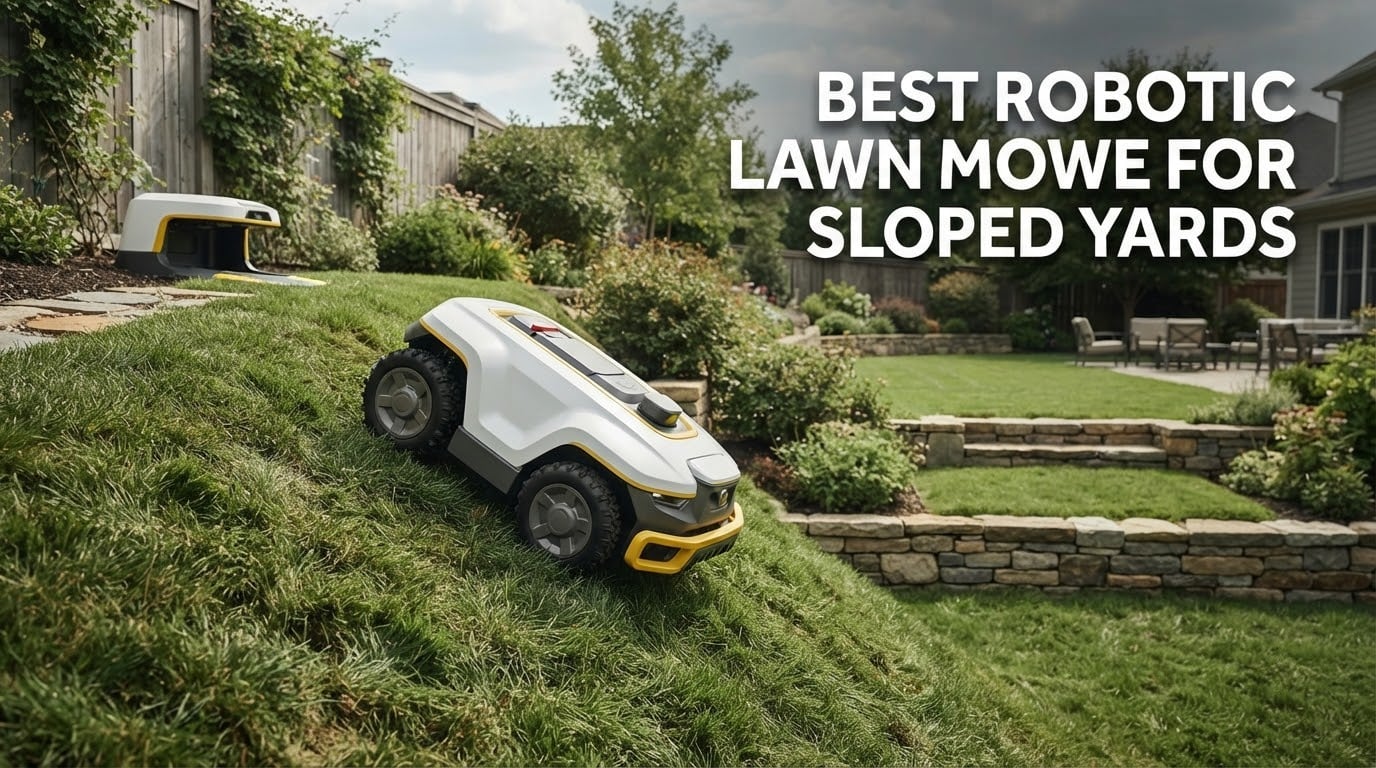
A robotic lawn mower is a battery-powered machine that cuts your grass on a schedule without a chute, a bag, or a person pushing a handle. It drives its own route, senses obstacles, and returns to a charging dock when the battery runs low.
That simple description breaks down the moment your yard tilts. Most robot mowers are two-wheel drive, and two-wheel drive loses grip somewhere around a 20 to 25 percent grade. On a sloped property the machine either stalls halfway up, slides sideways on a traverse, or digs ruts in soft turf that trap it on the next pass.
This guide covers the best robotic lawn mowers for sloped yards: ten wire-free models with all-wheel drive or four-wheel drive, published slope ratings from 45 percent to 84 percent, and the navigation tech that keeps them on your lawn instead of in the neighbor’s hedge. We also cover the part most roundups skip, which is how rated slope behaves when the grass is wet and the hill is being crossed sideways.
We looked at manufacturer slope claims, owner review patterns, mapping systems, drive trains, battery runtime, and acreage ceilings side by side. If you want a broader look at how autonomous equipment gets evaluated, our guide to the 8 best robotic camera arms for studios takes the same spec-first approach on a different category.
One warning before we start. Every slope number in this article is a manufacturer specification measured on prepared, dry ground. On wet grass, clay soil, or a side-hill traverse, real-world performance typically lands a full grade below the published figure. Budget for that gap when you pick a machine.
Table of Contents
- Top 3 Robot Mower Picks for Steep Yards in 2026
- Best Robotic Lawn Mowers for Sloped Yards (October 2026)
- 1. Mammotion LUBA 2 AWD 5000HX: Our Top Pick for Serious Grades
- 2. Mammotion LUBA mini 2 AWD 1500H: Top Rated for Small Steep Yards
- 3. ANTHBOT M9: Best Value Robot Mower for Moderate Slopes
- 4. Mammotion LUBA 3 AWD 3000: Premium Pick for Large Multi-Level Properties
- 5. WORX WR342 4WD: The Steepest Rated Mower in the Group
- 6. Segway Navimow i206 AWD: A Compact Mower With Zero-Turn Steering
- 7. MOVA LiDAX Ultra 1000: Best for Edge Cutting on Tight Borders
- 8. Sunseeker X5 AWD: Built for Wooded Yards with Patchy Signal
- 9. ECOVACS Goat O1000 RTK: Fastest Setup for Smaller Yards
- 10. Roborock RockNeo Q110H: Budget Pick with Class-Leading Battery Life
- What Slope Rating Do You Actually Need?
- Drive System: 2WD vs AWD vs Tracked
- Navigation on Hills: RTK, LiDAR and V-SLAM
- Wire-Free vs Boundary Wire on Graded Ground
- Uneven, Bumpy and Rut-Prone Lawns
- Real Owner Failure Modes on Hills
- When You Should Skip a Robot Mower
- Frequently Asked Questions
- The Bottom Line
Top 3 Robot Mower Picks for Steep Yards in 2026

Best Robotic Lawn Mowers for Sloped Yards (October 2026)
The table below lists all ten machines in slope-rating order, so you can see the spread before you read individual reviews. Ratings run from 45 percent on four models to 84 percent on the four-wheel-drive WORX WR342.
| Product | Specs | Action |
|---|---|---|
| Mammotion LUBA 2 AWD 5000HX |
|
Check Latest Price |
 WORX WR342 4WD WORX WR342 4WD |
|
Check Latest Price |
 Mammotion LUBA mini 2 AWD 1500H Mammotion LUBA mini 2 AWD 1500H |
|
Check Latest Price |
 Mammotion LUBA 3 AWD 3000 Mammotion LUBA 3 AWD 3000 |
|
Check Latest Price |
 Sunseeker X5 AWD Sunseeker X5 AWD |
|
Check Latest Price |
 ANTHBOT M9 ANTHBOT M9 |
|
Check Latest Price |
 MOVA LiDAX Ultra 1000 MOVA LiDAX Ultra 1000 |
|
Check Latest Price |
 Segway Navimow i206 AWD Segway Navimow i206 AWD |
|
Check Latest Price |
 ECOVACS Goat O1000 RTK ECOVACS Goat O1000 RTK |
|
Check Latest Price |
 Roborock RockNeo Q110H Roborock RockNeo Q110H |
|
Check Latest Price |
1. Mammotion LUBA 2 AWD 5000HX: Our Top Pick for Serious Grades
Mammotion LUBA 2 AWD 5000HX Robot Lawn Mower with 4G, Reception 1.25 Acres, Max. 1.48 Acres, All-Wheel-Drive for 80% Slope, UltraSense AI Vision & RTK Automatic Edge Mapping, 2.2″-4.0″ Cutting Height
80% slope (38 degrees)
165W AWD motors
15.7 inch cutting width
Up to 1.48 acres
Pros
- Handles 80 percent slope with four driven wheels
- Wire-free RTK plus UltraSense AI vision
- Maps up to 50 mowing zones with no-go areas
- Recognises 200 plus obstacle types
- Quiet operation with clean stripe patterns
Cons
- RTK antenna mounting makes setup fiddly
- Customer support reported as slow by some owners
- Turning algorithm tears turf on tight pivots
- 4G subscription needed after the first year
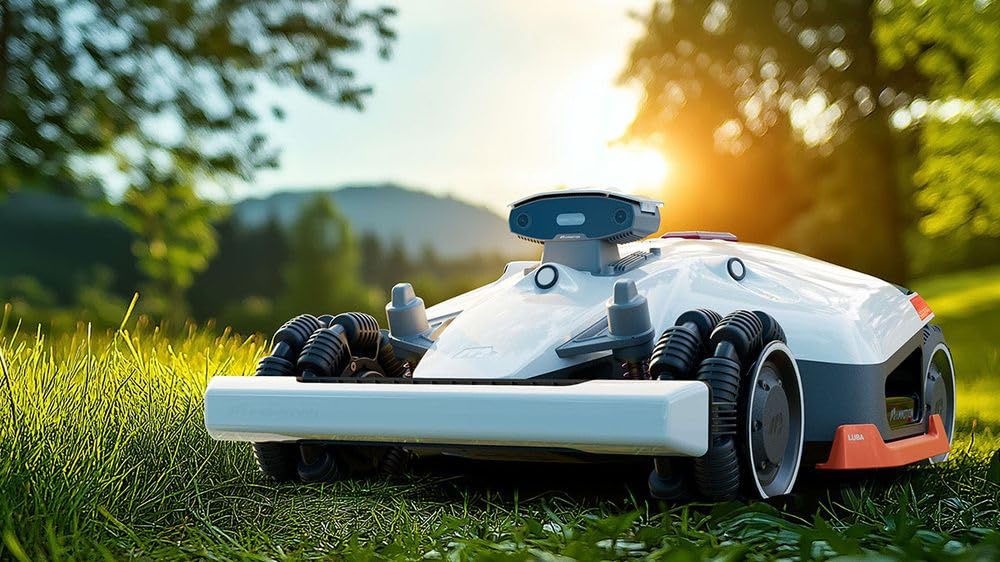
The LUBA 2 AWD 5000HX is the machine we keep coming back to for genuinely sloped properties, and it earns the top slot for a simple reason: it is the only model here with a large review base and an 80 percent slope rating. Four driven wheels fed by a 165W motor give it the torque to hold a line on a grade where lighter machines spin their tires.
Its navigation stack pairs UltraSense AI vision with RTK positioning, so the mower builds an automatic edge map without a boundary wire. That matters more on a hillside than the raw climbing number, because a wire you have to stake across uneven ground is a wire that will eventually break at a grade transition. Owners managing fifty mowing zones and no-go areas around sprinkler heads get a level of control that most competitors in this price range simply do not offer.
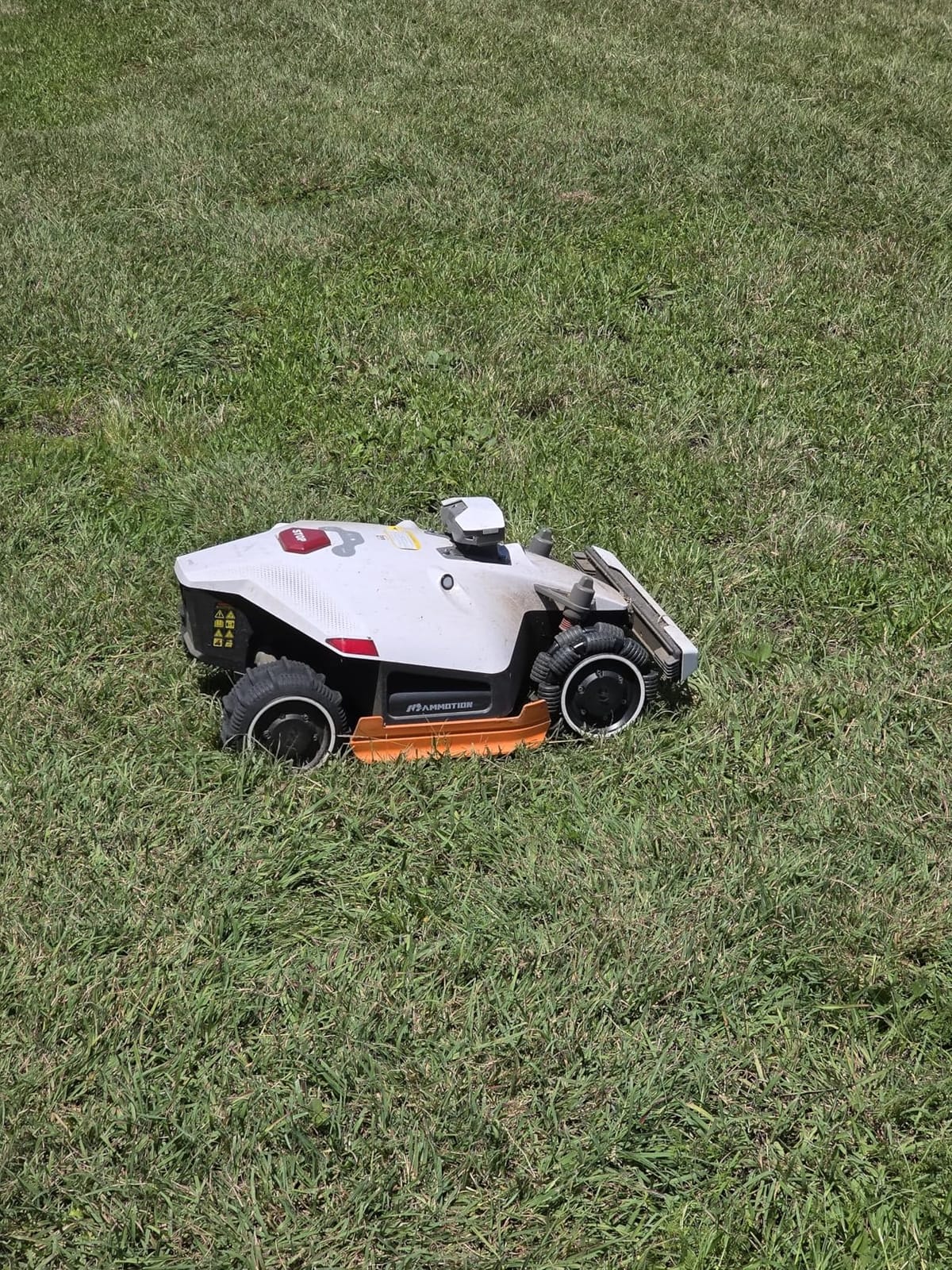
The 15.7 inch cutting width and dual-blade disc system cover ground quickly on medium yards, and the adjustable range from 2.2 inch to 4.0 inch handles the tall grass that collects in low spots at the base of a hill. Reviewers consistently mention the stripe patterns as one of the unexpected pleasures, since the machine drives straight lines even on uneven turf.
Battery coverage is listed at up to 13000 sq.ft per charge, which is why the reception area runs to 1.25 acres with a stated maximum of 1.48 acres. GPS tracking and anti-theft protection are standard, which is worth having on a yard where the mower spends time out of sight line.
The honest complaints cluster around ownership friction. The RTK antenna needs careful mounting, and several owners describe it as a fiddly first afternoon. Others report the app as functional but not polished, and a few note that the tight-turn algorithm can pull up turf when the machine pivots in a confined area on a slope.
Why the LUBA 2 fits steep and awkward yards
Its four-motor layout keeps torque distributed across the chassis rather than loading two contact patches, which is exactly what you need when one side of the machine is higher than the other. That is the difference between climbing a hill and traversing one.
Fifty zones with no-go areas also lets you protect the things that make sloped yards awkward: pop-up sprinklers, irrigation lines, and garden beds at the toe and crest of the grade. Reviewers report that multi-zone handling is the feature that made the setup manageable on a complex property.
Where it falls short
Reviewers report the mower struggling with leaves and general yard debris, so a hillside under trees will need clearing before each heavy mowing cycle. The turning behaviour on tight corners is another recurring note, and a few owners report it catching on small bumps at zone transitions.
There is also a subscription angle worth knowing about. Some owners report needing a paid 4G connectivity plan after the first year for remote monitoring. If you want a fully standalone mower with no recurring connectivity charge, look at a WiFi-only model instead.
2. Mammotion LUBA mini 2 AWD 1500H: Top Rated for Small Steep Yards
(2026 Upgrade) Mammotion LUBA mini 2 AWD 1500H Robot Lawn Mower, for 0.37 Acres, 360° LiDAR+Dual-Camera AI Vision, 80% Slope, DropMow, 20 Multi-Zone Management
80% slope (38.6 degrees)
360 degree LiDAR plus dual cameras
7.9 inch cutting width
0.37 acre
Pros
- 360 degree LiDAR fused with dual-camera AI vision
- 80 percent slope rating from two 88W motors
- Adaptive suspension clears 75mm obstacles
- DropMow mode for jobs without mapping
- Smart battery management with off-peak charging
Cons
- Narrow 7.9 inch cutting width
- About 60 minutes of battery per charge
- Newer model with limited long-term history
This is the highest-rated machine in the group, sitting at 4.4 across 260 reviews, and the number is earned by a design choice that matters on hills: it navigates with 360 degree LiDAR plus dual cameras rather than depending on a satellite signal. A hilly yard with trees loses RTK accuracy precisely where LiDAR keeps working.
Two independent 88W motors drive all four wheels for an 80 percent, or 38.6 degree, climbing rating. That matches the flagship LUBA 2’s slope capability in a body sized for 0.37 acres, which makes it the better match for a small front lawn with one serious grade rather than a property-wide install.
The adaptive suspension is the detail that owners with uneven ground mention most. It clears obstacles up to 75mm, which covers the tree roots, pine cones, and minor transitions that stop a rigid-chassis mower dead halfway up a hill.
Twenty independent mowing zones let you schedule the flat sections separately from the slope, so you can run the hill at off-peak hours when the ground is firmer. Smart battery management with custom charge limits and off-peak charging support is a nice touch for anyone trying to reduce electricity costs.
The dual cutting discs, one main and one edge unit, with automatic height adjustment handle the 2.2 inch to 4.0 inch range. DropMow mode is genuinely useful for a quick pass before guests arrive, since it does not require a full mapping run first.
Why this is the right call on a compact hillside
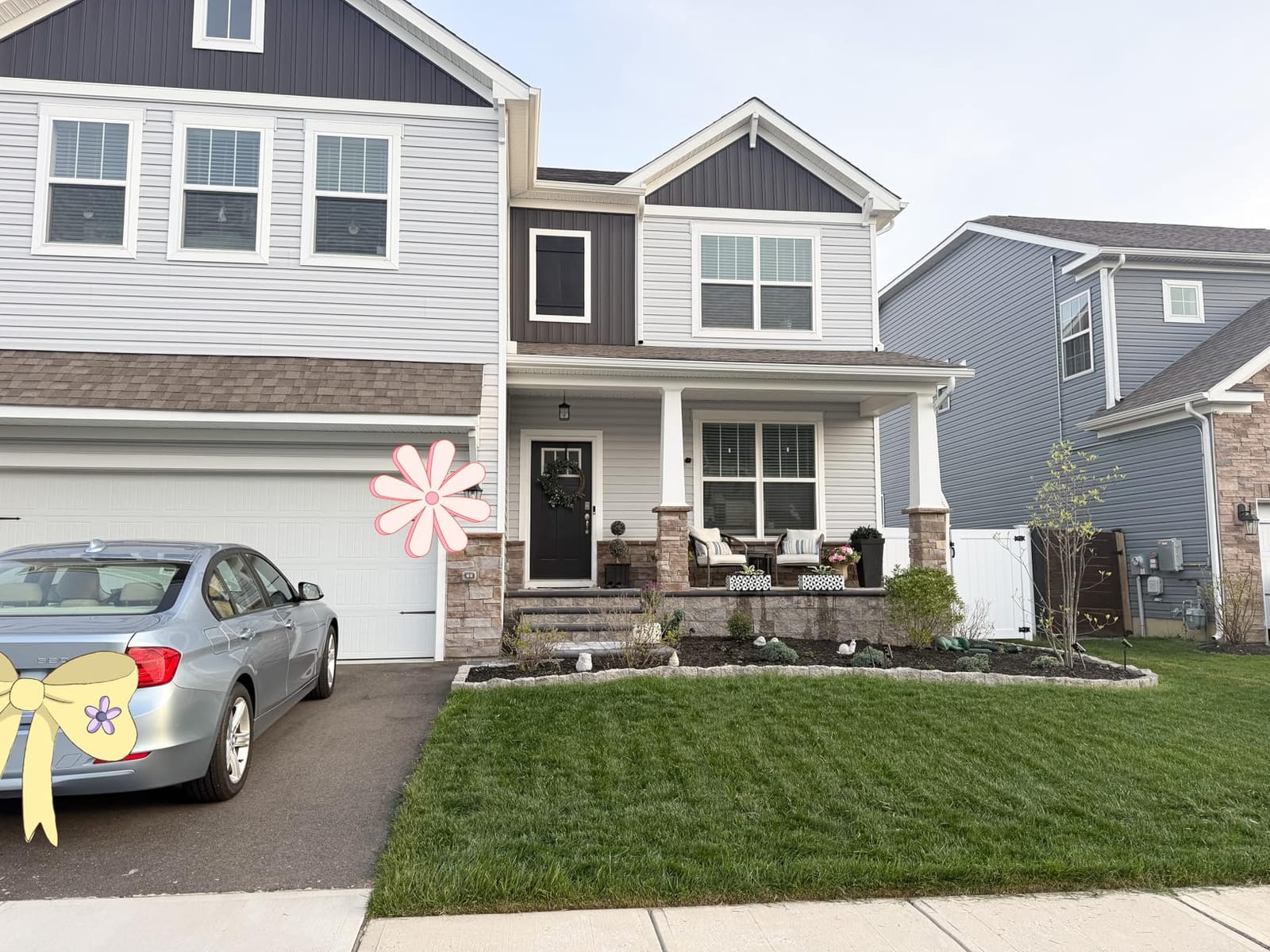
Yard sizing is the deciding factor. At 0.37 acres, this fits the small steep front yard that owners often describe as the hardest case, where a large mower cannot manoeuvre and a cheap two-wheel-drive unit stalls halfway up. The 500 sq.m per-charge figure and 60 minute runtime are appropriate to that scale.
The LiDAR-plus-camera combination also handles the tree canopy problem better than RTK-only machines. Owners in wooded yards report continued mapping where satellite-based rivals stall, which on a hillside means the difference between finishing the pass and ending up parked mid-slope.
Where it falls short
The 7.9 inch cutting width is the narrowest of the AWD machines here. On anything larger than a third of an acre you will be making more passes, and more passes on a slope means more opportunities to rut the turf.
As a 2026 release it has a shorter review history than the LUBA 2, and the roughly 60 minute battery life means frequent charging cycles on a big schedule. Buyers who want a proven long-term record should read the durability reports with that in mind.
3. ANTHBOT M9: Best Value Robot Mower for Moderate Slopes
ANTHBOT M9 Robotic Lawn Mower, 1/4 Acre Wire-Free NRTK & Vision
45% slope (24.2 degrees)
NRTK plus dual-camera vision
7.9 inch cutting width
Up to 0.3 acre
Pros
- Wire-free NRTK and dual-camera vision mapping
- Auto-maps in about 10 minutes
- 45 percent slope capability
- Recognises 1000 plus obstacle types
- Quiet at 58dB or below
Cons
- Some owners report struggling on hills below the 45 percent rating
- May need multiple passes for an even cut
- RTK needs a clear sky view
- Auto-mapping sometimes needs manual refinement
The ANTHBOT M9 is the reason this list does not require a large budget. At 359 reviews it carries more owner feedback than several pricier machines here, and its 4.3 rating reflects a machine that does the fundamentals well without a premium badge.
Navigation runs on NRTK with dual 150 degree HDR cameras, and the auto-mapping routine finishes in roughly 10 minutes. Thirty work zones, app-controlled cutting height from 1.2 inch to 2.7 inch, and identification of over 1000 obstacle types cover the feature set most buyers actually use.
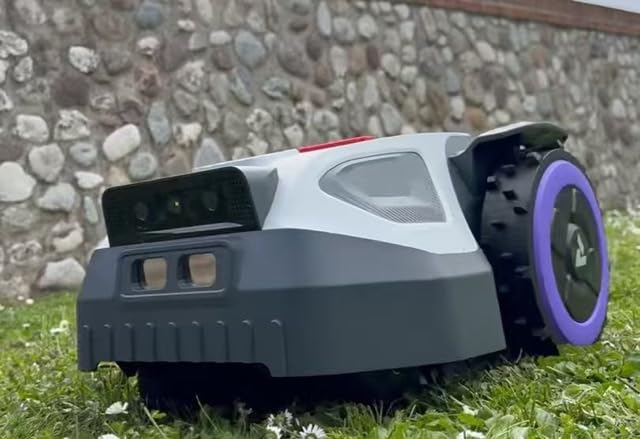
Five free-rotating blades are designed to produce a carpet-like finish rather than a stripe pattern, and the operating noise is listed at 58dB or below. That quiet figure is worth noting if your lawn sits close to a bedroom wall or a neighbour’s patio.
The self-charging and auto-resume behaviour is standard, so once it is mapped the machine runs its schedule without intervention. For a yard with multiple terraces and separate lawn areas, thirty zones is more than enough granularity.
What deserves attention is the slope reporting. Owners report that some machines struggle on hills below the published 45 percent figure, particularly when the grade is approached sideways. If your property has a sustained side-hill traverse, this is the pick to test carefully on the steepest section first.
Why the M9 suits moderate grades and small lots
At a 45 percent rating, this is a mower for a gentle incline or a moderate hill, not a serious grade. If your measurements put you in the 20 to 45 percent band, the M9 handles that terrain with plenty of margin, and the wire-free setup keeps installation to an afternoon.
Maximum mowing size is listed at 0.3 acre, so it is really a small and medium yard machine. The dual-camera vision plus RTK fusion is the part that carries the value, since it is the same navigation philosophy used on machines costing several times as much.
Where it falls short
Reviewers note that it can need multiple passes for a clean cut, that edging could be tighter than competing machines, and that manual mode feels clunky. None of those are deal breakers, but all three add friction on a property where you care how the slope stripes read.
The RTK requirement for a clear sky view is the real limitation on a wooded or hillside yard with heavy tree cover. And if your hill is genuinely steep rather than moderately sloped, an 80 percent-rated AWD machine is the safer purchase than stretching this one.
4. Mammotion LUBA 3 AWD 3000: Premium Pick for Large Multi-Level Properties
Mammotion LUBA 3 AWD 3000 Robot Lawn Mower with Cleaning Stand (Ship Separately), 360° LiDAR+NetRTK+AI Vision, AWD for 80% Slopes, 5400 sq.ft/h, Cutting Height 1.0″-2.7″
80% slope (38.6 degrees)
LiDAR plus NetRTK plus vision
5400 sq.ft per hour
12Ah battery, 175 min runtime
Pros
- Tri-fusion navigation for reliability under tree cover
- Covers 5400 sq.ft per hour
- 175 minutes of runtime per charge
- Recognises 300 plus obstacle types
- Omni wheel pivots precisely on slopes
Cons
- Cleaning stand packaged separately
- Occasional navigation quirks reported
- RTK setup is complex
- App needs work
The LUBA 3 AWD 3000 is the machine to consider when a sloped yard is also large. It covers 5400 sq.ft per hour, runs up to 175 minutes on a 12Ah battery, and carries a 30-zone limit with no-go areas, which is a different class of capability from the quarter-acre machines.
Its tri-fusion navigation combines 360 degree LiDAR, NetRTK, and dual-camera AI vision. On a property that has both open sky and heavy canopy, that three-way redundancy is the difference between a clean map and a mower that keeps stopping to re-acquire position halfway up a hill.
Four independent motors deliver the 80 percent slope rating, and dual 165W motors drive six-blade cutting discs at a 15.7 inch width. The LiDAR unit has a 230 foot range with a 59 degree vertical field of view, which matters on a hillside where terrain hides obstacles from a lower sensor.
The omni wheel is an underrated feature here. On a side-hill traverse, a machine that can pivot in place without driving a turning arc is far less likely to shear a strip of turf or slip sideways than one with conventional steering.
Intelligent path planning offers perimeter, zigzag, checkerboard, and adaptive patterns. Adaptive is the one to choose on uneven ground, since it adjusts coverage density where the mower spends more time climbing.
Why this is the pick for a large multi-level lot
The coverage numbers are the argument. 500m2 per hour with a 175 minute runtime means a big sloped property can be cut overnight on a single charge cycle, which is where the labour savings actually accumulate against a landscaping service.
Cutting height adjustment from 1.0 inch to 2.7 inch is the widest range in the group, so you can run a tall summer height on the flat sections and a tighter cut on the visible front slope near the street.
Where it falls short
The cleaning stand is packaged as a separate item, so plan for a second delivery and setup session if you want the wash-down station. A few owners also report occasional navigation quirks and an app that needs improvement.
The RTK setup complexity is a real barrier for first-time buyers. If you dislike assembly and antenna placement, the ECOVACS Goat and MOVA LiDAX are considerably faster to get running, at the cost of some slope capability.
5. WORX WR342 4WD: The Steepest Rated Mower in the Group
WORX Robot Lawn Mower 4WD for 1/2 Acre, No Perimeter Wire, WR342
84% slope (about 40 degrees)
RTK Cloud navigation
4WD terrain-adaptive chassis
0.5 acre
Pros
- Highest published slope rating here at 84 percent
- RTK Cloud needs no local antenna
- Terrain-adaptive chassis keeps four wheels planted
- Cut-to-Zero blade trims edges closely
- Includes a WiFi repeater and 3-year warranty
Cons
- Only about 41 minutes of battery per charge
- App controls and map editing widely criticised
- No LED light included for night mowing
- Only 17 reviews so far
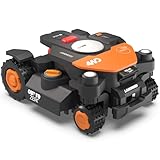
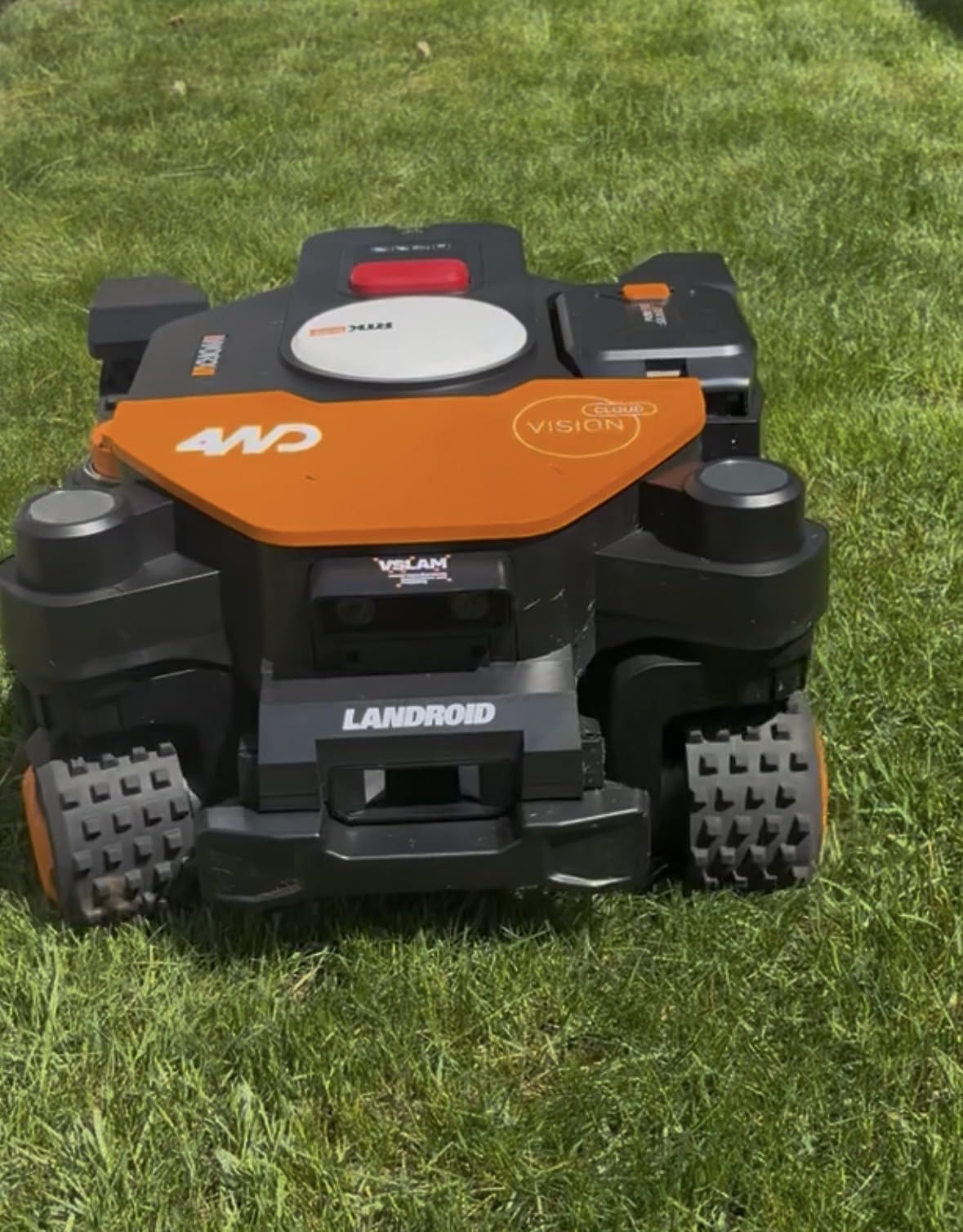
The WR342 carries the highest slope figure in this roundup at 84 percent, roughly 40 degrees, and it is the only machine here with genuine four-wheel drive and true front-wheel steering. If your grade is severe enough that 80 percent feels marginal, this is the one built for it.
RTK Cloud navigation is a meaningful difference from antenna-based systems. There is no local antenna to mount, which removes the single most common installation complaint on hillside installs, and no cloud subscription attached to that positioning service.
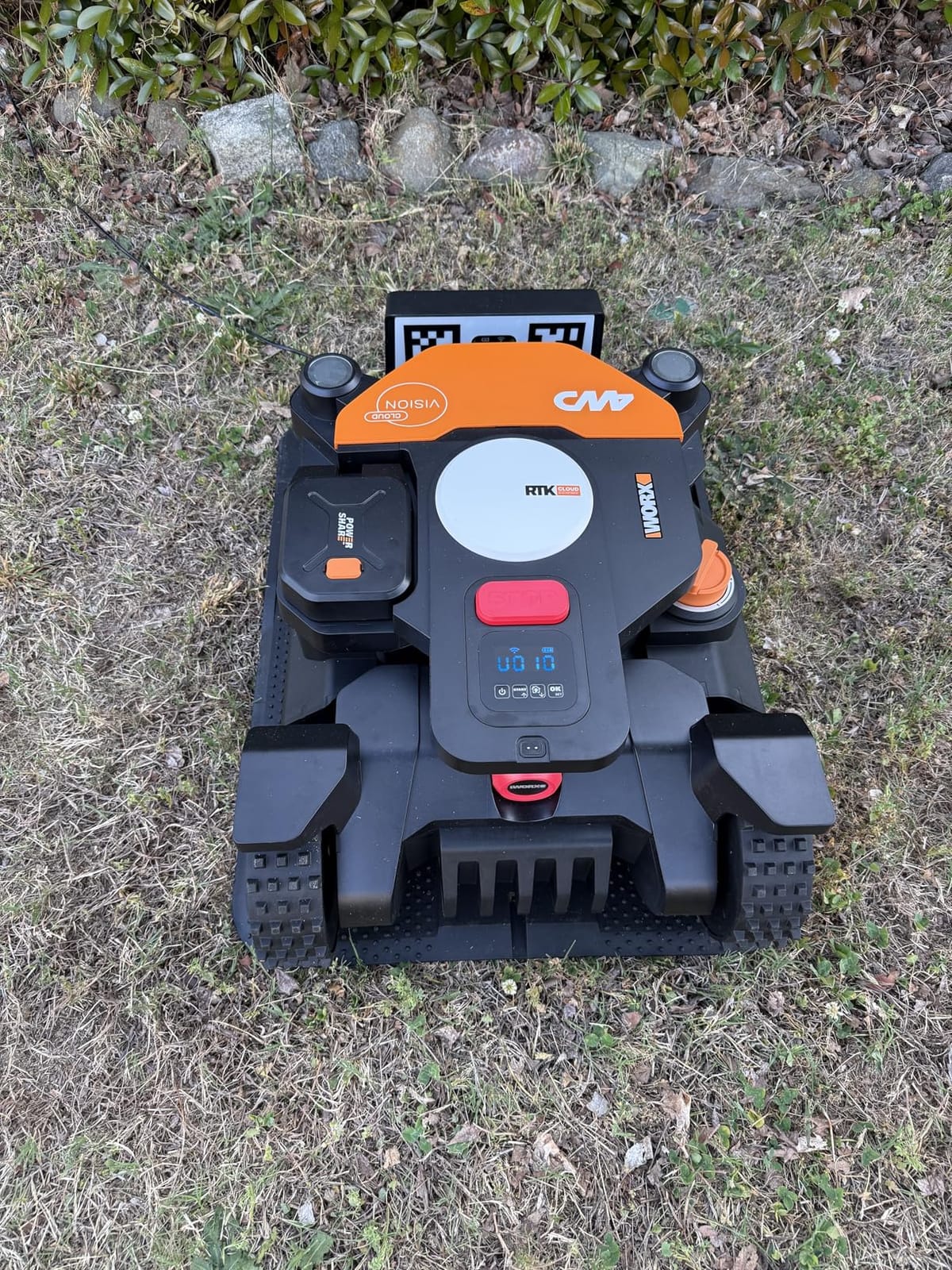
The terrain-adaptive chassis is what does the physical work. Keeping all four wheels planted on an uneven surface is how the machine maintains traction while crossing a grade at an angle, rather than loading the downhill wheels and spinning.
True front-wheel steering produces smooth, precise turns instead of skidding, and the Cut-to-Zero offset blade cuts close enough to the boundary that string trimming is mostly a corner job. Obstacle avoidance runs on a vision AI system described at 10 trillion operations per second.
For navigation in shade, the machine fuses RTK Cloud with V-SLAM visual odometry, and Find My Landroid adds GPS plus cellular tracking for theft recovery. A WiFi repeater is included, which matters on a large property where the dock sits at the edge of coverage.
Why it wins on the toughest grades
At 84 percent, this covers terrain where most residential machines stall. A 40 degree pitch is a serious grade, and if your measurement came in above 70 percent you have very few residential options left.
Owners report strong traction on hills and uneven ground, and quiet operation. The combination of four-wheel drive, adaptive chassis, and front-wheel steering is a genuinely different mechanical class from the AWD wheel machines above it.
Where it falls short
Battery life is the headline weakness. At roughly 41 minutes per charge, a half-acre sloped yard needs more charge cycles than most competitors, and on steep ground that translates into more time working the hill.
The software is the other complaint reviewers repeat most. Controls are described as clunky, map editing is difficult, and automatic mapping produces mixed results. It also returns to the dock early in low light well before sunset, and no LED light is included for night mowing. With only 17 reviews, long-term reliability is unproven.
6. Segway Navimow i206 AWD: A Compact Mower With Zero-Turn Steering
Segway Navimow i206 AWD Robot Lawn Mower, New i105N, 0.15 Acre, 45% Slopes
45% slope
AWD with stability control
17 inch cutting width
0.15 acre
Pros
- AWD with automotive-grade stability control
- Zero-turn steering protects turf on pivots
- EFLS RTK plus vision auto-mapping
- Quiet enough that dogs ignore it
- Customer service praised for free replacement parts
Cons
- Small 0.15 acre coverage and 1350 sq.ft per charge
- Auto-mapping fails for some owners
- Can wander into mapped no-go areas
- Lifting the mower can delete the map
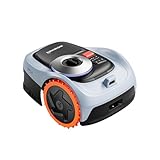
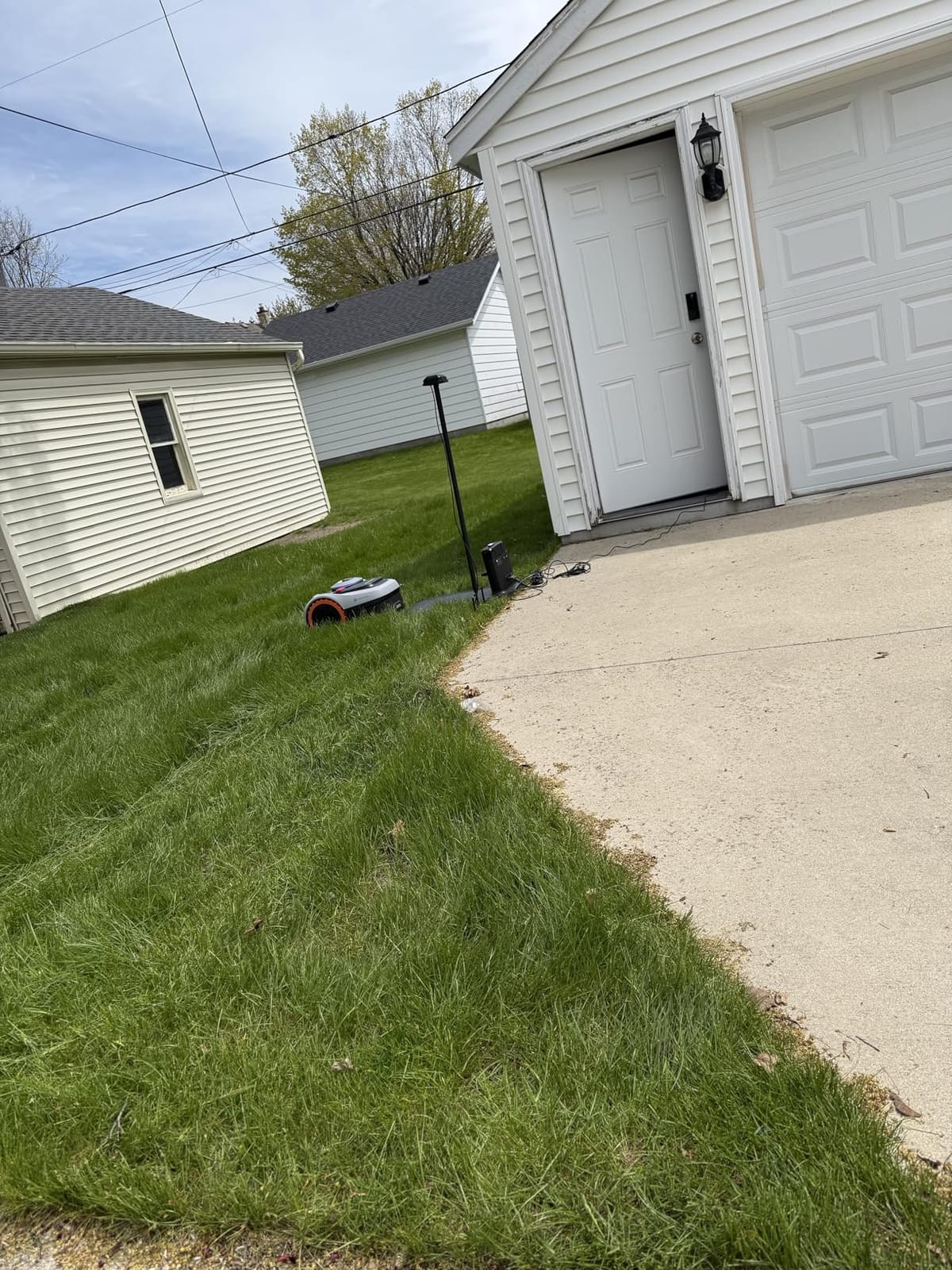
The Navimow i206 AWD handles slopes up to 45 percent with all-wheel drive and automotive-grade stability control, which is an unusual amount of chassis engineering in this class. The stability system is what keeps it tracking a side-hill line instead of sliding.
Its most practical feature on uneven ground is zero-turn steering. The mower pivots on the spot rather than driving an arc, which eliminates the wide scuffed turns that cause turf damage on a slope, and it means narrow passages stay navigable.
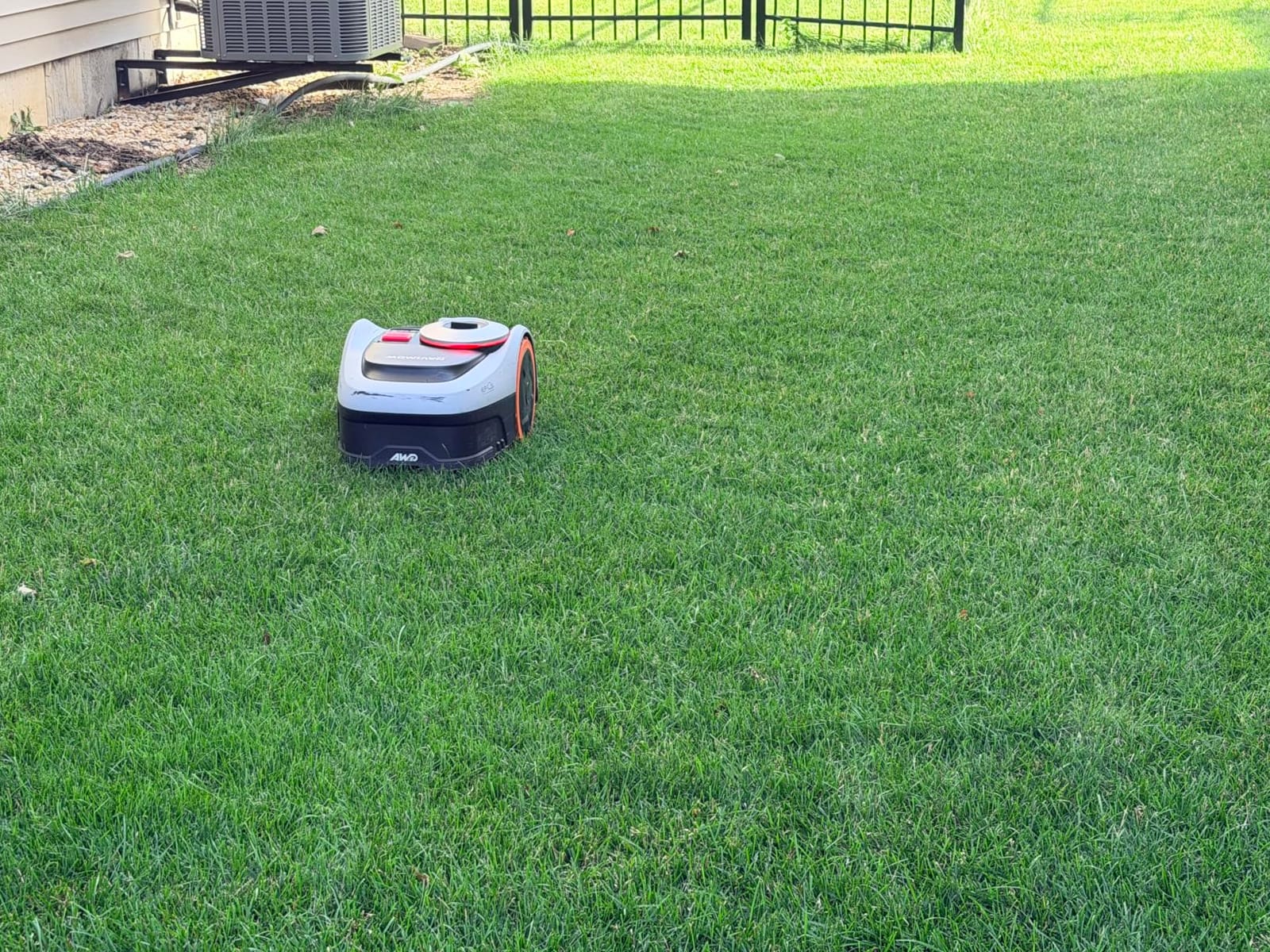
Despite the 17 inch cutting width, the coverage is small at 0.15 acre, with roughly 1350 sq.ft per charge from a 2.5Ah battery. That figure makes it a small-yard machine, and it is the reason this sits at number six despite solid slope capability.
EFLS network RTK with vision handles one-tap auto-mapping, and up to 20 mowing zones with optimised routes plus auto-resume charging keep the schedule running unattended. Intelligent torque adaptation is listed for thick grass and inclines, adjusting output as load increases on the climb.
Cutting height adjusts from 2 inch to 3.6 inch across seven positions on a 7.1 inch deck. Real-time GPS alerts cover both theft and lift detection, which is useful if you plan to leave the machine out overnight.
Why it suits a small steep yard
This is a strong choice for a compact lot under a quarter acre with one pronounced hill, especially where the mower will be operating between beds or walls. Zero-turn steering handles tight geometry better than the skid-steer machines at this size.
Customer service is the most consistently praised element in owner feedback, with free replacement parts reported repeatedly. On a small yard where a single failed component would stop the whole install, that support matters more than a spec sheet line.
Where it falls short
Auto-mapping reliability is the main problem. Several owners report it failing and requiring manual mapping, which is a slow afternoon on a complex hillside. Others report the mower wandering into mapped no-go areas such as mulch beds.
Map management is also fragile, with some owners reporting that lifting the mower deletes the entire stored map. The 33.5 inch by 24 inch footprint is large for a 0.15 acre machine, and the limited per-charge area means more dock returns on a bigger property.
7. MOVA LiDAX Ultra 1000: Best for Edge Cutting on Tight Borders
MOVA LiDAX Ultra 1000 Robot Lawn Mower Wire Free for 1/4 Acre, RTK-Free+360° 3D LiDAR+AI Vision Auto Mapping, Zero-Edge Cutting, Cutting Height 1.2″-3.9″, 45% Slope, Up to 150 Managed Zones Dual Maps
45% slope
RTK-free 360 degree 3D LiDAR
Cuts within 2 inches of edges
Up to 150 zones
Pros
- No RTK antenna or boundary wire required
- UltraTrim cuts within 2 inches of edges
- Handles 45 percent slopes and 1.6 inch obstacles
- Up to 150 managed zones with dual maps
- 3-year manufacturer warranty
Cons
- Bulky at 34 inches long and 30 lbs heavy
- Only 74 reviews
- About 60 minutes of battery per charge
- RTK-free navigation can struggle under dense canopy
The LiDAX Ultra 1000 is RTK-free, using 360 degree 3D LiDAR with AI vision for auto-mapping. That removes both the boundary wire and the antenna, which on a hillside is arguably the most valuable feature on the spec sheet, because it eliminates the two installation steps most likely to fail on graded ground.
Edge cutting is its differentiator. UltraTrim 1.0 gets within 2 inches of edges, and a movable disc handles flush borders where the mower can run its cutting deck right up to a wall or kerb. For a terraced sloped yard with hard borders, that removes most of your string trimming.
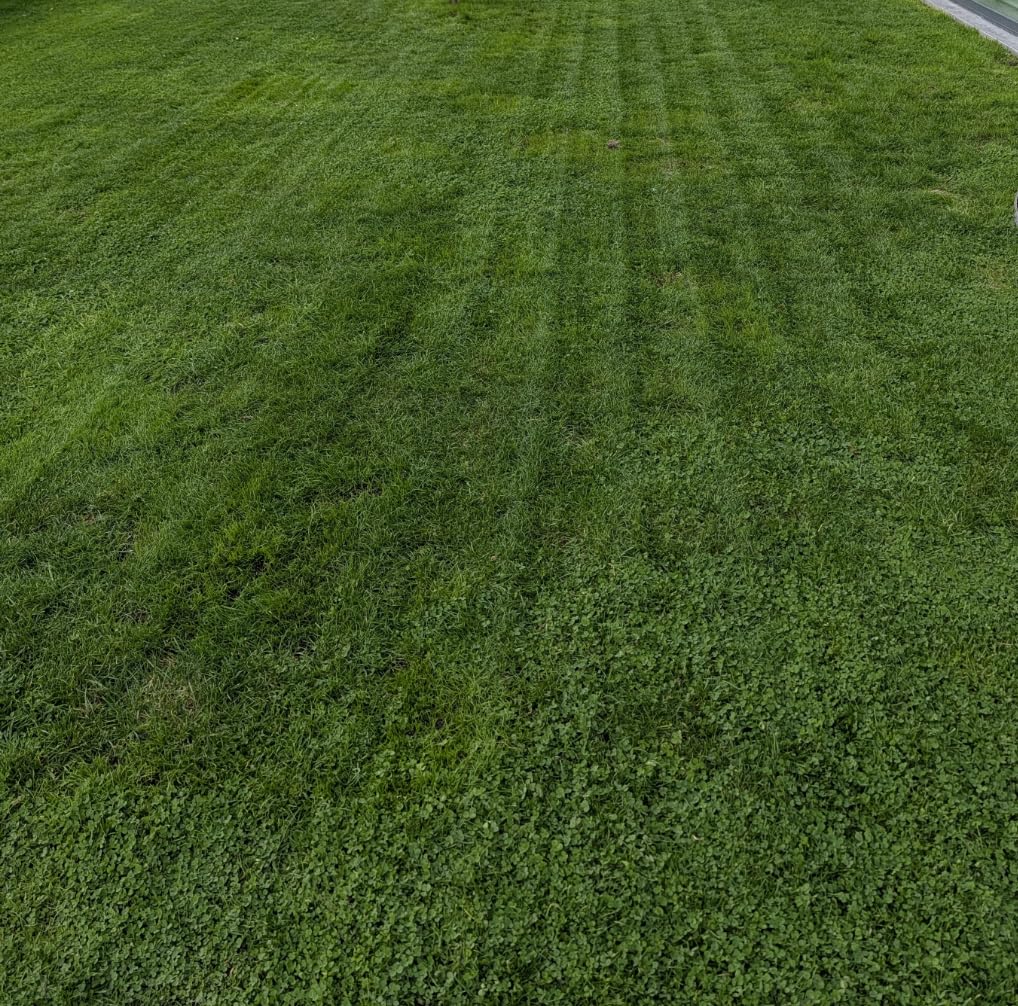
Obstacle avoidance uses a 3D point cloud with AI vision and covers 300 plus obstacle types, and the machine handles 45 percent slopes plus 1.6 inch obstacles. Rear-wheel drive with off-road wheels provides the traction for moderate grades.
Zone management is the standout number at up to 150 managed zones, and dual maps let you run separate front and back areas or two distinct lawn shapes. Cutting height adjusts from 1.2 inch to 3.9 inch through the app, and U-shaped path planning is a sensible pattern on irregular borders.
The warranty is listed at three years with 24/7 after-sales service, and anti-theft protection with real-time tracking is included rather than sold as an add-on.
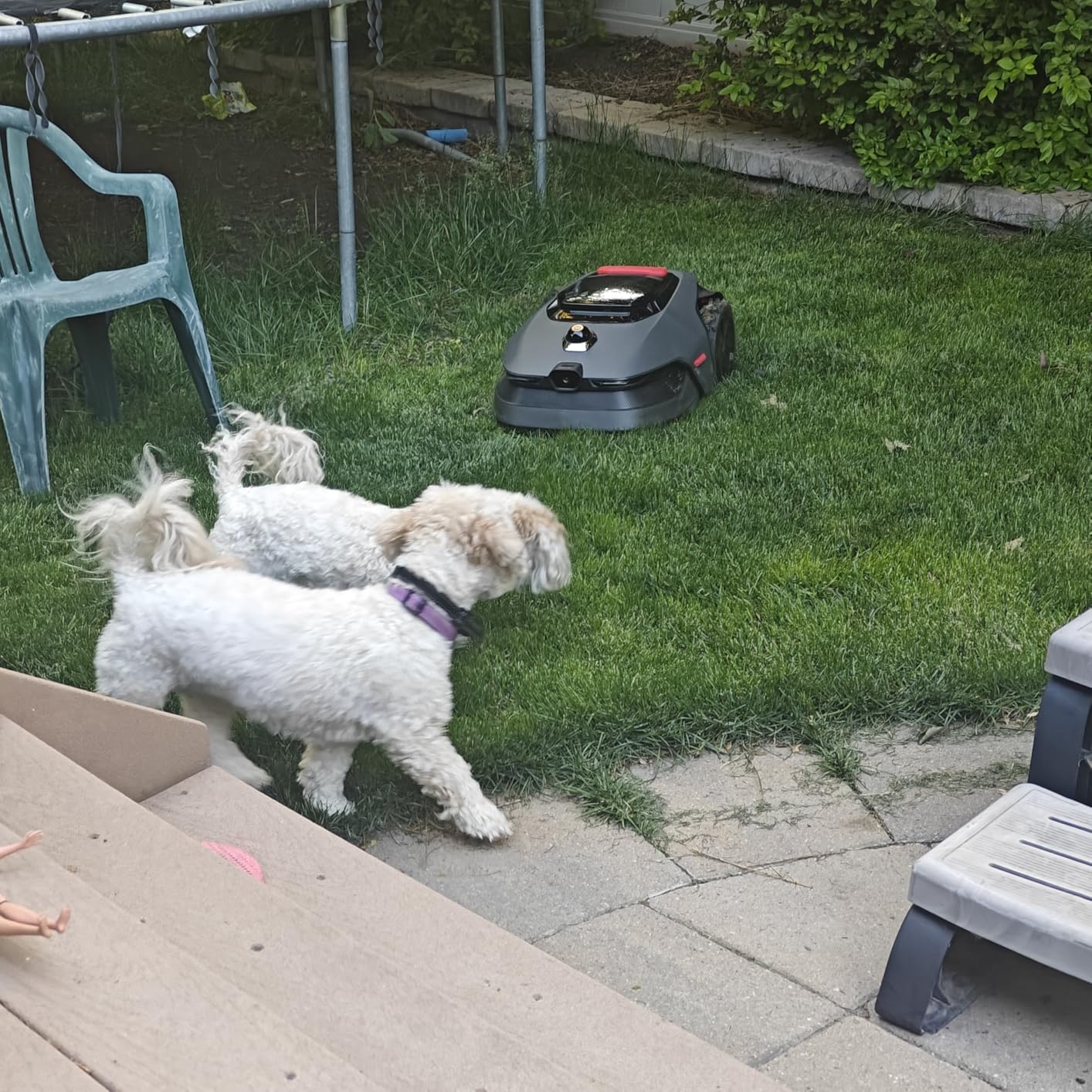
Why it fits terraced and bordered yards
Hard boundaries and level changes are where wired systems struggle most. Since this machine maps by LiDAR alone, a retaining wall, a kerb, or a split-level terrace can be recorded as an edge without running cable across the grade.
It also handles 1.6 inch obstacles, which covers uneven ground and light debris that would stall a lower-clearance machine mid-slope. For a quarter-acre yard with a moderate hill, the feature set here is unusually complete.
Where it falls short
Size is the practical drawback. At 34 inches long and 30 pounds, it is the heaviest machine in this roundup, and that bulk is awkward on a narrow side passage or a steep access route from the dock.
Owners also note that RTK-free navigation can struggle under dense tree canopy, which is the trade-off for skipping the antenna. With 74 reviews there is limited long-term data, and battery life sits at about 60 minutes per charge.
8. Sunseeker X5 AWD: Built for Wooded Yards with Patchy Signal
Sunseeker X5 AWD Robot Lawn Mower, RTK, Vision AI, 0.5 Acre, Wire-Free
30 degrees or 60% slope
RTK plus Vision AI plus V-SLAM
0.5 acre coverage
26 lbs
Pros
- Navigation keeps working under trees and in shade
- AWD rated for 30 degrees or 60 percent
- Handles passages as narrow as 31.5 inches
- Quiet at 60dB with 2-year US-backed warranty
- Creates very straight stripe patterns
Cons
- Only 29 reviews
- Can get stuck on small bumps and transitions
- Mapping is challenging on complex yards
- May need WiFi extenders on large properties
The Sunseeker X5 AWD is the pick when your sloped yard is wooded, because its navigation is explicitly built for that case. RTK, Vision AI, and V-SLAM work together, which is the standard answer to GPS signal loss under a tree canopy, the single most common complaint in owner communities about robotic mowers.
Its slope rating is 60 percent, or 30 degrees, driven by an all-terrain AWD system with rugged tires and independent front suspension. Independent suspension matters more than buyers expect, since it is what keeps the deck level and the wheels loaded on a broken grade.
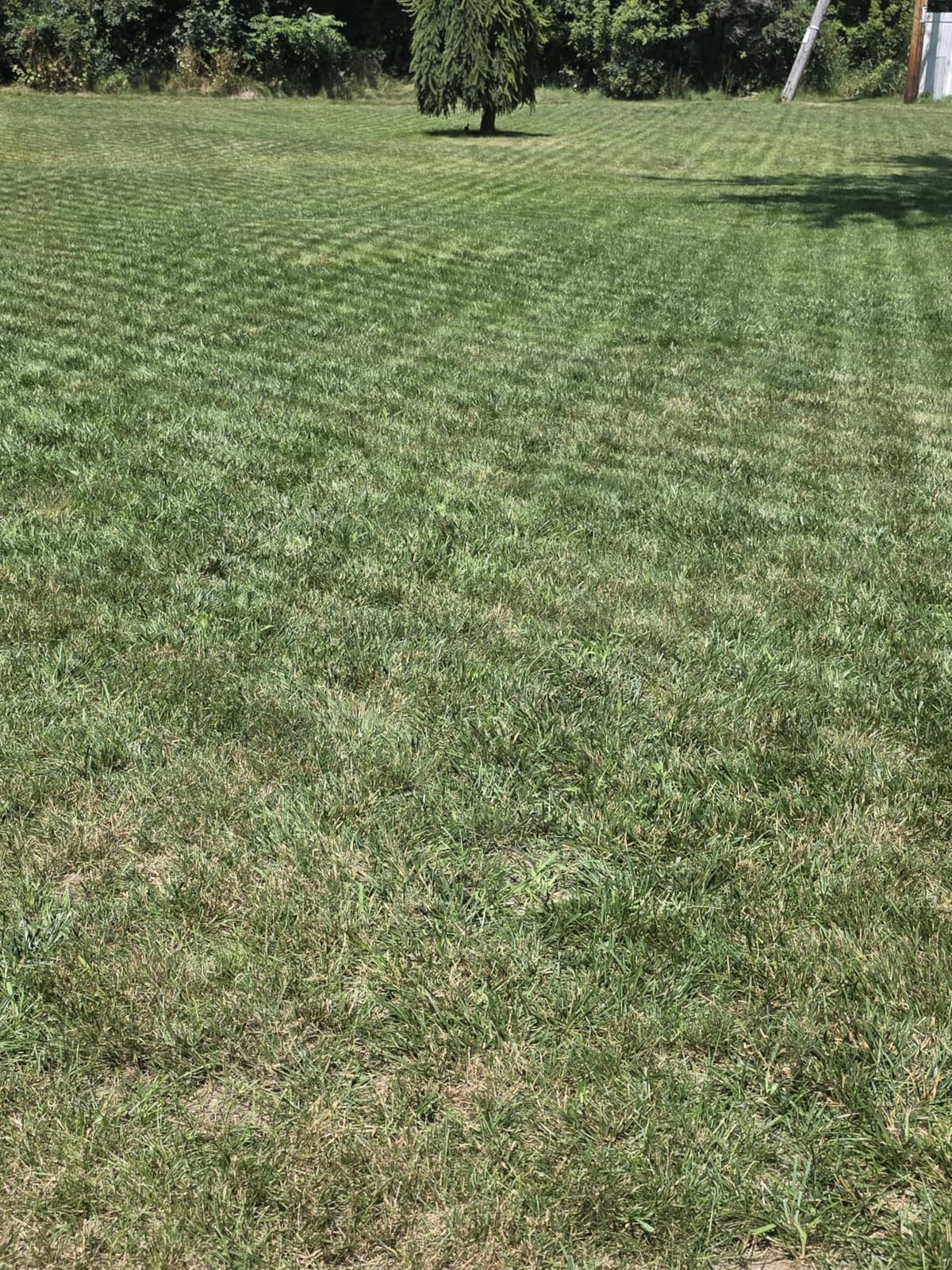
Coverage is 0.5 acre, or 21780 sq.ft, and the machine handles passages as narrow as 31.5 inches, which is useful on a slope divided by terraces or a walkway. Wire-free mapping supports up to 5 maps with smart zones and no-go areas.
The 8.7 inch floating cut deck adjusts from 1.6 inch to 3.2 inch, and floating deck design is a genuine advantage on uneven ground because the deck follows the terrain instead of scalping high spots. Operating noise is listed at 60dB, and the machine weighs 26 pounds.
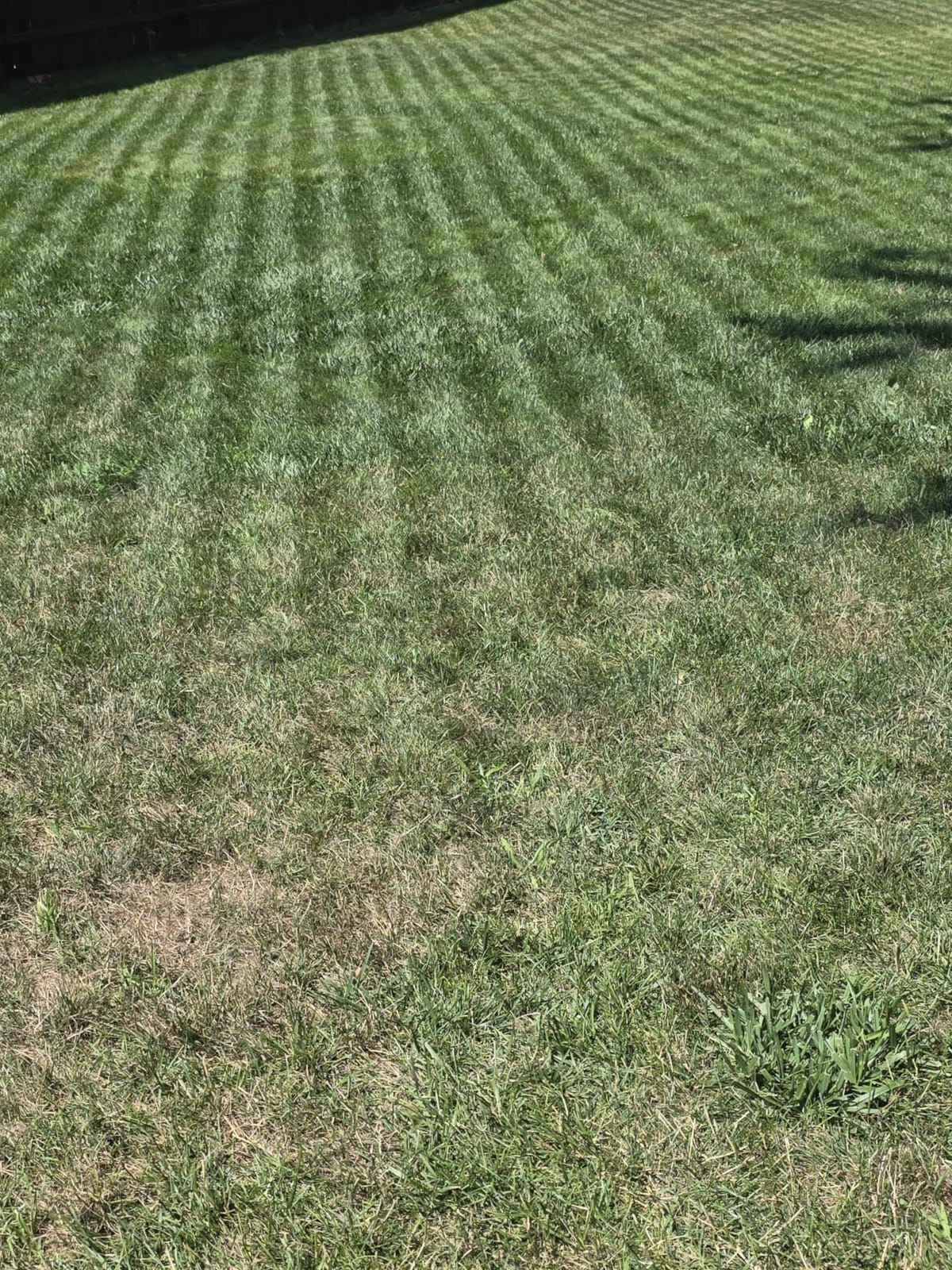
Owners consistently mention the stripe quality as the standout result. Straight, consistent lines across a slope are hard to achieve with a machine that drifts, and reviewers report the X5 holding its line.
Why it suits a wooded sloped property
If your yard has mature canopy over part of the hill, this is the navigation stack you want. Vision AI with V-SLAM keeps position when the satellite signal drops, so the mower does not stop and re-acquire in the middle of a grade where it is least stable.
The 2-year warranty with US-based local support is also a differentiator among the newer brands in this list. For a machine installed on difficult terrain, having a reachable service option is worth checking before purchase.
Where it falls short
At 29 reviews, the long-term reliability picture is thin. Some users report getting stuck on small bumps and elevation transitions, which is exactly the failure mode to watch for on a rough hillside.
Mapping is described as challenging for complex yards, and larger properties may need WiFi extenders to keep the dock online. Owners also report early returns to dock in low light and an app that some find difficult to program.
9. ECOVACS Goat O1000 RTK: Fastest Setup for Smaller Yards
ECOVACS Goat O1000 RTK Robot Lawn Mower, Wire-Free Robotic Lawnmower for Up to 1/4 Acre, RTK + Vision Navigation, Auto Mapping, TruEdge Edge Cutting, AIVI 3D Obstacle Avoidance, APP Control
45% slope (24 degrees)
LiDAR-enhanced RTK auto-mapping
TruEdge edge cutting
Up to 1/4 acre
Pros
- Auto-maps in about 5 minutes
- Lightest machine here at 23.6 lbs
- TruEdge handles edging well
- App scheduling with no-go areas
- 45 percent slope with RTK plus vision stability
Cons
- Included RTK pole is too short for many yards
- Not practical for night mowing
- Rear wheel tread tears wet or soft ground
- Needs strong outdoor WiFi
The ECOVACS Goat O1000 RTK is the fastest machine here to get running, auto-mapping in roughly 5 minutes. On a hilly yard where mapping a complex boundary by hand is the hardest part of installation, that speed is worth real money in setup time.
Navigation combines RTK, vision, and 3D time-of-flight sensing for centimetre-level positioning, and the machine climbs slopes up to 45 percent, or 24 degrees. Coverage is up to a quarter acre, or 10890 sq.ft, with cutting height from 1.2 inch to 3.2 inch.
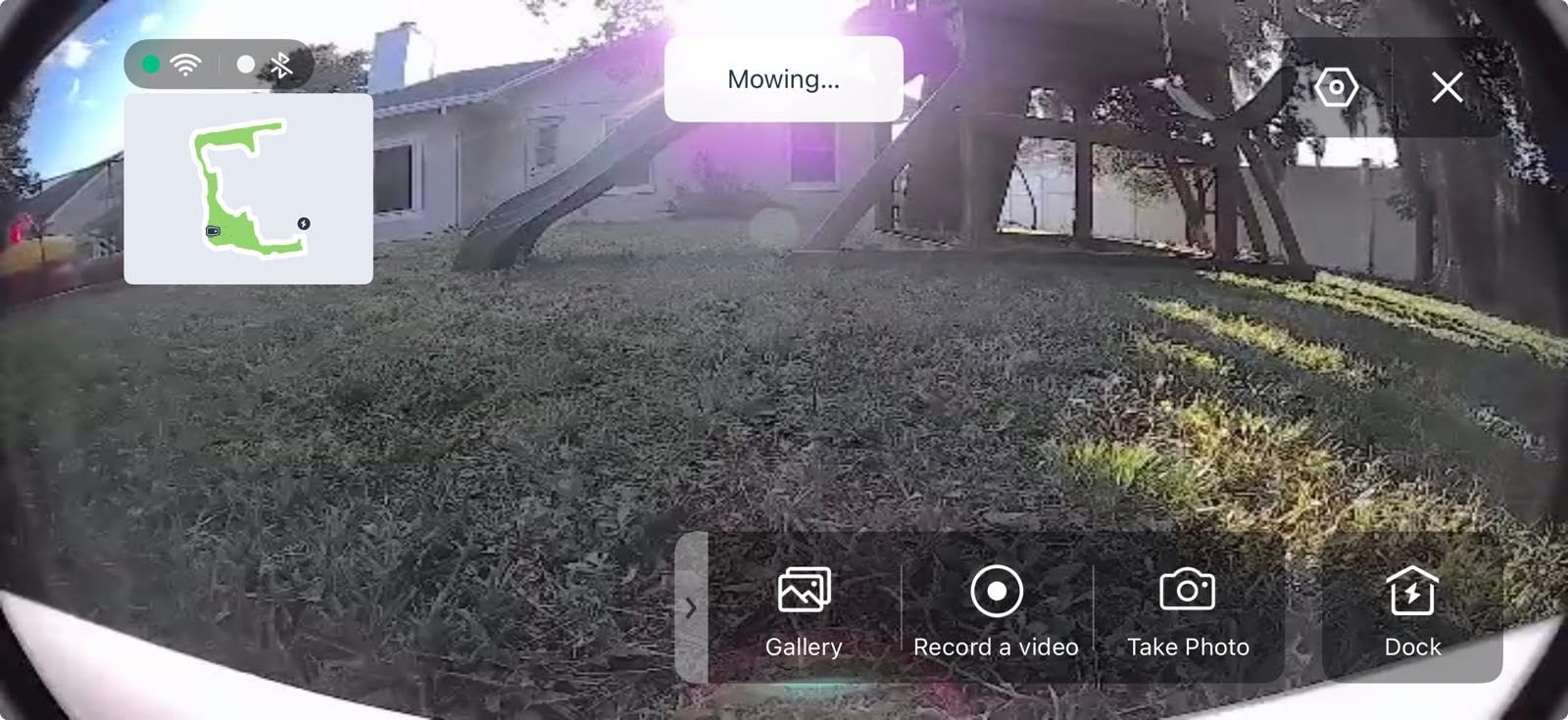
TruEdge technology handles the boundary cut, and AIVI 3D obstacle avoidance detects furniture, toys, trees, and pets. Narrow passages of 2.3 ft or wider are navigable, which is useful where a slope is divided by a path or a bed.
At 23.6 pounds this is the lightest machine in the roundup, which matters when you are carrying it up steps to reach a dock location on an elevated terrace. The app supports multi-zone, no-go areas, scheduling, and real-time monitoring.
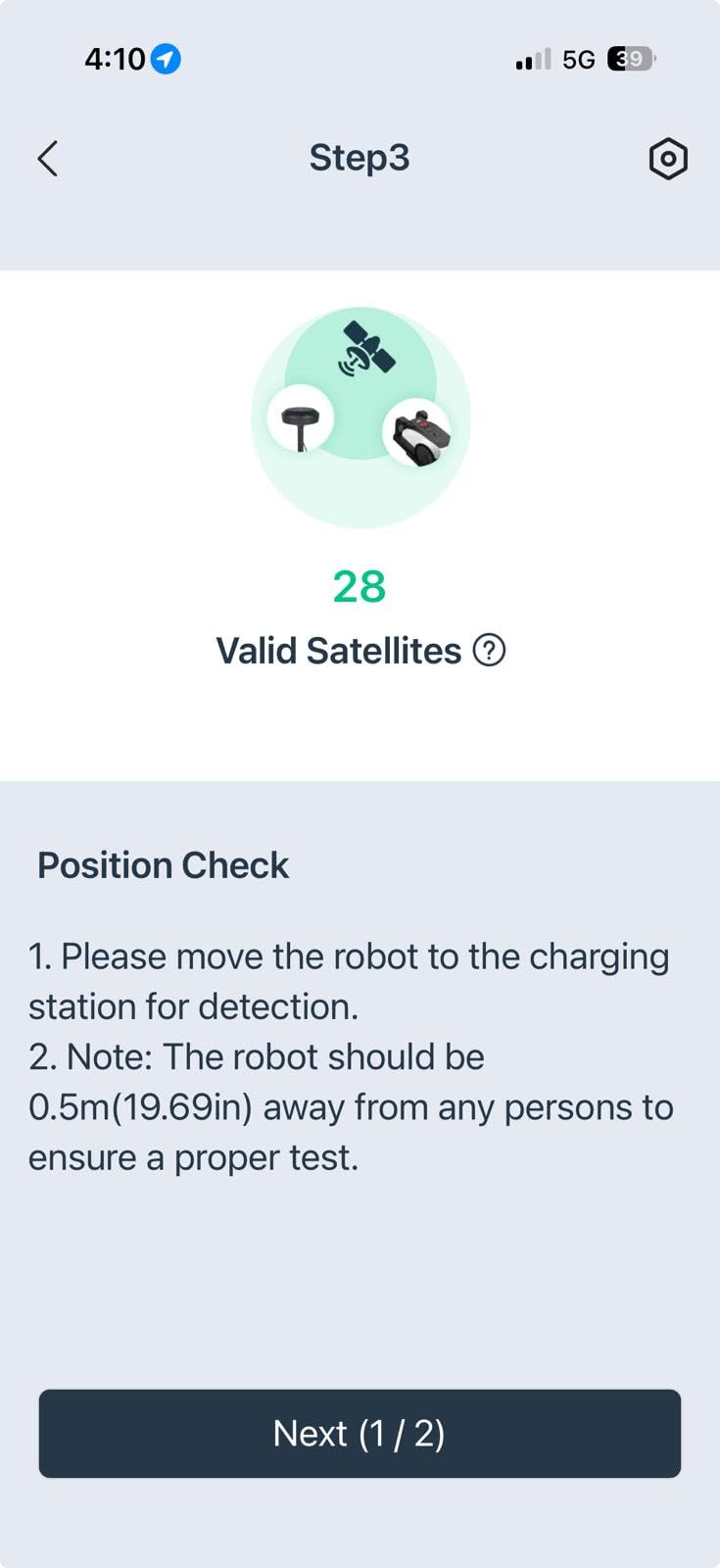
The most common owner criticism is about the included RTK antenna pole, which several reviewers report being too short for their yard and needing 6 to 7 ft of elevation to hold a reliable signal.
Why it suits a moderate hill and a busy schedule
If your grade sits in the 45 percent bracket and your yard is under a quarter acre, the Goat covers the requirement without a premium drive system. That combination of speed and adequate capability is why it suits households that want installation finished in an afternoon.
Owners also report good performance on thick grass, which matters on slopes where grass grows faster in the low areas and holds moisture longer after rain.
Where it falls short
Night mowing is not practical with this machine, since RTK needs a clear sky view. Some owners also report that the edge cutting behaviour involves a trade-off between cutting aggressively enough to reach the border and crossing the boundary or catching on edges.
Rear wheel tread is reported to tear wet or soft ground, which is a genuine concern on a slope after rain. The rain delay default is also shorter than some owners want for damp turf, and strong outdoor WiFi is required.
10. Roborock RockNeo Q110H: Budget Pick with Class-Leading Battery Life
Roborock RockNeo Q110H Robot Lawn Mower, Wire-Free Robotic Lawn Mower with Full-Band RTK + VSLAM Navigation, Auto Mapping, AI Vision Obstacle Avoidance, App Control, 45% Slope, Covers Up to 1/4 Acre
45% slope
Full-band RTK plus V-SLAM
130 minute battery
Up to 1/4 acre
Pros
- 130 minutes of battery life
- best in this group
- Full-band RTK with V-SLAM holds position under trees
- Quiet with headlights for night mowing
- Floating cutting deck adapts to contours
Cons
- Auto-mapping is unreliable and needs manual mapping
- Leaves 1 to 1.5 ft of grass along boundaries
- Lift detection triggers falsely on bumps
- Only 35 reviews
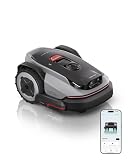
The RockNeo Q110H is the lowest-cost machine here and the one with the longest battery life at 130 minutes. For a hilly yard, runtime matters more than on flat ground, because climbing burns power faster than driving level, so a long cycle means fewer interrupted climbs.
Full-band RTK paired with V-SLAM visual navigation maintains position under dense trees, near fences, and in shaded corners. That is the correct hardware response to the signal loss that stops GPS-only mowers on wooded hillsides.
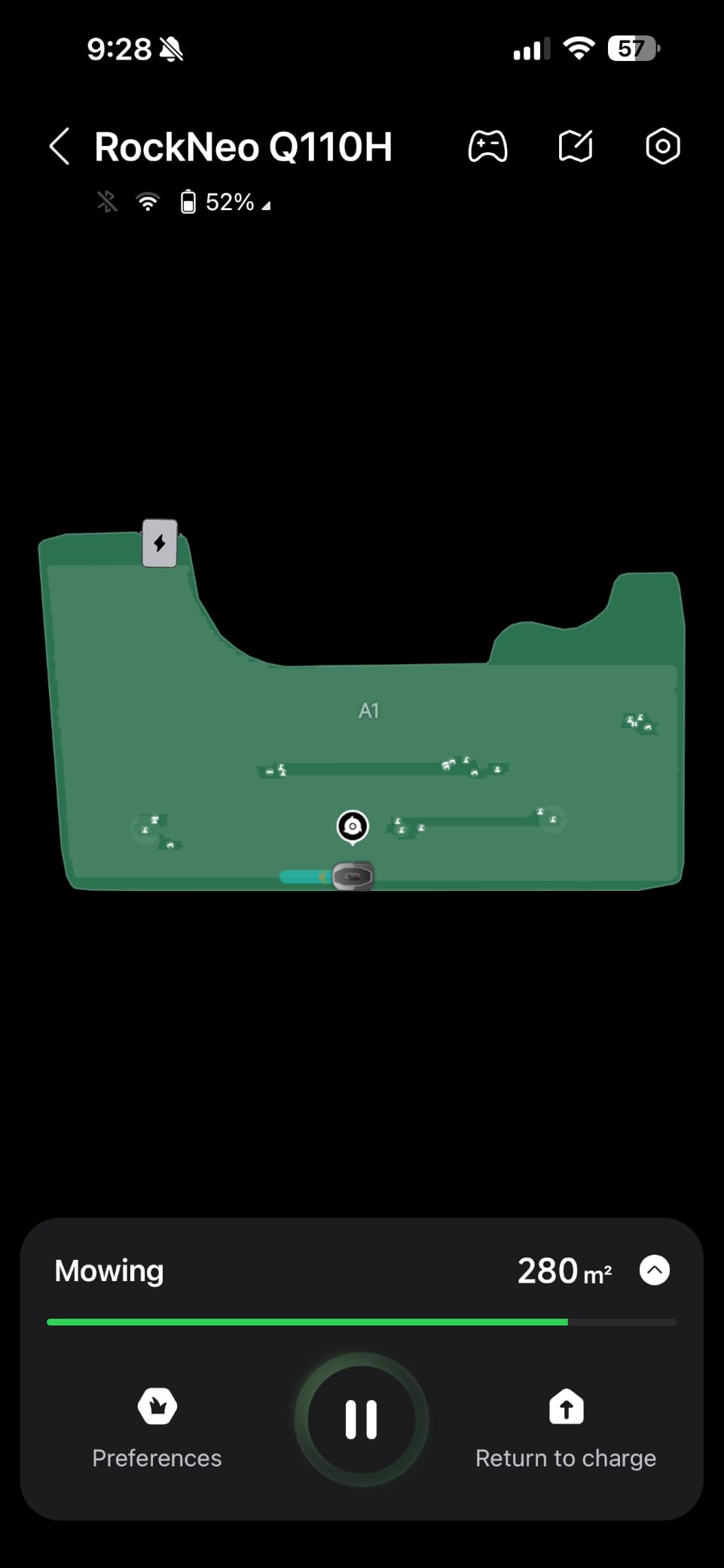
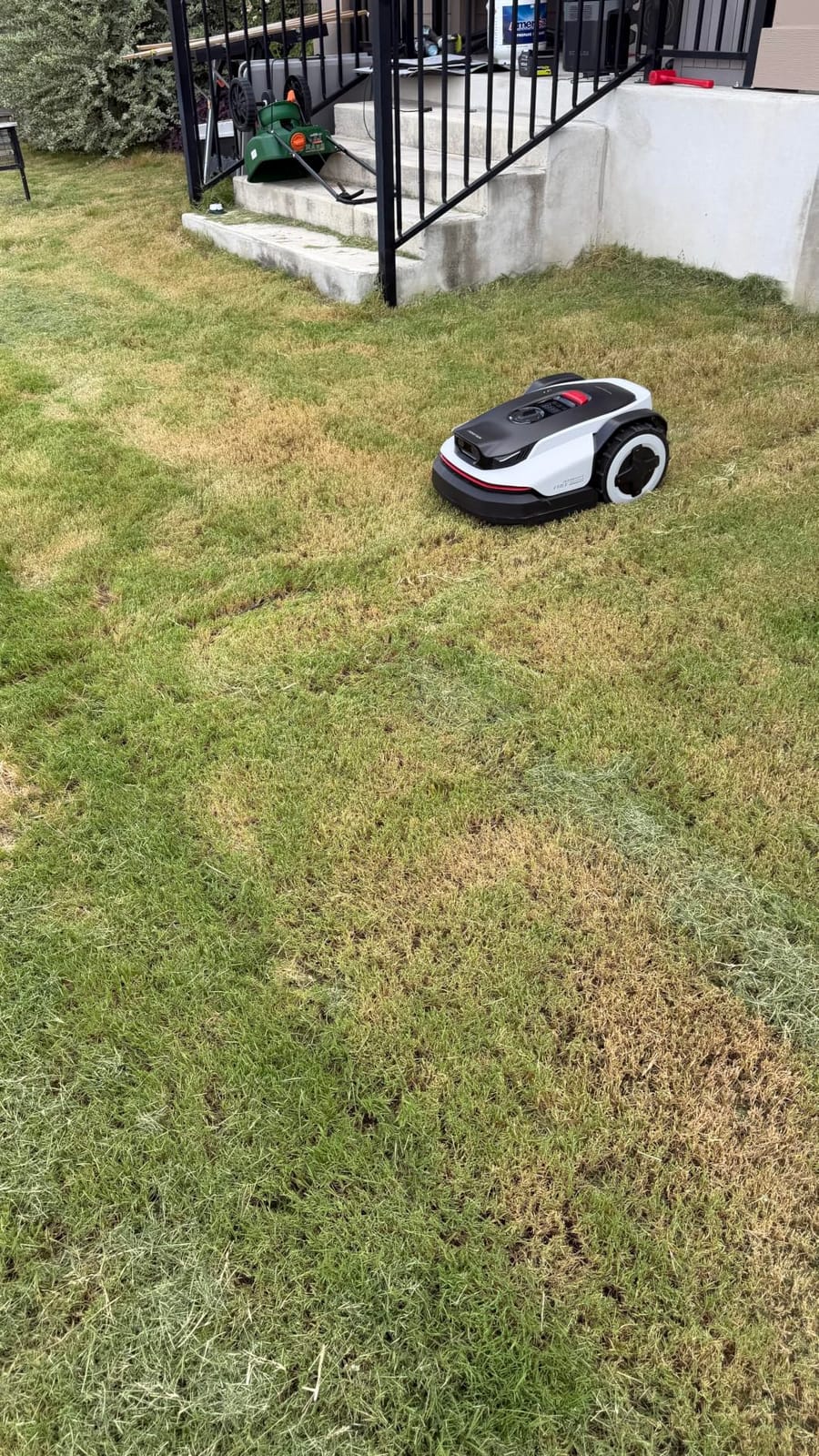
Large-diameter wheels handle 45 percent slopes and 1.57 inch obstacles, and the floating cutting deck adapts to ground contours, which is a sensible pairing with the uneven-terrain problem. Narrow passages as slim as 2.3 ft are navigable.
Stereo vision AI understands obstacles and bypasses furniture, toys, and people, and the app includes multi-zone scheduling, a real-time dashboard, and a wildlife-friendly mode. PIN lockout with a high-decibel alarm is standard, with 4G anti-theft sold separately.
The lighting is a genuine advantage here. Headlights are included for night mowing, which is rare at this price point and useful if your schedule only fits after dark.
Why it suits a simple yard on a budget
If your slope measures around 45 percent, your yard is under a quarter acre, and you are willing to do manual mapping in the app, this machine covers the requirement and leaves money in your pocket. Manual mapping is genuinely tedious on a complex boundary, though.
The Roborock app is a familiar interface, which helps if you already own other Roborock devices, and the 130-minute cycle reduces the number of dock returns on a slope.
Where it falls short
Edge cutting is the biggest functional gap. Owners report 1 to 1.5 ft of unmowed grass along boundaries, and the optional 1.2 inch edging module is not available in the US. Boundary detection is also described as overly conservative.
Auto-mapping does not work reliably and requires manual work, map editing requires physically walking the robot, and there is no partial zone mowing. Lift detection can trigger falsely on bumps, which matters if your hill has any unevenness, and owners report weak traction on St. Augustine grass.
What Slope Rating Do You Actually Need?
The maximum slope most residential robot mowers handle is 45 percent, or 24.2 degrees. Machines purpose-built for hills go further: the four AWD models here claim 80 percent and the WORX WR342 claims 84 percent. Match the number to your measurement, then add margin for wet grass and side-hill traverses.
Here is how we translate the bands into yard descriptors rather than raw percentages. A gentle incline falls between 10 and 25 percent and needs nothing special. A moderate hill sits at 25 to 45 percent, which is where the four 45 percent-rated machines become relevant. A serious grade runs from 45 to 70 percent and needs AWD. Above 70 percent you are in tracked or four-wheel-drive territory.
Use the conversion table above to move between units. Remember that the same physical slope described as a percentage and as degrees differs, and that 100 percent is the mathematical ceiling of a 45 degree pitch.
Drive System: 2WD vs AWD vs Tracked
Two-wheel drive is the budget default and it gives up around 20 to 25 percent grade. Owners consistently confirm that cheaper two-wheel-drive mowers lose traction above that mark, which matches what the drive layout predicts: two contact patches cannot distribute torque uphill without spinning.
All-wheel drive gives each wheel torque and distributes load across four contact patches, which is what lets the LUBA and Navimow models hold a climb. It is the sensible default for anything past a moderate hill, and it is what most of this roundup uses.
Four-wheel drive with a terrain-adaptive chassis and true front-wheel steering, as on the WORX WR342, adds a second layer. It keeps all four wheels planted on broken ground and pivots in place rather than skidding, which matters on side-hill traverses where a conventional turn can shear turf.
Tracked drive pushes further still, spreading weight over a contact patch that resists slipping. None of the ten machines here use tracks, so if your measurement exceeds 84 percent, you are shopping outside this roundup entirely.
Navigation on Hills: RTK, LiDAR and V-SLAM
RTK GPS gives centimetre-level accuracy in open sky and is the most precise option on a clear, unobstructed property. The weakness is tree canopy. Owners report mowers stopping, wandering, or failing to return to the dock as leaf cover grows, which is a recurring failure mode in wooded yards.
LiDAR builds a map by scanning the environment rather than triangulating from satellites. It works regardless of sky visibility and handles edges, walls, and hard borders well, which is why the MOVA LiDAX and the LUBA mini 2 use it.
V-SLAM uses onboard cameras and visual odometry to track position by comparing frames. On its own it drifts, so it appears alongside RTK as a fallback. The Sunseeker X5 and the Roborock RockNeo both pair RTK with V-SLAM, and that fusion is the standard answer to patchy signal.
For a sloped yard with mixed conditions, a machine combining at least two of these three is the right target. The LUBA 3 AWD runs all three at once, and that redundancy is why it holds position on a hill that stalls single-system rivals.
Wire-Free vs Boundary Wire on Graded Ground
Boundary wire is the traditional method and it is genuinely harder to install on a slope. Staking cable across a grade puts tension on the run, and the wire stretches, sags, or breaks at the transition points where the grade changes. Every break becomes a persistent failure point that needs finding and splicing.
Wire-free mapping removes that work entirely. You walk the boundary or let the mower map it, and there is nothing physical to break. On flat ground the difference is minor. On a hillside with multiple terraces, it is often the deciding factor.
The trade-off is signal dependence. Wire-free systems that rely purely on GPS need sky visibility, which wooded hillsides restrict. LiDAR-based wire-free machines such as the MOVA LiDAX Ultra 1000 avoid that problem, and they are the right pick for a treed property.
Uneven, Bumpy and Rut-Prone Lawns
For a bumpy lawn, five specs do most of the work. Deep-tread or large-diameter wheels for grip on soft ground. Independent or adaptive suspension so the deck follows contours rather than scalping. A floating cutting deck that rises over rises instead of cutting into them. Multi-zone mapping so you can vary cut height by area. And reliable obstacle detection for the roots, rocks, and branches that cause a mower to stop and strand itself.
Rutting is the failure owners describe most often, and the mechanism is worth understanding. A mower works the same hill repeatedly, wheels sink slightly each pass, and the resulting channel grows until the machine cannot climb out. Wide tires, all-wheel drive, and low cut height on the slope all slow the process, but no machine eliminates it.
One practical habit helps: mow the slope less frequently than the flat sections. Twice-weekly cutting on flat ground and every few days on the hill keeps the grass long enough to hold the soil together without doubling the work.
Real Owner Failure Modes on Hills
Charging failures show up disproportionately on sloped installs, because a dock that is not level is hard to enter reliably. Site your dock on the flattest part of the property even if it means running cable further, and check the approach angle before you commit.
GPS signal loss under tree canopy causes mowers to stop mid-route and fail to return to the dock. This is why the LUBA mini 2, Sunseeker X5, and Roborock RockNeo all carry LiDAR or V-SLAM backup rather than relying on satellites alone.
Blade motor overheating in afternoon heat is reported by owners, and the symptom is distinctive: the mower keeps driving with the blades off, leaving long uncut stripes through an otherwise finished lawn. Scheduling the hill for early morning sidesteps it.
Boundary wire breaking at grade transitions is the most common complaint about wired installations on hills, and it is the strongest argument for going wire-free if your property has real elevation changes. App instability and slow support responses are also repeated themes across newer brands.
When You Should Skip a Robot Mower
Some yards are simply too steep for any residential robot mower, and the honest answer is better than a purchase you regret. If your steepest measurement exceeds 84 percent, nothing in this roundup will serve you properly, and a tracked commercial-class machine is the correct category.
If your yard is very small and steep, a robot mower may not be worth it. Owners of compact sloped yards note that a push mower can finish the job faster than the machine spends time navigating, docking, and charging. The economics only work when the mowing time you are replacing is genuinely painful.
Skip it too if you have heavy clay soil that holds water, since the combination of a heavy machine and soft ground produces rutting no amount of traction solves. And if you need night mowing in a yard with heavy tree cover, an RTK-only machine will not deliver it.
Frequently Asked Questions
What is the maximum slope a robot lawn mower can handle?
Most residential robot mowers are rated to 45 percent, or 24.2 degrees. Purpose-built hillside models with all-wheel drive reach 80 percent (38.6 degrees), and four-wheel-drive machines reach 84 percent, roughly 40 degrees. Tracked commercial machines go further. On wet grass or a side-hill traverse, expect real-world performance a grade below the published figure.
Do robot lawn mowers work on hills?
Yes, but only with the right drive system. Two-wheel-drive mowers lose traction above roughly 20 to 25 percent grade. For anything steeper you need all-wheel drive, four-wheel drive, or tracks, plus a slope rating that exceeds your measured grade with margin for wet conditions.
Why does my robot mower get stuck on hills?
The usual causes are insufficient drive torque for the grade, narrow tire contact patches, and repeated passes that rut the turf deeper each time. A mower rated 45 percent may struggle on a wet hillside because published figures are measured on dry, firm ground. Matching the drive system and slope rating to your measured grade resolves most cases.
How do I measure the slope of my yard?
Divide the vertical rise in feet by the horizontal run in feet, then multiply by 100 for a grade percentage. A 3 foot rise over a 10 foot run equals 30 percent. Measure the steepest several spots including side-hill traverses, and confirm with a clinometer app on your phone.
What is the best mower for a steep slope?
For residential grades up to about 40 degrees, the Mammotion LUBA 2 AWD 5000HX and the Mammotion LUBA mini 2 AWD 1500H both deliver an 80 percent rating with all-wheel drive. The LUBA 2 suits larger properties and the mini 2 suits small steep yards. For the most severe residential grades, the WORX WR342 4WD is rated to 84 percent.
Is a robot lawn mower worth it on a sloped yard?
The case is strongest on larger properties and steep lawns where manual mowing is genuinely difficult. On a small steep yard, a robot may take longer than a push mower because of navigating, docking, and charging. Compare the machine against recurring landscaping visits on your slope before deciding.
The Bottom Line
For most sloped yards, the Mammotion LUBA 2 AWD 5000HX is the best robotic lawn mower for sloped yards you can buy today. Its 80 percent rating, four driven wheels, RTK plus AI vision navigation, and 481 reviews make it the pick we would put on a property with a real grade.
Match the machine to the measurement rather than the marketing. Gentle and moderate slopes up to 45 percent are covered by the ANTHBOT M9, the MOVA LiDAX Ultra 1000, the ECOVACS Goat O1000 RTK, and the Roborock RockNeo. Serious grades to 70 percent need AWD. Beyond 70 percent, the WORX WR342 at 84 percent is the ceiling of this roundup.
Measure first, buy second, and leave the steepest section for the first week of testing.