
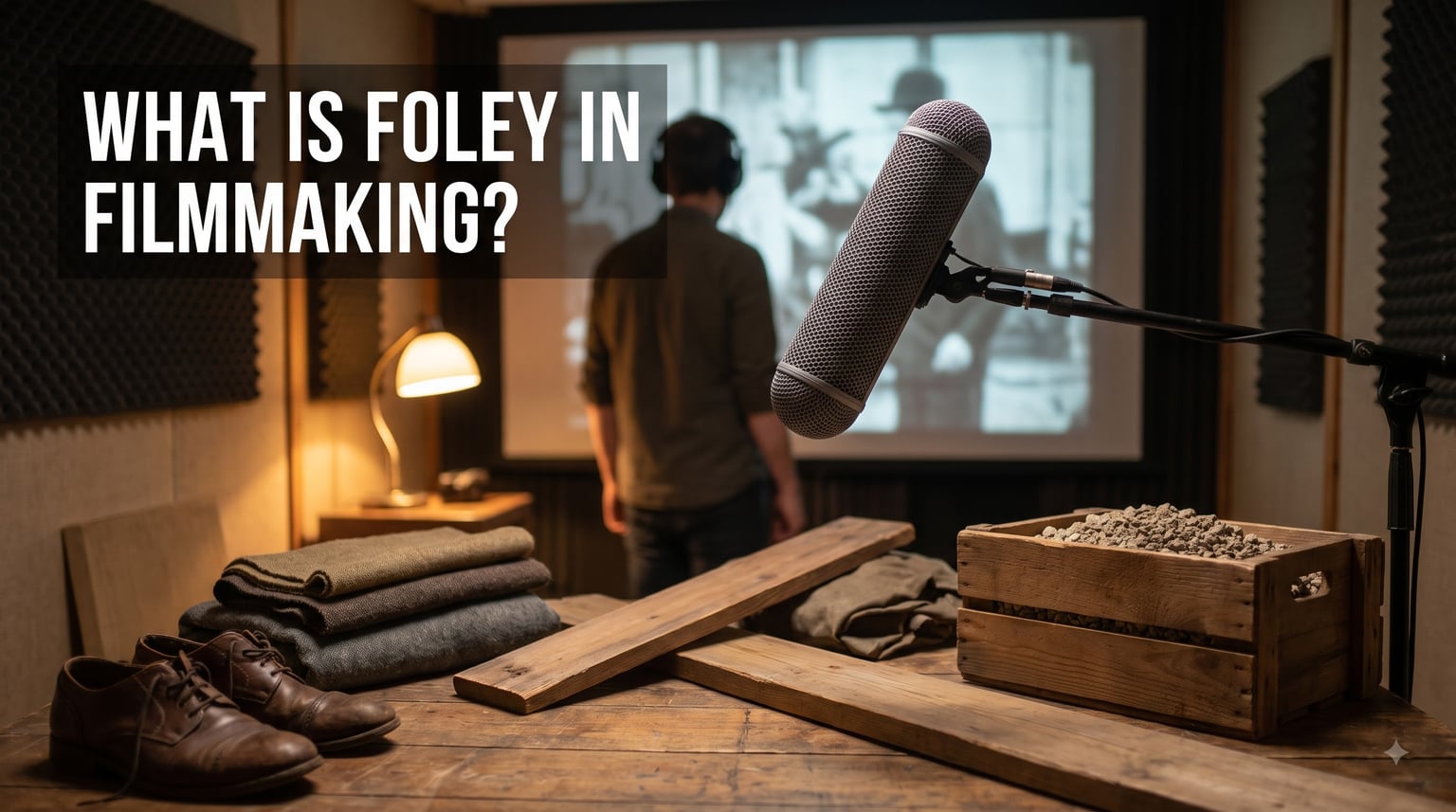
What is foley in filmmaking? It is the reproduction of everyday sound effects (footsteps, clothing rustles, door closings, glass breaking) created by artists in a studio during post-production to enhance a film’s audio realism. The technique is named after Jack Donovan Foley, the sound-effects pioneer who developed it at Universal Studios in the late 1920s. Today, foley remains essential to virtually every feature film, television show, animation, and short you watch.
I have spent time on real foley stages, watched artists perform footstep tracks and glass breaks in sync with picture, and edited the results into short films. This guide pulls together what I learned, plus what seasoned foley artists say on Reddit and in interviews, so you can understand exactly what foley is, why it exists, and how you can use it on your own productions.
Table of Contents
- What Is Foley in Filmmaking and Why Was It Invented?
- The Three Core Categories of Foley Sounds
- Why Filmmakers Still Rely on Foley Today?
- How a Foley Recording Session Actually Works?
- Foley vs Sound Effects Libraries and ADR
- Common Foley Tricks and Props That Surprise Everyone
- DIY Foley for Indie and Short Film Productions
- Famous Foley Moments in Movie History
- Frequently Asked Questions
- Final Thoughts on Foley in Filmmaking
What Is Foley in Filmmaking and Why Was It Invented?
Foley is a post-production sound technique where artists recreate everyday sounds in a studio and sync them to the picture. It fills in audio details that on-set microphones miss and replaces sounds that are too noisy, too quiet, or simply wrong for the story.
The story of foley starts with Jack Donovan Foley, who began working at Universal Studios in 1914 as a janitor in the props department. Within a decade he moved into the studio’s sound department and, in 1927, he created the very first foley effects for the transition of silent films to sound. Studios needed a way to add footsteps, cloth movement, and small prop sounds to the new soundtracks quickly and affordably. Foley solved that by performing the sounds live while the picture played back on a screen, recording the result in real time.
That basic workflow is still used today. Whether the production is a Hollywood feature, an indie short, or a video game cutscene, the principle is the same: a foley artist watches picture, performs sounds in sync, and a recordist captures everything.
The Three Core Categories of Foley Sounds
Most foley artists organize their work into three broad categories. Understanding these categories is one of the fastest ways to understand what foley actually is in practice.
1. Feet (Footsteps)
The feet category covers every footstep on screen, walking on hardwood, gravel, snow, grass, stairs, or carpet. Footsteps are arguably the most common foley element in any film because production sound rarely captures them cleanly. The artist walks on a foley surface that matches the screen surface, wearing shoes that match the on-screen shoes.
2. Moves (Body and Clothing Movement)
The moves category covers sounds the body and clothing make: a jacket swish as someone turns, fabric rubbing against a chair, a hand brushing across a table, hair flicking across a pillow. These tiny sounds are almost always added in post because they are too quiet for a boom mic to pick up cleanly.
3. Specifics (Props, Doors, Glass, and More)
The specifics category is everything else: a glass set down on a counter, a knife drawn from a drawer, a phone picked up, a cigarette lighter flicked, a sword unsheathed. This is also where bigger one-off effects live, like punches, falls, or a body hitting the floor.
Why Filmmakers Still Rely on Foley Today?
Production audio has improved dramatically with wireless lavs and digital mixers, yet foley is still standard on virtually every project. Here is why.
Boom mics miss the small stuff. A shotgun mic pointed at an actor will capture dialogue but rarely capture clothing rustle, finger taps on a steering wheel, or footsteps on a wooden floor. Foley fills in those small cues that your brain uses to feel present in a scene.
Location sound is often unusable. Crowd ambience, distant traffic, hum from lighting rigs, or air conditioning can drown out the sounds that matter. Re-recording those tiny moments in a quiet foley stage gives the final mix clean, controllable material.
Picture and sound do not always match. Sometimes an actor slides a chair in post-editing that was not slid on set. Sometimes a scene is reshot without sound. Foley lets the team add the right sound for the final cut, regardless of how the scene was originally shot.
Emotion comes from detail. The soft sound of fingers touching a photograph, the leather creak of a cop climbing into a cruiser, the wet slap of a body hitting the floor: those tiny details are what make scenes feel real instead of staged.
How a Foley Recording Session Actually Works?
Every foley session follows a fairly predictable rhythm. I have watched a half dozen of them, and the workflow rarely changes, whether the project is a feature or a short.
Step 1: Cueing and prep. The foley artist receives a cue sheet, which is a list of every moment in the film that needs foley, and a copy of the picture. The team gathers props and surfaces in advance: leather jackets, specific shoes, dirt boxes, snow boxes, glass rigs, door rigs.
Step 2: Setting up the foley stage. A foley stage is a small studio with a projection screen, a microphone, and a wide-open floor that can hold an assortment of surfaces. Most stages also have a foley pit, which is a sunken area that holds gravel, water, or other materials the artist can reach from above without kneeling.
Step 3: Performing in real time. The artist stands or sits in front of the screen, picture plays, and the artist performs the sounds while watching. Most artists work with a partner called a foley walker or second artist, so one person can perform props while the other handles footsteps or clothing.
Step 4: Recording multiple takes. A single cue might take four or five takes to land perfectly. The recordist captures everything, the editors later pick the best take, and the re-recording mixer blends the chosen performance into the final mix.
Foley vs Sound Effects Libraries and ADR
If you are new to post-production audio, it is easy to confuse foley with sound effects libraries and ADR. Here is the difference.
Foley is performed live in a studio by a human artist, recorded specifically for the picture. It is custom, tailored, and unique to that film.
Sound effects libraries are pre-recorded, ready-to-use sound files (rain, explosions, city ambience, gunshots). They come from companies like Sound Ideas, Boom Library, and the BBC Sound Effects archive. Libraries are great for things you cannot easily record: weather, large explosions, or background crowds.
ADR (Automated Dialogue Replacement) is re-recording dialogue in a studio to replace unusable production dialogue. If you have ever watched the bonus features of a film, the actor stands in front of a microphone and loops their lines to match the picture.
In a typical post-production sound workflow, all three work together. ADR handles dialogue, foley handles the subtle everyday details, and libraries handle the big environmental elements. Each one solves a different problem.
Common Foley Tricks and Props That Surprise Everyone
Part of the fun of foley is how creative the artists get. Here are some well-known tricks that have appeared in major films.
Celery snapping for bone breaks. The crisp snap of fresh celery break sounds remarkably like a small bone breaking. The film industry’s most famous example is in A Quiet Place.
Stun gun and grapes for gunshots. Holding a stun gun to a bunch of grapes produces a tight, squishy pop that reads as a bullet impact on flesh. Studios keep grapes in the foley fridge for this very reason.
Wet leather for punches. A punch thrown at a leather jacket draped over a pillow sounds heavy and wet. Combined with body movement, the result feels shockingly real.
Cornstarch on a hard surface for snow. Squeezing cornstarch underfoot on a hard floor makes a satisfying crunch that reads perfectly as snow under a boot.
A thunder sheet for thunder. A large sheet of thin metal shaken overhead creates that big cinematic rumble of rolling thunder.
Cellophane for fire. Crumpling cellophane slowly over a microphone produces the soft crackle of a small fire.
These substitutions exist because the real sound is either too quiet, too dangerous, or simply impossible to record cleanly on set. Foley is, at its core, a creative problem-solving art.
DIY Foley for Indie and Short Film Productions
If you are making a short film with a small crew and almost no budget, you can still record decent foley. I have done it on multiple shorts, and the basics are surprisingly accessible.
You need a quiet room (a closet full of clothes works, the clothes absorb echo), a decent microphone (even a USB condenser mic in a quiet space can work for practice), and a prop kit. Build your prop kit by collecting shoes in different styles, fabric swatches (silk, leather, denim), a small bag of gravel, cornstarch in a tray, a piece of hardwood, a doorknob, and a glass bottle. That little kit covers a huge percentage of the sounds most short films need.
Record your foley by importing your film’s audio and picture into any free editor like Audacity or DaVinci Resolve’s Fairlight page. Watch the picture, perform the sound as you watch, record, and trim the takes. You will be surprised how much your short’s audio lifts with even a few hours of basic foley.
Famous Foley Moments in Movie History
Some films are remembered as much for their sound as for their visuals. A Quiet Place would not work without foley; the celery breaks and rustle of grass are central to the tension. The original Star Wars trilogy is full of foley: Ben Burtt famously used a stick on a wire for lightsaber hums and thumped a leather jacket for Darth Vader’s breathing. Even animated films depend on foley: Into the Woods uses layers of cloth and prop work to make its fairy-tale world feel tactile.
If you watch any of these films with the sound muted and try to imagine what the foley artist performed, you start to understand the level of detail that goes into every scene you have ever watched.
Frequently Asked Questions
Do movies still use Foley?
Yes. Every major studio film, most television shows, animations, and video games still use foley during post-production. Modern wireless microphones have improved production sound, but foley remains the only way to capture the tiny everyday sounds (footsteps, clothing rustle, prop touches) that make scenes feel real.
What’s the difference between SFX and Foley?
SFX (sound effects) usually refers to pre-recorded, library-based sounds (explosions, weather, ambience) that are dropped into a scene. Foley is performed live in a studio by an artist who watches the picture and recreates the small, specific sounds the scene needs. Foley is custom; SFX is reusable.
What is an example of a Foley sound?
Common examples of foley sound include footsteps on different surfaces, a jacket swishing when a character turns, a glass set down on a table, a punch landing on leather, and the rustle of bedsheets. The snapping of celery for bone breaks and grapes against a stun gun for bullet hits are also well-known foley tricks.
How much does a Foley artist make?
Foley artist pay varies widely by region and project. In the United States, union foley artists working on major studio productions can earn several hundred to several thousand dollars per day. Independent and short-film foley artists typically charge much less and often supplement their income with other audio work like sound editing or mixing.
Final Thoughts on Foley in Filmmaking
What is foley in filmmaking? It is the art of recreating everyday sounds in a studio and syncing them to picture so that audiences feel present in the story. From the silent-era work of Jack Foley to today’s indie short film sets, the technique has remained almost unchanged for nearly a century, and it remains one of the most quietly important crafts in all of cinema.
If you are making your own short film, try recording even ten minutes of foley for your most important scene. You will hear the difference immediately, and you will start to appreciate every footstep and every rustle you have ever noticed in a film you loved.