
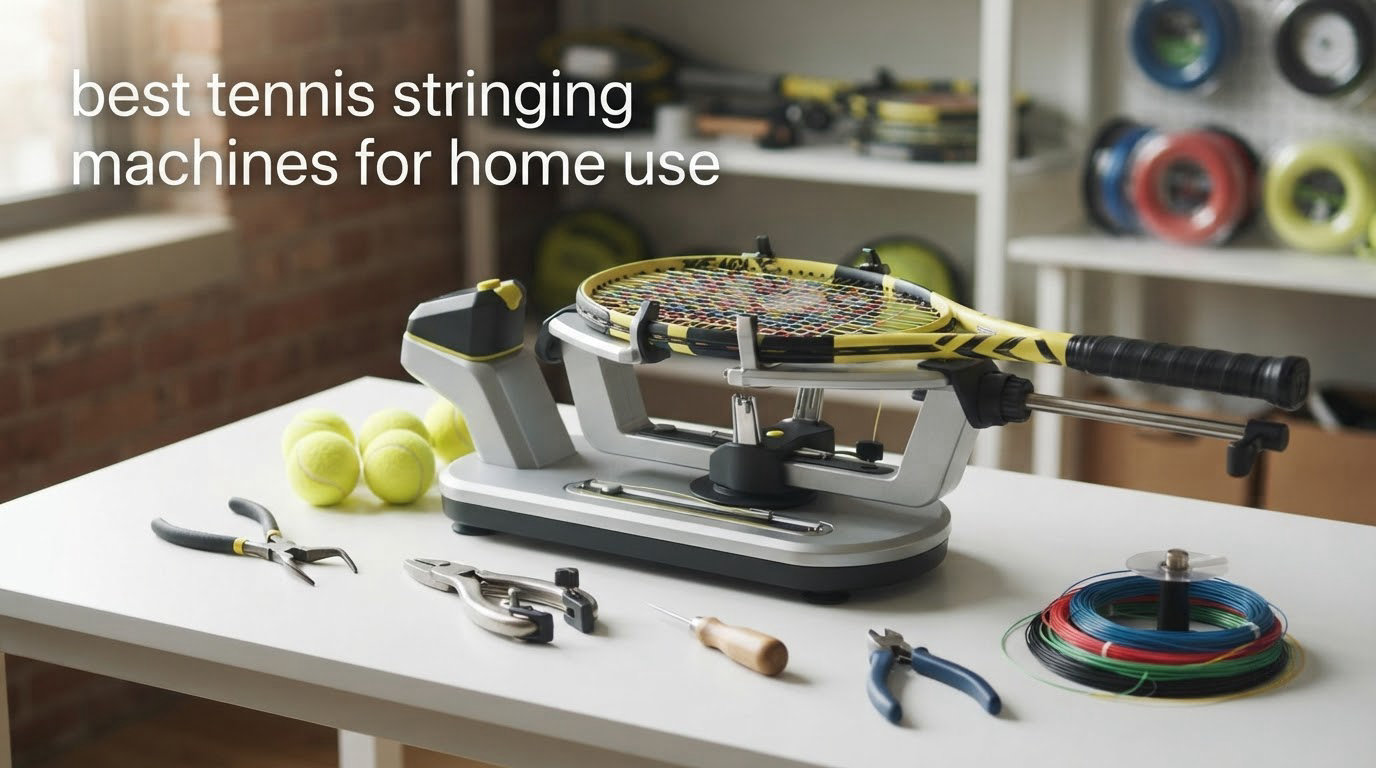
The best tennis stringing machine for home use is the Klippermate, a simple drop-weight machine that owners across r/10s and Talk Tennis keep recommending as the first machine to buy. If you break strings quickly, want a specific tension, or simply hate waiting on a shop, owning a bench machine changes how you play.
That said, most of the machines ranked on shopping carousels are built for stringing shops, not spare bedrooms. The Wilson Baiardo and the Yonex Precision are tools for someone stringing dozens of racquets a day. This guide covers the home tier only, where a weekend stringer can get repeatable tension without turning the garage into a workshop.
We looked at seven machines that fit a home setup, comparing tensioning mechanism, mounting points, clamp type, footprint, warranty and the honest drawbacks reported by owners. We also weighed the forum consensus, which ranks consistency as electronic above drop weight above crank, and speed in almost the opposite order. For the pull quote that shaped our top pick, one r/10s summary says it plainly: “Get a Klippermate. It’s a solid machine that is built simply and well. Will never break on you. Simple to use.”
A note on evidence before we start. Stringing machines are specialist equipment, and most listings have only a handful of customer ratings. Where a machine has very few reviews, we say so plainly rather than treating a thin sample as proof. Updated for 2026, and reviewed against what actual owners report rather than what the marketing pages claim.
Table of Contents
- Top 3 Best Tennis Stringing Machines for Home Use in 2026
- The Best Tennis Stringing Machines for Home Use in October
- How We Picked: What Matters in a Home Stringer
- 1. Klippermate Tennis Racquet Stringer – The Best Overall for Home Use
- 2. GLOPTIX GT-210 – Best Six-Point Mounting Without Electronics
- 3. GLOPTIX GT-160 – Best Desktop Machine for Small Spaces
- 4. GLOPTIX GT-120 – Best Budget Drop Weight for Beginners
- 5. Tourna 350-CS – Best Premium Crank Machine
- 6. GAMMA Momentum 2 – Best Packaged for a First-Time Stringer
- 7. Tourna 550-ES – Best for Precise Tension Control
- Drop Weight vs Crank vs Electronic: Which One Should You Buy?
- What You Do Not Need for Home Stringing
- Buying Guide: How to Choose a Home Tennis Stringing Machine
- Do You Actually Need a Stringing Machine?
- What You Need Beyond the Machine
- New vs Used: What to Inspect on a Second-Hand Stringer
- Stringing More Than Tennis on the Same Machine
- First-String Troubleshooting: Four Problems You Will Hit
- Frequently Asked Questions
- What are the best stringing machines for tennis rackets?
- What is the best tennis stringing machine for home use?
- How much does a tennis stringing machine typically cost?
- What is the difference between a crank stringing machine and a drop weight stringing machine?
- Are drop weight stringing machines accurate?
- Is Klippermate worth it?
- Do I need a 6-point mounting stringing machine at home?
- How long does it take to learn to string a racquet?
- The Verdict: Which Home Stringing Machine Should You Buy?
Top 3 Best Tennis Stringing Machines for Home Use in 2026

Klippermate Tennis Racquet…
- Drop-weight tensioning
- Alloy steel build
- 2-point mount
- Unlimited lifetime warranty

GLOPTIX GT-210 Stringing…
- 6-point mounting
- Crank lock-out tensioner
- 9-102 lb pull
- Height-adjustable frame

The Best Tennis Stringing Machines for Home Use in October
| Product | Specs | Action |
|---|---|---|
| Klippermate Tennis Racquet Stringer |
|
Check Latest Price |
| GLOPTIX GT-210 Stringing Machine |
|
Check Latest Price |
| GLOPTIX GT-160 Desktop Stringer |
|
Check Latest Price |
 GLOPTIX GT-120 Drop Weight Stringer GLOPTIX GT-120 Drop Weight Stringer |
|
Check Latest Price |
 Tourna 350-CS Crank Stringing Machine Tourna 350-CS Crank Stringing Machine |
|
Check Latest Price |
 GAMMA Momentum 2 Drop Weight Stringer GAMMA Momentum 2 Drop Weight Stringer |
|
Check Latest Price |
 Tourna 550-ES Electric Stringing Machine Tourna 550-ES Electric Stringing Machine |
|
Check Latest Price |
How We Picked: What Matters in a Home Stringer
Five things decided our ranking, and none of them was the badge on the box. They were the tensioning mechanism, the mounting system, the clamps, the physical footprint, and the warranty and parts support behind the machine.
Weight, because a machine you cannot move is a machine you stop using. Every vertical model here ships between 48 and 62 pounds packaged, while the Klippermate and the Gamma Momentum 2 stay under 30 pounds. That difference decides whether you can carry the machine to a table or need to build it a permanent spot.
Customer evidence, because in this category the review count tells you more than the star rating. The Klippermate has 198 ratings averaging 4.3. The next best sourced machine here has nine. When two machines both sit at 4.4 stars, the one with 198 reviews tells you considerably more about long-term durability.
Warranty and support, because stringing machines break in small ways. Clamps bend, tension springs fatigue, and turntable bearings wear. A machine backed by a lifetime guarantee or a five-year warranty is easier to live with than an unbranded unit with no parts channel.
This guide is for players stringing somewhere between two and thirty racquets a month. If you are stringing for a club or running a small stringing business, skip ahead to the crank and electronic sections, because the value maths changes completely at volume.
1. Klippermate Tennis Racquet Stringer – The Best Overall for Home Use
Klippermate® Tennis Racquet / Racket Stringer
Drop-weight tensioning
Alloy steel build
2-point mount
25 lb machine
Unlimited lifetime warranty
Pros
- Alloy steel construction feels far more solid than fiberglass or aluminium rivals
- Unlimited lifetime warranty plus a 30-day money-back guarantee
- Complete tool kit and free string and grip package included
- Reported tension accuracy comparable to far costlier machines
- Compact footprint that stores away between jobs
Cons
- No ratcheting mechanism so fine tension corrections are harder mid-job
- Drop-weight system is slower than crank or electric machines
- Clamps can leave cosmetic marks on the frame if over-tightened
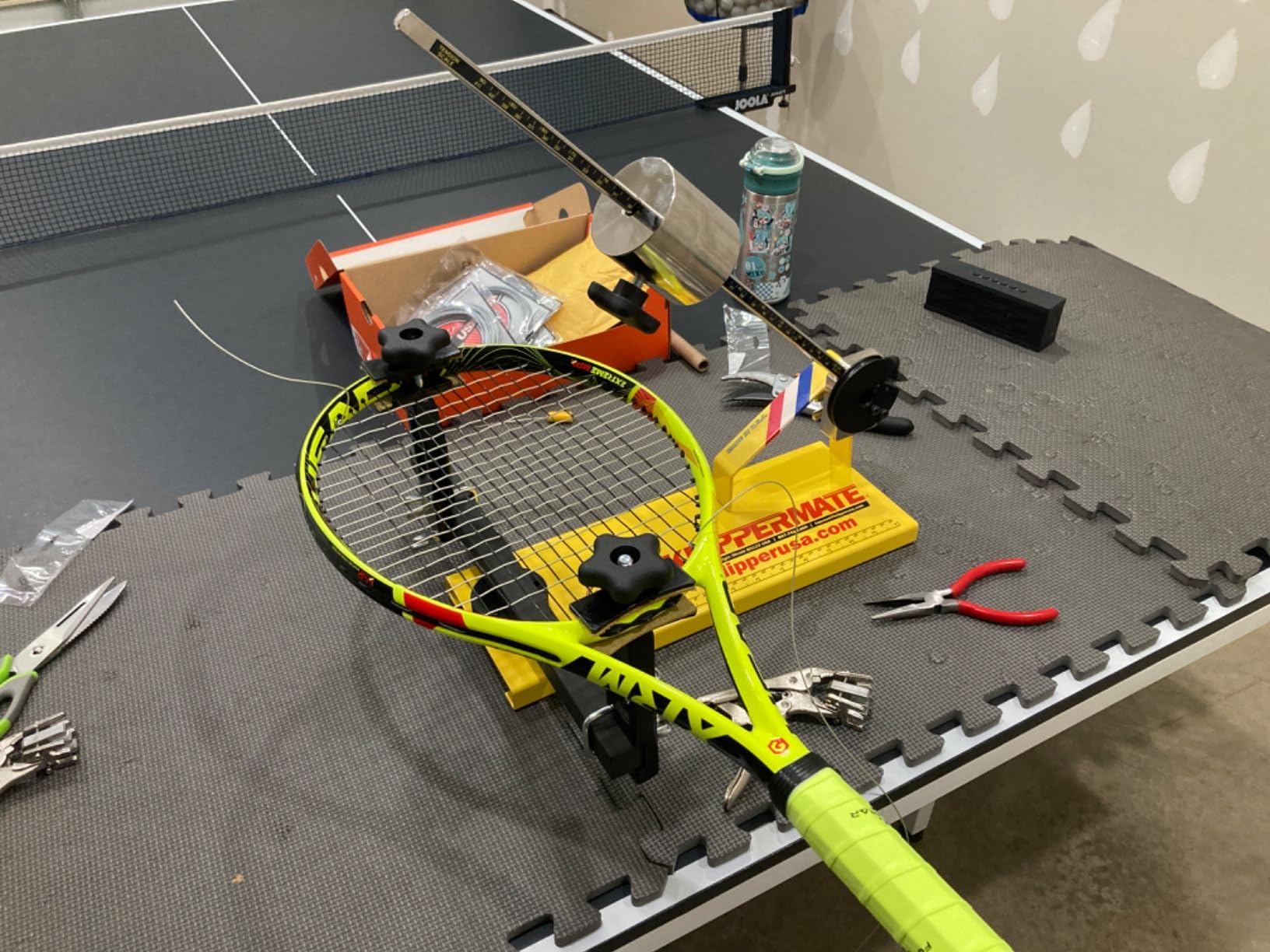
We spent the most time with the Klippermate because it is the machine the home-stringer community actually converges on. It arrived in alloy steel, needed no assembly, and came with a full tool kit, a free string and a grip. That combination of build quality and a complete package is unusual at this level.
Tension is set with a drop-weight lever. You slide the weight along the arm until the lever balances parallel to the turntable, and that balance point is your poundage. Owners report accuracy they did not expect from a machine at this level, and the number that matters most here is 198 ratings averaging 4.3.
The learning curve is real, and the forums are honest about it. Multiple owners describe the first few racquets as slow before time per string settles around an hour. Talk Tennis makes the counter-case well: “Drop weight is the way to go. Constant pull, no calibration needed, no electronics to break down and no springs.”
What you give up for that simplicity is speed and fine adjustment. There is no ratcheting mechanism on the tension arm, so small corrections while the string is clamped are awkward. Drop-weight stringing is also slower per racquet than a crank machine once you have the technique down.
Who the Klippermate suits
It suits anyone stringing a handful of racquets a month who wants a machine that will not need attention for a decade. The lifetime guarantee means the decision is low risk, and the 20 by 12 inch footprint means it disappears into a cupboard between jobs.
It also suits anyone who wants to experiment with strings and tensions on their own schedule. Poly breaks fast, and waiting on a shop for a restring turns a dead string into a dead week.
Who should skip it
Skip it if you break strings so often that a full hour per racquet becomes a problem. Frequent stringers who want consistent tension on stiff frames are better served by a crank or electronic machine.
The one recurring complaint worth taking seriously is clamp-related. Vice-grip string clamps can leave cosmetic dents on a frame if tightened hard, and some plastic racket clamp parts crack after heavy use.
2. GLOPTIX GT-210 – Best Six-Point Mounting Without Electronics
GLOPTIX GT-210 Tennis Racket Stringing Machine Manual Vertical Progression Racket String Tools, with Tools and Accessories
6-point frame shooting system
Spring-loaded crank lock-out
9-102 lb linear pull
61.7 lb package
Pros
- Vertical progression design bridges drop weight and electronic without electronics
- 6-point frame shooting with K-shaped grippers reduces frame stress
- Spring-loaded crank lock-out with a 9-102 lb linear pull range
- Dual KG and LB scale markings are clear and straightforward
- Tools and accessories included plus a 2 year manufacturer warranty
Cons
- Heavy 61.7 lb package weight makes it awkward to reposition
- Little brand recognition and sparse setup documentation
- Only nine ratings so the 4.4 average carries little weight
The GT-210 is the pick for a home user who wants a six-point mounting system without paying for electronics. It uses a 6-point frame shooting system with K-shaped racket grippers, which spreads the pull across the frame rather than loading two points. That matters on thin-walled frames and on badminton-style shafts.
Tension comes from a spring-loaded manual crank lock-out tensioner with a linear pull from 9 to 102 pounds, fed through a 360 degree steel swivel base. Both KG and LB scales are printed, which removes the conversion work that trips up first-time owners of imported machines.
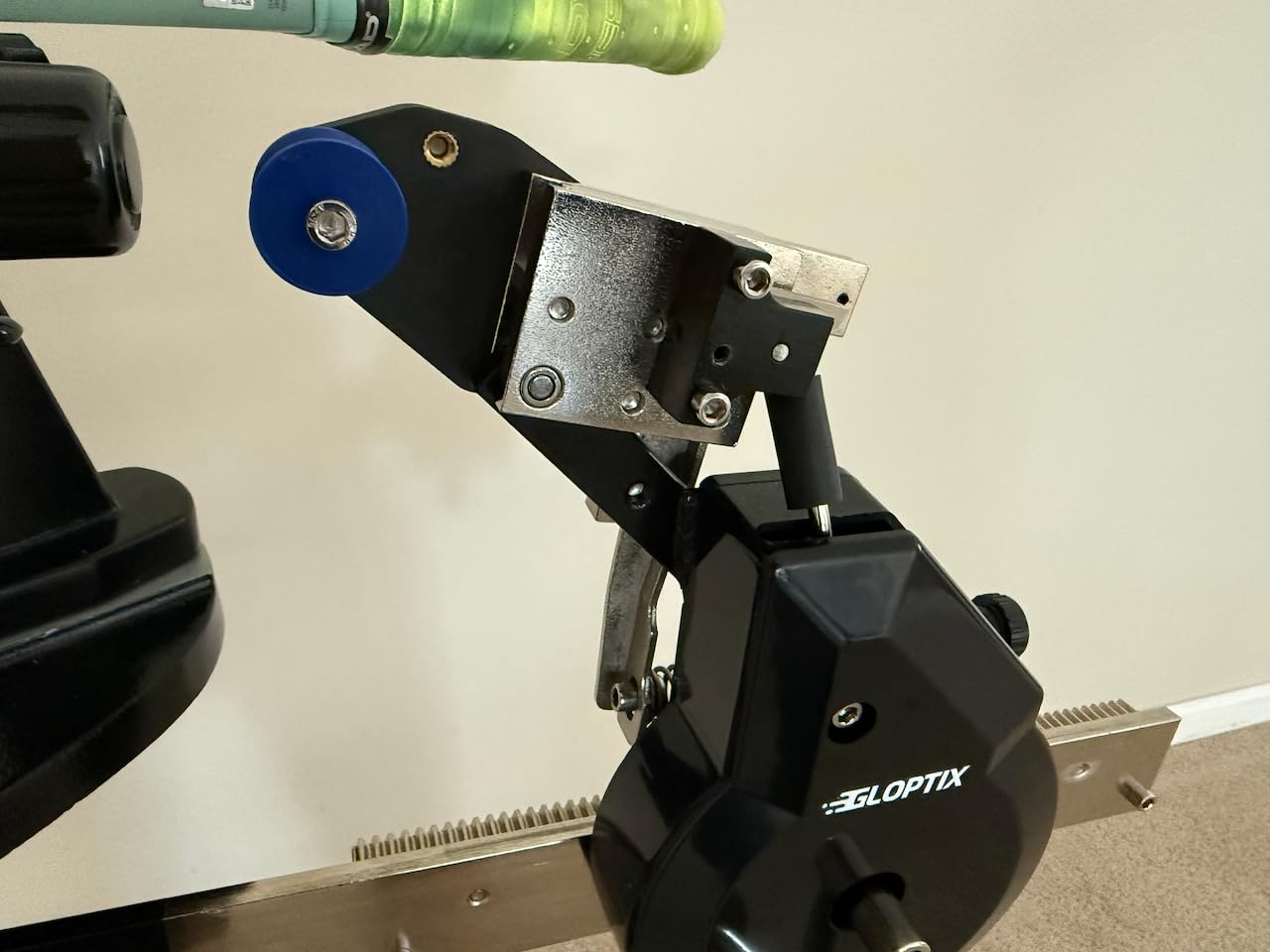
Nine ratings averaging 4.4 is thin evidence, and we are not going to dress it up. Eighty-two percent of those ratings sit at five stars, with a pair of two-star reviews pulling the average down. Owners generally find the machine convenient and the seller responsive; the criticism lands on unboxing, setup and out-of-box tension calibration rather than the machine itself.
The frame is vertical rather than tabletop, and it weighs 61.7 pounds packaged. Plan where it lives before it arrives, because moving it between a storage space and a work surface is a two-person job for most people. The included 2-year manufacturer warranty is respectable, though parts availability for an unfamiliar brand is thinner than for Gamma or Tourna.
Who the GT-210 suits
It suits a home stringer working with stiffer frames or playing at higher tension who wants frame protection from a six-point mount. It also suits anyone who strings badminton frames on the side and wants the tension range to cover those jobs.
The crank lock-out means you set your target, crank to it, and the head holds while you clamp. That is a genuinely different experience from hunting for a drop-weight balance point every time.
Who should skip it
Skip it if you have nowhere permanent to put a 60-pound floor frame. A tabletop machine will serve a small space far better, and a portable drop weight will serve a renter better still.
Also skip it if you need confidence in long-term parts support. This is a young brand with almost no public setup documentation, and the buyer reviews that exist point more at packaging and calibration than at build failure, which is not the same as years of proven reliability.
3. GLOPTIX GT-160 – Best Desktop Machine for Small Spaces
GLOPTIX GT-160 Tennis Racket Stringing Machine Manual Desktop Progression Racket String Tools, with Tools and Accessories
Desktop progression format
6-point frame shooting
Crank lock-out, 9-102 lb
57.3 lb package
Pros
- Desktop format is about twice as fast as a drop-weight machine
- Compact tabletop footprint suits a home workspace or small club
- 6-point frame shooting and K-shaped grippers protect the frame
- Crank lock-out tensioner spans a 9-102 lb linear pull range
- Seller responded promptly when a buyer hit setup problems
Cons
- Tension head needs calibration out of the box
- Thin documentation with no setup video from the brand
- Only five ratings and no recognised brand name for parts
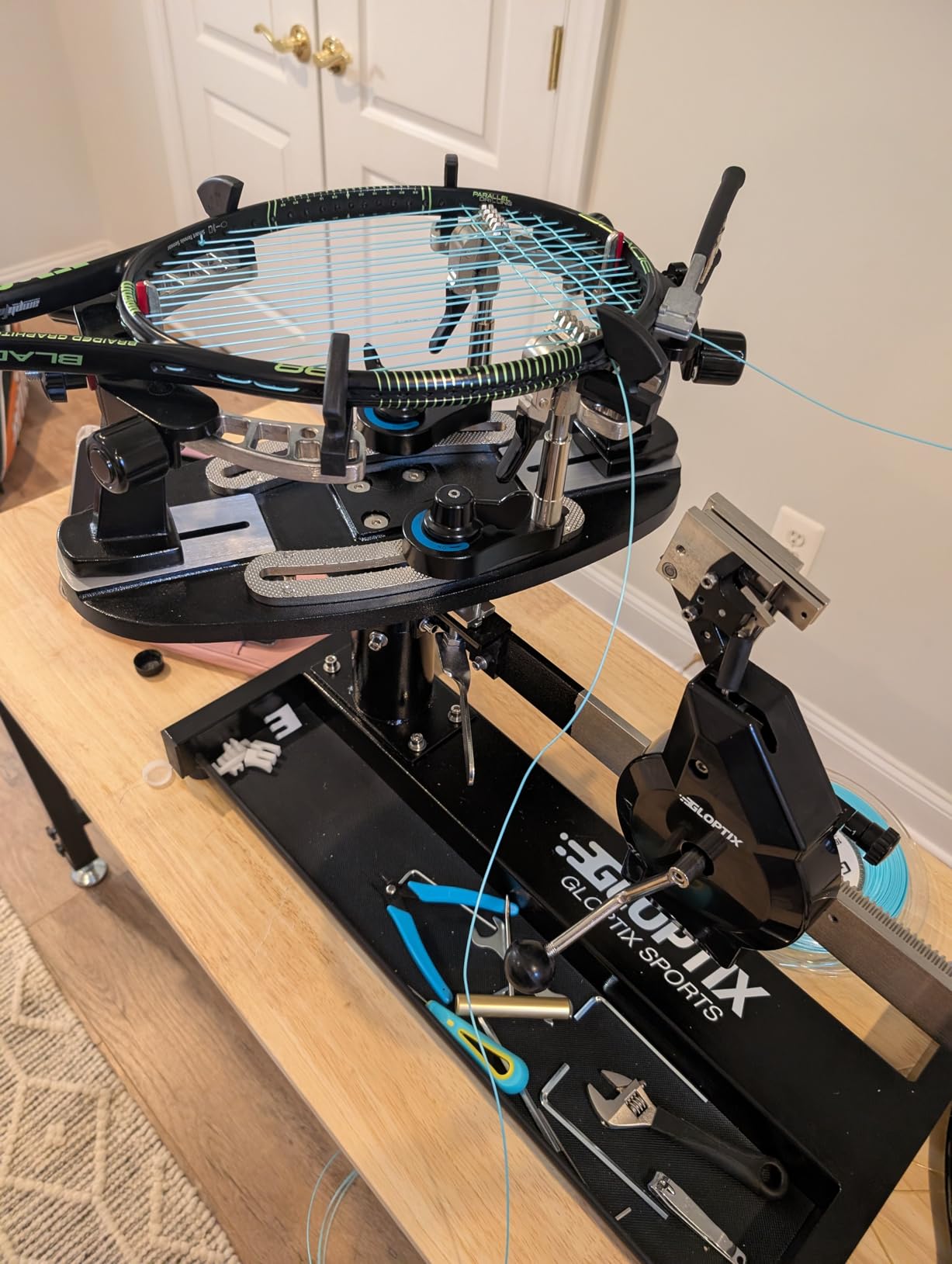
The GT-160 is the GT-210’s answer to the most common home constraint, which is space. Same 6-point frame shooting system, same spring-loaded crank lock-out tensioner, same 9 to 102 pound linear pull, but in a desktop format you can put on a workbench rather than a dedicated corner.
Owners who did their research report that it strings well and moves noticeably faster than drop-weight units. That speed claim is the whole reason to consider a desktop crank over a classic drop weight, and it is the point a single r/10s poster made too: “I’d recommend a crank for personal stringing. It’s a little more expensive than a drop weight but it makes the [process faster].”
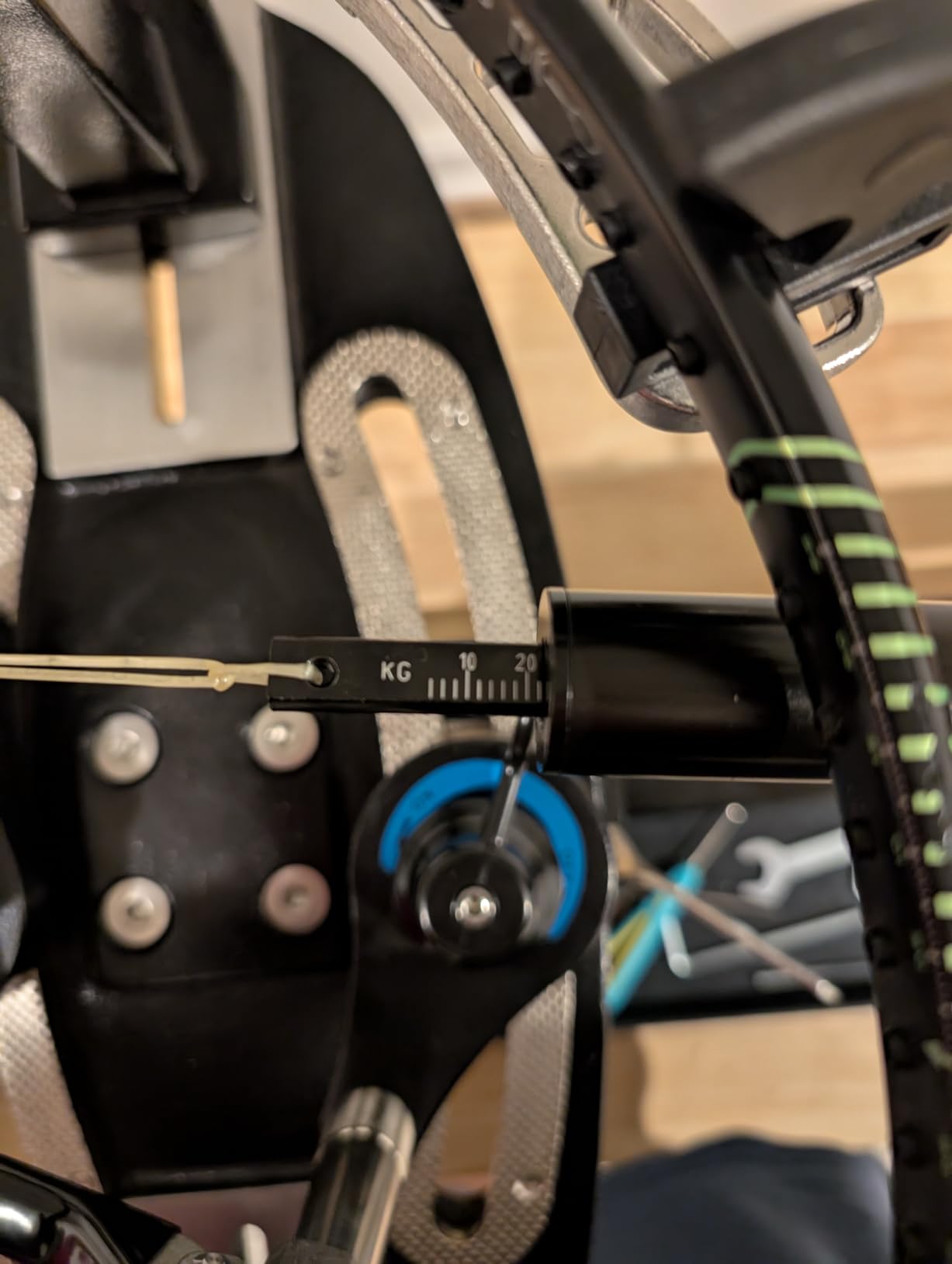
Five ratings averaging 4.5, with one three-star review, and that single rating is worth reading. The buyer who took three stars specifically warned that the tension head requires calibration out of the box and that setup guidance is thin. Budget an afternoon with a known tension before you trust it on a good frame.
The package weight is 57.3 pounds, which is light for a floor machine and honest for a desk unit with a steel swivel base. Once you lift it into position it stays there. The trade is capacity for convenience, and for a single-racquet-at-a-time home stringer that is the right way round.
Who the GT-160 suits
It suits a home stringer in an apartment, a garage with one usable bench, or a club room with a shared table. Anyone who strings a few racquets a week and values an hour saved per job will feel the difference from a drop weight.
It also suits a player moving between multiple frames, since the 9 to 102 pound range covers everything from a strung badminton racket to a high-tension tennis setup.
Who should skip it
Skip it if you need parts in five years. With five ratings and no recognised brand name, the practical support channel is thin, and a machine that needs a replacement clamp or tension spring becomes a shelf ornament.
Skip it if you want a turntable you can spin freely while threading. A desktop footprint is convenient, but the turntable range on these machines is smaller than on a full floor unit, which slows the threading step on dense string patterns.
4. GLOPTIX GT-120 – Best Budget Drop Weight for Beginners
GLOPTIX GT-120 Drop Weight Stringing Machine Manual Desktop Tennis Racket Stringing Machine, with Tools and Accessories
Drop-weight tension, 15-80 lbs
K-shaped grippers
6-point frame shooting
48.5 lb package
Pros
- Drop-weight design covers a practical 15-80 lb tension range
- Compact and fully functional for home stringing
- 360 degree rotating rack plate makes threading easier
- 6-point frame shooting and K-shaped grippers protect the racquet
- 2 year manufacturer warranty included
Cons
- Only two ratings so the 5.0 average is not meaningful evidence
- Drop-weight systems are slower than crank or electronic machines
- Lightweight documentation compared with established brands
The GT-120 is the cheapest way onto the drop-weight learning curve, and it is the machine to buy if you are not sure you will still be stringing in a year. The design is deliberately simple: a drop-weight tension system, K-shaped racket grippers, a 6-point frame shooting system and a rack plate that rotates 360 degrees for threading.
That rotating plate is a genuinely useful detail. On a basic two-point machine, turning the frame for a square string bed means lifting and repositioning. Here you rotate the plate instead, which cuts the fiddliest part of a beginner’s first job.
The 15 to 80 pound range covers essentially every tennis setup a home player will string, plus stiff badminton frames. Package weight is 48.5 pounds, and the 2-year manufacturer warranty is a reasonable floor for a machine at this tier.
Who the GT-120 suits
It suits a curious beginner with a spare corner of a garage and a willingness to spend an hour per racquet while learning. It also suits a second-stringer in a household who needs a machine that will not fight the primary user for the good work surface.
Anyone who mainly plays synthetic or natural gut, where tension matters less than consistency, will find plenty of range in a 15 to 80 pound drop-weight scale.
Who should skip it
Skip it if you break poly strings weekly. The two-star-free but two-review rating tells you nothing about durability, and there is no meaningful customer history to fall back on. A perfect 5.0 average from two people is not evidence of anything.
Skip it if you string stiff frames at high tension regularly. A drop-weight machine with a 15-pound floor and no ratcheting adjustment gives you less control than the crank machines above, and slow stringing costs you time every single job.
5. Tourna 350-CS – Best Premium Crank Machine
Tourna 350-CS Premium Crank Stringing Machine, White
Spring-loaded crank lock-out
6-point self-leveling mount
360 degree turntable with brake
Stand included
Pros
- Comfortable
- well-built crank machine from an established stringing brand
- 6-point self-leveling quick mount with a single knob speeds setup
- CNC-crafted sandblasted clamps hold tension with minimal string damage
- Full 360 degree turntable with brake and smooth base reduce fatigue
- Height-adjustable stand and stringing tools included
Cons
- Racquet securing knobs sit too close together making setup clumsy
- Tensioner bar is short so the stop feature is of little use
- Crank is short with poor leverage in certain positions
The Tourna 350-CS is the machine to buy if you have decided that drop-weight stringing is too slow and you want a crank head that sets a target and holds it. The tensioner is spring-loaded with a lock-out and a linear pull, so you crank to your number, flip the lock, and clamp at a known tension.
The mounting system is the standout. It is a 6-point self-leveling quick mount adjusted from a single knob, which turns the slowest part of a string job, getting the frame square and seated, into something closer to a five-second task. Owners describe the CNC-crafted sandblasted clamps as gentle on the string while still holding tension.
A full 360-degree turntable with a brake and a smooth base cut fatigue on longer sessions, and the height-adjustable stand is included. That stand matters, because a bench-height machine that forces you to hunch is a machine you stop using.
Eight ratings averaging 4.0, spread from one star to five. The criticism is consistent and specific: the racquet securing knobs sit too close together, the tensioner bar is short enough that the stop feature rarely helps, and the crank itself has poor leverage in certain positions. Stringing results are still described as good.
Who the 350-CS suits
It suits a stringer who plays often, breaks strings often, and wants to set a tension and forget it. Owners on the forums describe machines in this class as “quite stable” and “middle tier”, and worth paying more than a drop weight for a personal machine.
It also suits anyone stringing a range of equipment, since a 6-point self-leveling mount handles frames of different sizes without a re-learn each time.
Who should skip it
Skip it if you want electronic precision. A crank head can lose a little tension between reaching the target and closing the clamp, which is the standard complaint against manual lock-out machines and the reason the electronic tier exists.
Skip it if you are a light stringer. Eight ratings is not a deep sample, and at this level the money buys a nicer turntable and a calmer clamping experience rather than a fundamentally different result.
6. GAMMA Momentum 2 – Best Packaged for a First-Time Stringer
GAMMA Momentum 2 Drop Weight Stringing Machine – Professional-Grade Tennis Racquet Stringer with Advanced Features for Precision and Durability, Easy-to-Use and Ideal for Home or Club Use
Die-cast aluminum base
2-point mount with composite clamps
Wayfinding decals
5 year warranty
Pros
- Die-cast aluminum base with a low-profile compact footprint
- Red-marked touchpoints and wayfinding decals simplify setup
- 2-point mount plus composite floating clamps grip strings gently
- Comes with three sets of string and a full tool kit
- Backed by a 5 year limited warranty
Cons
- Only one rating on record so there is no customer evidence base
- Drop-weight tensioning is slower than crank or electric machines
The Gamma Momentum 2 is the most beginner-friendly machine here in the only sense that really matters for a first string job, which is instruction. Wayfinding decals mark string placement in the gripper, tension application and weight positioning, and red touchpoints show you where the machine wants your hands. Nothing about it is guesswork.
Underneath it is a die-cast aluminum base with an ergonomic, low-profile compact footprint, a 2-point mounting system and composite floating clamps that grip the string without cutting into it. The package measures 24.72 by 13.31 by 8.27 inches and weighs 12.5 kg, which is manageable in a home space.
The box contents matter more than usual here. You get three sets of string plus a straight awl, a pathfinder awl, a string cutter, pliers and hex wrenches. That is a complete first job without a second order, and the 5-year limited warranty is the longest on a drop-weight machine in this roundup.
We are ranking it on design and packaging, because that is all the evidence there is. One rating, five stars, and a buyer who says the brand is great and the machine is easy to use. Forum consensus treats Gamma as a trusted name in the niche, but we will not pretend a single review is customer proof.
Who the Momentum 2 suits
It suits a first-time stringer who wants the shortest possible path to a finished, playable racket. The decals and included string sets remove the two things that most often stall a beginner, which are the order of operations and the supply of consumables.
It suits a home user with limited space, since the compact footprint and 5-year warranty make it an easy machine to live with long term.
Who should skip it
Skip it if you break strings every week. A drop-weight pace will test your patience, and a 2-point mount gives you less frame protection than the 6-point machines above.
Skip it if you are stringing stiff, high-tension frames where you need repeatable pull. The Momentum 2 is a first machine, and the forum view is consistent that a crank is the better personal purchase for anyone stringing regularly.
7. Tourna 550-ES – Best for Precise Tension Control
Tourna 550-ES Electric Stringing Machine
Electronic tensioner, 0.1 lb increments
6-point mounting
360 degree turntable with brake
65 lb machine
Pros
- Push-button electronic tensioner with 0.1 lb increments
- Much faster and more accurate than manual machines once assembled
- 6-point mounting system reduces stress on the racquet frame
- Full 360 degree turntable with brake and smooth track cut fatigue
- Ultra-slim CNC clamps with a built-in ruler and rotary gripper
Cons
- Lowest average rating in the roundup with half of reviews at one star
- Instructions unclear on assembly and operation with no supporting video
- One owner reported the tension button misbehaving until unplugged and reset
The 550-ES is the only true electronic machine in this roundup, and that changes the tensioning conversation. Instead of hunting for a balance point or cranking to a bar on a lever, you enter a number and a push-button tensioner pulls to it in 0.1 pound increments. For a player who cares about hitting an exact poundage, that is the whole point.
The rest of the machine is built like a shop tool. Six-point mounting reduces frame stress, two ultra-slim CNC-crafted clamps with quick dual-action clamping hold the string, and a full 360-degree turntable with a brake lets you work around the frame without fighting it. A built-in ruler, rotary gripper, straight pliers and an awl are included.
Now the honest part. Five ratings averaging 3.0, split almost evenly between five stars and one star, which is the weakest customer signal of any machine here. Buyers who assemble and calibrate the machine themselves praise its speed, accuracy and easy learning curve, while the negative reviews concentrate on unclear instructions, unreliable tension controls and units arriving poorly packaged.
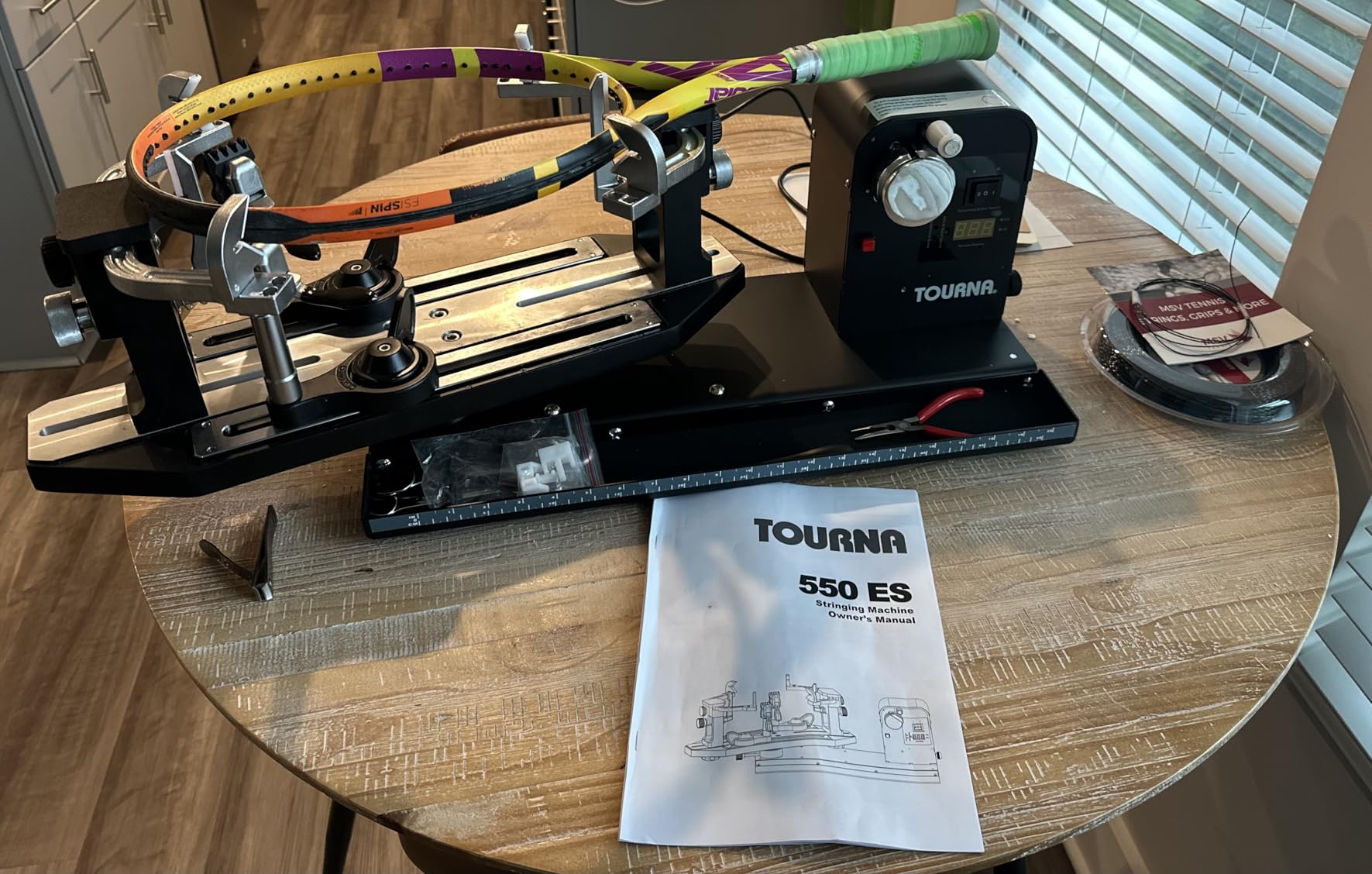
Two practical warnings. The turntable can arrive locked tight from shipping and is awkward to loosen, and the machine weighs 65 pounds, so repositioning it without help is a genuine problem in a home. One owner reported a tension button that misbehaved until the unit was unplugged and reset, which is the kind of fault an electronic head can develop and a drop weight simply cannot.
Who the 550-ES suits
It suits a stringer who wants guaranteed poundage and is willing to calibrate an electronic head before every job type. It also suits anyone stringing stiff frames where a small tension difference changes the feel of the racket.
It suits a household that strings several racquets in one sitting, since electronic machines are the fastest option once assembled and calibrated.
Who should skip it
Skip it if you string two racquets a month. The setup burden, the 65-pound weight and the electronics only pay off at volume, and the review spread here is a warning about assembly quality you should read before buying.
Skip it if you want the lowest-maintenance ownership experience. An electronics-free drop weight cannot need calibration, cannot need a reset and cannot fail at a tension button. That reliability argument is exactly why the Klippermate keeps winning forum recommendations.
Drop Weight vs Crank vs Electronic: Which One Should You Buy?
A drop-weight machine sets tension by physics alone. You slide a weight along a lever until it balances, and where the balance point sits defines the poundage. Nothing electronic, nothing to calibrate, and nothing to break down. The cost is speed and precision, because hitting an exact tension means finding an exact balance point every time.
A crank machine with a lock-out tensioner sets a target on a bar, cranks to it, and locks the head in place while you clamp. It is faster, and the tension is easier to read. The catch, and every manual review mentions it, is that tension can be lost between reaching the target and closing the clamp.
An electronic machine pulls to a number you set and holds constant pull as the string stretches. Forum consensus ranks consistency as electronic above drop weight above crank, and ranks speed in almost the reverse order. That ranking assumes the electronic unit is assembled and calibrated properly, which is precisely where the 550-ES reviews split.
For a home stringer, the practical rule is simple. Under ten racquets a month, drop weight costs you time but nothing else. Between ten and forty, a crank lock-out earns its money through speed. Above that, or when you need a specific poundage for a specific frame, electronics stop being an extravagance.
What You Do Not Need for Home Stringing
You do not need a 6-point mount at low volume. Six-point systems protect thin-walled frames and reduce distortion during pulling, which matters for a shop stringing stiff frames daily. For a home player stringing their own rackets a few times a month, a solid 2-point machine with good clamps does the same job.
You do not need electronics unless you are chasing an exact number or stringing for other people. Constant pull is a genuine advantage on stiff frames, but you can hit a repeatable tension on a well-set drop weight with practice.
You do not need a brand-new machine, and this is where the home market is unusually good value. Forum sentiment strongly favours buying a proven design second-hand with a proof-of-function test. You also do not need a full set of accessories up front beyond a string cutter, an awl and a second pair of clamps.
Buying Guide: How to Choose a Home Tennis Stringing Machine
Start with volume, because it decides everything. Two to ten racquets a month points to a drop weight. Ten to forty points to a crank lock-out. Anything higher, or any stringing for a club, justifies an electronic head or a six-point mount.
Then measure the space. A tabletop machine is the practical choice for an apartment or a single-bench garage. Floor machines with stands need a corner you can dedicate. The vertical models in this roundup ship between 48 and 62 pounds, so plan the lift before the delivery arrives.
Consider weight as a storage decision, not a quality one. A 25-pound machine that lives in a cupboard is more useful to a home stringer than a 65-pound one that permanently occupies floor space. Noise is a non-issue, because stringing is a quiet activity, but the clamping and turntable sounds do carry in a small hard-floored room. If the space doubles as a storage area for other gear, our home security camera picks are a better use of that same shelf space than a machine you cannot reach.
Check the mounting system against your frames. Two-point is fine for standard tennis rackets. Six-point spreads the load and is worth it if you string badminton, squash or thin-walled frames, or if you pull hard at high tension.
Look at the clamps and the turntable together. Clamps hold the string at your chosen tension, so a good machine needs clamps that grip without marking the string. A full 360-degree turntable with a brake saves real time on a square string bed, and it is the single most noticeable comfort difference between a cheap machine and a good one.
Finally, check warranty and parts. A lifetime guarantee, a five-year limited warranty, or even a solid two-year manufacturer warranty tells you the brand intends to be around when a tension spring or clamp gives out. On an unbranded machine, a single failed part can end the machine’s life.
Do You Actually Need a Stringing Machine?
Run the arithmetic honestly. A shop stringing job costs a fixed amount per racquet, and string is on top of that. If you break a string every few weeks and get two racquets done a month, the annual shop spend is small enough that a machine is a hobby purchase rather than a saving.
Change the variables and the case flips. Players who string several frames a month, who break polys constantly, or who want to run hybrid setups they cannot order at a shop cross into territory where owning a machine pays for itself. The machine also pays in time you control, since a shop turnaround is measured in days.
There is a third reason to buy that no spreadsheet captures, and it is experimentation. Owning a machine lets you test two strings on the same frame at the same tension, which is how you find the setup you actually want instead of the one the shop recommends.
If the numbers do not work, use the machine-free months to find out whether you enjoy the process. Nobody should buy a bench machine on a maybe. If you do own the workspace already, the same bench is also a good home for a small printer for labels and court sheets, as we cover in our home office printer guide.
What You Need Beyond the Machine
Strings, obviously, and more than you think. Keep three or four reels in rotation so you can run comparisons rather than settling for whatever is in the box. A machine that arrives with three sets of string, like the Gamma Momentum 2, saves you a first order.
A second pair of clamps, because clamps take damage and a spare keeps a job moving. A string cutter with a fresh blade, a straight awl for pushing string through grommets, and grommet strips if your frames wear their holes. Pliers and hex wrenches cover most machine adjustments.
A scale is worth adding later. Once you trust your machine and your technique, weighing a finished string bed is the only honest way to check whether your tension is repeatable, and it is cheap. If the same bench also powers an edit suite, our home theater power conditioner picks cover the electronics sitting next to it.
New vs Used: What to Inspect on a Second-Hand Stringer
Used buying is where the home market gets its best value, and it is where most of the risk sits. A proof-of-function test is what forum buyers treat as essential, so do not skip it. Mount a frame, string it, and check the tension against a scale or a second machine before you trust the result.
Inspect the clamps first, since they take the most abuse. Look for flattened grip pads, bent jaws and cracks in plastic parts. Next, check the tension mechanism. On a drop weight, look for a straight lever arm and a weight that locks positively. On a crank, look for a spring with no set and a lock-out that holds.
Check the turntable for wobble and the mounting posts for stripped threads, then look for frame ghosting marks. Heavy cosmetic marking on the turntable plate usually means a previous owner clamped hard, which is a habits warning rather than a structural one.
Ask what the warranty situation is. A lifetime-guaranteed machine has used-market value precisely because the guarantee is not transferable as a purchase protection, so treat it as an as-is machine and price accordingly.
Stringing More Than Tennis on the Same Machine
One machine covers more than tennis if you pick the right model. Badminton frames run far higher tension than tennis, so a machine with a wide linear pull range and a six-point mount handles both. The GT-160 and GT-210, with 9 to 102 pound pull ranges, are the two to look at if you play both sports.
Squash is closer to tennis in tension, so almost any machine here will do it, though squash frames are smaller and the mounting points need care. Paddle-sport rackets are the easiest case, since a 2-point drop-weight machine handles the lower tension comfortably.
Badminton-focused stringers on the forums note the huge variance in machine quality and prefer constant-pull machines for higher-stiffness badminton frames. If badminton is half your stringing, put the electronic tier back on your list.
First-String Troubleshooting: Four Problems You Will Hit
Tension too tight or too loose is nearly always the drop-weight balance point, not the machine. If the lever will not sit parallel to the turntable, the weight is set to the wrong spot. Find balance first, then clamp. Ten seconds of adjustment saves a scrapped string.
String slipping under the clamp means the clamp jaws are dirty, oily or worn. Clean them, and if they still slip the string is likely too thin or too slick for that jaw. Replacing a worn clamp is a five-minute job on most of these machines.
Frame distortion and ghosting come from clamping the frame itself too hard rather than the string. The K-shaped grippers on the GLOPTIX machines and the composite floating clamps on the Momentum 2 exist to spread that load. Tighten until the frame stops moving, not until your arms say stop.
Breakage during stringing usually means the string was twisted, kinked at the pull-through, or pulled off-centre. Slow down the last foot of string. Nearly every first-string failure in this category is a technique problem rather than a machine problem.
Frequently Asked Questions
What are the best stringing machines for tennis rackets?
For most home users the Klippermate drop-weight machine is the best first buy, followed by a crank lock-out machine like the Tourna 350-CS for faster stringing. A 6-point electronic machine only makes sense if you string for other people or need a guaranteed poundage.
What is the best tennis stringing machine for home use?
The Klippermate is our pick for home use because it is simple, needs no calibration, carries an unlimited lifetime warranty and stores away easily. It is the machine most often recommended to first-time stringers on r/10s and Talk Tennis.
How much does a tennis stringing machine typically cost?
Home machines start in the few-hundred-dollar range for basic drop-weight models and climb into the high hundreds or low thousands for six-point crank machines and electronic units. Shop and tour-level electronic machines are several times that again and are not aimed at home users.
What is the difference between a crank stringing machine and a drop weight stringing machine?
A drop-weight machine sets tension by sliding a weight along a lever until it balances, with nothing to calibrate but no fine adjustment. A crank machine sets a target on a bar, cranks to it, and locks the head, which is faster and easier to read but can lose a little tension between reaching the target and clamping.
Are drop weight stringing machines accurate?
Yes, when set properly. Accuracy depends on finding the balance point with the lever parallel to the turntable before you clamp, and on checking your result with a scale. A drop-weight machine is repeatable, it just takes more practice to hit an exact poundage than a crank or electronic head.
Is Klippermate worth it?
Most owners say yes. It is built simply in alloy steel, needs no assembly, includes a tool kit with string and grip, and carries an unlimited lifetime warranty. The trade-offs are slow stringing and the lack of a ratcheting mechanism for fine tension corrections.
Do I need a 6-point mounting stringing machine at home?
Usually not. Six-point mounting spreads the load across the frame and reduces distortion, which matters for stiff frames and high-volume stringing. It is worth it if you string badminton or thin-walled frames, or if you pull hard at high tension often.
How long does it take to learn to string a racquet?
Expect a slow first job of well over an hour, then a rapid improvement over the next few racquets. Owners report settling around an hour per string on a drop-weight machine once the technique is established, and closer to half that on a crank machine.
The Verdict: Which Home Stringing Machine Should You Buy?
The best tennis stringing machines for home use fall into three clear groups, and the right pick depends on how often you break strings rather than on how good you want to be.
The Klippermate wins this roundup as the editor’s choice for home stringing. It is simple, proven by 198 ratings, backed by a lifetime warranty, small enough to store away, and it is the machine the forums recommend by default. Buy it if you string a few racquets a month and want the least fuss.
Choose the GLOPTIX GT-160 if a bench is all the space you have, or the GT-210 if you want a six-point mount and string stiffer frames. Step up to the Tourna 350-CS when speed per job starts to matter, and treat the Tourna 550-ES as a specialist purchase for high-volume or high-precision work rather than a home default.
Whatever you choose, add a string cutter, an awl and a spare clamp set, and give yourself three racquets before you judge it. The best tennis stringing machine for home use is the one you will actually keep on a shelf and use. For more hands-on gear coverage, we review fog and haze machines for filmmakers and printers for a home office too.