
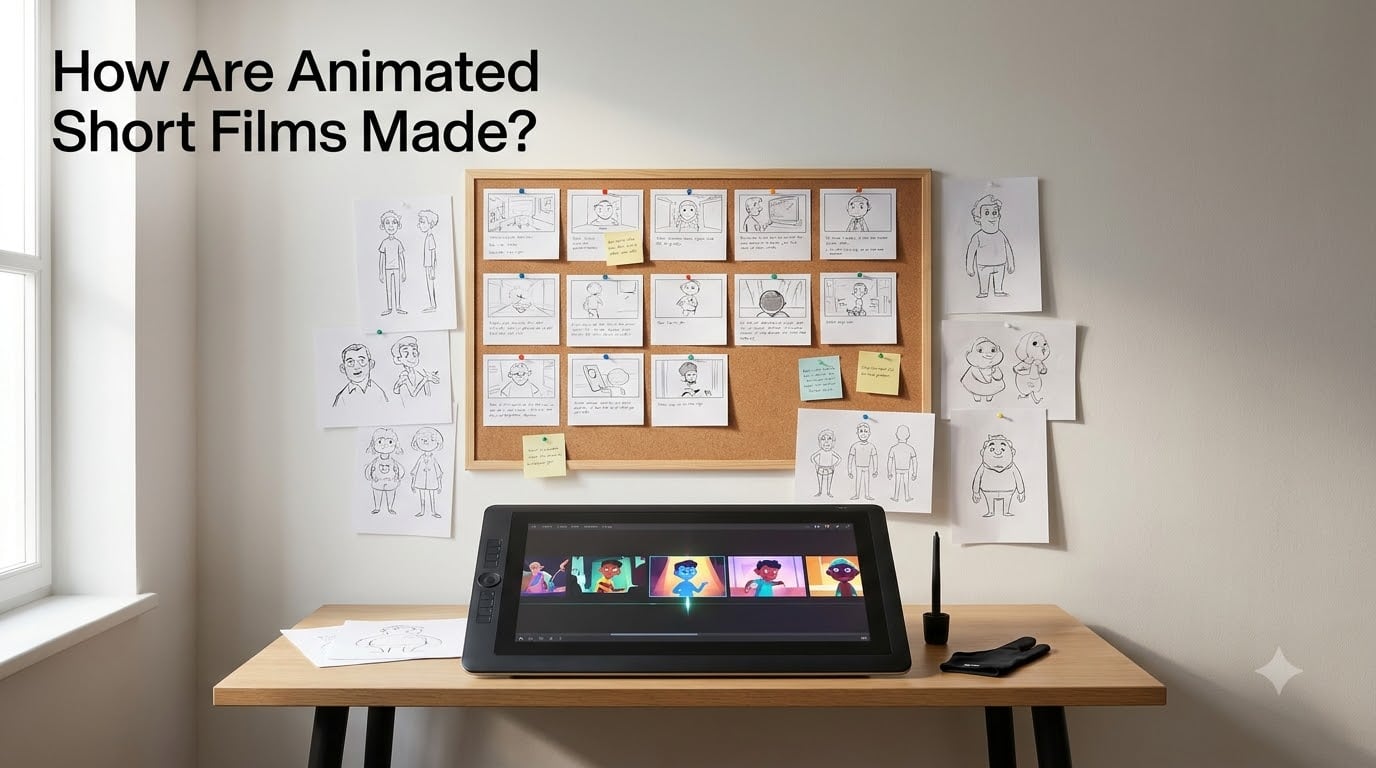
Every animated short film starts with a single drawing, a vague idea, or a moment of inspiration that someone refuses to let go. From there, it moves through a structured production pipeline that can take anywhere from a few months to several years. Whether hand-drawn, computer-generated, or stop motion, the process shares the same fundamental stages.
In this guide, I break down exactly how animated short films are made, from the first spark of a story concept to the final rendered frame. You’ll learn what happens at each stage of the animation process, what tools professionals and solo creators use, and how long you can expect each phase to take.
If you’ve ever watched a short film at a festival or online and wondered how someone brought that world to life, this walkthrough will give you the full picture. I’ve pulled together insights from professional animators, student workflows, and solo filmmakers who’ve completed projects entirely on their own.
Table of Contents
- How Are Animated Short Films Made? The Complete Pipeline Overview
- Pre-Production: Where Every Animated Short Film Begins
- Storyboarding and Animatics: Planning Every Frame
- Character and Environment Design
- The Animation Production Process
- Software and Tools for Animated Short Films
- Post-Production: Editing, Sound Design, and Compositing
- Solo vs Team Production: Can One Person Make an Animated Short?
- Time Management and Common Mistakes to Avoid
- FAQs
- Conclusion
How Are Animated Short Films Made? The Complete Pipeline Overview
Animated short films are made through a three-phase production pipeline: pre-production, production, and post-production. Each phase contains specific steps that build on the previous one, and skipping any step usually creates problems downstream.
Here is the standard process, broken into six core stages:
Story and Concept Development – Generate ideas, write the script, and define the narrative structure.
Design and Pre-Production – Create character designs, environments, storyboards, and animatics.
Asset Creation – Build all visual elements: character models, backgrounds, rigs, or physical puppets.
Animation – Bring characters and elements to life through keyframes, inbetweening, or frame-by-frame techniques.
Post-Production – Edit the animated sequences, add sound design, music, voice-over, and visual effects.
Finishing and Delivery – Composite everything, color grade, render the final output, and export in the required format.
This pipeline applies to 2D animation, 3D animation, and stop motion. The tools and specific techniques change, but the structure stays the same. Some stages overlap, especially for solo creators, but the order rarely shifts.
A common mistake beginners make is jumping straight into animation without finishing the story or storyboard. Professional studios spend weeks or months in pre-production precisely because every decision made there saves time later. Reddit users on r/animation consistently report that poor planning is the number one reason projects stall or get abandoned.
Pre-Production: Where Every Animated Short Film Begins
Pre-production is the planning phase of short film production, and it’s where roughly 40% of the total work happens. This stage covers everything from brainstorming to finalizing the animatic. No animation gets created here, but every creative decision does.
Idea Generation and Story Development
Every animated short film begins with a concept. Some filmmakers start with a character they want to explore, others with a mood, a single image, or a personal experience. The key is finding a story that works within the constraints of animation, which rewards visual storytelling over dialogue.
I’ve noticed that the best short films tend to focus on a single idea or emotion rather than a complex plot. A graduating student at a university animation program might spend four to six weeks just refining their concept before writing a single script line. That investment pays off because a weak story can’t be saved by beautiful animation.
During story development, you’ll typically write a treatment, which is a one-to-three page prose summary of the narrative. This document captures the beginning, middle, and end, plus the emotional arc. Some filmmakers outline beats on index cards or use software like Scrivener to organize story structure.
Writing the Script and Treatment
The script for an animated short is usually shorter than a live-action equivalent because animation communicates visually. A five-minute short might have only two or three pages of dialogue. Pixar’s short films, for example, often contain almost no spoken words at all.
Your script should include scene descriptions, character actions, and any dialogue. Even if your film is nonverbal, write action descriptions so you know what happens in each scene. This document becomes the reference point for the storyboard artist, who translates written words into visual sequences.
Professional studios often go through ten or more script revisions before locking the story. Solo animators may do three to five drafts. Forum users on Reddit frequently mention getting stuck on endings, so having a complete script before storyboarding helps prevent that common trap.
Storyboarding and Animatics: Planning Every Frame
Storyboarding is the process of drawing every scene as a sequence of panels, similar to a comic strip. Each panel shows the composition, character poses, camera angle, and action for that moment in the film. This is where the story becomes visual for the first time.
A storyboard artist typically draws between 100 and 300 panels for a five-minute short film, depending on scene complexity. Each panel includes notes about camera movement, timing, and character expressions. Some panels get more detail than others, but the goal is to capture the flow of the entire film before any animation begins.
Once the storyboard is complete, the panels are photographed or scanned and assembled into a video timeline with rough timing and temporary audio. This is called an animatic. The animatic is essentially a rough draft of the film, showing how the story plays out in real time.
I think of the animatic as the most important planning tool in the entire pipeline. It reveals pacing problems, confusing transitions, and scenes that drag. Better to discover these issues in a rough sketch than after spending weeks animating a sequence that gets cut.
For 2D animation, the animatic also includes an exposure sheet, which is a document that specifies exactly how many frames each drawing occupies. This sheet guides the animators on timing and helps maintain consistency across scenes worked on by different team members.
Character and Environment Design
Design happens alongside or just after storyboarding. This stage defines the visual identity of your film, from character silhouettes to the color of the sky. Every creative choice here contributes to the mood and tone established during story development.
Character Design Process
Character design starts with research and reference gathering. A designer creates mood boards collecting images, textures, color palettes, and real-world references that capture the intended feel. From there, they sketch dozens of variations, exploring shapes, proportions, and personality through silhouette alone.
A strong character design works as a simple silhouette. If you can recognize the character from a black shape with no internal detail, the design is solid. This principle matters because animation requires characters to be readable in motion, often at small sizes or from a distance.
For 3D animation, the approved character design moves into modeling, where a 3D artist builds the character as a digital sculpture. Then a rigger creates a skeleton structure that allows animators to pose and move the character. For 2D, the designer creates model sheets showing the character from multiple angles with consistent proportions.
One insight from forum discussions: solo animators benefit enormously from simple character designs. A Reddit user reported that using a cube-shaped character for their short film cut production time in half while still delivering an emotionally resonant story. Complexity in design multiplies complexity in animation.
Environment and Prop Design
Environments set the stage for your characters. Background artists create layouts for each location, considering camera placement, lighting direction, and depth. In 2D animation, backgrounds are painted separately from characters. In 3D, environment artists build digital sets with textures, materials, and lighting rigs.
Prop design covers every object characters interact with, from a coffee cup to a spaceship. Each prop needs to match the visual style established for characters and environments. Consistent design language across all elements is what makes a short film feel cohesive.
Color Scripts and Mood Boards
A color script is a sequence of small thumbnails, one per scene, showing the dominant color palette and lighting mood for each moment in the film. This document ensures the color story supports the emotional arc. Warm colors might dominate a happy scene, while cool tones signal loneliness or tension.
Mood boards and color scripts are used by studios of every size. Even solo creators benefit from planning color in advance rather than making decisions shot by shot during production. The color script becomes a reference that keeps the entire film visually unified.
The Animation Production Process
Production is where the film actually gets animated. This is the longest phase, and it’s where the majority of the technical skill comes into play. The approach differs significantly between 2D, 3D, and stop motion, though the principles of movement are shared across all forms.
2D Animation Workflow
Traditional 2D animation begins with keyframe drawing. A key animator draws the most important poses in a scene, establishing the timing, spacing, and emotional beats. These keyframes might be spaced several frames apart, with large gaps between major poses.
Next comes inbetweening, where additional drawings fill the gaps between keyframes to create smooth motion. In traditional studio workflows, this work was done by inbetweeners. Today, digital tools like TVPaint, Toon Boom Harmony, and OpenToonz handle much of this process, though hand-drawn inbetweens still produce the most organic results.
Clean-up follows, where rough animation drawings are refined into final line art with consistent quality. Then color is applied to each cleaned frame, either by hand or digitally. Background paintings are combined with the animated characters in a compositing step that assembles the final image.
3D Animation Workflow
3D animation follows a different path because the characters and sets already exist as digital models. The process starts with layout, where a artist positions cameras and blocks out character movement within the digital set. This stage resembles live-action cinematography.
Animation begins with blocking, where the animator sets key poses at specific frames to establish timing. Then they refine the movement through a process called spline editing, adjusting the motion curves between poses. Polish adds secondary motion like hair movement, cloth simulation, and facial details.
Meanwhile, other team members handle shading, which applies materials and textures to models, and lighting, which places virtual lights to create mood and depth. The rendering pipeline then processes each frame, calculating how light interacts with surfaces to produce the final image. Rendering can take anywhere from minutes to hours per frame depending on complexity.
For 3D shorts, the rendering step alone can consume days or weeks of processing time. Student projects at universities often rely on render farms, which are clusters of computers working simultaneously to process frames faster.
Stop Motion Animation
Stop motion is the most physically demanding form of animation. An animator builds a puppet or object, positions it, takes a photograph, moves it slightly, and repeats. At 12 frames per second, a one-minute film requires 720 individual photographs.
The puppets typically have internal armatures, which are metal skeletons that hold poses. Sets are built physically on tabletop stages, and lighting is achieved with real studio lights. Software like Dragonframe helps animators monitor their progress frame by frame.
Stop motion shares the same pre-production pipeline as other forms. Storyboards and animatics are equally important here, if not more so, because reshooting a scene means physically rebuilding and repositioning everything.
Software and Tools for Animated Short Films
The tools you choose depend on your animation style, budget, and experience level. Here’s a breakdown of what professionals and independent creators use at each stage of the pipeline.
For 2D animation, the industry standards are Toon Boom Harmony and TVPaint. Both are paid professional tools with robust drawing and timeline features. For free alternatives, Krita and OpenToonz offer capable 2D animation workflows. OpenToonz was used by Studio Ghibli, which speaks to its quality.
For 3D animation, Blender has become the go-to tool for independent creators and students. It’s free, open-source, and handles modeling, rigging, animation, shading, lighting, and rendering in one package. Autodesk Maya remains the industry standard at major studios, and ZBrush is widely used for character sculpting. Substance Painter handles texturing for 3D models.
For stop motion, Dragonframe is the professional standard. It provides onion-skinning, instant playback, and camera control features designed specifically for frame-by-frame shooting.
Post-production relies on different tools. Adobe After Effects handles compositing, visual effects, and motion graphics. Adobe Premiere Pro or DaVinci Resolve handle editing. DaVinci Resolve also offers professional color grading. For sound design, Reaper and Audacity are popular free or low-cost options.
Reddit users consistently recommend Blender for beginners because of its zero cost and massive community of tutorials. The learning curve is steep, but the resources available make it manageable for motivated self-learners.
Post-Production: Editing, Sound Design, and Compositing
Post-production is where all the pieces come together. This phase can make or break a film, because strong editing and sound design elevate decent animation into something memorable.
Editing and Pacing
Even though animation is planned shot by shot, editing still plays a major role. The editor assembles animated sequences according to the animatic, adjusting timing, cutting redundant frames, and tightening pacing. In professional studios, editors work alongside the director throughout production, not just at the end.
For solo creators, editing is often the first time they see the complete film from start to finish. This is where pacing problems become obvious. A scene that felt right in storyboard form might drag at full animation speed. Cutting is part of the craft.
Sound Design and Music
Sound design is one of the most underappreciated aspects of animated short films. Every footstep, rustle, door creak, and ambient tone needs to be created or sourced. Unlike live-action film, animation has no production audio, so every sound is a deliberate addition.
Voice-over recording happens during this phase if the film includes dialogue. Professional productions hire voice actors and record in treated studios. For independent creators, a quiet room with a decent microphone and pop filter can produce acceptable results. Some filmmakers recorded remote voice-over during pandemic restrictions, which became a normal practice.
Music can be original composition, licensed tracks, or royalty-free library music. A composer typically receives the locked edit and creates a score that matches the emotional beats. Sound designers then mix dialogue, sound effects, and music into a balanced final audio track.
Forum discussions reveal that sound design is a major stumbling block for solo animators. Many recommend focusing on sound early rather than treating it as an afterthought. Poor audio quality can undermine otherwise excellent animation.
Compositing and Color Grading
Compositing is the process of combining all visual layers into final images. For 2D, this means merging character animation, backgrounds, and effects. For 3D, it involves combining rendered passes, adding particle effects, adjusting depth of field, and applying lens flares or atmospheric effects.
Color grading is the final visual step. The colorist adjusts the overall look of the film, creating consistent tone across scenes and enhancing mood through color manipulation. This is where the color script developed during pre-production becomes reality.
After grading, the film is rendered or exported in its final format, typically a high-resolution video file suitable for festival submission or online distribution.
Solo vs Team Production: Can One Person Make an Animated Short?
Yes, one person can absolutely make an animated short film. Animation students regularly complete graduation films almost entirely solo, handling story, design, animation, and sound. Independent creators have produced award-winning shorts working alone over extended timelines.
The trade-off is time. Reddit users report spending one to two years on five-minute shorts when working solo. One filmmaker spent four years making a thirteen-minute animated fantasy film entirely by themselves. Studios with full teams can produce similar content in months because the workload is distributed across specialists.
If you’re working alone, scope management becomes your most important skill. Simple character designs, limited locations, and short runtimes keep the project achievable. A two-minute short with one character in one environment is a realistic first project for a solo animator.
For those who want collaborators, finding reliable team members is a known challenge. Forum users suggest animation communities on Discord, LinkedIn groups, and university alumni networks as good places to find collaborators. Clear communication about expectations, deadlines, and credit is essential from the start.
Hybrid approaches work well too. You might handle story and animation solo while commissioning a composer for the score and a voice actor for dialogue. This gives you professional results in specific areas without managing a full team.
Time Management and Common Mistakes to Avoid
Time management is the skill that separates finished films from abandoned projects. The animation process is slow, and enthusiasm in week one can turn into frustration by month three. Here are strategies that experienced animators recommend.
First, set a realistic scope before starting. A one-minute film is a legitimate project. Many award-winning shorts run under three minutes. Ambition is good, but a finished short film always beats an unfinished epic.
Second, block out dedicated time daily rather than waiting for long free stretches. Even ninety minutes per day adds up. One hour every day for a year equals over 500 hours of production time, which is enough to complete a short solo.
Third, use the animatic as your production schedule. Break it into scenes and assign each one a deadline. Track your progress visually so you can see the film filling in panel by panel.
Common mistakes to avoid include overcomplicating character designs, skipping the storyboard, neglecting sound design until the end, and attempting advanced techniques before mastering fundamentals. Another frequent issue is scope creep, where new ideas expand the project beyond what’s achievable.
Burnout is real, especially for solo creators. Taking scheduled breaks, sharing work-in-progress with supportive communities, and celebrating small milestones all help maintain momentum across a long production timeline.
FAQs
How long does it take to make an animated short film?
A solo animator typically needs 6 months to 2 years for a 3-to-5 minute short film. Professional studios with full teams can produce similar content in 3 to 6 months. The timeline depends on animation style, complexity, runtime, and whether you’re working alone or with a team.
Can one person make an animated short film?
Yes, one person can make an animated short film. Animation students regularly complete graduation films solo, and independent creators have produced award-winning shorts working entirely alone. The trade-off is time, as solo projects take significantly longer than team productions.
What software is best for beginners making animated short films?
Blender is the best free software for 3D animation beginners due to its zero cost and large tutorial community. For 2D animation, Krita and OpenToonz are excellent free options. All three tools are capable of producing professional-quality short films.
How much does it cost to make an animated short film?
You can make an animated short film for free using open-source software like Blender, Krita, or OpenToonz. Costs increase if you hire voice actors, commission music, or purchase professional tools. Student shorts often cost nothing but time, while professional productions can range from a few thousand to over $100,000.
What anime took 7 years to animate?
Redline, directed by Takeshi Koike, took approximately 7 years to produce. The film is known for its hand-drawn animation style with over 100,000 hand-drawn frames and a massive team of animators working to complete the ambitious project.
Is Toy Story CGI or hand drawn?
Toy Story is fully CGI, or computer-generated imagery. Released in 1995, it was the first feature-length film created entirely with 3D computer animation. No hand-drawn traditional animation was used in its production.
Conclusion
Animated short films are made through a structured pipeline of pre-production, production, and post-production, with each phase building on the last. The process begins with a story concept, moves through storyboarding and design, then animation, and finishes with editing, sound, and compositing. Understanding how animated short films are made gives you the roadmap to start your own project.
If you’re ready to begin, start with a simple idea and a short scope. Sketch a storyboard, create an animatic, and pick software that matches your style and budget. The most important step is the first one, and a finished one-minute short will teach you more than a planned ten-minute epic that never gets made.