
Hand shake is the reason binoculars stop working past 10x. Every extra magnification multiplies the wobble your arm and pulse feed into the eyepiece, and at 15x or 18x the view turns into a shifting blur. Image stabilized binoculars solve that with gyroscopic sensors, a microprocessor, and a moving optical element, most often a Vari-Angle Prism, that measures your movement and cancels it in real time. That is the whole idea behind the best image stabilized binoculars on the market in 2026, and it is why they show up in the hands of birders, hunters, boaters, and stadium spectators who would otherwise be squinting through a pair of ordinary glasses on a tripod.
We spent weeks reading owner feedback, forum threads, and long-term reports on stabilized binoculars before putting this list together. The category is smaller than it looks once you strip out the padding: plenty of roundups list the same Canon model twice under different bundle names, and some include zooms with no stabilization at all. Everything below genuinely has shake cancellation built in, and every pick comes with an honest note on what it costs you.
Canon still builds the widest stabilized line, and it is the brand most buyers land on. Fujifilm’s Techno-Stabi is the long-running marine favorite, the SIG SAUER Zulu6 HDX line brought roof prism portability to the category, Kite Optics offers the most aggressive published correction figures, and Nikon covers the compact end. If you want the short version, the Canon 12×36 IS III is the one most people should buy.
Table of Contents
- Are Image Stabilized Binoculars Worth It?
- Top 3 Picks for Best mage Stabilized Binoculars in September
- All 8 Image Stabilized Binoculars at a Glance in 2026
- Canon 12×36 IS III Binoculars: The Best All-Round Stabilized Pair
- Canon 18×50 IS All-Weather Binoculars: More Power Than You Can Hold Steady Without Them
- Canon 10×42 L IS WP Binoculars: The Best Glass in the Lineup
- Fujinon Techno-Stabi TS1440 14×40: The Most Correction You Can Buy
- SIG SAUER Zulu6 HDX OIS 16×42: 16x in a Body the Size of an 8×42
- SIG SAUER ZULU6 HDX PRO 18×50: The Most Capable Electronics, Least Proven
- Kite Optics APC Stabilized 16×42: Strong Correction in a Light Body
- Nikon STABILIZED 10×25 Binoculars: The One You Can Actually Carry
- How to Choose Image Stabilized Binoculars in 2026
- Frequently Asked Questions
- Who makes the best image stabilization binoculars?
- What are the best binoculars with image stabilization?
- Are stabilised binoculars worth it?
- Which image stabilized binoculars are best for birding?
- Can image stabilized binoculars work without batteries?
- Can I use image stabilized binoculars with eyeglasses?
- Which Image Stabilized Binoculars Should You Buy in 2026?
Are Image Stabilized Binoculars Worth It?
Yes, for most people who need magnification above 10x. Stabilization is worth it when you glass a moving subject, sit in a boat, or hold binoculars longer than a few minutes at a time. It is not worth it if you are steady-handed, stay at 8x or 10x, and view from a solid seat, because you would be paying for electronics, extra weight, and batteries you do not need.
The honest version carries a condition. Every stabilized binocular is a compromise, and the compromise is usually optical quality and weight. Brands spend money on the moving prism and the gyro, and many of them quietly economize on glass to keep the price down. You are not buying a better view. You are buying the same view held steady for longer.
Top 3 Picks for Best mage Stabilized Binoculars in September
Three models cover most readers, and the difference between them is how much power and how much glass you need. Here is the short list before the full breakdown.


All 8 Image Stabilized Binoculars at a Glance in 2026
Every model below has working shake cancellation, listed in the order we recommend them. Features are drawn from the manufacturers’ published specifications and owner feedback.
| Product | Specs | Action |
|---|---|---|
| Canon 12×36 Image Stabilization III |
|
Check Latest Price |
| Canon 18×50 Image Stabilization All-Weather |
|
Check Latest Price |
| Canon 10×42 L IS WP |
|
Check Latest Price |
 Fujinon Techno Stabi TS1440 14×40 Fujinon Techno Stabi TS1440 14×40 |
|
Check Latest Price |
 SIG SAUER Zulu6 HDX OIS 16×42 SIG SAUER Zulu6 HDX OIS 16×42 |
|
Check Latest Price |
 SIG SAUER ZULU6 HDX PRO 18×50 SIG SAUER ZULU6 HDX PRO 18×50 |
|
Check Latest Price |
 Kite Optics APC Stabilized 16×42 Kite Optics APC Stabilized 16×42 |
|
Check Latest Price |
 Nikon STABILIZED 10×25 Nikon STABILIZED 10×25 |
|
Check Latest Price |
Canon 12×36 IS III Binoculars: The Best All-Round Stabilized Pair
Canon 12×36 Image Stabilization III Binoculars
12x/36mm, 1.8 lb
55.3 deg apparent FOV
Vari-Angle Prism IS, 2 AA
14.5mm eye relief
Pros
- Steady view that rivals a tripod
- Compact 1.8 lb body for long walks
- Sharp Super Spectra multicoated optics
- 14.5mm eye relief works with glasses
- Long AA battery life
Cons
- No objective lens covers included
- IS button must be held down
- Water resistant rather than waterproof
This is the model I keep coming back to. At 1.8 pounds it is light enough to carry all day, and 12x is the sweet spot where stabilization starts to matter but the view is still wide enough to find a bird in a tree. Owners describe the image as steady enough that a distant subject stops bouncing within a second of settling the barrels.
The optics are Super Spectra multicoated with doublet field-flattener lenses, which is Canon’s standard for a reason: the picture stays sharp toward the edges rather than going soft and milky in the corners. Color is neutral, contrast is good, and the 55.3 degree apparent field of view feels roomy in practice.
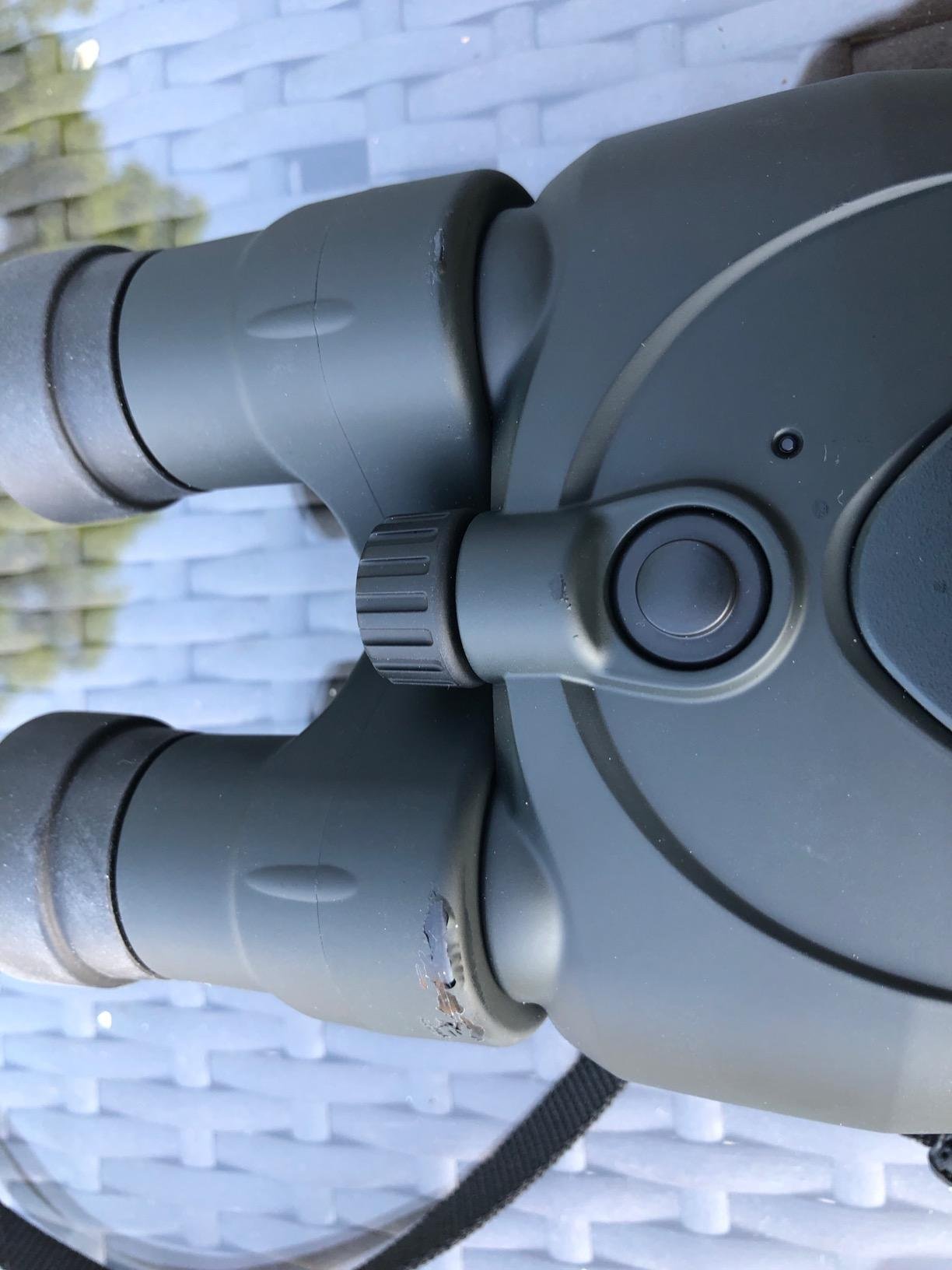
The one thing that catches new owners is the control. Unlike the SIG models and the Nikon compact, the Canon IS switch is a button you hold down. Let go and stabilization stops. That is fine if you settle on a branch or a boat rail, but it means you cannot relax your hand while eating lunch or checking a map.
It is also water resistant, not waterproof, so a full soaking in heavy rain is not the intended use. The soft case included in the box is thin, and the objective lens caps are not included or tethered, which is a small thing that annoys everyone within a week.
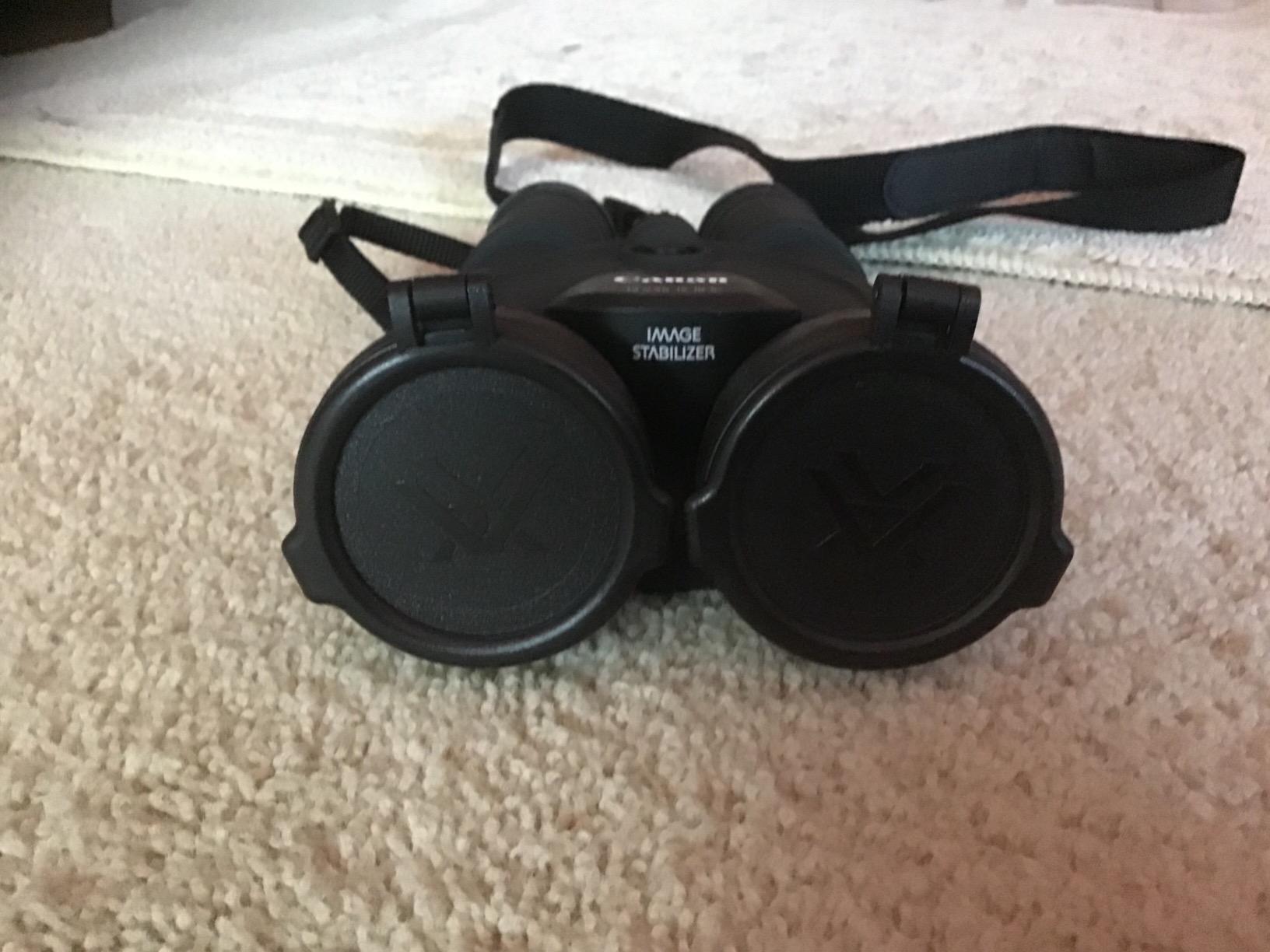
What the 36mm objective costs you in low light
The 36mm objective is the compromise that keeps this model at 1.8 pounds, and you feel it after sunset. The exit pupil is a 3mm opening, bright enough for dawn and dusk birding but not a genuine twilight instrument.
If your birding happens in the last forty minutes of light, the two Canon L-series models further down the list handle that far better. If you are glassing in the middle of the day and want to move around, this is the one to take.
Who should look past the 12×36
Anyone who regularly shoots or scans marine distances wants more correction than a Vari-Angle Prism offers, and anyone with hand tremor wants a system that stays on without a held button. Both of those point elsewhere.
It is also the wrong tool for pure astronomy. Stabilization steadies the view but does not brighten it, and binoculars on a tripod are cheaper, lighter, and optically better for finding stars.
Canon 18×50 IS All-Weather Binoculars: More Power Than You Can Hold Steady Without Them
Canon 18×50 Image Stabilization All-Weather Binoculars
18x/50mm, 4.1 lb
7.5 deg FOV
Optical IS, 2 AA
15mm eye relief, all-weather
Pros
- Reach no other portable model matches
- All-weather construction
- 50mm objectives hold up at dusk
- Monopod mountable
- Case strap and batteries included
Cons
- Heavy at 4.1 lbs
- Individual focus is slower than center focus
- Water resistant not waterproof
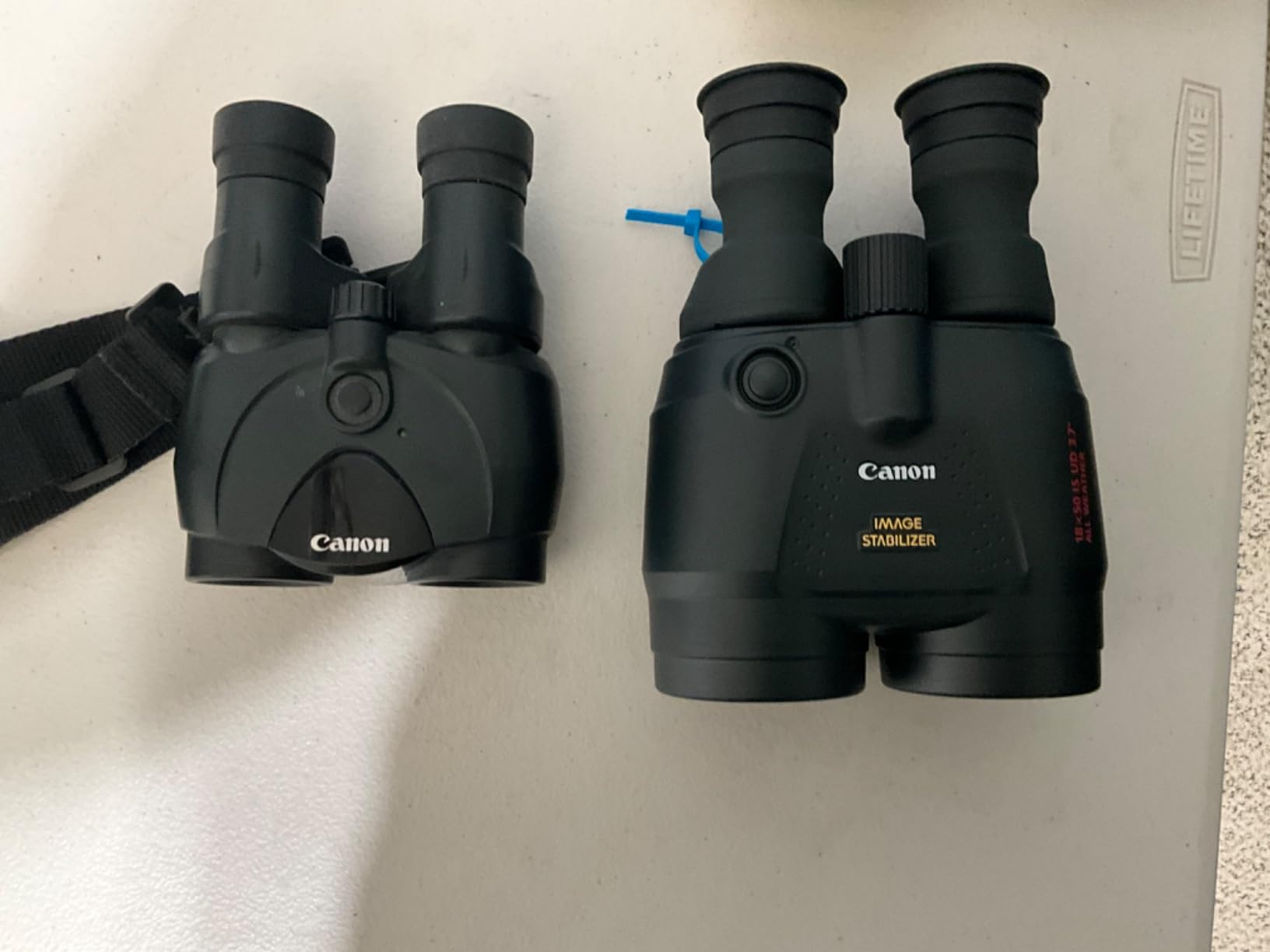
Eighteen times is genuinely useful on a boat, in open country, or at a stadium, and outside of a tripod it is close to unusable without stabilization. This model makes 18x a real handheld tool rather than a tabletop instrument. Users who came from the 10×30 line tend to be the most enthusiastic about it.
The 50mm objectives are the real story at the back end. Where the 12×36 goes dim after sunset, the 18×50 keeps working into the last useful light, which is why it is the pick for marine and dusk wildlife work. Individual focus on each barrel means you can bring a target into focus for both eyes and hold it there.
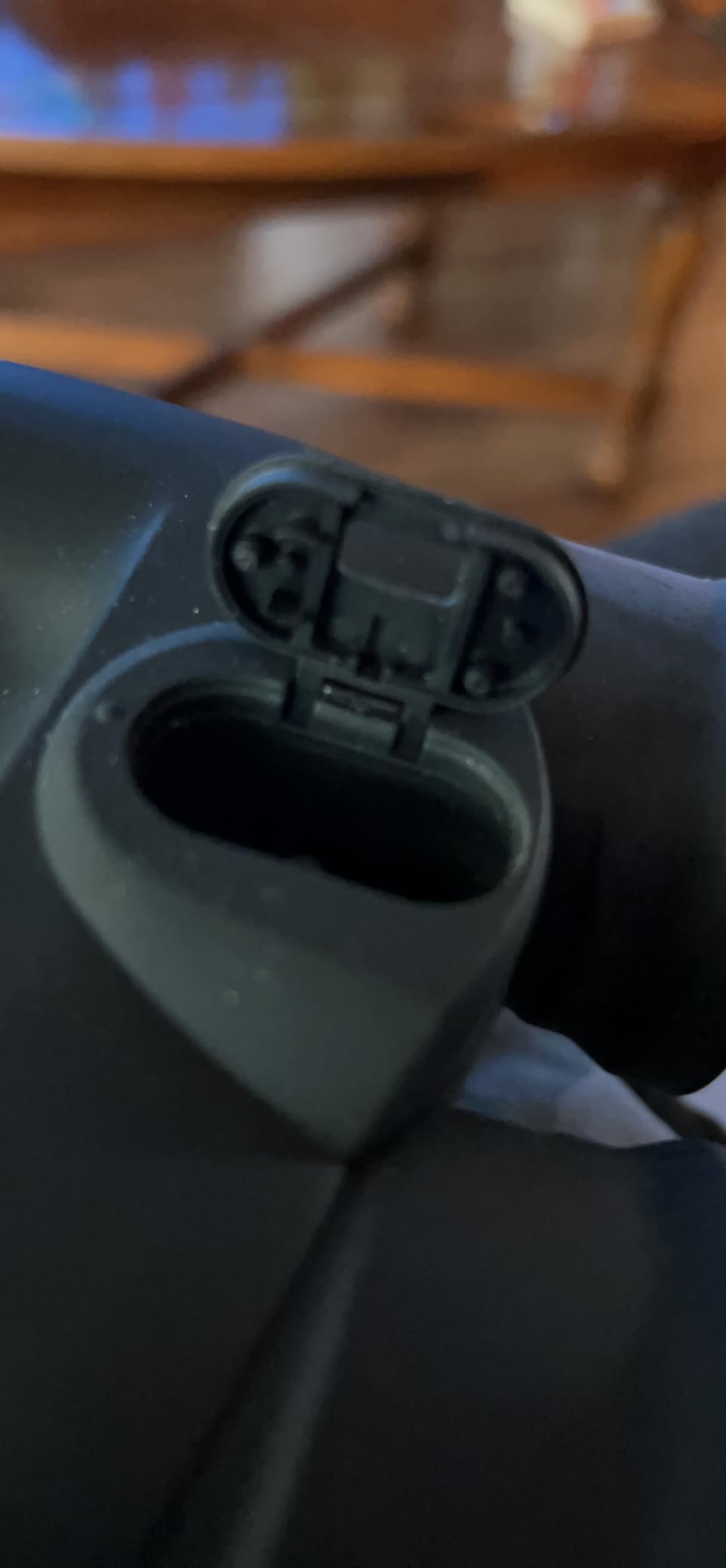
The costs are substantial and mostly physical. At 4.1 pounds this is the heaviest stabilized binocular in the group, and it is the one that turns a pleasant walk into a shoulder workout. Individual focus is also slower than a single center knob, because you are turning one barrel, then the other, then adjusting.
The stabilization hardware is an older design, and the body is rated water resistant rather than sealed. Long-term owners report that it holds up well, but the rubber armor and the plastic body parts are the first things to show their age.
Whether 18x is actually usable handheld
With stabilization engaged, yes. The view holds together and you can track a subject for a few seconds at a time. Without it, 18x is a mess, and 7.5 degrees of field of view makes finding anything in the first place the hard part.
That narrow field is the honest trade. Wide views at high power do not exist in optics. If your usual subject is close and moving fast, 18x is the wrong answer even with perfect stabilization.
Who should skip a body this heavy
Long-distance hikers, anyone carrying optics all day on a mountain trail, and users who want one pair for every job. At 4.1 pounds it wants to sit in a car, a boat console, or a blind, not a pack.
It is also a poor birding choice in dense cover, where a 12x with a wider view is more productive. Save this one for open sightlines and low light.
Canon 10×42 L IS WP Binoculars: The Best Glass in the Lineup
Canon 10×42 L is WP Image Stabilized Binoculars
10x/42mm, 2.4 lb
65 deg apparent FOV
L-series UD glass, VAP IS
16mm eye relief, 3-year warranty
Pros
- L-series UD glass with edge-to-edge sharpness
- Fully waterproof and fogproof
- 16mm eye relief suits glasses
- Large center focus knob
- Three-year warranty
Cons
- Heavy for a 10x42
- IS button must be held down
- Porro body is bulkier than roof prism
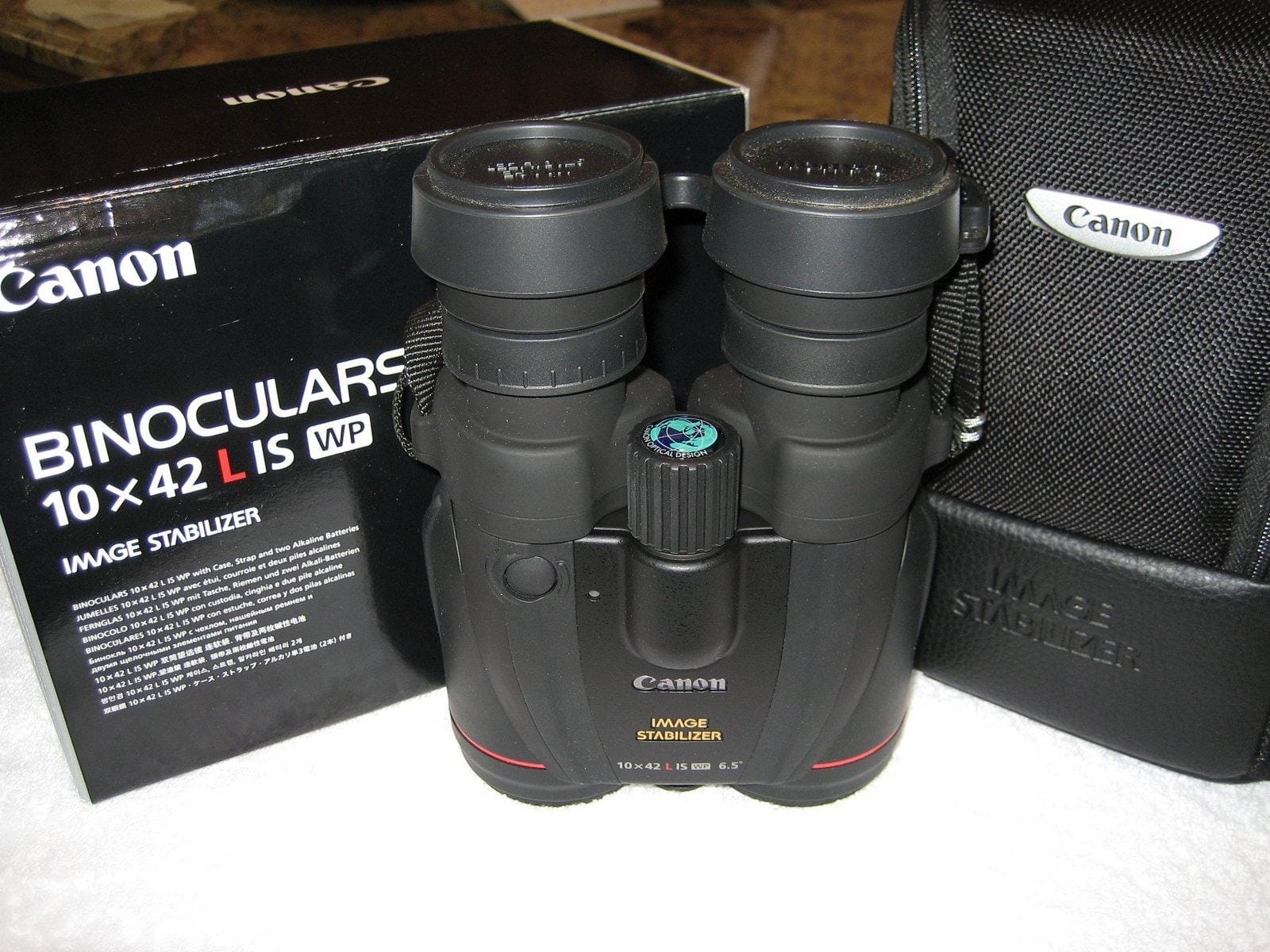
Ten times is not where stabilization matters most, so the first question with this model is why bother. The answer is that most people buying stabilized binoculars want the electronics for the times they hand them off to someone with more steady hands, and for the person who does use it, this is the sharpest glass Canon puts in a stabilized body. L-series ultra-low dispersion glass with full Super Spectra coatings is a genuine step up.
Reviewers consistently describe edge-to-edge sharpness and accurate color, with none of the corner smearing that cheaper Porro designs show. The 65 degree apparent field of view is the widest in this group, and at 10x it translates to a genuinely expansive picture.
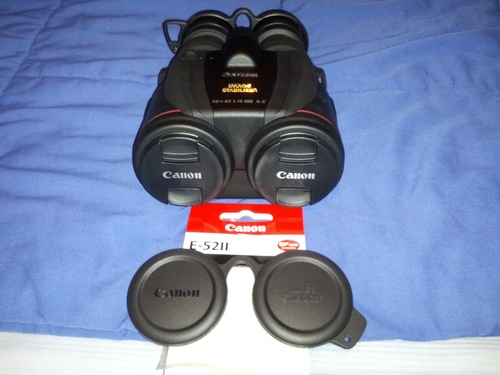
It is also the only fully waterproof and fogproof Canon in the lineup, with a sealed body and a nitrogen fill, and it carries a three-year warranty against the one to two years on the cheaper models. For anyone who works outdoors in real weather, that matters more than the magnification figure.
Against that, it is 2.4 pounds for a 10×42, which is heavy for the magnification, and it still uses the hold-the-button Vari-Angle Prism control. The Porro prism body is also bulkier than the roof prism designs further down.
Why 16mm eye relief is the sleeper feature
Eye relief is the distance between your eye and the front lens element, and anything under about 14mm makes binoculars unusable with glasses on. At 16mm this model clears the threshold comfortably, so you can keep your glasses on and still see the whole field.
That single specification rules it in or out for a lot of buyers. If you wear glasses, a 14mm model means removing them and fighting a blurry edge, and no amount of stabilization compensates for that.
Who should skip a 10x stabilized body
Anyone whose main goal is magnification. There is no scenario where 10x beats the 12×36 or the 14×40 for spotting distant subjects, and paying for stabilization you rarely switch on is hard to justify on performance grounds alone.
Buy it for the glass, the sealing, and the eye relief. If you buy it for power, step up one section.
Fujinon Techno-Stabi TS1440 14×40: The Most Correction You Can Buy
Fujinon Techno Stabi TS1440-14×40 Image Stabilization Binocular
14x/40mm
5 degree electronic gimbal correction
Waterproof and fogproof
4 AA replaceable battery pack
Pros
- Five degrees of published correction
- Waterproof and fogproof for marine work
- Replaceable battery pack
- Hard case included
- Sharp glass with strong contrast
Cons
- Very heavy and bulky
- Fixed interpupillary distance
- Narrow 5 degree field of view
This is the model the marine crowd has trusted for years, and the published 5 degree correction figure is the largest in this group. Rather than shifting a prism, the Techno-Stabi uses an electronic gimbal that physically counters angular movement, which is why it holds together on a rolling deck when lighter systems start to show it.
BirdForum posters with long ownership histories consistently name the Fujinon 14×40 as having the best optics of any stabilized binocular they have owned. That is a long-standing consensus among experienced users, and it is why this model has survived so long in a category that turns over constantly.

The 40mm objective gives a 2.86mm exit pupil, which is dim compared with the Canon L-series, so this is not a dusk glass. The multi-layer coatings deliver good contrast in daylight, and the waterproof, fogproof body is sealed for spray and rain.
There are trade-offs. The body is large and heavy, the interpupillary distance is fixed rather than adjustable, and the 5 degree field of view is narrow enough that locating a subject takes patience. A replaceable battery pack is a real advantage over sealed compartments, and the included hard case is genuinely useful.

Why a gimbal beats a shifting prism on a moving platform
On a boat, the platform supplies large, slow, continuous motion rather than the small high-frequency tremor of a steady hand. A gimbal counters that whole angular movement mechanically, which is why the Techno-Stabi holds a rock-steady view from a heaving deck where a Vari-Angle Prism binocular still shows motion.
If your stabilization needs are on land, this advantage mostly disappears. The gimbal earns its keep on water and in strong wind.
Who should skip a fixed-interpupillary body
Anyone whose eyes are far from average spacing, or who shares a pair with another user. A fixed bridge cannot be dialled to fit, and forcing an incorrect setting causes real eye strain over a long session.
It is also too heavy and bulky for a walking birding trip. Treat it as equipment that lives in a boat locker or a vehicle, not a pack.
SIG SAUER Zulu6 HDX OIS 16×42: 16x in a Body the Size of an 8×42
SIG SAUER Zulu6 FDE HDX OIS 16X42mm Roof Prism Binocular
16x/42mm, 2.25 lb
IPX-7 roof prism body
Scan and Target OIS modes
16mm eye relief, HDX glass
Pros
- 16x reach in a compact roof prism body
- Scan and Target stabilization modes
- IPX-7 waterproof and fogproof
- 16mm eye relief
- Lighter than the Canon high-power models
Cons
- Focus play reported by some owners
- Tunnel-like field of view at 16x
- Veiling flare reported by some users
The roof prism chassis is the headline here. At 2.25 pounds carrying 16x magnification, this is the first stabilized binocular in the group that is genuinely compact at high power, and the sealed aluminum body with rubber armor is built for rough handling in the field.
Two stabilization modes are the clever part. Scan Mode smooths the view for general panning and moving subjects, while Target Mode applies heavier correction for locking onto a fixed point, which is the steadier of the two when a deer is standing still at distance. Owners report the stabilization holding better than Canon systems at comparable power.
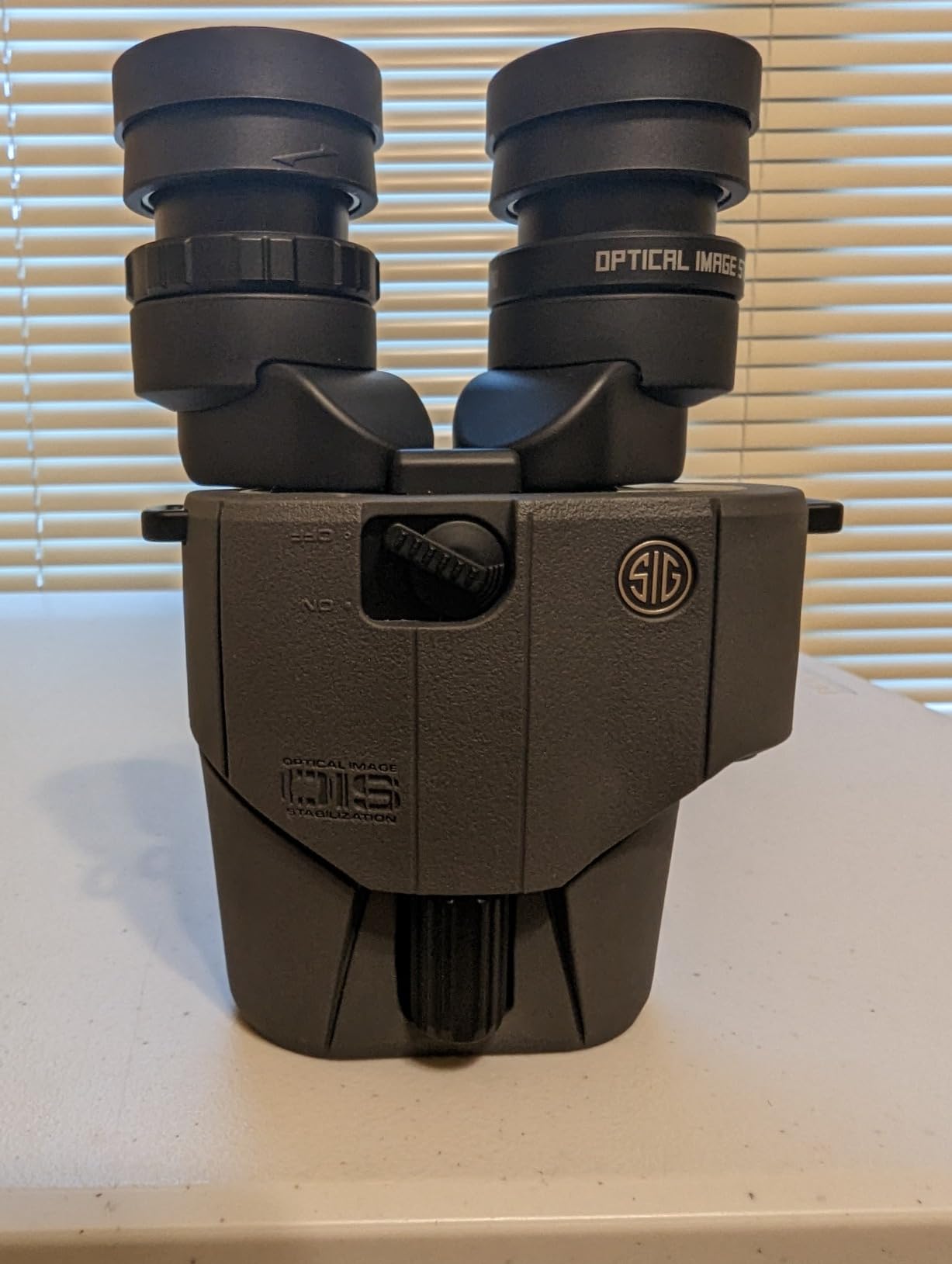
HDX glass with SpectraCoat coatings keeps the image clean, and 16mm eye relief is generous enough for glasses. IPX-7 waterproofing and fogproofing mean it does not care much about rain.
The complaints are consistent: some owners report play in the focus mechanism, a tunnel-like view at 16x that takes practice to search, and veiling flare under bright backlight. Low-light performance also draws criticism given where it sits in the range.

Whether Target Mode is worth switching to
For static subjects, yes. Target Mode applies more correction and settles a fixed point into a near-constant image, which is exactly what you want when an animal is standing still and you want to see detail rather than track motion. For panning after a moving bird, Scan Mode feels more natural.
The mode switch is a single button, and the difference is obvious within a few minutes of use, so it is worth learning which one you actually need.
Who should skip a 16x stabilized body
Birders working in close cover, and anyone who needs to find and track a small fast subject. A narrow field at 16x works against you when the bird is moving between branches, and no stabilization system fixes a search problem.
It is better suited to hunting, open-country wildlife, and spectator sports at a distance, where the subject is large and relatively slow.
SIG SAUER ZULU6 HDX PRO 18×50: The Most Capable Electronics, Least Proven
SIG SAUER ZULU6 HDX PRO 18x50mm FDE Image Stabilized Binoculars
18x/50mm OmniScan OIS
40-hour runtime on 2 AA
IPX-7 waterproof and fogproof
15.3mm eye relief, HDX PRO glass
Pros
- OmniScan accelerometer adapts to your movement
- 40-hour battery runtime
- HDX PRO glass cuts glare
- IPX-7 sealed
- Relocated battery doors and textured focus wheel
Cons
- Fixed focus rather than adjustable focus
- Newest design with a short review history
- Thermoplastic frame
OmniScan is the most sophisticated stabilizer in this group. Rather than applying a fixed correction, a digital accelerometer reads how you are moving and adapts the correction in real time, which is why early owners describe the image as the steadiest they have used at 18x. The 4.9 rating across 26 reviews is the highest average in the lineup, and the feedback is uncommonly enthusiastic.
The HDX PRO lens system with SpectraCoat and LensArmor coatings is designed to cut veiling glare, which is the exact weakness owners reported in the standard Zulu6 HDX. For twilight and dawn work at 18x, that is a meaningful upgrade rather than a marketing label.
Battery life is the practical headline. A 40-hour runtime on two AA cells is the longest published figure here, which means a full day of scanning without a spare set.
The reasons for hesitation are honest ones. This is the newest design in the group, and 26 reviews is not a long-term record. The focus is fixed rather than adjustable per eye, which will bother people whose eyes differ in strength, and the frame is thermoplastic rather than the aluminum used on the standard Zulu6.
What adaptive stabilization actually changes
A fixed correction system fights you with the same amount of compensation no matter what you are doing, so it either over-corrects when you are still or under-corrects when you move hard. An accelerometer measures the actual angular movement and varies the response, which is why the view feels settled rather than actively worked against.
In practice, the difference shows up most in medium movement, such as walking slowly across a field while glassing. You are not constantly re-finding the subject because the image is not drifting.
Who should wait before buying
Buyers who want a proven record. A 4.9 rating across 26 reviews tells you early owners are delighted, but it does not tell you how the moving parts and battery door seals look after five years in a wet truck bed.
If you are comfortable being an early adopter and want the best electronics available, this is the one. If you want a decade of owner history, the Canon 12×36 IS III or the Fujinon Techno-Stabi have the track record.
Kite Optics APC Stabilized 16×42: Strong Correction in a Light Body
Kite Optics APC Stabilized 16×42 Binoculars – Wide-Angle Stabilized Binoculars for Hunting, Bird Watching, and Long-Range – 16x Magnification, Waterproof, Built for The Outdoors
16x/42mm, 1.6 lb
APC correction at 2 and 3 degrees
56 degree apparent field of view
IPX7 metal chassis
Pros
- APC correction available in two strengths
- Lightest 16x stabilized body here
- Wide 56 degree apparent field of view
- Metal chassis with rubber armor
- IPX7 waterproof and nitrogen purged
Cons
- Small review base so long-term data is thin
- Autofocus does not suit every user
- Diopter range not published
At 1.6 pounds this is the lightest 16x stabilized binocular in the group, and it is less than half the weight of the Canon 18×50. Kite markets the APC system to military and law enforcement users, and the metal chassis with rubber armor backs up the claim better than most marketing in this category.
The correction runs in two strengths, two and three degrees, so you can dial the stabilization to match how much you are moving. That is unusual, and in practice it lets you trade a steadier image against a slightly slower response when panning after a fast bird.
The 56 degree apparent field of view is wide for 16x, which makes this easier to search with than most high-power stabilized models. IPX7 waterproofing and nitrogen purging handle bad weather without complaint.
Owners frequently single out the stabilization as a step change, and the review base, while small, is enthusiastic. The problem is that base: 21 reviews is not enough to judge long-term durability of the moving parts, and the autofocus system, while convenient, does not suit users who want to focus manually on a specific subject.
Whether two stabilization strengths are genuinely useful
They are, mainly because users fall into two groups. People with hand tremor want maximum correction, while people panning after moving subjects want the lighter setting so the view does not lag behind the target. A single fixed strength forces one of those groups to accept a compromise.
It is also a nice middle ground between the mechanical gimbal of the Fujinon and the fixed correction of the Canon Vari-Angle Prism systems.
Who should skip this one
Careful buyers who want a long service record. A 21-review history gives you no way to compare failure rates against models with hundreds of reviews, and stabilized binoculars fail through the electronics and seals rather than the glass.
It is also a less obvious choice for pure birding, where the wide field of view helps but the small review base makes it harder to judge long-term.
Nikon STABILIZED 10×25 Binoculars: The One You Can Actually Carry
Nikon STABILIZED 10×25 Binoculars – Optical Image Stabilization, Blur-Free View, Waterproof Design, 10x Magnification for Hunting, Birdwatching & Outdoor Activities
10x/25mm, 14.3 oz
Electronic IS that stays switched on
12-hour AA battery life
Waterproof, limited lifetime warranty
Pros
- 14.3 ounces in a 10x stabilized body
- IS stays on without holding a button
- Twelve-hour AA battery life
- Waterproof with a limited lifetime warranty
- Silver alloy high-reflectivity prism coatings
Cons
- 25mm objectives are dim at dusk
- Electronic IS is less durable than optical systems
- Thin neck strap
Nothing else here comes close on portability. At 14.3 ounces and roughly the size of a paperback, this is the only stabilized binocular on the list that fits in a daypack without being the reason you skip the walk. The closed-bridge roof prism body and turn-and-slide eyecups keep it compact.
The electronic stabilization switches on and stays on, which solves the single most common complaint about Canon’s hold-the-button system. For users with hand tremor, being able to relax your grip is worth more than a few extra pounds of correction.
Nikon’s optical side is solid for the size, with anti-reflective multicoated lenses and silver alloy high-reflectivity prism coatings, plus 14mm eye relief and a closed-bridge design. Battery life is listed at 12 hours on AA with an automatic shutoff after 60 minutes of inactivity, and the warranty is limited lifetime.
The limits are obvious once you use it after sunset. A 25mm objective produces a 2.5mm exit pupil, which is fine in daylight and genuinely dim in low light. This is not an astronomy or serious twilight instrument, and some owners report fragility after minor drops.
Why electronic IS suits tremor more than optical
Optical systems like the Canon Vari-Angle Prism and the Fujinon gimbal correct a larger angle of movement, which is what you need when you are holding 16x or 18x. At 10x the shake is small enough that the correction does not have to be heroic.
What matters at low power is that the correction simply stays engaged. Users who cannot hold a button down for twenty minutes get more benefit from this model than from a technically stronger system they switch off.
Who should skip the 10×25
Birders, hunters, and anyone who regularly works at dawn or dusk. The 25mm objectives are the limiting factor, and no amount of stabilization makes a dim image bright.
It is built for travel, theatre and stadium viewing, casual wildlife watching in daylight, and as a grab-and-go pair for someone with shaky hands who does not want to think about it.
How to Choose Image Stabilized Binoculars in 2026
The honest starting point is that stabilization solves one problem and creates two. It removes the magnification ceiling, and it adds weight, battery dependency, and moving parts. Everything below is about deciding whether that trade suits you.
Active, optical, and electronic stabilization explained
All three systems in this roundup run the same four-step loop. Gyroscopic sensors detect angular movement as you hold the binoculars. A microprocessor calculates the correction needed. A moving optical element applies it. The image stays steady while you pan.
What differs is the moving part. Canon’s Vari-Angle Prism shifts a solid-glass prism to bend the light path. The Fujinon Techno-Stabi moves an entire optical block on a gimbal, which is why it handles large, slow platform motion better. The Nikon 10×25 uses electronic correction that stays switched on rather than a mechanical mechanism you trigger.
Passive stabilization is a different idea entirely. It means a fixed mechanical feature such as a rubber body or a high-mass objective that resists shake, with no sensors involved. It helps a little and it is not what this article is about.
Choosing magnification and objective diameter
The usual rule is that 10x is the practical ceiling for handheld binoculars because shake scales with magnification. Stabilization removes that ceiling, which is the entire reason these products exist. A 12x model is the safe starting point for general use, 14x to 16x suits open-country wildlife, and 18x and beyond is a specialist tool.
Objective diameter is the second half of the equation and the one people rush. A 50mm objective gathers much more light than a 25mm one, which is what determines whether you can see at dusk. Many stabilized models trade objective size for weight, so check that you are not giving up an entire stop of light to save half a pound.
The 5mm exit pupil rule is the next thing to understand. You cannot use it to pick magnification on stabilized binoculars, because a 2.5mm exit pupil is perfectly usable when the image is not moving. Brightness still follows the objective diameter, and stabilization cannot change that.
Field of view is the number people ignore
Field of view comes in three forms. Apparent field of view is the width of the view as you see it, measured in degrees. Angular field of view is the true coverage, also in degrees. Linear field of view converts that to a width at a fixed distance.
It matters most at high magnification. The Fujinon Techno-Stabi has a 5 degree field of view, which is narrow enough that finding a moving subject takes real practice, while the Canon 10×42 L IS WP offers 65 degrees of apparent field. A wide field does not reduce stabilization, it just makes the instrument usable for searching.
Battery life and planning a full day in the field
Battery management is where most owners form an opinion. Every stabilized binocular works perfectly well as an ordinary pair of binoculars if the batteries die, so the risk is being left with a heavy, blurry, and useless object in your pack.
Carry a spare set no matter what. Published runtimes range from 12 hours on the Nikon compact to 40 hours on the SIG Zulu6 HDX PRO, but real-world figures depend on how long the switch stays on. Models with a hold-to-activate control, like the Canon Vari-Angle Prism pairings, drain far more slowly simply because you release the button.
Rechargeable NiMH cells work in every model here and are the sensible choice for regular use. Remove batteries between multi-day trips regardless of type, because a leaking cell in a sealed compartment is exactly the failure the owner reports worry about.
Look for automatic shutoff. The Nikon switches off after 60 minutes of inactivity, which protects you from the exact scenario that ruins a trip.
Do you still need a tripod with stabilized binoculars?
Not for handheld viewing, and that is the point. But stabilization cancels movement, not gravity, and it does not replace a tripod for astronomy where tracking a faint object at high power needs a rock-steady platform rather than a damped one.
Stargazers on forums consistently recommend a sturdy conventional pair on a tripod for anything beyond casual wide-field scanning, because you get better glass for the money and no batteries to manage. Buy a stabilized pair for the day, and borrow a tripod for the night.
The same logic applies to long stationary sessions. If you will be sitting in one spot watching a waterline for an hour, a non-stabilized pair on a tripod is cheaper, brighter, and optically sharper. Stabilization pays for itself when you are moving, panning, or unable to hold a button down.
Eye relief, weight, and who should skip IS entirely
Eye relief is the distance from your eye to the front lens. Below about 14mm, binoculars are frustrating or impossible to use with glasses on. The Canon 10×42 L IS WP, the SIG Zulu6 HDX OIS, and the Canon 18×50 all clear that threshold comfortably; anything at 13mm or below will frustrate a glasses wearer.
Weight is the other honest filter. Stabilized bodies in this group run from 14.3 ounces to 4.1 pounds, and the heaviest are usually the most capable. Decide how far you actually walk before you decide how much glass you want.
Some readers should skip image stabilization entirely. If you are steady-handed, if you stay at 8x or 10x, if you view from a stable seat or a tripod, or if you want the best optical performance for your money, a conventional binocular is the better purchase. The stabilization hardware is paid for directly with glass quality on many of these models.
Buy stabilized binoculars when you need power without a tripod, when you work from a moving platform, or when a held button is a problem your hands cannot solve. Outside those three cases, you are paying for a feature you will switch off.
Frequently Asked Questions
Who makes the best image stabilization binoculars?
Canon makes the widest range and is the most common answer, with a stabilized body at nearly every power from 10x to 18x. Fujifilm’s Techno-Stabi is the established marine choice with the largest published correction figure, SIG SAUER covers high power in a light roof prism body, Kite offers the strongest advertised correction per weight, and Nikon covers the compact end. The right brand depends on the power and portability you need.
What are the best binoculars with image stabilization?
The Canon 12×36 IS III is the best all-round choice at 1.8 pounds with 12x magnification and reliable Vari-Angle Prism stabilization. The Canon 18×50 IS All-Weather suits open country and low light, the Canon 10×42 L IS WP has the sharpest L-series glass and full waterproofing, the Fujinon Techno-Stabi 14×40 has the strongest correction for marine use, and the Nikon 10×25 is the most portable option.
Are stabilised binoculars worth it?
They are worth it when you need more than 10x magnification without a tripod, work from a moving platform such as a boat, or cannot hold a button down for long periods. They are not worth it for steady-handed users viewing at 8x or 10x from a stable position, because you pay for electronics, extra weight, and batteries while the glass is often no better.
Which image stabilized binoculars are best for birding?
For general birding the Canon 12×36 IS III is the best balance, since 12x finds birds and a 1.8 pound body is easy to carry all day. For open-country species at distance the Canon 18×50 IS All-Weather gives more reach and brighter glass at dusk. For close woodland work a conventional 8x or 10x still finds more birds than any stabilized model.
Can image stabilized binoculars work without batteries?
They work as ordinary binoculars without batteries, but the stabilization stops, so you are left with a heavier pair of glasses and a shake problem at high magnification. Models with a hold-to-activate button such as the Canon 12×36 IS III drain slowly for that reason. Always carry a spare set, and remove cells between multi-day trips.
Can I use image stabilized binoculars with eyeglasses?
Yes, as long as the eye relief is at least 14mm. Several models here clear that comfortably, including the Canon 10×42 L IS WP and the SIG SAUER Zulu6 HDX OIS at 16mm, while the Fujinon Techno-Stabi at 13mm is awkward with glasses. Models with twist-up or turn-and-slide eyecups help, since folding them down brings your eye closer to the lens.
Which Image Stabilized Binoculars Should You Buy in 2026?
If you want one recommendation, take the Canon 12×36 IS III. It weighs 1.8 pounds, holds a steady view, has eye relief that works with glasses, and has the largest owner base in this group, which means better long-term reliability information than anything newer here.
Buy the Canon 18×50 IS All-Weather if you need reach and low-light capability on open ground. Buy the Canon 10×42 L IS WP if optical quality, weather sealing, and eye relief matter more than magnification. Buy the Fujinon Techno-Stabi 14×40 if you work on a moving boat and want the strongest correction available.
Buy the SIG SAUER Zulu6 HDX OIS 16×42 for high power in a portable body, the HDX PRO 18×50 for the best electronics and twilight performance, the Kite APC 16×42 for correction strength in a light chassis, and the Nikon 10×25 if weight and a switch that stays on are your priority.
Skip image stabilization entirely if you are steady-handed, stay under 10x, or can use a tripod. These are the best image stabilized binoculars in 2026 because each one earns its electronics with real power or real portability. Just do not expect better glass as a bonus.